Unit 5: Structuring and Refining the Line of Reasoning
Understanding Methods of Development
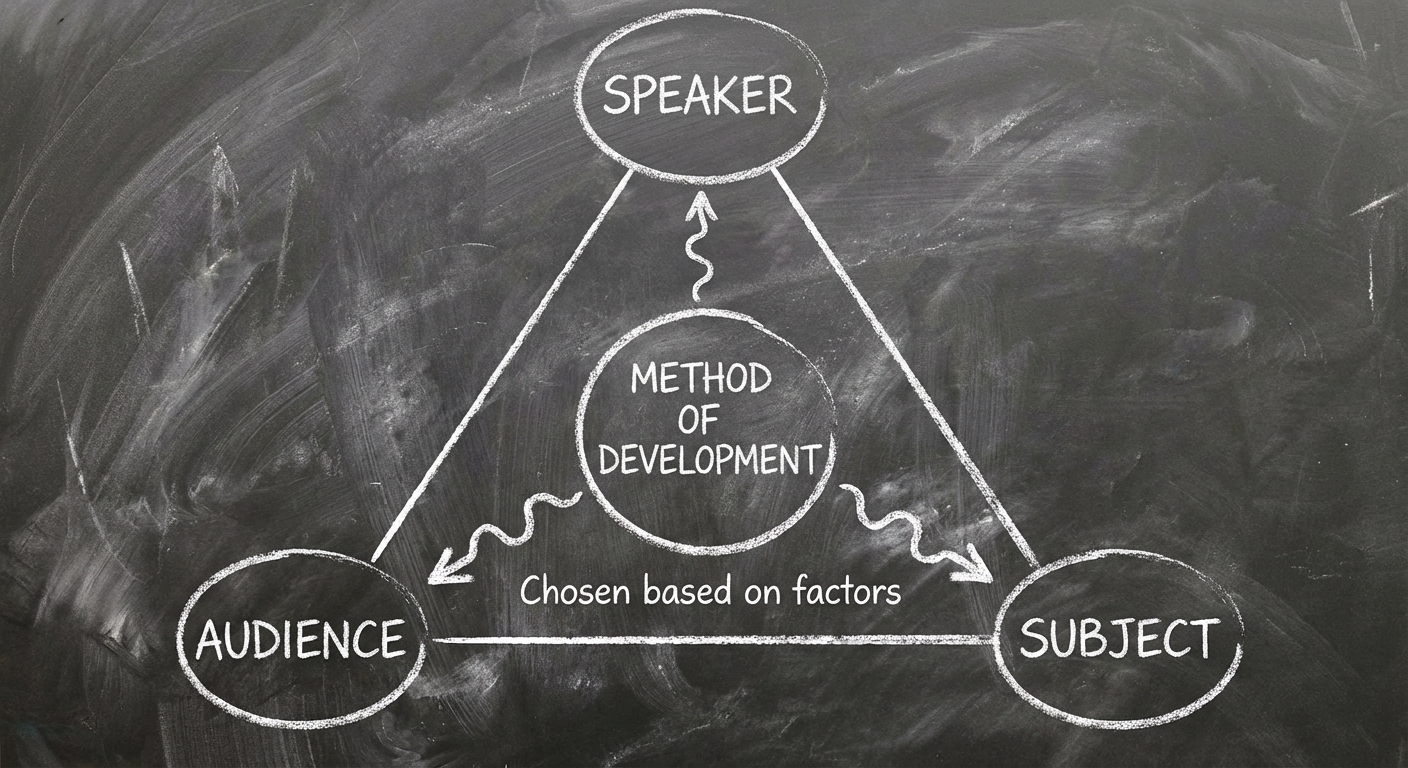
In AP English Language and Composition, an argument is not merely a statement of opinion; it is a structured progression of ideas known as the Line of Reasoning. To build this line effectively, writers generally rely on specific rhetorical modes, or Methods of Development. These methods act as the scaffolding for the argument, determining how evidence is presented and how the audience flows from one point to the next.
The choice of method is never random; it is a strategic decision made to serve the Rhetorical Situation (Speaker, Audience, Subject).
Narration
Narration is the act of storytelling. In an argumentative context, a writer does not tell a story simply to entertain, but to illustrate a point, establish exigence, or build an emotional connection (pathos) with the audience.
- Conceptual Function: It anchors abstract arguments in concrete reality.
- Key Component: A timeline or sequence of events.
Example:
"Before discussing the statistics of climate change, let me take you back to the summer of 2019 in my hometown…"
(Here, the writer uses narration to personalize a global issue before shifting to hard data.)
Description
Description involves using sensory details (sight, sound, touch, smell, taste) to create a mental image for the reader.
- Conceptual Function: It immerses the reader in the setting or context of the argument. It is often used to establish the mood/tone or to describe the severity of a problem.
- Key Component: Vivid adjectives, specific nouns, and imagery.
Cause-Effect Analysis
This method explains the relationship between an event (cause) and its consequences (effect), or vice versa. It is essential for arguments proposing solutions or analyzing history.
- Conceptual Function: It demonstrates logic (logos) and inevitability.
- Key Component: Transitional phrases like consequently, as a result, sparked, or precipitated.
Formula for Cause-Effect Logic:
Comparison and Contrast
This method highlights similarities and differences between two or more subjects. It is often used to prove that one solution is superior to another.
- Conceptual Function: It creates categorization and evaluation.
- Key Component: Juxtaposition (placing two things side-by-side for contrast).
Achieving Flow: Cohesion and Coherence
Students often confuse these two terms, but they refer to different aspects of writing mechanics and logic. A strong argument requires both.
Cohesion: The Micro-Level Connection
Cohesion refers to the "glue" that holds sentences together. It occurs at the sentence level. A paragraph is cohesive if sentence A flows naturally into sentence B, which flows into sentence C.
Techniques for Cohesion:
- Transitional Devices: Words like however, furthermore, therefore, and conversely.
- Repetition of Key Terms: Repeating a keyword (or a synonym) from the end of one sentence at the beginning of the next.
- Syntactic Parallelism: Repeating sentence structures to show that ideas are of equal importance.
- Pronoun References: Using it, they, this, or these to refer back to an antecedent mentioned differently.
Example of Cohesion:
"The city council proposed a new tax. This tax, while unpopular, is necessary for infrastructure. Without it, our bridges will continue to crumble."
(Notice the chain: tax $\rightarrow$ This tax $\rightarrow$ it)
Coherence: The Macro-Level Connection
Coherence refers to the relationship between the main ideas (paragraphs) and the thesis statement. It occurs at the whole-text level. A text is coherent if the reader understands how paragraph 3 relates to the overall argument, even if the sentences inside are simple.
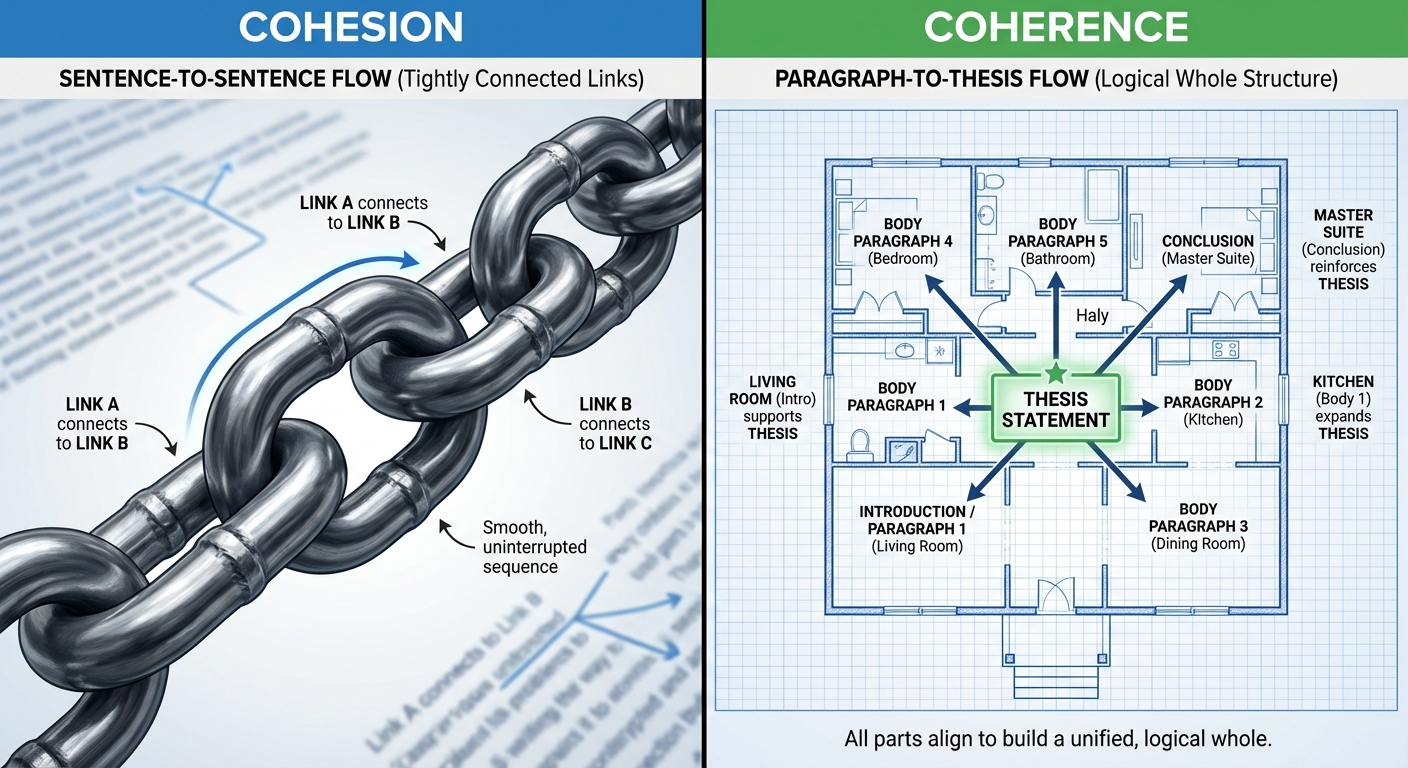
- Goal: To answer the question, "Why is this paragraph here?"
- Method: Topic sentences that link back to the thesis, rather than just stating a fact.
Modifying an Argument
Sophisticated arguments rarely deal in absolutes (always, never, everyone). To demonstrate complexity and maturity, writers must modify their arguments. This serves to make the argument more defensible and realistic.
Qualification
Qualifying a claim means placing limits or boundaries on it using specific language. It shifts an argument from being easily disprovable to being nuanced.
| Absolute (Weak) | Qualified (Strong) |
|---|---|
| "Technology always destroys human interaction." | "Technology often alters the nature of human interaction, sometimes at the cost of intimacy." |
| "Everyone agrees that…" | "A significant majority of experts agree that…" |
Common Qualifiers:
- Typically, usually, often
- In most cases, under these conditions
- Might, could, may, suggests
Counterarguments
Ignoring opposing views makes an argument seem biased or ill-informed. Addressing them strengthens your credibility (ethos).
- Concession: Acknowledging that an opposing point is valid or true.
- "Admittedly, the implementation of this policy will be expensive…"
- Refutation: Countering the admitted point by showing that your argument is still stronger or more important.
- "…However, the long-term economic benefits far outweigh the initial costs."
The Counterargument Formula:
Common Mistakes & Pitfalls
1. The "Laundry List" Approach
The Mistake: Writing body paragraphs that feel like a random list of examples without a unifying line of reasoning.
The Fix: Ensure every topic sentence connects explicitly to the thesis, not just to the general subject. Use transition words between paragraphs, not just inside them.
2. Confusing Narrative for Argument
The Mistake: Telling a long story (Method of Narration) that takes up 80% of the essay, leaving no room for analysis.
The Fix: Keep the narrative brief. Use it as evidence, not the entire essay. If you describe a personal experience, explain what it proves immediately after.
3. Absolute Language
The Mistake: Using words like all, none, always, never, or prove. In AP Lang, you rarely "prove" anything; you "suggest," "imply," or "support."
The Fix: Ctrl+F (mentally) for absolute words and replace them with qualifiers (e.g., change always to frequently).
4. pronoun Confusion (Poor Cohesion)
The Mistake: Using "this" or "it" without a clear antecedent.
- Weak: "Pollution is rising and the economy is falling. This is bad."
- Why it's wrong: Does "This" refer to pollution, the economy, or the combination?
The Fix: Always follow "This" with a noun. (e.g., "This economic downturn is problematic…").