Unit 5: The Phrase Model and Predominant Harmonies
The Harmonic Phrase Model
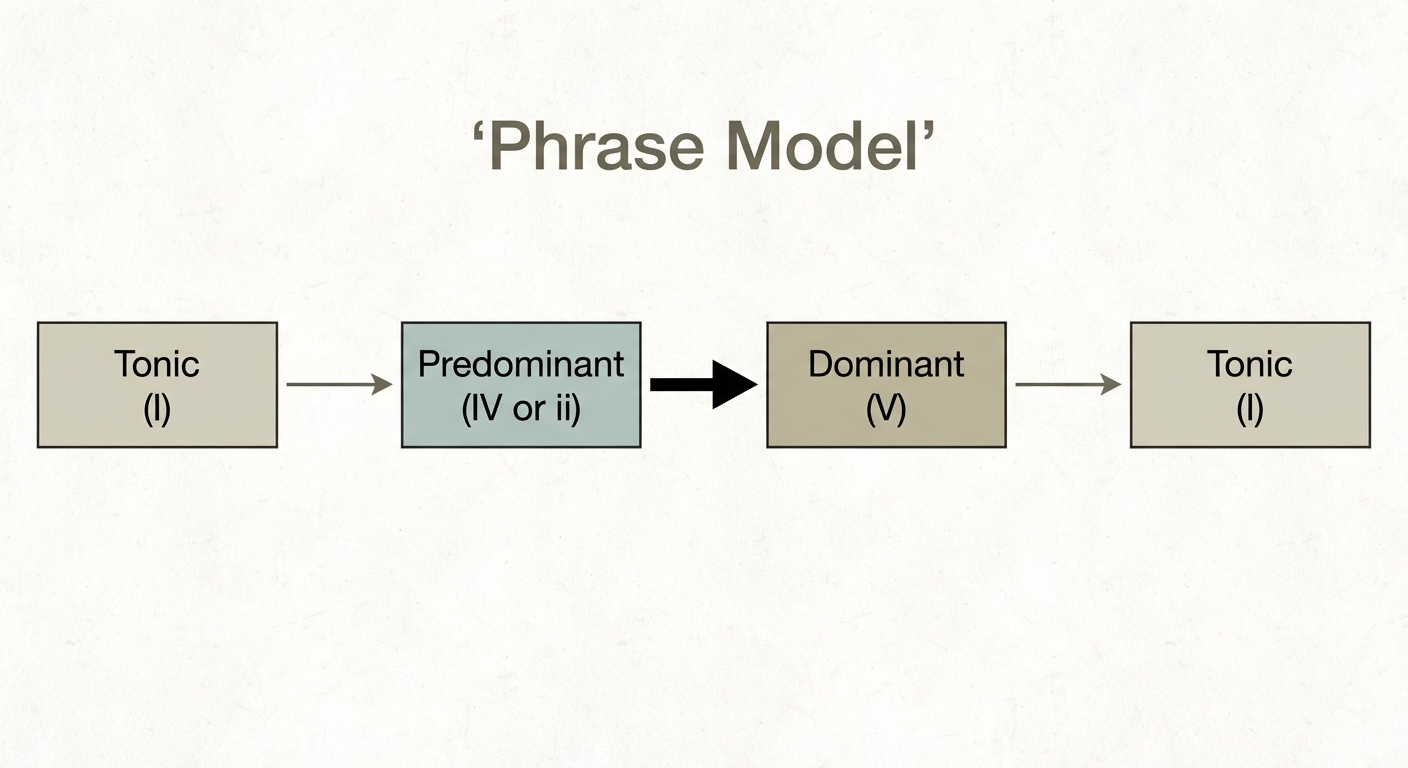
To understand Unit 5, you must master the fundamental grammar of Western functional harmony: the Phrase Model. This model dictates the logical flow of chord progressions that establish a key.
The standard progression follows this trajectory:
- Tonic (T): Establishes stability ($I$ or $i$).
- Predominant (PD): moves away from the tonic and prepares the dominant ($IV$, $iv$, $ii$, $ii^\circ$).
- Dominant (D): Creates maximum tension requiring resolution ($V$ or $V^7$).
- Tonic (T): Resolution and return to stability.
The Role of Predominant Function
Predominant Function (or pre-dominant) refers to chords that bridge the gap between stability (Tonic) and tension (Dominant). While the Tonic can move directly to the Dominant ($I - V$), inserting a Predominant chord expands the phrase and strengthens the arrival of the Dominant.
- Key Characteristic: They share scale degrees with the Tonic (giving a sense of departure) and the Dominant (providing smooth voice leading).
- Primary Chords: The Subdominant ($IV/iv$) and the Supertonic ($ii/ii^\circ$).
The Subdominant Chord ($IV$ and $iv$)
The Subdominant triad is built on the 4th scale degree (${4, 6, 1}$). It creates a sense of moving away from home without the urgent "leading tone" pull of the Dominant.
Quality and Usage
- Major Keys ($IV$): A Major triad.
- Minor Keys ($iv$): A Minor triad.
- Function: It typically leads to $V$ or $vii^\circ$. It can also appear in the Plagal Cadence ($IV - I$), commonly known as the "Amen" cadence, though this ends a phrase rather than preparing the dominant.
Voice Leading: The $IV \rightarrow V$ Danger Zone
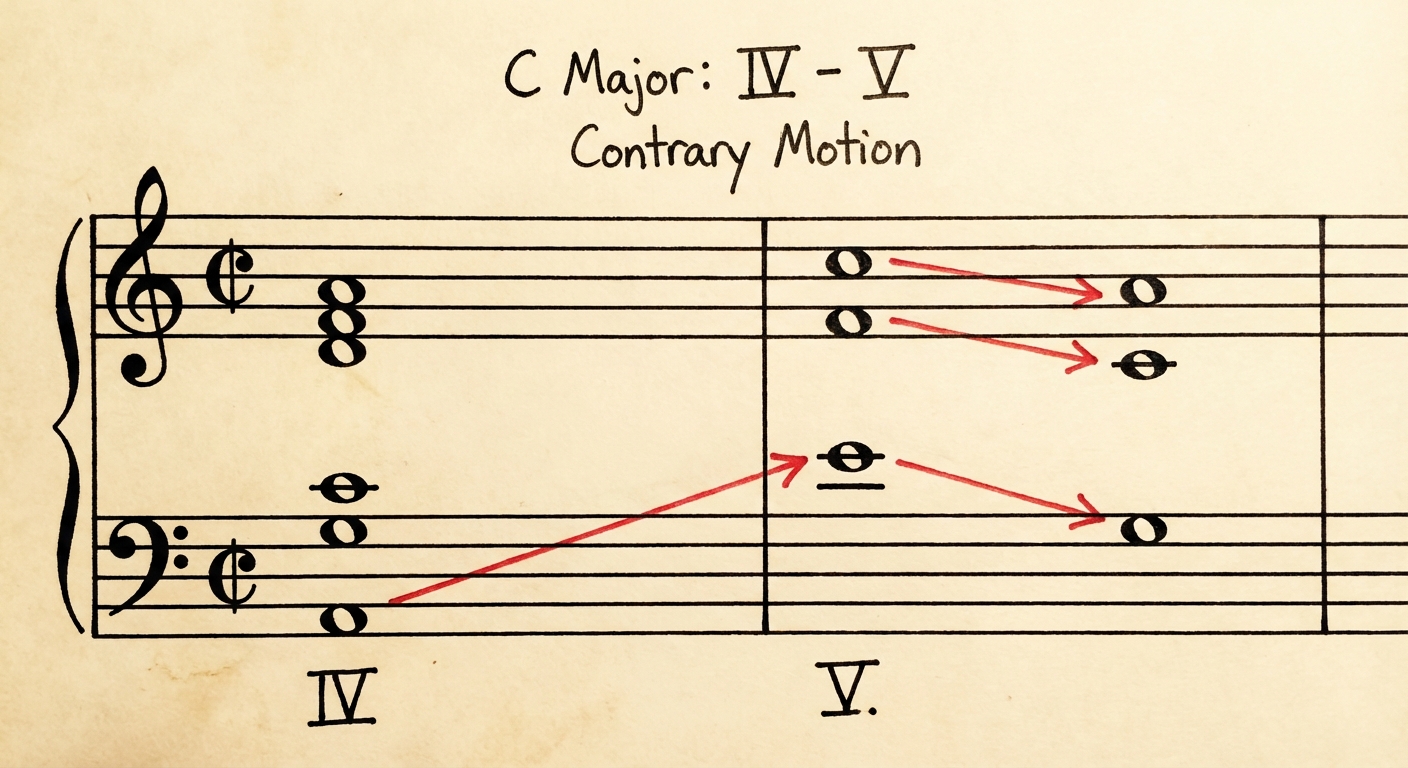
Moving from $IV$ to $V$ is one of the most dangerous movements in AP Music Theory part-writing due to the stepwise root motion.
The Problem:
If the Bass moves up by step ($4 \rightarrow 5$) and the upper voices also move up, you will almost certainly create Parallel 5ths and Parallel 8ves.
The Solution:
Use Contrary Motion. If the bass moves UP by step, the Upper Voices (Soprano, Alto, Tenor) should move DOWN to the nearest chord tone of V.
- Bass: Moves up ($Fa \rightarrow Sol$)
- Upper Voices: Move down to the nearest chord tones.
The Supertonic Chord ($ii$ and $ii^\circ$)
The Supertonic triad is built on the 2nd scale degree (${2, 4, 6}$). It is widely considered a stronger predominant than the $IV$ chord because its root moves to the Dominant by a descending 5th (a very strong harmonic motion).
Quality varies by Key Mode:
| Mode | Roman Numeral | Quality | Notes (in C) |
|---|---|---|---|
| Major | $ii$ | Minor Triad | D - F - A |
| Minor | $ii^\circ$ | Diminished Triad | D - F - A$\flat$ |
The Supertonic in First Inversion ($ii^6$ and $ii^{\circ6}$)
In part-writing and the AP exam, the first inversion supertonic is often preferred over the root position, especially in minor keys.
- Usage in Major ($ii^6$): The bass is scale degree 4. It functions similarly to a $IV$ chord but with a different root.
- Usage in Minor ($ii^{\circ6}$):
- In minor keys, the $ii^\circ$ is a diminished triad.
- Diminished triads are rarely used in root position because of the dissonant tritone with the bass.
- Rule: Always use $ii^\circ$ in first inversion ($ii^{\circ6}$) to place the chordal third (a consonant interval) in the bass.
Doubling Rules for $ii^6$
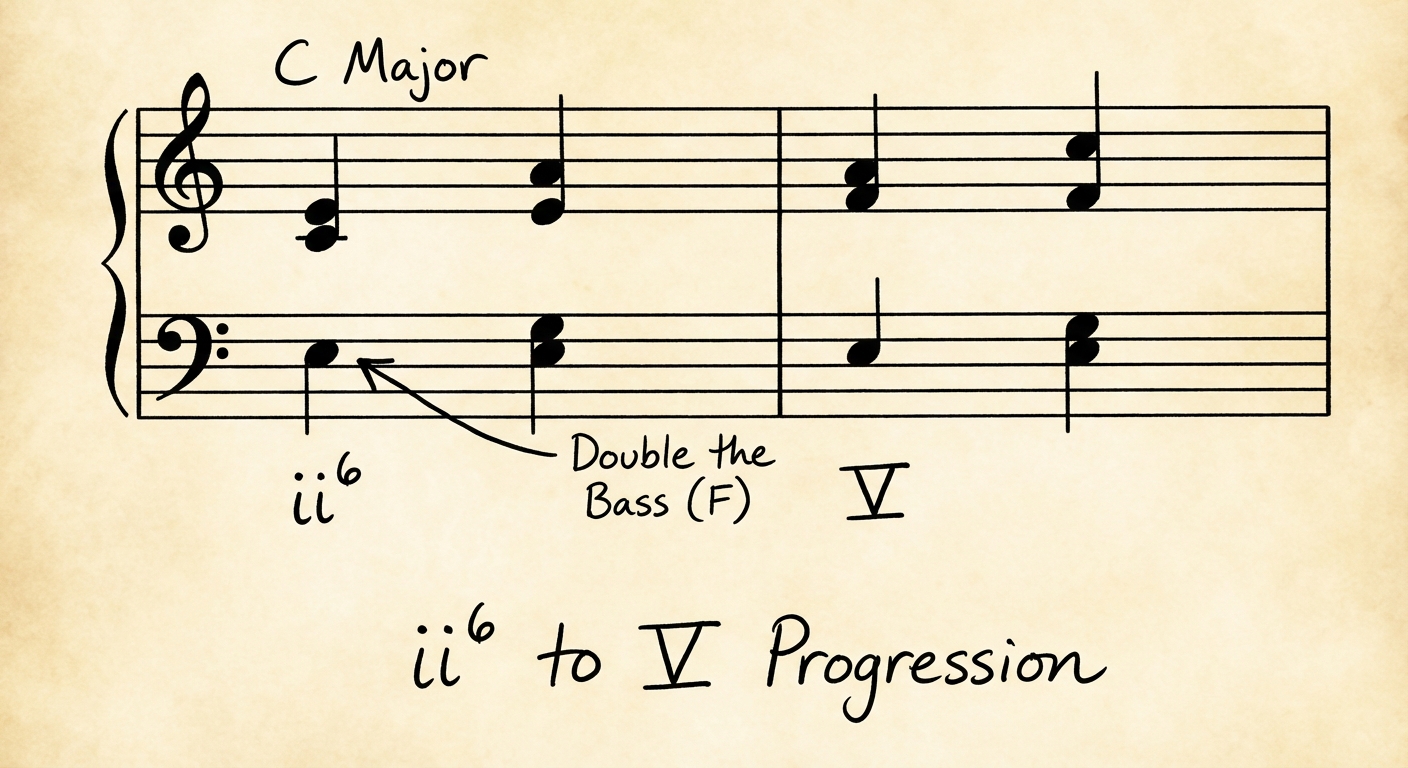
When writing a $ii^6$ (or $ii^{\circ6}$), the bass note is the chordal third.
- Standard Doubling: Double the Bass (the third of the chord).
- Why? The bass allows for smooth voice leading and reinforces the subdominant flavor (since the bass note is scale degree 4).
The Cadential Six-Four Chord ($I^6_4$)
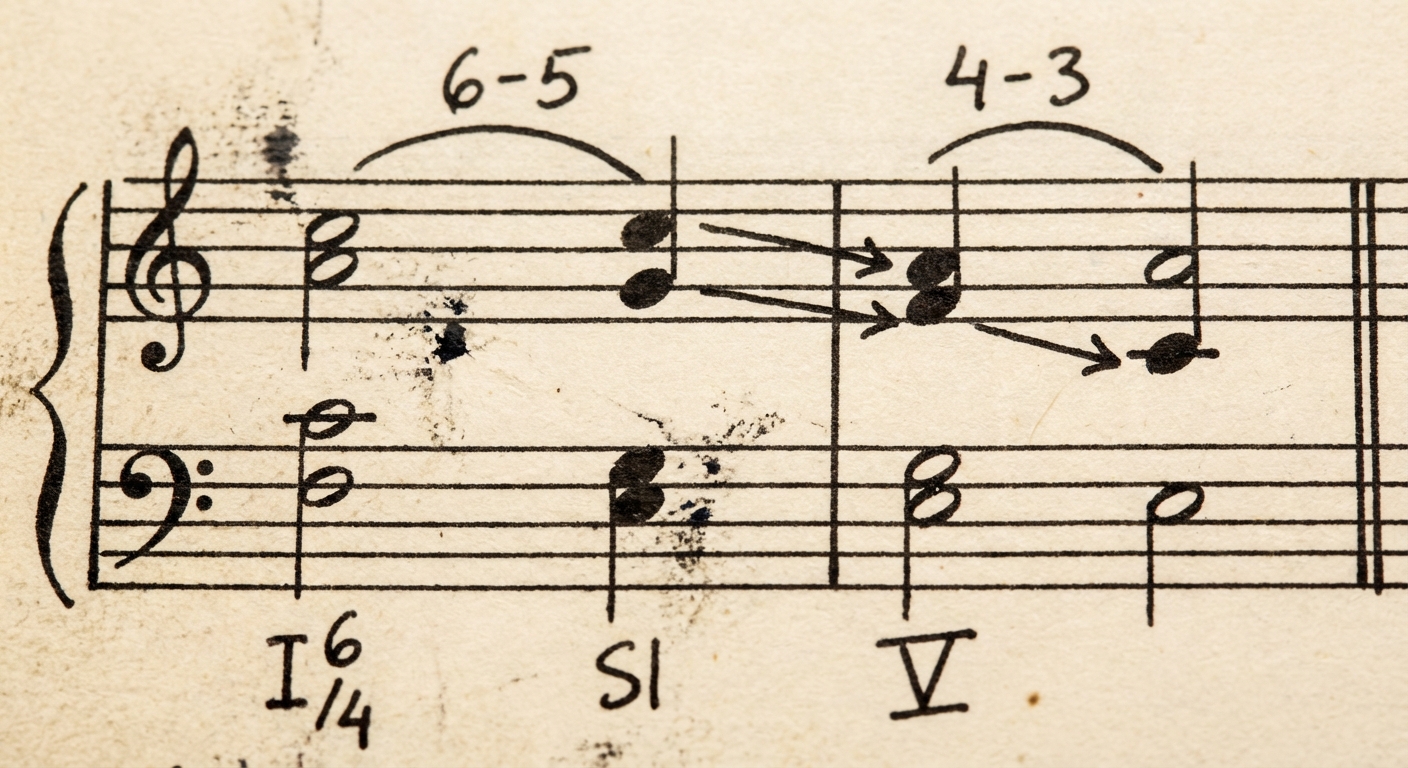
Although it looks like a Tonic chord, the Cadential Six-Four functions as Dominant harmony. It is vital for Unit 5 voice leading.
Concept
The $I^6_4$ acts as a "double suspension" or decoration of the $V$ chord. It delays the arrival of the dominant tones.
- Notation: It is often analyzed as $V^{6-5}_{4-3}$.
- Bass: Scale degree 5 (Dominant note).
- Upper Voices: Scale degrees 1 and 3 (which are a 4th and 6th above the bass).
AP Exam Guidelines for $I^6_4$
- Metrical Placement: Must occur on a Strong Beat (stronger than the $V$ that follows it).
- Resolution:
- The 6th above the bass (scale degree 3) resolves down to the 5th (scale degree 2).
- The 4th above the bass (scale degree 1) resolves down to the 3rd (leading tone).
- Doubling: Always double the Bass (scale degree 5).
Voice Leading: Predominant to Dominant ($ii \rightarrow V$)
Connecting the Supertonic to the Dominant involves specific voice-leading strategies.
Common Tone Retention
Unlike $IV \rightarrow V$, the progression $ii \rightarrow V$ shares a common tone (scale degree 2).
- Keep the Common Tone: Ideally, keep the common tone in the same voice (usually Alto or Tenor).
- Move Other Voices: Move the remaining voices stepwise to the nearest chord tones of $V$.
- Leading Tone: Ensure the resulting $V$ chord contains the leading tone (scale degree 7). In minor keys, you MUST accidentally raise the leading tone.
Handling Seventh Chords ($ii^7 \rightarrow V$)
If using a supertonic seventh chord (very common):
- Preparation: The 7th of the $ii^7$ is usually prepared by common tone or step.
- Resolution: The 7th of the chord MUST resolve down by step.
Summary of Harmonic Progressions
When harmonizing a melody or realizing a figured bass, utilize these standard predominant strings:
- Basic: $I - IV - V - I$
- Stronger Root Motion: $I - ii^6 - V - I$
- Cadential Extension: $I - ii^6 - I^6_4 - V - I$ (The "Classic" AP progression)
- Minor Key: $i - iv - V - i$ or $i - ii^{\circ6} - V - i$
Common Mistakes & Pitfalls
1. Parallel 5ths/8ves in $IV \rightarrow V$
- Mistake: Moving all voices upward when the bass moves $4 \rightarrow 5$.
- Correction: Use contrary motion. If Bass goes up, Soprano/Alto/Tenor should generally move down.
2. Incorrect Doubling in $ii^6$
- Mistake: Doubling the root in a first inversion supertonic chord.
- Correction: In $ii^6$ (and especially $ii^{\circ6}$), double the Bass (scale degree 4). This avoids doubling the tritone tones in minor keys.
3. Misunderstanding the $I^6_4$
- Mistake: Labeling a $I^6_4$ based on its notes (C-E-G) as a Tonic function.
- Correction: If the bass is scale degree 5 and it resolves to $V$, it is a Dominant function. Always write it as part of the dominant block.
4. Forgetting the Accidental in Minor
- Mistake: Writing a $ii^{\circ6} \rightarrow V$ in minor but forgetting to raise the definition of the leading tone in the $V$ chord.
- Correction: In harmonic minor, scale degree 7 must be raised to create a major $V$ chord.
5. Root Position $ii^\circ$
- Mistake: Writing a diminished supertonic triad in root position ($ii^\circ$).
- Correction: Diminished triads should almost always be in first inversion ($ii^{\circ6}$) to soften the dissonance.