Unit 1 Master Guide: Continuity in Calculus
Defining Continuity at a Point
In standard geometry, we often describe a continuous curve as one you can draw without lifting your pencil from the paper. However, in AP Calculus, we need a rigorous mathematical definition to prove continuity analytically.
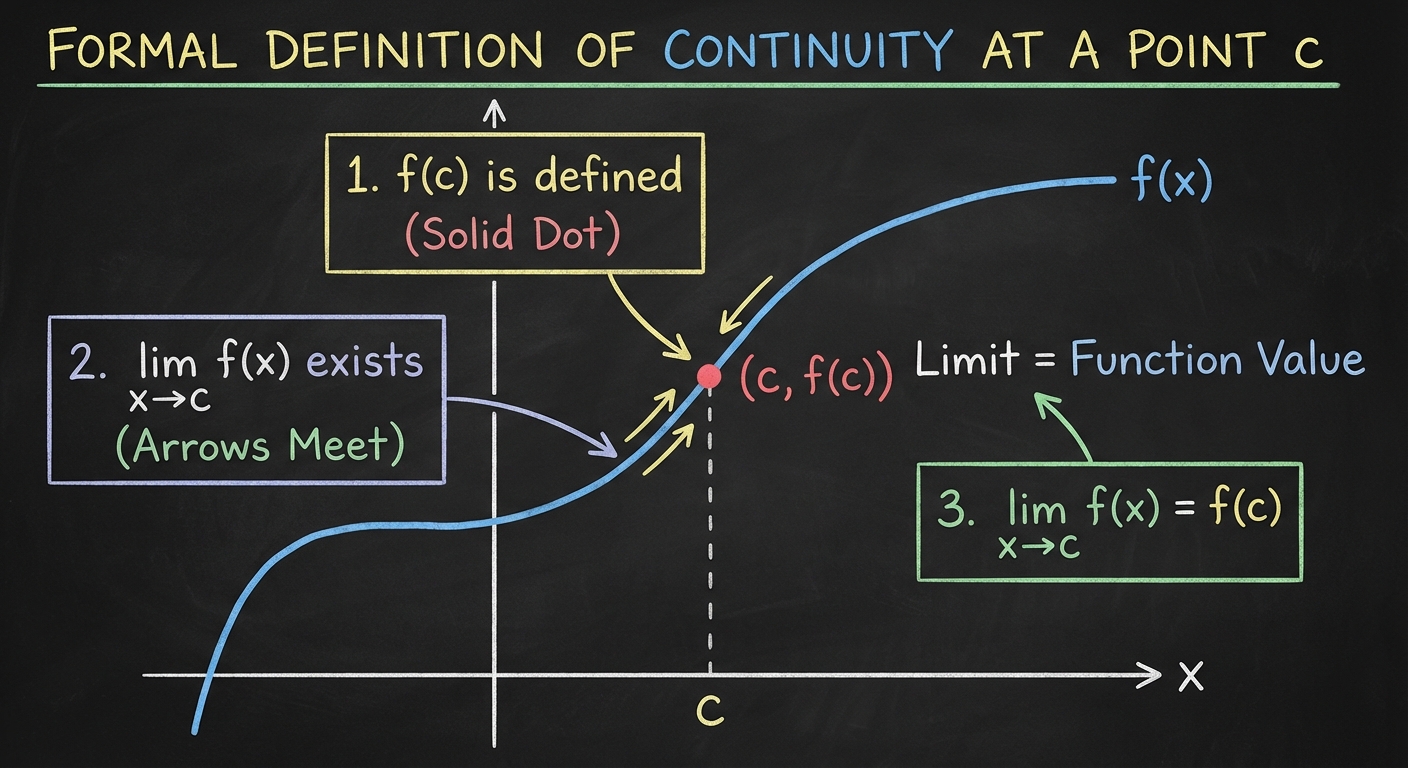
For a function $f(x)$ to be continuous at a specific point $x = c$, three strict conditions must be met simultaneously. This is often referred to as the Definition of Continuity Checklist.
The Three-Part Definition
- $f(c)$ must be defined: The value of the function at $x = c$ must exist (no holes or vertical asymptotes at the value itself).
- $\lim{x \to c} f(x)$ must exist: The left-hand limit and the right-hand limit must approach the same finite value.
- The limit must equal the function value: The approached value (limit) must match the actual coordinate.
If any of these three conditions fails, the function is discontinuous at $x = c$.
Types of Discontinuities
When continuity fails, it falls into specific categories. Understanding these classifications is essential for analyzing function behavior.
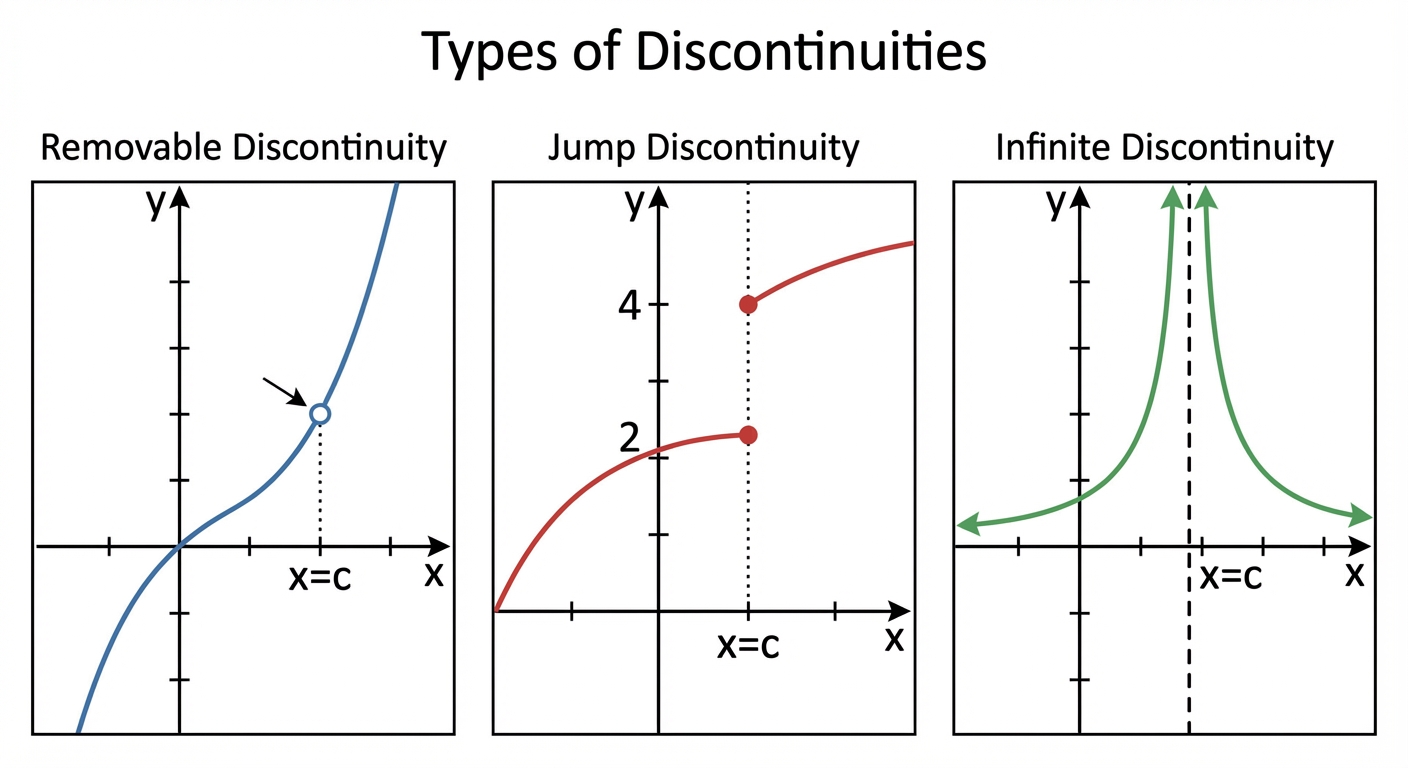
1. Removable Discontinuities (Holes)
These occur when the limit exists ($Condition #2$ is met), but the limit does not equal the function value ($Condition #3$ fails).
- Visual: A curve with a small open circle (hole).
- Cause: Usually caused by a common factor in the numerator and denominator of a rational function.
- Limit: $\lim_{x \to c} f(x)$ exists and is a real number.
2. Non-Removable Discontinuities
These are discontinuities that cannot be fixed by simply redefining a single point.
A. Jump Discontinuity
This happens when the left-hand limit and the right-hand limit both exist but are not equal.
- Visual: The graph "jumps" from one height to another at $x=c$.
- Cause: Common in piecewise functions or absolute value definitions like $y = \frac{|x|}{x}$.
- Limit: $\lim_{x \to c} f(x)$ does not exist (DNE) because the one-sided limits differ.
B. Infinite Discontinuity (Asymptotic)
This occurs when the function goes to positve or negative infinity as $x$ approaches $c$.
- Visual: A vertical asymptote.
- Cause: Division by zero where the numerator is non-zero.
- Limit: $\lim_{x \to c} f(x)$ does not exist (often described as approaching $\infty$ or $-\infty$).
C. Oscillating Discontinuity
This is a rare case where the function oscillates infinitely fast as it approaches a point (e.g., $f(x) = \sin(\frac{1}{x})$ at $x=0$). The limit does not exist purely due to oscillation.
Comparison Table
| Type | Limit Checklist Failure | Visual Characteristic |
|---|---|---|
| Removable | Condition 3 fails (Limit $\neq$ Function Value) | Hole in graph |
| Jump | Condition 2 fails (Left Limit $\neq$ Right Limit) | Vertical gap/step |
| Infinite | Condition 1 or 2 fails (Function Undefined or Limit is $\infty$) | Vertical Asymptote |
Confirming Continuity over an Interval
Once we understand continuity at a point, we expand the concept to an interval.
Open Intervals $(a, b)$
A function is continuous on an open interval $(a, b)$ if it is continuous at every single point inside that interval.
- Common Continuous Functions: Polynomials, exponential functions ($e^x$), sine, and cosine are continuous for all real numbers $(-\infty, \infty)$. Rational functions are continuous everywhere except where the denominator is zero.
Closed Intervals $[a, b]$
To claim continuity on a closed interval (including the endpoints), strictly checking the general limit isn't enough because limits generally require approaching from both sides. For endpoints, we use one-sided continuity.
A function is continuous on $[a, b]$ if:
- It is continuous on the open interval $(a, b)$.
- It is continuous from the right at $a$: $\lim_{x \to a^{+}} f(x) = f(a)$.
- It is continuous from the left at $b$: $\lim_{x \to b^{-}} f(x) = f(b)$.
![A graph of a function on a closed interval [a, b] showing solid dots at the endpoints to indicate continuity from the right at a and left at b.](https://knowt-user-attachments.s3.amazonaws.com/study-notes/8c4af29e-a7f7-4ae6-8ea3-14bc853d9775/039f4e77-0a91-4b69-83d2-ccc2a298c9c4.png)
Removing Discontinuities
Only Removable Discontinuities can be "fixed." This process involves redefining the function or simplified algebraic manipulation to fill the "hole."
The Algebraic Approach
If a rational function yields the indeterminate form $\frac{0}{0}$ when evaluating a limit, there is likely a removable discontinuity (a hole) that corresponds to a common factor.
Worked Example:
Let $f(x) = \frac{x^2 - 9}{x - 3}$. Is there a discontinuity at $x=3$? Can we remove it?
Check $f(3)$: $\frac{3^2 - 9}{3 - 3} = \frac{0}{0}$. The function is undefined at $x=3$ (Condition 1 fails).
Find the Limit: Factor the numerator.
Cancel the common factor $(x-3)$:
Since the limit exists (it equals 6), this is a Removable Discontinuity.Redefine the Function: To make the function continuous, we define a new function $g(x)$ that is the same as $f(x)$ everywhere except at the hole, where we plug the gap.
This new function $g(x)$ is continuous at $x=3$ because now $g(3) = 6$ and $\lim_{x \to 3} g(x) = 6$.
Common Mistakes & Pitfalls
Confusing "Limit Exists" with "Continuous"
- Mistake: Assuming that because the left and right limits match, the function is continuous.
- Correction: A limit can exist even if there is a hole. You MUST check that the function value $f(c)$ also exists and equals that limit.
Assuming $\frac{0}{0}$ is an Asymptote
- Mistake: Seeing a zero in the denominator and immediately claiming "Vertical Asymptote."
- Correction: If you get $\frac{nonzero}{0}$, it is an asymptote (Infinite Discontinuity). If you get $\frac{0}{0}$, it is likely a hole (Removable Discontinuity). Always factor first.
Ignoring Endpoints on Intervals
- Mistake: Applying standard two-sided limits to the endpoints of a closed interval.
- Correction: At endpoints, calculate connection only from the interior of the interval (one-sided limits).