Cultural Rebirth: A Comprehensive Guide to European Renaissance Art (1400–1600 CE)
The Roots of Renewal: Proto-Renaissance and Early Concepts
Defining the Renaissance
The Renaissance (French for "rebirth") marked a shift from the Middle Ages to the Modern era, characterized by a revival of interest in Classical antiquity (Greece and Rome). In AP Art History, this period is critical for understanding the shift from stylized, symbolic religious art to naturalism, individual observation, and secular synthesis.
Key Concept: Humanism
Humanism is an intellectual movement that emphasized secular concerns, human potential, and the study of the Studia Humanitatis (grammar, rhetoric, poetry, history, moral philosophy).
- The Shift: Instead of viewing humans solely as sinful creatures, Humanists viewed man as the measure of all things.
- Impact: Artists began studying anatomy and emotions to depict the human form realistically.
The Bridge: Giotto di Bondone
Before the "High Renaissance," there was the Proto-Renaissance. Giotto is the pivotal figure who broke away from the flat, gold-backed Byzantine style (Maniera Greca).
- Work to Know: Arena (Scrovegni) Chapel, particularly the Lamentation panel.
- Innovation: He introduced weight and mass to figures. His figures have backs turned to the viewer, creating a sense of space and inviting the viewer into the scene.
The Italian Renaissance (Florence & Rome)
The Italian Renaissance is defined by Rationality, Idealism, and Perspective. Artists sought to perfect nature through mathematics and classical order.
Filippo Brunelleschi: Mastering Architecture
Brunelleschi rediscovered the principles of linear perspective and engineered the dome of the Florence Cathedral.
Scientific Perspective
Brunelleschi developed Linear Perspective—a mathematical system for creating the illusion of space and distance on a flat surface.
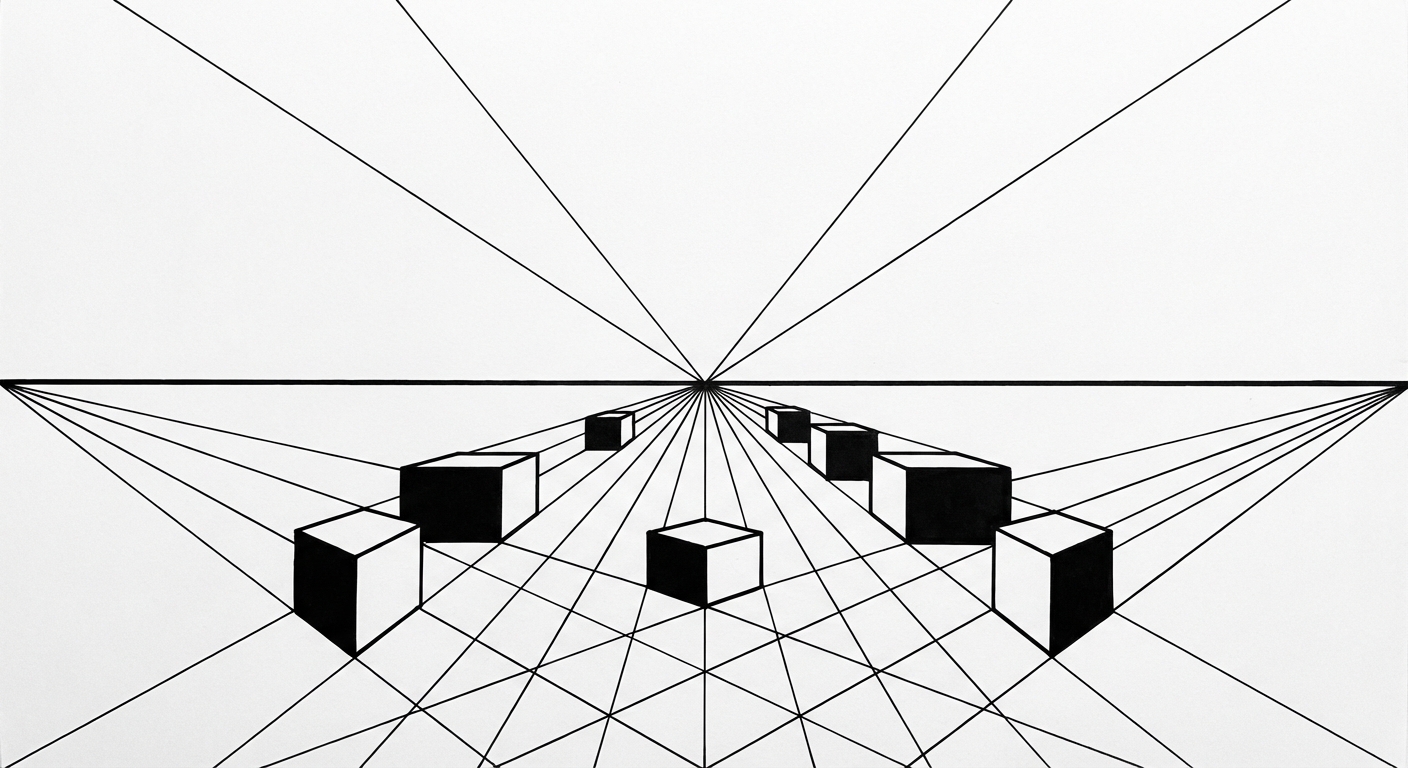
- Horizon Line: Eye level.
- Vanishing Point: The single point where parallel lines appear to converge.
- Orthogonals: Diagonal lines drawing the eye to the vanishing point.
The Pazzi Chapel
- Style: Early Renaissance refinement.
- Features: uses pietra serena (gray sandstone) to articulate the geometry against white walls. It references the Roman Pantheon but emphasizes light and geometric clarity over mass.
The High Renaissance Triad
The High Renaissance (approx. 1495–1520) represents the pinnacle of artistic achievement in Rome and Florence.
1. Leonardo da Vinci (The Scientist-Artist)
Leonardo defined the concept of the "Renaissance Man." He prioritized observation of the natural world.
- Chiaroscuro: The treatment of light and shade in drawing and painting to create volume.
- Sfumato: A "smoky" haziness that softens outlines, allowing tones to merge gradually (e.g., Mona Lisa).
- The Last Supper:
- Composition: Organized grouping of disciples in threes; Jesus is the anchor in a stable equilateral triangle.
- Narrative: Captures the psychological moment Jesus says, "One of you will betray me."
2. Michelangelo Buonarroti (The Sculptor-Painter)
Michelangelo viewed the body as a "prison for the soul" and believed sculpture was the act of freeing the figure from the stone. His style is characterized by Terribilità (emotional intensity and awe).
- Sistine Chapel Ceiling:
- Focus: The human figure (ignudi) is central. The architecture is painted (trompe l'oeil).
- The Creation of Adam: God and Adam mirror each other implies man is created in God's image physically and intellectually.
- The Last Judgment (Altar Wall): Painted decades later. The style shifts toward pessimism; figures are heavier, almost grotesque, reflecting the turmoil of the Protestant Reformation (Mannerism influences).
3. Raphael (The Synthesizer)
Raphael combined Leonardo's softness and Michelangelo's monumentality. He is the master of clarity and grace.
- School of Athens:
- Location: The Stanza della Segnatura (Papal Library).
- Symbology: Represents Philosophy. Plato points up (world of forms/ideas), Aristotle points down (empirical world). Raphael includes likenesses of his rivals (Michelangelo as Heraclitus) and himself.
The Venetian Renaissance
While Florence focused on Disegno (drawing/design/line), Venice focused on Colorito (color/application of paint). Due to the damp climate of Venice, frescoes dissolved; therefore, Venetians mastered Oil on Canvas.
Titian and the Female Nude
- Work to Know: Venus of Urbino.
- Characteristics:
- The warm, glowing skin tones created by layers of oil glazes (glazing).
- The Gaze: The figure looks directly at the viewer, engaging them, unlike the modest Classical Venus.
- Composition: Established the standard for the reclining female nude for centuries (influencing Manet and Ingres).
The Northern Renaissance
Occurring in Flanders (Belgium/Netherlands) and Germany, the Northern style differs distinctly from the Italian.
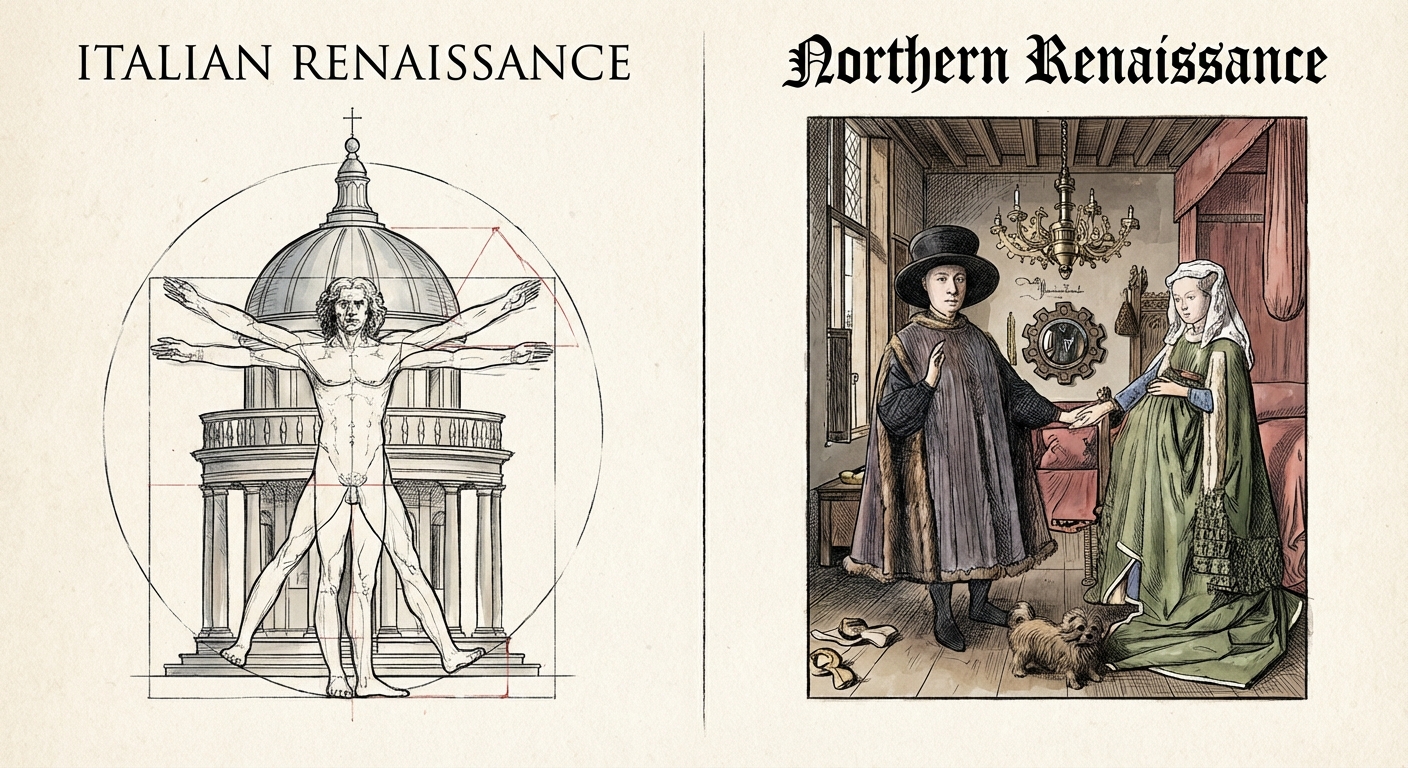
Key Differences Table
| Feature | Italian Renaissance | Northern Renaissance |
|---|---|---|
| Primary Goal | Ideal beauty, geometric proportion | Intense realism, surface detail |
| Perspective | Mathematical/Linear | Atmospheric/Intuitive |
| Subject Matter | Mythology, heavy Anatomy | Domestic interiors, portraits, religious scenes in local settings |
| Detail | Broad strokes, idealized forms | Microscopic attention to texture (fabric, wood, hair) |
Jan van Eyck
Master of oil painting in Flanders.
- Work to Know: The Arnolfini Portrait.
- Symbolism: Every object has meaning (dog = fidelity, shoes off = holy ground, single candle = presence of God).
- Technique: Use of oil paint allowed for luminous color and incredibly fine details (e.g., the reflection in the convex mirror).
Albrecht Dürer
A German artist who traveled to Italy and combined Northern detail with Italian proportion. He was the first superstar of Printmaking.
- Work to Know: Adam and Eve (Engraving).
- Concept: The bodies are based on classical Greek statues (Apollo Belvedere/Medici Venus), but they are placed in a dark German forest.
- The Four Humors: Represented by animals (Cat = choleric/angry, Rabbit = sanguine/energetic, Ox = phlegmatic/lethargic, Elk = melancholic/sad). Before the Fall of Man, these humors were in balance.
Reformation vs. Counter-Reformation Impact
- The Protestant Reformation (North): Martin Luther challenged Church authority. This led to Iconoclasm (destruction of religious images). Northern art shifted away from massive church altarpieces toward smaller, secular genres: landscapes, still lifes, and portraits.
- The Counter-Reformation (South/Catholic): The Church responded (Council of Trent) by affirming that art should be didactic and emotionally engaging to keep the faithful. This led to the dramatic style of the later Renaissance and Baroque.
Common Mistakes & Pitfalls
Confusing "Iconography" with "Iconoclasm":
- Iconography is the study of symbols in art (e.g., lilies represent purity).
- Iconoclasm is the destruction of images (happened during the Protestant Reformation).
Misidentifying Perspective Types:
- Italian art uses Linear Perspective (math-based).
- Northern art typically uses Atmospheric Perspective (fading clarity in distance) or intuitive perspective. Do not claim Van Eyck used perfect linear perspective.
The "Ninja Turtle" Fallacy:
- Donatello is Early Renaissance (Florence). Leonardo, Michelangelo, and Raphael are High Renaissance. Donatello came first—his David (bronze) influenced the later masters.
Misunderstanding "Mannerism":
- Mannerism (e.g., Pontormo) comes after the High Renaissance. It intentionally distorts the perfect proportions of Raphael/Michelangelo to create imbalance and elegance. It is not "bad" anatomy; it is a stylistic choice.