APUSH Unit 5: The American Civil War (1861–1865)
The Election of 1860 and the Crisis of Secession
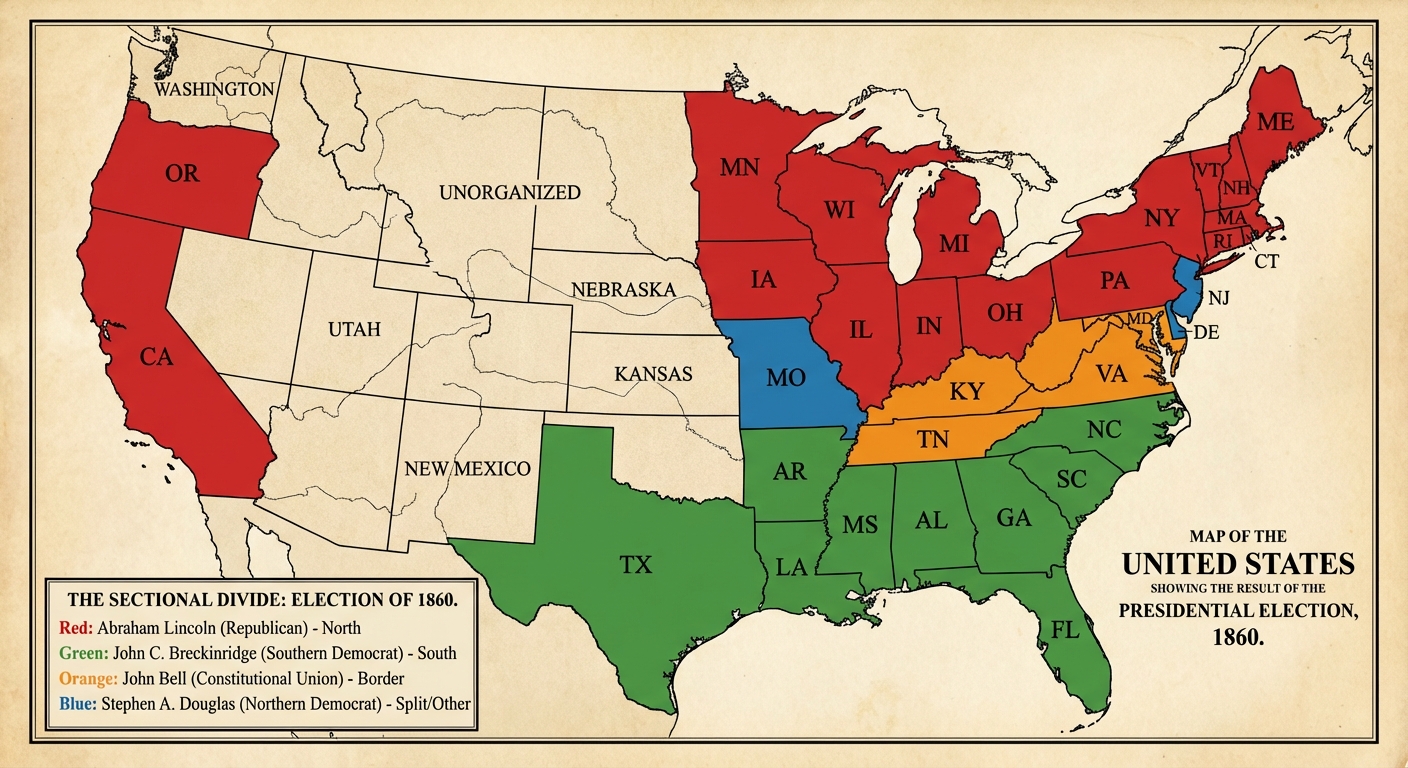
The road to the Civil War culminated in the election of 1860, a political event demonstrating that the United States had effectively become two separate political entities. The breakdown of the fierce debates regarding the expansion of slavery into the territories made compromise impossible.
The Fracture of the Party System
By 1860, the Democratic Party, the last remaining national institution with cross-sectional support, shattered along sectional lines:
- Northern Democrats: Nominated Stephen Douglas. They supported Popular Sovereignty (letting territories decide on slavery).
- Southern Democrats: Nominated John C. Breckinridge. They demanded federal protection of slavery in all territories.
- Constitutional Union Party: Nominated John Bell. Their platform was vague, focused solely on preserving the Constitution and the Union.
- Republican Party: Nominated Abraham Lincoln.
The Republican Platform (Free Soil)
It is a common misconception that Lincoln campaigned on abolishing slavery. He ran as a Free Soiler. His platform included:
- Non-extension of slavery: Slavery would be left alone where it existed but banned from expanding into new territories.
- Economic policies favoring the North: Protective tariffs, internal improvements (Pacific Railroad), and free homesteads for farmers.
The Result and Immediate Aftermath
Lincoln won the election with only 40% of the popular vote but a clear majority in the Electoral College. Crucially, he did not appear on the ballot in ten Southern states.
- Secession: Perception matters more than reality in politics. While Lincoln promised not to touch slavery in the South, Southern leaders, specifically in the Deep South, viewed his victory as the death knell for their economy and way of life.
- South Carolina seceded in December 1860, followed rapidly by six other states (MS, FL, AL, GA, LA, TX) to form the Confederate States of America (CSA).
- The Crittenden Compromise: A final, failed attempt to avoid war by proposing a constitutional amendment to permanently protect slavery south of the 36°30' line. Lincoln rejected it because it violated the core Republican principle of non-extension.
Mobilization and Strategy: The War Begins
The war officially began on April 12, 1861, when Confederate forces fired on Fort Sumter in Charleston Harbor. Lincoln called for 75,000 volunteers to suppress the rebellion, prompting four states of the Upper South (VA, AR, TN, NC) to secede, seeing this as an act of aggression.
The Border States
Lincoln’s political genius was tested immediately by the Border States (slave states that stayed in the Union: Delaware, Maryland, Kentucky, and Missouri).
- Strategic Importance: They contained significant white populations and industrial capacity. Losing Maryland would have surrounded the Union capital, Washington D.C.
- Lincoln's Tactics: He declared the war was about saving the Union, not freeing slaves, to keep these states loyal. He famously suspended the Writ of Habeas Corpus in Maryland to arrest pro-Confederate agitators without trial.
Comparative Advantages
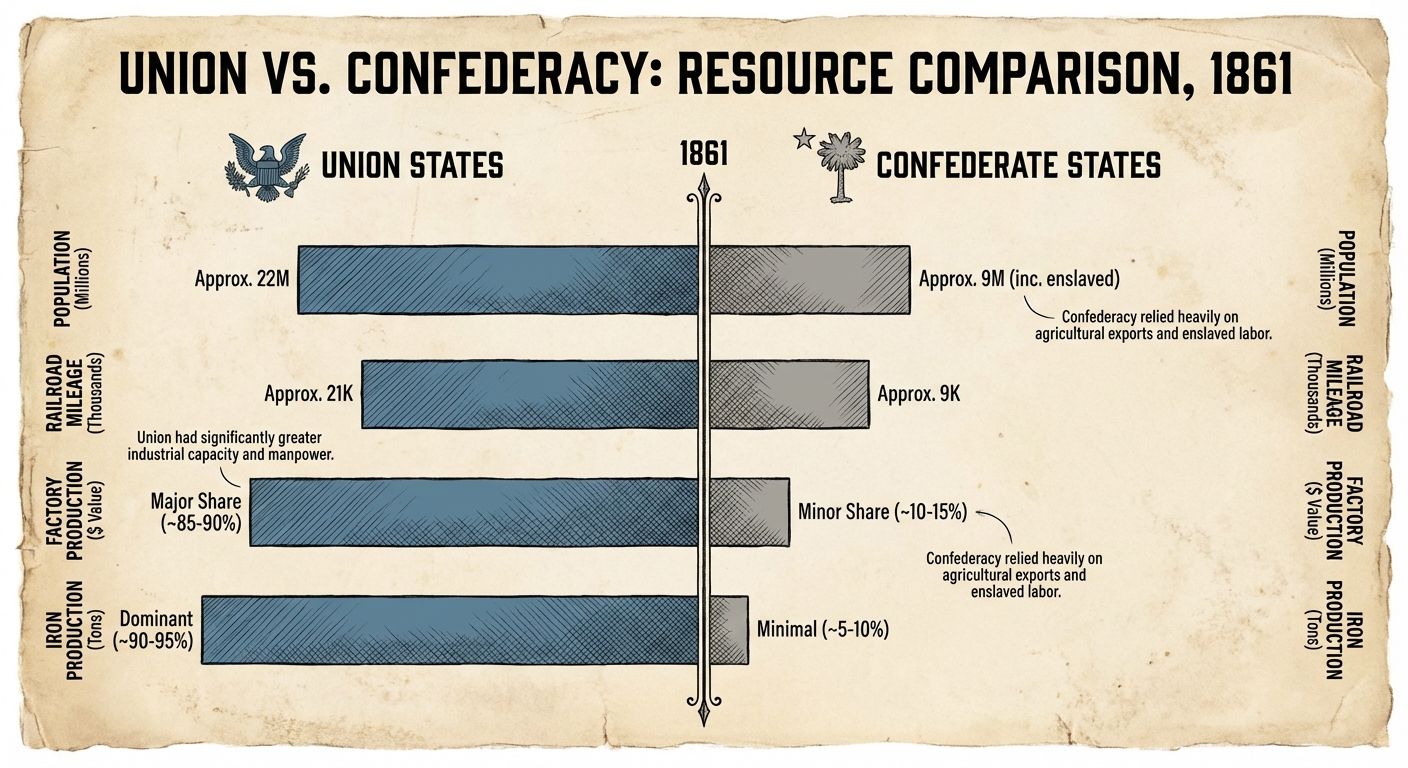
| Feature | The Union (North) | The Confederacy (South) |
|---|---|---|
| Population | 22 million (large manpower reserve) | 9 million (inc. 3.5 million enslaved people) |
| Industry | 90% of manufacturing capacity | Very limited; relied on imports |
| Transportation | Extensive railroad network | Limited and disconnected railroads |
| Leadership | Struggled to find competent generals early on | Strong military tradition (Robert E. Lee, Stonewall Jackson) |
| Motivation | Abstract concept (preserving the Union) | Defending home, soil, and self-determination |
Military Strategies
Union Strategy: The Anaconda Plan
- Devised by Winfield Scott.
- Blockade Southern ports to cut off supplies.
- Control the Mississippi River to split the Confederacy in two.
- Capture the capital, Richmond, Virginia.
Confederate Strategy: King Cotton Diplomacy
- Fight a defensive war of attrition (wear down Northern will).
- Rely on European dependency on Southern cotton to gain recognition and aid from Britain and France. (This failed as Europe found cotton elsewhere and frowned upon slavery).
Major Military Conflicts and Turning Points
1. The Early War (1861–1862)
- Battle of Bull Run (Manassas): The first major battle. A Confederate victory that ended the illusion of a short, bloodless war.
- Antietam (September 1862): The single bloodiest day in American history.
- Military Result: A strategic draw, but Lee retreated.
- Political Consequence: It gave Lincoln the victory he needed to issue the Emancipation Proclamation. It also effectively prevented British intervention on the side of the South.
2. The Turning Points (July 1863)
Two major Union victories occurred almost simultaneously, shifting the tide toward the North.
- Battle of Gettysburg: Lee invaded the North to force a peace settlement. The Union victory halted the advance. It was the "high water mark" of the Confederacy.
- Siege of Vicksburg: General Ulysses S. Grant captured Vicksburg, giving the Union full control of the Mississippi River and completing the "split" phase of the Anaconda Plan.
3. Total War (1864–1865)
Lincoln eventually promoted Ulysses S. Grant to command all successes. Grant adopted a strategy of constant pressure, utilizing the North's numerical superiority.
- Sherman's March to the Sea: General William Tecumseh Sherman marched through Georgia, destroying infrastructure, crops, and railroads. This was Total War—warfare directed not just at armies, but at the civilian will and economic capacity to fight.
Political and Social Dimensions
The Changing Purpose of the War
Initially, the war was fought to preserve the Union. Over time, it evolved into a crusade against slavery.
- The Confiscation Acts: Early laws allowing the Union to seize "property" (enslaved people) used for insurrection.
- The Emancipation Proclamation (Jan 1, 1863):
- Declared all enslaved people in rebel territory free.
- Limitation: It did NOT free slaves in the Border States (Lincoln still feared they would secede).
- Impact: Changed the moral force of the war and encouraged enslaved people to escape to Union lines.
- The Gettysburg Address: Lincoln redefined the war as a struggle for human equality, linking the sacrifice of soldiers to a "new birth of freedom."
Dissent and Politics
- Copperheads: Northern Democrats who opposed the war and demanded an immediate peace settlement with the Confederacy.
- Election of 1864: Lincoln faced George McClellan (whom he had fired as general). Sherman’s capture of Atlanta right before the election boosted morale, securing Lincoln’s reelection.
Civil Liberties
During the war, Lincoln expanded presidential power significantly. He suspended habeas corpus (the right to be charged before detention) and authorized military tribunals for civilians, arguing that the Constitution could be temporarily stretched to save the nation.
Military and Civilian Experience
The Experience of Common Soldiers
For the average soldier, the war was defined by boredom alternating with sheer terror. However, the biggest killer was not combat.
- Disease: Dysentery, typhoid, and pneumonia killed twice as many soldiers as battle wounds due to poor sanitation and primitive medicine.
- Technology: The use of the Minie Ball (a conical bullet) and rifled muskets increased accuracy and lethality, leading to high casualty rates and the necessity of trench warfare.
African Americans in the War
Following the Emancipation Proclamation, the Union began recruiting African American soldiers.
- The 54th Massachusetts Regiment: An all-Black unit (with white officers) whose bravery at Fort Wagner proved that Black men could fight with distinction.
- By the war's end, roughly 180,000 African Americans served in the Union Army (10% of the force). They faced discrimination, lower pay (initially), and the threat of execution if captured by the Confederates.
Women and the Home Front
- Nursing: Women like Clara Barton (future founder of the Red Cross) professionalized nursing, transforming it into a respectable female profession.
- Economic Roles: With men away, women took over managing plantations in the South and factory jobs/farming in the North.
- Bread Riots: In the South, inflation and food shortages caused by the Union blockade led to riots by women.
Common Mistakes & Pitfalls
- Emancipation Misconception: Mistake: Thinking the Emancipation Proclamation ended all slavery. Correction: It only applied to states in rebellion. The 13th Amendment (1865) was required to legally abolish slavery nationwide.
- Lincoln the Abolitionist: Mistake: Believing Lincoln entered the war to end slavery. Correction: His primary goal until 1863 was strictly saving the Union. His personal views against slavery were subordinate to his constitutional duty.
- The "State's Rights" Argument: Mistake: Arguing the South seceded solely for "State's Rights." Correction: While they argued for state sovereignty, the specific right they were defending was the right to own enslaved people. The declarations of secession explicitly cite slavery as the cause.
- Complete Southern Unity: Mistake: Assuming all Southerners supported the CSA. Correction: regions like West Virginia (which split from Virginia to join the Union) and areas of East Tennessee were strongly Unionist.