Unit 4: Linear Momentum Fundamentals
Understanding Linear Momentum
Linear Momentum represents the "quantity of motion" an object possesses. It is a vector quantity, meaning it has both magnitude and direction, and it serves as a measure of how difficult it is to stop a moving object.
Definition and Formula
Momentum is defined as the product of an object's mass and its velocity. In AP Physics 1, the symbol for momentum is $\vec{p}$.
Where:
- $p$ = Momentum ($kg \cdot m/s$)
- $m$ = Constant mass ($kg$)
- $v$ = Velocity ($m/s$)
Key Properties
- Vector Nature: The direction of the momentum vector is always the same as the direction of the velocity vector.
- Inertia in Motion: A heavy truck moving slowly can have the same momentum as a small bullet moving very fast.
- Newton's Second Law Revisited: Newton originally expressed his second law not as $F=ma$, but in terms of momentum:
This indicates that a net force is required to change an object's momentum over time.
Impulse and Change in Momentum
While momentum describes the state of a moving object, Impulse ($J$) describes the process of changing that momentum through the application of a force over a specific time interval.
Defining Impulse
Impulse is the product of the average force applied to an object and the time interval during which the force acts.
Units:
- Newton-seconds ($N \cdot s$)
- Note: $1 \ N \cdot s$ is universally equivalent to $1 \ kg \cdot m/s$.
The Impulse-Momentum Theorem
This is the governing principle for this section. It states that the impulse applied to an object is exactly equal to the change in its momentum.
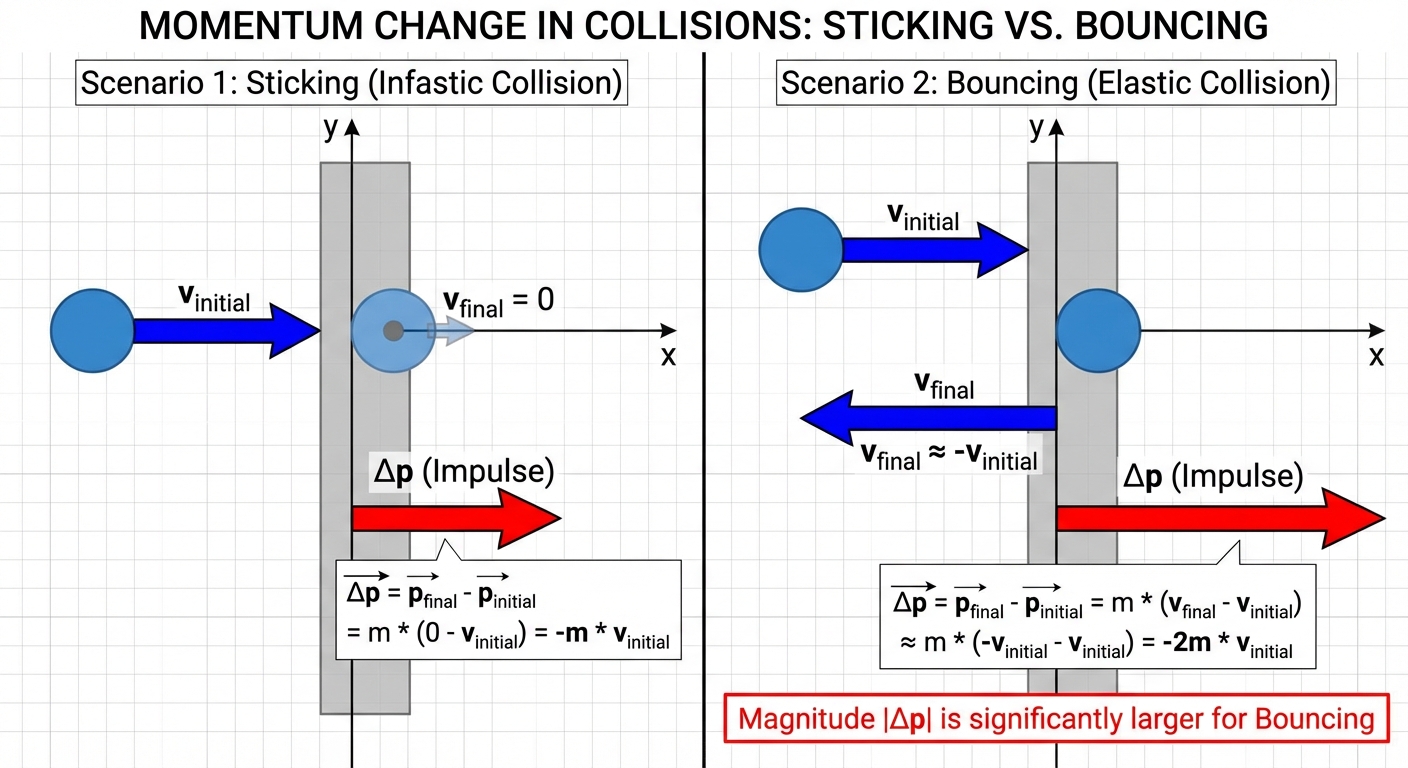
Crucial Concept: Bouncing vs. Sticking
- Sticking (Inelastic): An object hits a wall and stops. $\Delta v = 0 - v$. $\Delta p = -mv$.
- Bouncing (Elastic): An object hits a wall and rebounds with the same speed. $\Delta v = (-v) - v = -2v$. $\Delta p = -2mv$.
Result: Bouncing requires a greater impulse (and typically a greater force) than merely stopping, because you must first stop the object and then accelerate it in the opposite direction.
Graphical Interpretation: Force vs. Time
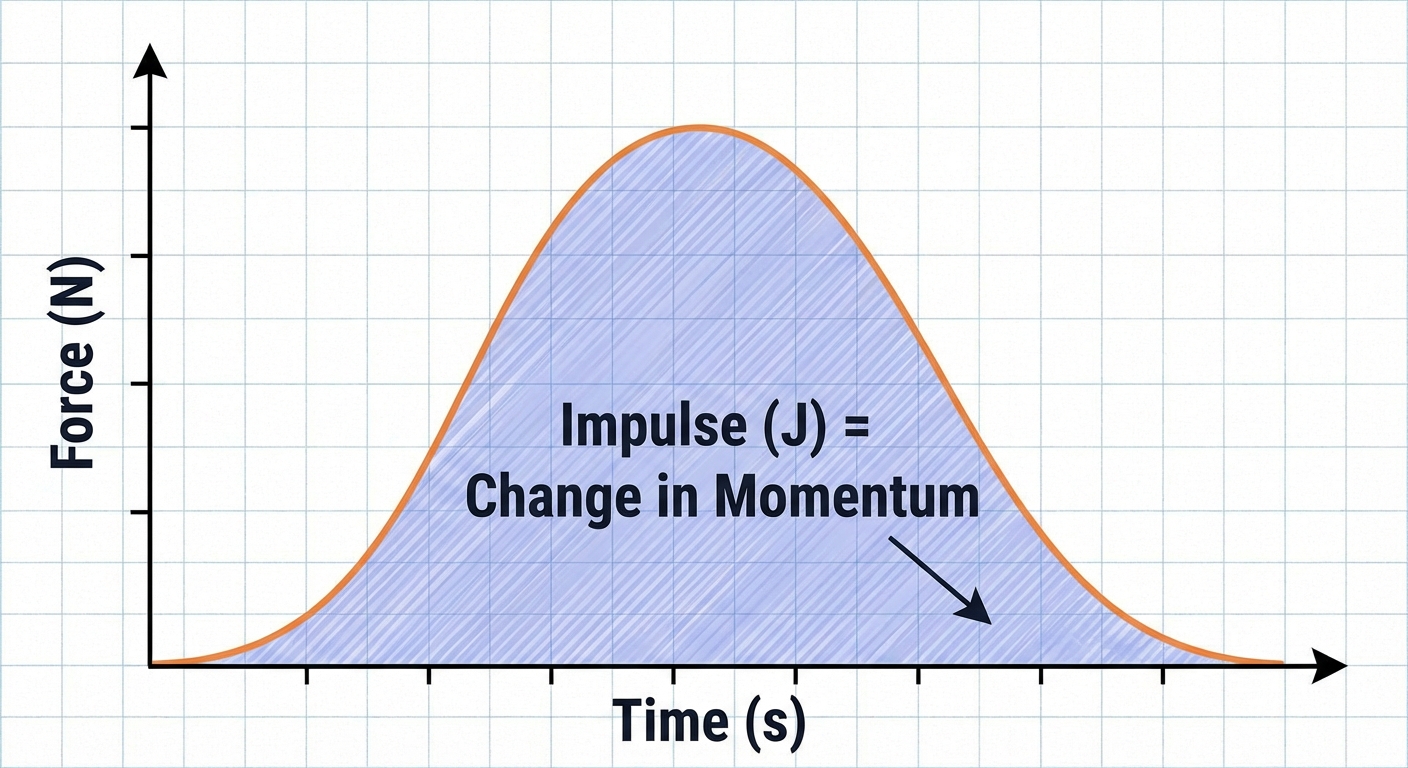
One of the most frequent exam questions involves analyzing a Force vs. Time graph.
- The Area Under the Curve: The area between the force curve and the time axis (x-axis) represents the Impulse (change in momentum).
- Constant Force: The area is a rectangle ($F \times t$).
- Varying Force: The area is usually a triangle ($1/2 \ b \cdot h$) or a shape requiring estimation.
Real-World Applications: Cushioning Impact
The Impulse-Momentum theorem explains the physics of safety devices like airbags, seatbelts, and crumple zones.
Consider a car crash where a person comes to a stop. The change in momentum ($\Delta p$) is fixed (mass is constant, speed goes from $v$ to $0$). Therefore, the Impulse ($J$) is also fixed.
Using the formula $F = \frac{\Delta p}{\Delta t}$:
- Goal: Minimize the Force ($F$) on the passenger to prevent injury.
- Method: Maximize the Time ($\Delta t$) of the collision.
| Scenario | Change in Momentum ($\Delta p$) | Time of Impact ($t$) | Force ($F$) | Outcome |
|---|---|---|---|---|
| Hitting Dashboard | Fixed | Very Small | Huge | Injury |
| Hitting Airbag | Fixed | Large | Small | Safe |
Common Mistakes & Pitfalls
1. The "Sign" Blindness
Mistake: Calculating $\Delta p$ using only magnitudes (e.g., $10 - 10 = 0$) when an object rebounds.
Correction: Velocity is a vector. If a ball hits a wall moving right ($+10 m/s$) and bounces left ($-10 m/s$), the change is $(-10) - (+10) = -20 m/s$. The momentum changed significantly!
2. Confusing Force with Impulse
Mistake: Thinking that a large force always means a large impulse.
Correction: A massive force applied for a microsecond might produce a smaller impulse than a gentle push applied for a minute. Impulse depends on time as well ($J = F\Delta t$).
3. Axis Confusion
Mistake: Trying to find the slope of a Force vs. Time graph.
Correction: In Unit 4, you satisfy the Area (Integral), not the Slope (Derivative). The slope of an F-t graph is "Yank" (rate of change of force), which is rarely tested in AP Physics 1. F-t Graph = Area = Impulse.
Mnemonic: "Fat Mav"
To remember the relationship between Force, Time, Mass, and Velocity:
"FAT = MAV"
(Force $\times$ Time = Mass $\times$ Change in Velocity)