AP United States History Unit 3: Governing the New Republic (1783–1800)
The Articles of Confederation
Following the Declaration of Independence, the newly formed states needed a framework for governance. Their first attempt, The Articles of Confederation (ratified 1781), reflected a deep skepticism of centralized power—a direct reaction to British tyranny.
Structure and Weaknesses
The Articles created a "firm league of friendship" rather than a unified nation. The government consisted of a unicameral legislature where each state possessed one vote, regardless of population.
Key structural limitations included:
- No Executive or Judicial Branch: There was no President to enforce laws and no Supreme Court to settle disputes between states.
- Inability to Tax: The federal government could only request money from states; it could not demand it to pay off war debts.
- Supermajority Requirements: Passing laws required 9/13 votes; amending the Articles required a unanimous 13/13 vote (making change nearly impossible).
The Success: The Northwest Ordinance of 1787
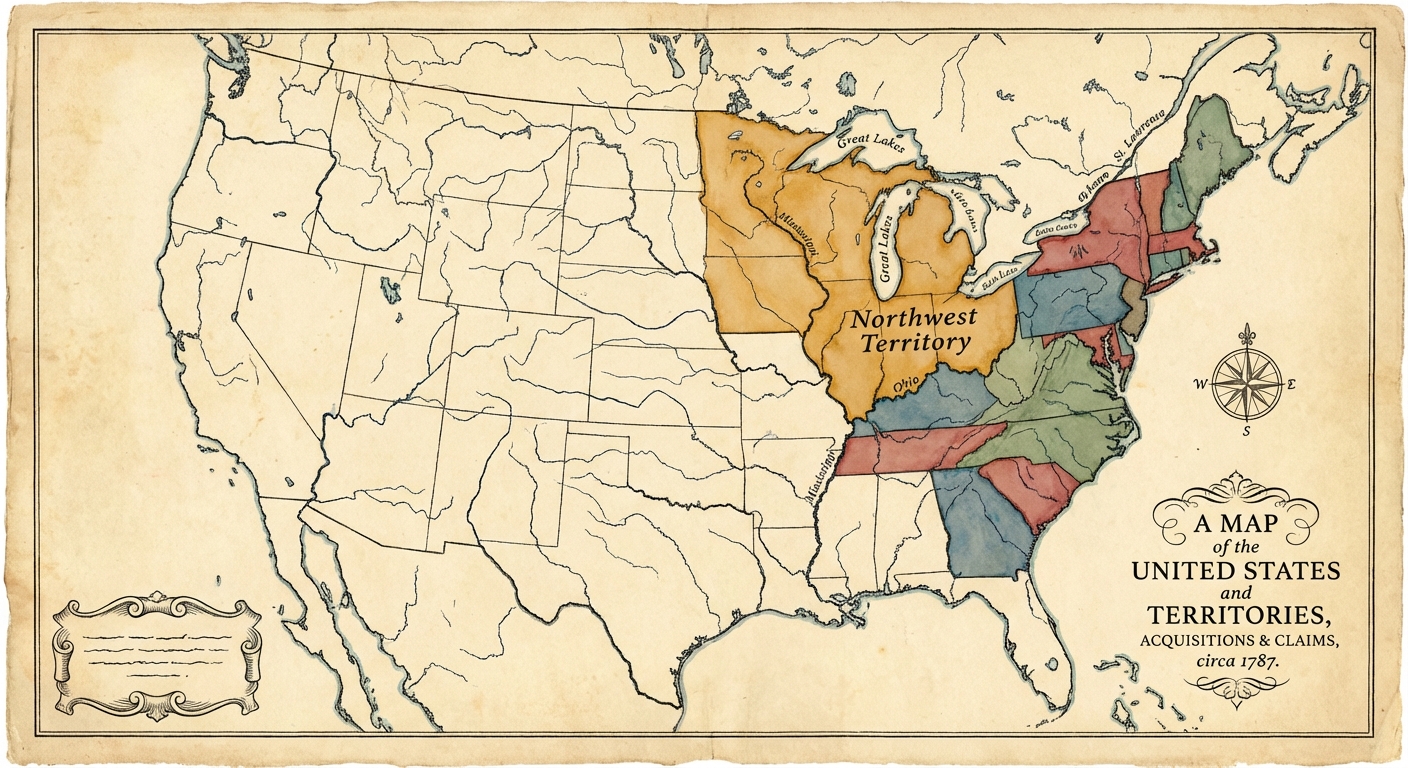
Despite its failures, the Confederation Congress passed one of the most significant laws in American history. The Northwest Ordinance established the precedent for how the U.S. would expand westward.
- Statehood Path: It set up a process for admitting new states on equal footing with original states (rejecting colonialism).
- Slavery Ban: It prohibited slavery in the Northwest Territory (Ohio, Indiana, Illinois, etc.), setting the stage for future sectional conflict.
- Education: It set aside land sales to fund public education.
The Breaking Point: Shays’ Rebellion (1786–1787)
The weakness of the Articles became undeniable during Shays’ Rebellion. Impoverished backcountry farmers in Massachusetts, many of them Revolutionary War veterans, were losing their farms to mortgage foreclosures and tax delinquencies. Led by Daniel Shays, they demanded printed money and lighter taxes.
- The Problem: The Massachusetts government raised an army to crush the rebellion, but the federal government under the Articles had no power or money to assist.
- The Impact: This event terrified the wealthy elite and political leaders, convincing them that a stronger central government was necessary to prevent "mob rule."
The Constitutional Convention and Ratification
In May 1787, 55 delegates met in Philadelphia ostensibly to "revise" the Articles. Instead, they scrapped them entirely and wrote the United States Constitution.
Compromises at the Convention
The convention was defined by negotiation between small states vs. large states, and slave states vs. free states.
The Great Compromise (Connecticut Compromise)
- Issue: How should states be represented in the legislature?
- Virginia Plan: Representation based on population (favored large states).
- New Jersey Plan: Equal representation (favored small states).
- Result: A Bicameral Legislature. The House of Representatives is based on population; the Senate has equal representation (2 senators per state).
The Three-Fifths Compromise
- Issue: Should enslaved people count toward a state's population for representation and taxation?
- Result: Each enslaved person counted as of a person. This gave Southern states disproportionate power in the House and the Electoral College.
The Slave Trade Compromise
- Congress agreed not to potentiall ban the international slave trade until 1808 (20 years later).
The Ratification Debate: Federalists vs. Anti-Federalists
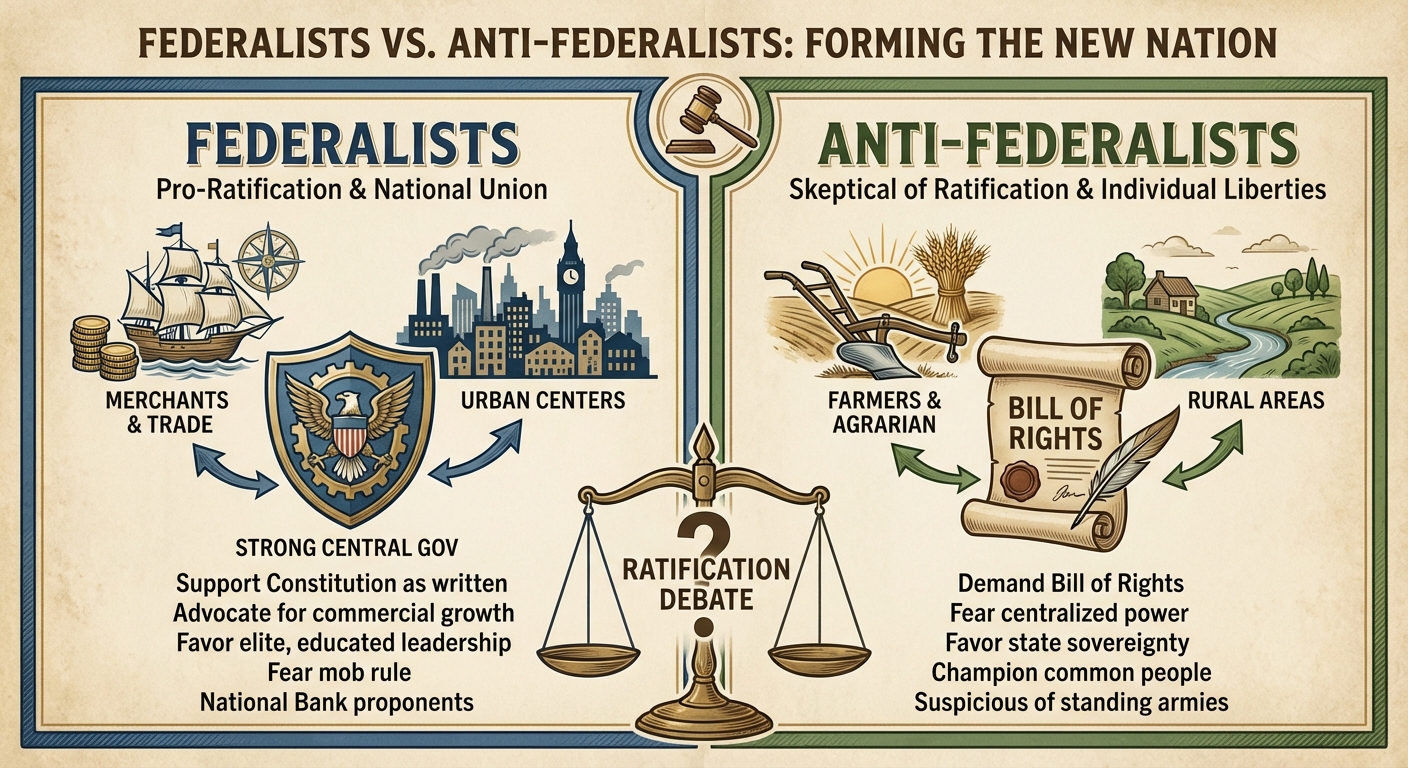
Once written, the Constitution required ratification by 9 of the 13 states. Two distinct camps emerged:
| Feature | Federalists | Anti-Federalists |
|---|---|---|
| Leaders | Hamilton, Madison, Jay | Patrick Henry, George Mason, Sam Adams |
| Philosophy | Strong central government is needed to maintain order and preserve the Union. | Strong central government will destroy the work of the Revolution and limit state rights. |
| Supporters | Urban dwellers, wealthy merchants, Atlantic coast. | Small farmers, frontiersmen, states' rights advocates. |
| Key Writing | The Federalist Papers (specifically #10 and #51). | Brutus No. 1. |
The Outcome: The Federalists promised to add a Bill of Rights (the first 10 amendments) to protect individual liberties, which secured the necessary votes for ratification.
Developing an American Identity
While the Constitution created a legal framework, the 1790s were defined by the struggle to create a cultural and political identity.
The Rise of Political Parties
Despite George Washington's warnings against "factions" in his Farewell Address, the first two-party system formed immediately around the conflicting visions of Alexander Hamilton and Thomas Jefferson.
- The Federalist Party (Hamilton): Envisioned an industrial, commercial nation. Favored the National Bank (using the "Elastic Clause"), high tariffs, and close ties with Britain.
- The Democratic-Republicans (Jefferson/Madison): Envisioned an agrarian republic of "yeoman farmers." Favored strict interpretation of the Constitution (states' rights) and close ties with France.
Social Identity: Republican Motherhood
Women’s roles began to shift slightly in the new republic. Since the republic relied on virtuous citizens, mothers were tasked with raising their sons to be patriotic and educated.
- Republican Motherhood: This concept elevated usage of women's role in the domestic sphere, arguing that women needed education to teach their children civic virtue. While it did not grant political rights (like voting), it expanded female education access.
Art and Literature
American culture struggled to separate itself from British influence. Artists like Gilbert Stuart painted iconic portraits of Washington, while architecture adopted the Neoclassical style (pillars, domes) to visually link the new U.S. republic to the ancient democracies of Greece and Rome.
Movement in the Early Republic
The period from 1783–1800 saw massive migration across the Appalachian Mountains, leading to diplomatic tension and conflict.
Conflict with Native Americans
As settlers moved into the Ohio River Valley (Old Northwest), they encroached on Native lands. A confederacy of tribes, aided by British forts that remained in the west, resisted.
- Battle of Fallen Timbers (1794): General "Mad Anthony" Wayne defeated the Native American confederacy.
- Treaty of Greenville (1795): Natives ceded vast amounts of land in the Ohio Valley to the U.S. government, opening the region for rapid settlement.
The Whiskey Rebellion (1794)
Backcountry farmers in Western Pennsylvania rebelled against Hamilton's excise tax on whiskey. Unlike Shays' Rebellion, the new federal government responded decisively.
- Washington’s Response: He led 13,000 troops to crush the rebellion.
- Significance: It demonstrated that the new Constitution provided the federal government sufficient power to enforce its laws.
Diplomatic Movement
The U.S. sought to secure its borders through treaties:
- Jay’s Treaty (1794): With Britain. Britain agreed to leave forts on the frontier but did not stop harassing U.S. ships. Controversial because it seemed too friendly to the British.
- Pinckney’s Treaty (1795): With Spain. A massive diplomatic success—Spain granted the U.S. the right to navigate the Mississippi River and use the port of New Orleans (crucial for western farmers).
Common Mistakes & Pitfalls
Confusing the Rebellions:
- Shays' Rebellion = Weak Articles of Confederation (Fed gov couldn't help).
- Whiskey Rebellion = Strong Constitution (Fed gov crushed it).
Federalists vs. Federalist Party:
- The Federalists (1787–1788) were people who wanted to ratify the Constitution.
- The Federalist Party (1790s–1815) was the political party led by Hamilton.
- Note: Madison was a Federalist (supported Constitution) who later became a Democratic-Republican (opposed Hamilton's party).
The Bill of Rights: Students often think the Bill of Rights was part of the original document signed in 1787. It was not; it was added in 1791 to appease Anti-Federalists.