Unit 2 (AP Calculus AB): Derivatives from Limits, Meaning, Estimation, Differentiability, and Core Rules
Building the Derivative from Limits
From average rate of change to instantaneous rate of change
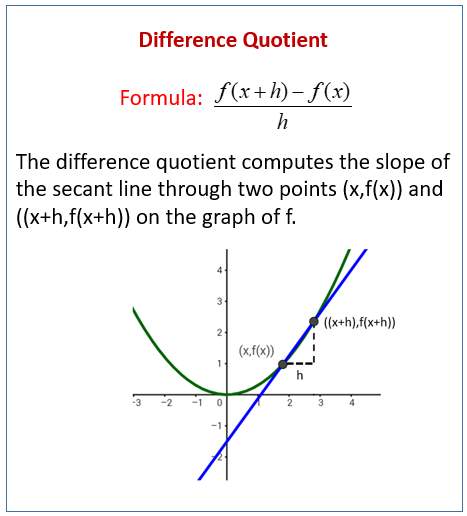
A lot of calculus starts with a simple question: “How fast is something changing right now?” If you have a function %%LATEX0%%, you may already know how to compute an average rate of change over an interval (often described as an interval of time in applications). Between %%LATEX1%% and %%LATEX2%%, the average rate of change is the slope of the secant line through the points %%LATEX3%% and :
A simpler way to say this is “change in %%LATEX6%% over change in %%LATEX7%%,” i.e.
This gives one slope for the whole interval, but it blends everything that happens between %%LATEX9%% and %%LATEX10%% into one number.
In real situations (speed at an instant, marginal cost at an output level, growth rate at a moment), you usually need the instantaneous rate of change at a specific point. For a straight (linear) line, slope is “rise over run,” but for a curved graph you can’t use a single constant slope. Instead, you approximate with secant lines: the closer the two points are, the more accurate the secant slope becomes.
To “zoom in” around %%LATEX11%%, set %%LATEX12%% where %%LATEX13%% is a small change in the input. Then the average rate of change from %%LATEX14%% to becomes:
As %%LATEX17%% approaches %%LATEX18%%, the secant slope (if it settles to a single value) becomes the slope of the tangent line at .
The (limit) definition of the derivative at a point
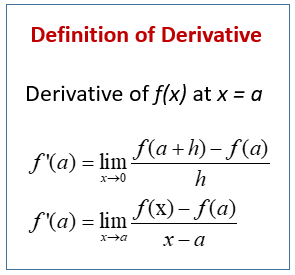
The derivative of %%LATEX20%% at %%LATEX21%% is defined by a limit:
This is called the definition of the derivative. You should read it as: “Take the slope between %%LATEX23%% and a nearby point %%LATEX24%%, then see what it approaches as the nearby point moves infinitely close.”
Why a limit? Because you can’t literally plug in %%LATEX25%% into the difference quotient: the numerator becomes %%LATEX26%% and you would divide by . The limit captures the trend of the slopes without requiring division by zero.
Derivative as the slope of the tangent line
Geometrically, if %%LATEX28%% is smooth enough at %%LATEX29%%, then %%LATEX30%% is the slope of the tangent line to the curve %%LATEX31%% at the point . The tangent line touches the curve at exactly one point and gives the best local linear approximation.
Once you know the slope, you can write the tangent line equation (point-slope form):
Worked example 1: Using the definition to differentiate
Using the definition at a general input %%LATEX35%% gives you the derivative function %%LATEX36%%.
Start with:
Compute the numerator:
So:
Factor out in the numerator:
Now take the limit:
So the instantaneous rate of change of %%LATEX43%% at input %%LATEX44%% is .
Worked example 2: Tangent line using a derivative value
Find the tangent line to %%LATEX46%% at %%LATEX47%%.
- Compute slope: %%LATEX48%%, so %%LATEX49%%.
- Point on curve: %%LATEX50%%, so the point is %%LATEX51%%.
- Tangent line:
You could simplify to , but point-slope form is already correct.
Exam Focus
- Typical question patterns:
- “Use the limit definition to find for a given function.”
- “Find the slope of the tangent line to %%LATEX55%% at %%LATEX56%% using first principles.”
- “Write the equation of the tangent line at .”
- Common mistakes:
- Forgetting that %%LATEX58%% means you substitute %%LATEX59%% everywhere appears (e.g., squaring binomials correctly).
- Canceling incorrectly before taking the limit; you usually need algebra to remove the factor that causes division by .
- Mixing up the point on the curve %%LATEX62%% with the slope %%LATEX63%% when writing the tangent line.
Interpreting the Derivative (Meaning, Units, and Notation)
What the derivative tells you
The derivative isn’t just a formula tool; it’s a meaning tool. At input %%LATEX64%%, the number %%LATEX65%% can be interpreted in two deeply connected ways:
- Instantaneous rate of change of %%LATEX66%% with respect to %%LATEX67%% at (rate at a specific point in time/input).
- Slope of the tangent line to %%LATEX69%% at %%LATEX70%%.
If models a physical quantity, the derivative is often a “rate” quantity. For instance:
- If %%LATEX72%% is position (meters) as a function of time (seconds), then %%LATEX73%% is velocity (meters per second).
- If %%LATEX74%% is cost (dollars) as a function of number of items, then %%LATEX75%% is marginal cost (dollars per item) at that production level.
Units: a powerful self-check
A reliable way to catch mistakes is to track units.
If %%LATEX76%% has units “output units” and %%LATEX77%% has units “input units,” then has units:
Example: if %%LATEX80%% is temperature in degrees and %%LATEX81%% is minutes, then is degrees per minute.
On many AP-style free-response questions, you’re asked to interpret a derivative value in context. Correct interpretation usually requires referencing the correct input value, stating the correct units, and clearly saying “increasing/decreasing at a rate of … per … at that instant.”
Derivative notation (you must be fluent in multiple forms)
Calculus uses several notations for the same idea. You should recognize them as equivalent ways of representing derivatives.
| Meaning | Common notations |
|---|---|
| Derivative of %%LATEX83%% with respect to %%LATEX84%% | %%LATEX85%%, %%LATEX86%% |
| Derivative of | %%LATEX88%%, %%LATEX89%% |
| Derivative evaluated at | %%LATEX91%%, %%LATEX92%% |
| Second derivative | %%LATEX93%%, %%LATEX94%%, |
The notation %%LATEX96%% is especially common in applied interpretation (rates), while %%LATEX97%% is common in pure function work.
One-sided interpretation and direction
The definition
implicitly uses values on both sides of %%LATEX99%% (positive and negative %%LATEX100%%). If the slope coming from the left doesn’t match the slope coming from the right, then the derivative does not exist at . This idea becomes crucial when discussing differentiability.
Worked example 1: Interpreting a derivative value with units
Suppose %%LATEX102%% is the population of a town (people) at time %%LATEX103%% (years), and you are told .
Interpretation: At %%LATEX105%% years, the population is increasing at a rate of about %%LATEX106%% people per year.
The phrase “at ” matters: it’s an instantaneous rate, not an average over an interval.
Worked example 2: Relating sign of derivative to local behavior
If %%LATEX108%%, then near %%LATEX109%% the function is increasing (tangent line has positive slope). If %%LATEX110%%, it’s decreasing near %%LATEX111%%.
This is not just a graph fact; it’s a local trend statement. A function can increase overall and still have places where is negative.
Exam Focus
- Typical question patterns:
- “Interpret in context, including units.”
- “Given a graph of %%LATEX114%%, describe where %%LATEX115%% is positive/negative/zero.”
- “Explain what it means if .”
- Common mistakes:
- Giving an average-rate interpretation (over an interval) when the question is about an instantaneous rate.
- Dropping units in a context interpretation.
- Saying means “no change at all” rather than “locally flat slope at that instant” (the function might still change elsewhere).
Estimating Derivatives from Graphs and Tables
Why estimation matters
In many real problems, you don’t get a clean formula for . You might get a graph (from measurement or simulation), a table of values, or a description of a trend. AP Calculus AB expects you to approximate derivative values from data and interpret what those approximations mean.
Estimating from a graph: tangent lines and slope triangles
If you have a graph of %%LATEX119%% and you need %%LATEX120%%, you’re trying to estimate the slope of the tangent line at .
A practical process:
- Sketch or visualize the tangent line at the point.
- Choose two convenient points on that tangent line (not necessarily on the curve) that are easy to read from the grid.
- Compute slope as rise over run.
The quality of the estimate depends on how well you place the tangent line and how far apart your two chosen tangent points are (farther apart often reduces reading error).
Estimating from a table: difference quotients
From a table, you estimate the slope using nearby points.
If you want %%LATEX122%% and you have values at %%LATEX123%% and :
If you have values on both sides of , a symmetric difference quotient is often more accurate:
Why symmetric is often better: it balances left and right behavior around , reducing error when the curve is not perfectly linear.
Reading derivative information from a graph of
Sometimes you’re given the graph of %%LATEX130%% instead of %%LATEX131%%.
Key ideas:
- If %%LATEX132%%, then %%LATEX133%% is increasing.
- If %%LATEX134%%, then %%LATEX135%% is decreasing.
- If %%LATEX136%%, %%LATEX137%% has a horizontal tangent (often a local max/min, but not always).
Even though deeper “first derivative test” ideas are typically emphasized later, these sign connections are foundational and show up early.
Worked example 1: Estimating from a table
Suppose a table gives:
| 1.9 | 2.0 | 2.1 | |
|---|---|---|---|
| 4.10 | 4.50 | 4.95 |
Estimate .
- Forward difference using :
- Backward difference:
- Symmetric difference (often preferred if available):
So a good estimate is (units would be “output units per input unit”).
Worked example 2: Estimating slope from a tangent line on a graph
If a tangent line at %%LATEX147%% appears to pass through grid points %%LATEX148%% and , then the slope estimate is:
A common trap is picking two points on the curve instead of on the tangent line; that gives a secant slope, not a tangent slope.
Exam Focus
- Typical question patterns:
- “Estimate from a table using appropriate difference quotients.”
- “Estimate the slope of the tangent line from a graph at a labeled point.”
- “Given a graph of %%LATEX152%%, identify intervals where %%LATEX153%% is increasing/decreasing.”
- Common mistakes:
- Using a secant slope across a wide interval when the question asks for instantaneous rate at a point.
- Forgetting to divide by the correct %%LATEX154%% (especially when the table spacing is not %%LATEX155%%).
- Confusing the value %%LATEX156%% with the derivative value %%LATEX157%% when reading graphs.
Differentiability and Continuity
What it means to be differentiable
A function %%LATEX158%% is differentiable at %%LATEX159%% if the limit in the derivative definition exists as a real number:
“Exists” here means the left-hand and right-hand approaches agree.
A function is differentiable on an interval if it is differentiable at every interior point of that interval.
Differentiability is a stronger condition than continuity: differentiability requires the graph to have a well-defined tangent slope (no sharp turns or breaks).
Differentiability implies continuity (but not the other way around)
A crucial theorem in this unit is:
- If %%LATEX161%% is differentiable at %%LATEX162%%, then %%LATEX163%% is continuous at %%LATEX164%%.
The converse is false:
- A function can be continuous at %%LATEX165%% but not differentiable at %%LATEX166%%.
Intuitively: a function can be unbroken (continuous) but still have a sharp corner where there is no single tangent slope.
How differentiability fails (graph features to recognize)
Even if a function is continuous, it might not be differentiable at a point. Common reasons include:
- Corner: the left-hand slope and right-hand slope are finite but different.
- Cusp: slopes blow up to infinity with opposite signs (very sharp point).
- Vertical tangent: slope becomes infinite (derivative not a finite real number).
- Discontinuity: if %%LATEX167%% is not continuous at %%LATEX168%%, then it cannot be differentiable at .
These show up often on AP questions where you are asked: “At which points is not differentiable?”
One-sided derivatives (useful diagnostic)
You can define one-sided derivatives:
Then exists exactly when both one-sided derivatives exist and are equal.
Differentiability in piecewise functions
Piecewise functions are a common setting for differentiability questions. The usual structure is:
- Ensure continuity at the junction point (the pieces meet).
- Then ensure the slopes match (the derivatives from left and right match).
This matches the intuition: the graph must connect, and it must do so smoothly.
Worked example 1: Continuity vs differentiability at a corner
Consider .
- It is continuous at %%LATEX175%% because the left and right limits both equal %%LATEX176%% and .
- But it is not differentiable at %%LATEX178%% because the slope coming from the left is %%LATEX179%% and from the right is .
So continuity does not guarantee differentiability.
Worked example 2: Checking differentiability at a junction (conceptual walkthrough)
Suppose you define a function by:
- one formula for ,
- another formula for ,
and you are asked to choose a constant so the function is differentiable at .
The logic you should follow:
- Continuity condition: match the function values at .
- Slope condition: match the derivatives at (left derivative equals right derivative).
Many students jump straight to matching derivatives without first ensuring continuity. But if the function is discontinuous at the point, differentiability is automatically impossible.
Exam Focus
- Typical question patterns:
- “Determine where is differentiable from its graph (identify corners, cusps, vertical tangents, discontinuities).”
- “Given a piecewise function with constants, find constants that make continuous and differentiable at a point.”
- “Explain why differentiability implies continuity at .”
- Common mistakes:
- Claiming a function is differentiable at a jump discontinuity because “it has a slope” on each side.
- Missing vertical tangents or cusps when scanning a graph for non-differentiable points.
- For piecewise functions: matching function values but forgetting to match left and right derivatives.
Fundamental Derivative Rules (Linearity and the Power Rule)
Why rules matter after the definition
The limit definition is conceptually central, but it’s often slow for repeated use. Derivative rules are shortcuts that are justified by limit properties. In practice, you use the definition to understand what a derivative means, and you use rules to compute derivatives efficiently.
Linearity: constants and sums behave nicely
Derivatives distribute over addition and can factor out constants. If %%LATEX189%% and %%LATEX190%% are differentiable and is a constant, then:
This is sometimes called the linearity of the derivative. It’s also the idea behind the “constant multiple rule”: if a constant multiplies a function, you can “pull the constant out.”
Derivative of a constant (constant rule)
A constant function never changes, so its rate of change is zero:
Example: if then:
A common misunderstanding is to think “the derivative of a constant is the constant.” Instead, remember: no change means zero slope everywhere.
The power rule
For power functions, the key computational tool is the power rule. For a real number (where the expression is defined),
A good way many students describe it is “multiply down and decrease the power.” For example, %%LATEX200%% becomes %%LATEX201%% and %%LATEX202%% becomes %%LATEX203%%.
Polynomials: differentiate term by term
A polynomial is a sum of constant multiples of powers of , like:
Using linearity and the power rule, you differentiate each term:
The constant term disappears.
Higher-order derivatives (second derivative and beyond)
Once you have %%LATEX207%%, you can differentiate again to get the second derivative %%LATEX208%%, and so on.
Notations:
- Second derivative: %%LATEX209%% or %%LATEX210%%
- Third derivative:
- General:
In this unit, higher derivatives often appear in contexts like “acceleration is the derivative of velocity,” though deeper motion analysis is usually emphasized later.
Worked example 1: Basic rule practice
Differentiate:
Apply power rule term-by-term:
So:
Worked example 2: Second derivative
Let:
First derivative:
Second derivative:
Exam Focus
- Typical question patterns:
- “Find for a polynomial or sum of power functions.”
- “Evaluate %%LATEX222%% once you have %%LATEX223%%.”
- “Find (often for motion or graph behavior later).”
- Common mistakes:
- Applying the power rule incorrectly to constants (remember ).
- Forgetting to multiply by the coefficient (e.g., differentiating %%LATEX226%% as %%LATEX227%% instead of ).
- Reducing the exponent incorrectly (it becomes %%LATEX229%%, not %%LATEX230%%).
Product and Quotient Rules (How to Differentiate Multiplication and Division)
Why you can’t just “distribute” the derivative
A very common early misconception is to treat derivatives like they distribute over multiplication. The false rule many students try is:
This is not true in general. Differentiation is linear (it respects addition and constant multiples), but it is not multiplicative.
To see why, consider a quick check: if %%LATEX232%% and %%LATEX233%%, then .
- True derivative:
- False rule would give:
So we need special rules for products and quotients.
The product rule
If %%LATEX237%% and %%LATEX238%% are differentiable, then:
A reliable way to remember it is: “differentiate the first, keep the second, plus keep the first, differentiate the second.” Another common mnemonic is:
- “1d2 + 2d1” (first times derivative of second, plus second times derivative of first).
Why it matters: if you have two polynomials multiplied by each other like you could multiply it out and then use the power rule, but that takes time. The product rule is designed to avoid that expansion when it’s inconvenient.
The quotient rule
If %%LATEX241%% and %%LATEX242%% are differentiable and , then:
A popular memory aid is:
- “low d high - high d low over low squared”
Here “high” means the numerator %%LATEX245%% and “low” means the denominator %%LATEX246%%.
Should you simplify first?
Often you can simplify an expression algebraically before differentiating, and that can reduce errors. For instance, if you can cancel factors safely, you might be able to use the power rule instead of the quotient rule.
But be careful: simplification must be valid on the domain you care about. If you cancel factors, you might remove a hole (a discontinuity) from the formula; the simplified expression matches the original only where the original was defined.
Worked example 1: Product rule
Differentiate:
Let:
Then:
Apply product rule:
You can expand if desired:
Worked example 2: Quotient rule
Differentiate:
Let:
Then:
Apply quotient rule:
Simplify numerator:
Note the domain restriction: (the original function is undefined there).
Reference visuals from class-style notes
The following images appeared in one version of the notes and are included here for completeness:
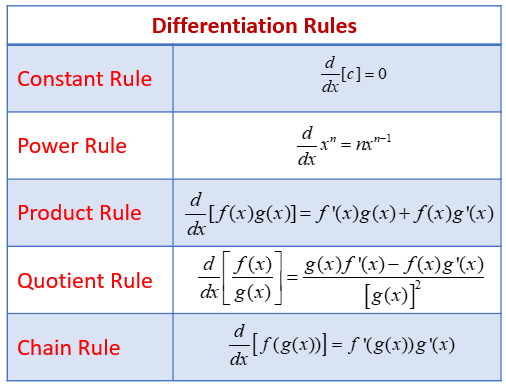
Exam Focus
- Typical question patterns:
- “Find for a function written as a product or quotient of basic expressions.”
- “Compute %%LATEX263%% where %%LATEX264%% is given as a product/quotient, sometimes without fully simplifying.”
- “Show algebraic steps carefully when applying product/quotient rules.”
- Common mistakes:
- Using the false rule .
- In the quotient rule: squaring the wrong part (only the denominator is squared).
- Dropping parentheses when substituting into formulas, which changes signs (especially in ).
Derivatives of Key Elementary Functions (Trig, Exponential, Logarithmic)
Why these “basic derivatives” are foundational
Polynomials alone can’t model everything. Periodic motion (sound waves, seasonal temperature) calls for trig functions; growth and decay call for exponentials; and many inverse relationships are naturally logarithmic.
AP Calculus AB expects you to know certain core derivative formulas as fundamentals. In this unit’s spirit, you use them the same way you use the power rule: as building blocks. In some class notes these are called “memory derivatives” because they’re usually easier to memorize than to derive every time.
Trigonometric derivatives: sine and cosine
The most fundamental trig derivatives are:
These are typically established from the limit definition together with key trig limits.
Tangent (as a quotient)
Since:
you can use the quotient rule. Let %%LATEX270%% and %%LATEX271%%. Then:
Simplify:
Using the identity :
This is often written as:
Exponential derivatives
The natural exponential function is special because its rate of change is equal to its value:
For other bases %%LATEX278%% with %%LATEX279%%:
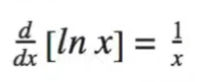
Logarithmic derivative
For the natural logarithm (domain ):
Being careful about what this unit’s rules can and cannot do
In Unit 2, you focus on derivatives using the definition and fundamental rules. A frequent issue is trying to differentiate compositions too early.
For example, knowing %%LATEX283%% does not by itself tell you how to differentiate %%LATEX284%% unless you have the chain rule (typically emphasized in the next unit). Similarly, %%LATEX285%% does not immediately give %%LATEX286%% without additional tools.
So when practicing within this unit’s scope, stick to inputs that are just (not complicated inside functions), unless you are explicitly told to use more advanced rules.
Worked example 1: Basic trig and exponential differentiation
Differentiate:
Differentiate term-by-term:
So:
Worked example 2: Quotient with trig
Differentiate:
Let:
Then:
Quotient rule:
So:
Notice this stays within Unit 2 rules because it uses trig derivatives plus quotient rule, not chain rule.
Reference visuals from class-style notes
The following images appeared in one version of the notes and are included here for completeness:

Exam Focus
- Typical question patterns:
- “Differentiate expressions involving %%LATEX298%%, %%LATEX299%%, %%LATEX300%%, and %%LATEX301%% using sum/product/quotient rules.”
- “Evaluate a derivative at a point (often to find a slope or rate).”
- “Use trig identities to simplify after differentiating (or simplify first when appropriate).”
- Common mistakes:
- Missing the negative sign: .
- Trying to apply these formulas directly to compositions like %%LATEX303%% or %%LATEX304%% without the chain rule.
- Confusing with a logarithm of another base; derivative rules depend on the base (natural log is the standard in calculus).
Putting It Together: Tangent Lines, Rates, and Modeling with Basic Derivatives
Tangent line as a local model (why it’s useful)
When a function is differentiable at , the tangent line doesn’t just touch the curve; it approximates the curve near that point. This is the idea of local linearity: zoom in far enough on a smooth curve and it looks like a line.
The linear function that matches %%LATEX307%% at %%LATEX308%% and has the same slope is:
This is the tangent line written as a “local model.”
Small changes: connecting %%LATEX310%% and %%LATEX311%%
If you change the input by a small amount , the output change is approximately:
This is the rate interpretation in its most practical form: “change in output is about slope times change in input.”
Worked example 1: Tangent line approximation
Let:
Find the tangent line at %%LATEX315%% and use it to approximate %%LATEX316%%.
- Compute derivative (power rule with exponent where defined):
- Evaluate at :
- Tangent line model:
- Approximate :
This makes sense because %%LATEX326%% increases slowly near %%LATEX327%%.
Worked example 2: Interpreting a derivative as a rate in context
Suppose %%LATEX328%% is the volume of water in a tank (liters) at time %%LATEX329%% (minutes). If %%LATEX330%%, then at %%LATEX331%% minutes, the volume is decreasing at liters per minute.
Common interpretation trap: students sometimes say “the volume is liters,” confusing the function value with its derivative. The derivative is a rate, not an amount.
Exam Focus
- Typical question patterns:
- “Find the equation of the tangent line to %%LATEX334%% at %%LATEX335%% and use it to approximate nearby values.”
- “Use to interpret how a quantity is changing at a specific moment.”
- “Relate small input changes to approximate output changes using .”
- Common mistakes:
- Using as if it were the function value (mixing up amount vs rate).
- Approximating too far from ; tangent line approximations are local.
- Forgetting units in context interpretations or mixing them (e.g., liters vs liters per minute).
Slopes, Secants, and Tangents (Visual Summary from Class-Style Notes)
Why these pictures matter
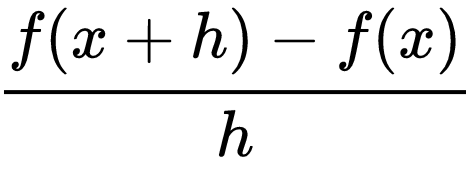
Some versions of these notes included visuals emphasizing the storyline: average rate of change comes from a secant line, and instantaneous rate of change comes from the tangent line as the secant points get closer together.
The following images are included exactly as they appeared in the class-style notes:
Exam Focus
- Typical question patterns:
- “Given two points on a curve, compute the secant slope (average rate of change) and explain what it represents.”
- “Explain how the tangent slope is obtained from secant slopes as points get closer.”
- Common mistakes:
- Treating a secant slope across a noticeable interval as if it were an instantaneous rate.
- Describing a tangent slope without clearly tying it to a limit process.