Sacred Space and Imperial Power: South Asian Art
Introduction to South Asian Art
South Asian art encompasses the visual culture of the Indian subcontinent (modern-day India, Pakistan, Bangladesh, Sri Lanka, and parts of Afghanistan). This region is the birthplace of three major world religions—Buddhism, Hinduism, and Jainism—and was later profoundly shaped by Islam through the Mughal Empire.
For the AP Art History exam, you must understand how art functions as a conduit for spiritual connection, a political tool for emperors, and a record of cross-cultural exchange (particularly the interaction between East and West on the Silk Road).
Buddhist Art and Architecture
Buddhism originated in the 6th century BCE with the teachings of Siddhartha Gautama. Early Buddhist art was aniconic (represented by symbols like footprints or the Bodhi tree), but eventually evolved into iconic figural representations and massive architectural projects under the patronage of rulers like Ashoka.
The Stupa: Architecture of the Cosmos
The fundamental architectural form of early Buddhism is the Stupa. It effectively functions as a 3D mandala (cosmic diagram).
Key Example: The Great Stupa at Sanchi (Madhya Pradesh, India. c. 300 BCE–100 CE)
- Definition: A stupa is a reliquary mound. It is a solid structure that cannot be entered; it holds the relics (ashes) of the Buddha or realized masters.
- Function: Devotees perform circumambulation (pradakshina)—walking around the stupa in a clockwise direction. This movement mimics the path of the sun, bringing the devotee into harmony with the cosmos.
- Architectural Anatomy:
- Anda: The hemispherical dome representing the universe/world mountain.
- Harmika: A square railing on top symbolizing the sacred domain of the gods.
- Yasti: The central pole rising from the harmika, acting as the Axis Mundi (axis of the world) connecting earth and heaven.
- Chatras: Three umbrella-like disks on the Yasti, representing the "Three Jewels" of Buddhism (The Buddha, The Law, The Monastic Community).
- Toranas: Four elaborately carved gateways at the cardinal points. These contain narrative carvings of the Buddha’s past lives (Jatakas), often utilizing continuous narrative.

Gandhara vs. Mathura: The Image of the Buddha
Around the 1st century CE, human representations of the Buddha appeared. Two distinct styles emerged, but the Gandhara style is critical for understanding global interconnectivity.
Key Example: Buddha (Bamiyan) (Afghanistan. c. 400–800 CE)
- Context: Located on the Silk Road, Gandhara (parts of modern Pakistan/Afghanistan) was a melting pot of Hellenistic (Greek) and Buddhist cultures.
- Greco-Buddhist Style:
- Drapery: The robes look like heavier Roman togas with rhythmic, realistic folds.
- Physiognomy: Wavy hair, distinct facial features (Apollonian influence), and contrapposto stances.
- Iconography: Despite the Greek style, the figure retains Buddhist symbols: the urna (dot on forehead), ushnisha (cranial bump of wisdom), and elongated earlobes (reminders of Siddhartha’s heavy jewelry as a prince).
Note: The Bamiyan Buddhas were colossal rock-cut statues destroyed by the Taliban in 2001. AP questions often focus on iconoclasm and the scale of these figures as a demonstration of the universality of the Buddha’s message.
Hindu Temple Architecture and Sculpture
Unlike the solid Buddhist Stupa, the Hindu temple is a residence for the god on earth. The architecture allows for Darshan—the mutual act of seeing the deity and being seen by the deity.
The Temple as a Mountain
Hindu temples are conceptualized as the cosmic mountain (Mt. Meru) where gods reside.
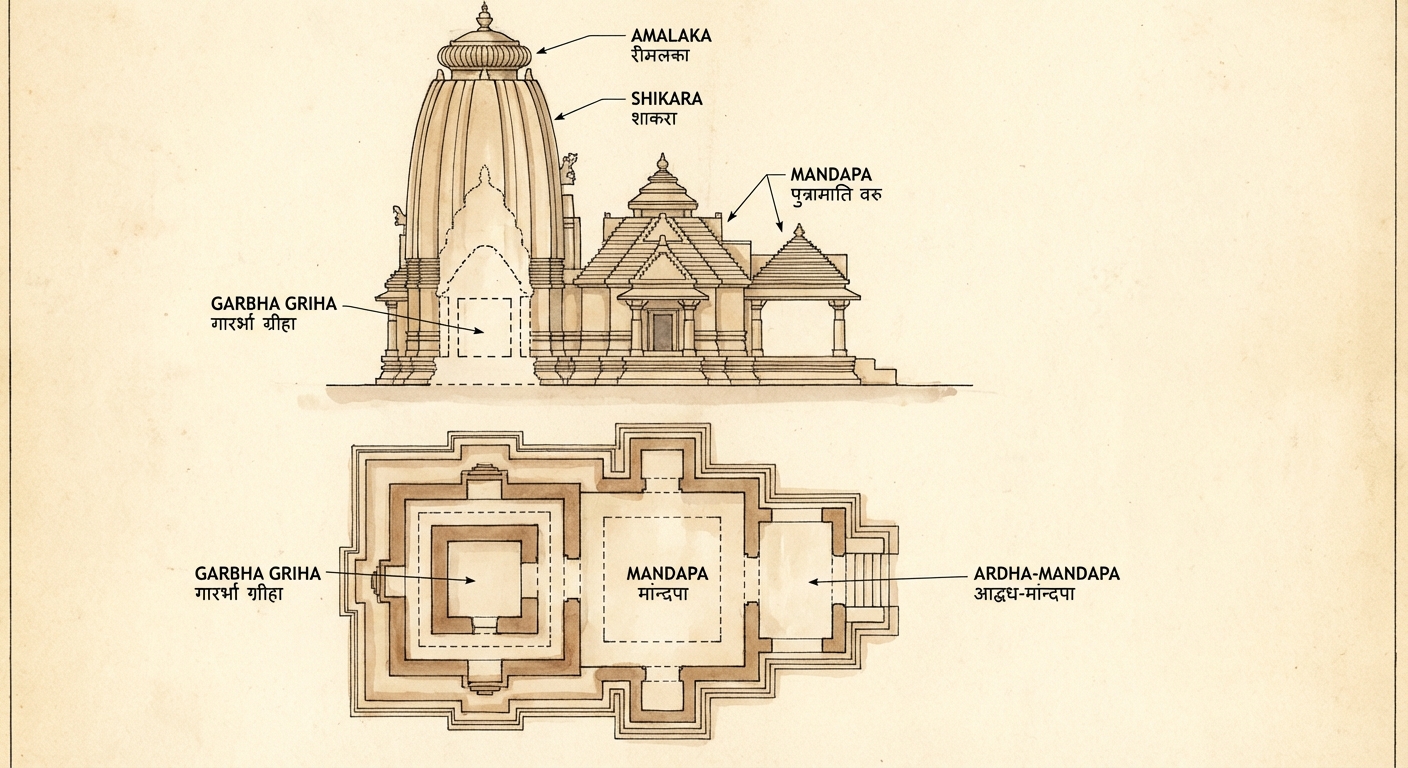
Key Example: Lakshmana Temple (Khajuraho, India. c. 930–950 CE)
This is a classic example of the Nagara (North Indian) style.
- Architectural Elements:
- Shikara: The tall, beehive-shaped tower that mimics a mountain peak. It is positioned directly over the shrine.
- Amalaka: A segmented disk (sunburst/lotus shape) on top of the Shikara.
- Mandapas: Pyramidal halls leading to the main shrine. As devotees move from the entrance to the back, the spaces become smaller, darker, and more intimate.
- Garbha Griha: The "Womb Chamber." This is the small, dark, cube-like inner sanctum housing the deity's image. Only the priest enters here.
- Sculptural Decoration:
- Exterior walls are covered in thousands of sculptures depicting gods, daily life, and Mithuna (loving couples).
- Misconception Alert: The erotic sculptures are not just secular pornography. They symbolize fertility, the union of the human soul with the divine, and the joy of life, serving as a boundary between the secular world outside and the sacred stillness inside.
Bronze Sculpture: The Chola Dynasty
Key Example: Shiva as Lord of Dance (Nataraja) (c. 11th Century CE)
These portable bronze statues were treated as living beings, dressed, fed, and carried in processions. They were created using the Lost Wax Process.
- Iconography Breakdown:
- Upper Right Hand: Holds the damaru (drum), the beat of creation.
- Upper Left Hand: Holds the agni (fire), the flame of destruction.
- Lower Right Hand: Abhaya mudra (gesture of "have no fear").
- Right Foot: Stomps on the dwarf Apasmara, representing the crushing of illusion and ignorance.
- Circle of Fire: Represents the continuous cycle of creation and destruction (samsara).
Mughal Art and Architecture
The Mughal Empire (1526–1857) was an Islamic dynasty in India. Their art represents a sophisticated synthesis of Persian literature/aesthetics, Indian colors/motifs, and European realism.
The Illuminated Manuscript
Mughal emperors utilized miniature paintings in albums (Muraqqa) to establish dynastic legitimacy and superiority.
Key Example: Jahangir Preferring a Sufi Shaikh to Kings (Artist: Bichitr, c. 1620 CE)
- Subject: Emperor Jahangir is seated on an hourglass throne. He ignores powerful worldly rulers to hand a book to a Sufi (Islamic mystic).
- Symbolism of Hierarchy:
- The Sufi: Highest respect, accepts the gift with a cloth (holy hands do not touch royal hands).
- The Ottoman Sultan: Shows respect.
- King James I of England: Copied from a European painting; looks uneasy.
- Bichitr (The Artist): Lowest, holding a placard with his name, but implying that art outlasts kings.
- Cross-Cultural Influences:
- European: Putti (angels) in the corners (Renaissance influence), realistic shading on King James.
- Persian: Carpet design, calligraphy border.
- Indian: The large sun/moon halo signifies the emperor's divinity.
Funerary Architecture: The Taj Mahal
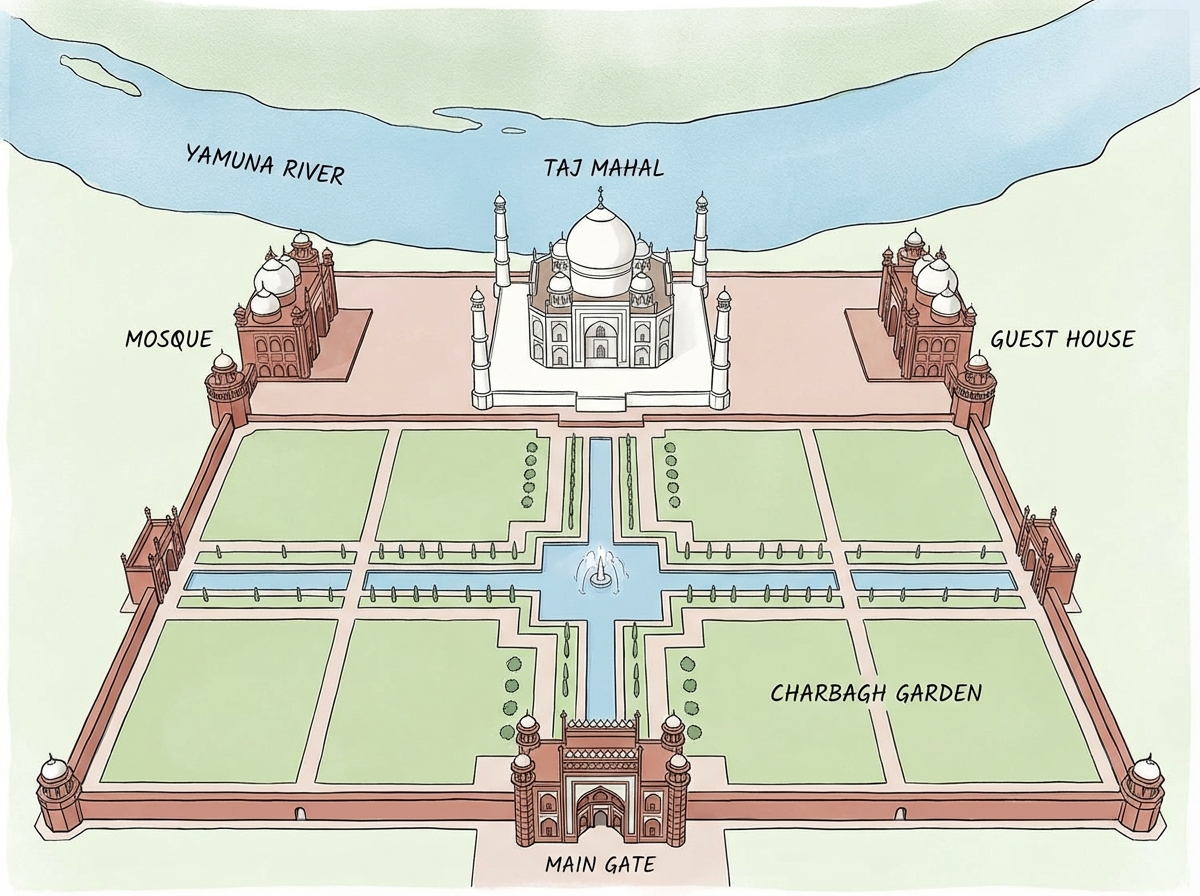
Key Example: The Taj Mahal (Agra, India. c. 1632–1653 CE)
Commissioned by Shah Jahan as a mausoleum for his favorite wife, Mumtaz Mahal.
- Architectural Concept: The phrase "The Luminous Tomb." It is designed to represent the Throne of God on the Day of Judgment and a physical realization of the Quranic Paradise.
- Key Features:
- Symmetry: Bilateral symmetry dominates the complex (mosque on one side, guest house on the other). The only asymmetrical element is Shah Jahan's cenotaph, added later next to his wife's.
- Material: White marble represents purity and the priesthood/spirituality (in Hindu tradition), distinct from the red sandstone used for forts/war.
- Hasht Bishisht: The "Eight Paradises" floor plan—a central room surrounded by eight smaller chambers.
- Charbagh: The four-part garden. While most mausoleums placed the tomb in the center, the Taj is placed at the edge of the garden, maximizing the reflection in the water channels.
- Pietra Dura: Intricate inlay work using semi-precious stones to create floral arabesques (aniconic Islamic decoration).
Common Mistakes & Pitfalls
- Confusing Stupas with Temples: A Stupa is a solid mound. You cannot enter it. You walk around it. A Hindu temple contains a hollow chamber (Garbha Griha) that you generally do not enter, but the structure itself has an interior.
- "Buddha" vs. "Bodhisattva": A Buddha is an enlightened being who has escaped samsara. A Bodhisattva (often depicted with rich jewelry and princely garb) is a compassionate being who delays nirvana to help others. In Gandharan art, Maitreya (the future Buddha) is often depicted as a Bodhisattva.
- Religious Exclusivity: Do not assume these styles developed in isolation. Hindu temples often have Buddhist influences, and Mughal art aggressively borrowed from European Renaissance prints brought by Jesuit missionaries.
- The "Erotic" Sculptures: Avoid describing the Khajuraho sculptures as "pornographic." In the AP context, discuss them in terms of Moksha (liberation), fertility, and the non-duality of the human and divine experience.