Comprehensive Guide: Families and Communities in the Francophone World
La Famille et la Communauté: Unit 1 Mastery Guide
This unit explores how families are defined, how they function, and how they change over time across the Francophone world. Success in AP French requires understanding not just vocabulary, but the cultural perspectives behind family dynamics in France, Canada, Africa, and the Caribbean.
1. Family Structures & Evolution (La Structure Familiale)
Definitions & Concepts
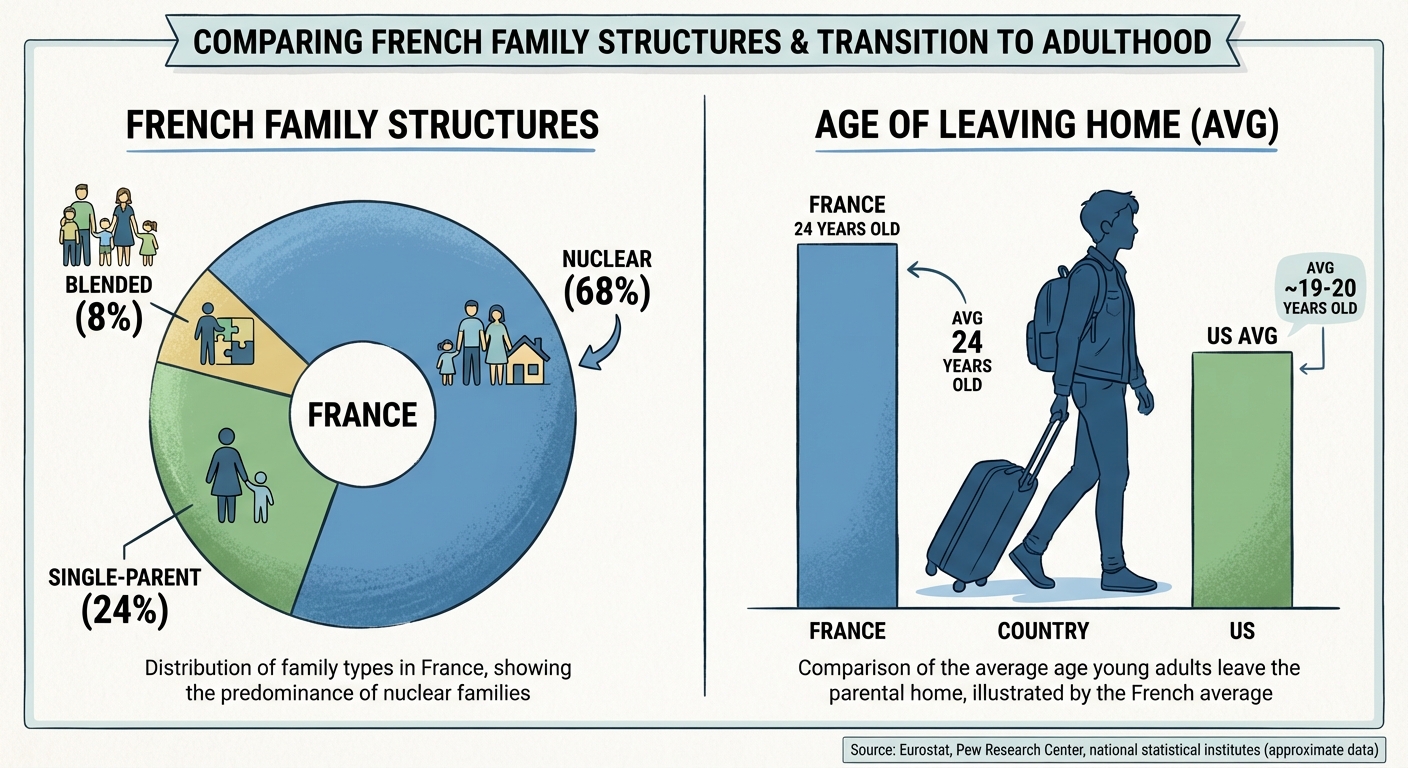
The concept of "family" has evolved significantly in France over the last 50 years. It is no longer synonymous with the traditional married couple with children.
- La famille nucléaire (The Nuclear Family): The traditional model—two parents and their biological children living together. While still common, it is no longer the sole standard.
- La famille monoparentale (Single-parent Family): A family with one parent (usually the mother) raising one or more children. This represents roughly 1 in 4 families in France.
- La famille recomposée (The Blended Family): Formed when divorced or widowed parents remarry or cohabit, bringing children from previous relationships together.
- La famille élargie (The Extended Family): Includes grandparents, aunts, uncles, and cousins.
- Cultural Nuance: In France, the extended family is emotionally close but often lives apart. In Francophone Africa (e.g., Senegal, Ivory Coast), the extended family often lives under one roof or in a compound, playing a daily role in raising children.
- La famille homoparentale: Same-sex parents raising children, legally recognized and supported since the Mariage pour tous (Marriage for All) law in 2013.
The "Tanguy" Phenomenon
A crucial cultural concept in modern France is Le phénomène Tanguy. This refers to young adults (20-30s) who continue living with their parents well into adulthood, often due to longer studies (les études longues) and economic challenges (le chômage des jeunes - youth unemployment).
2. Marriage, Unions, and Law (Le Mariage et L'Union)
In the Francophone world, particularly France, legal commitment takes three distinct forms. You must distinguish between them for the Cultural Comparison task.
| Type of Union | Description | Key Vocabulary |
|---|---|---|
| Le Mariage | The traditional civil (and potentially religious) union. Only the civil marriage at the Mairie (City Hall) is legally distinct. | se marier (to get married), le maire (the mayor), la noce (the wedding party) |
| Le PACS | Pacte civil de solidarité. Originally designed for same-sex couples before 2013, now widely used by straight couples. It offers tax benefits like marriage but is easier to dissolve and cheaper to organize. | se pacser, un conjoint (partner) |
| L'Union Libre | Cohabitation without legal paperwork. Very common in France; couples live together and have children without marrying or PACs-ing. | vivre en concubinage, conjoint de fait |
Trends to Know
- Decline of Marriage: Fewer French people are getting married; many prefer le PACS.
- Divorce: Roughly 50% of marriages in Paris end in le divorce.
- Le Mariage pour tous (2013): The law that legalized same-sex marriage in France. It was a major societal shift and a topic of intense debate (La Manif pour tous).
3. Parenting, Education, and Values
Parenting Styles (L'Éducation Parentale)
- Authorité vs. Laissez-faire: French parenting is generally considered stricter regarding manners (la politesse) and food (l'alimentation) than American parenting. There is a strong emphasis on boundaries (le cadre).
- L'enfant roi: A pejorative term for a child who runs the household; French parents typically try to avoid raising an enfant roi.
The Role of State Support
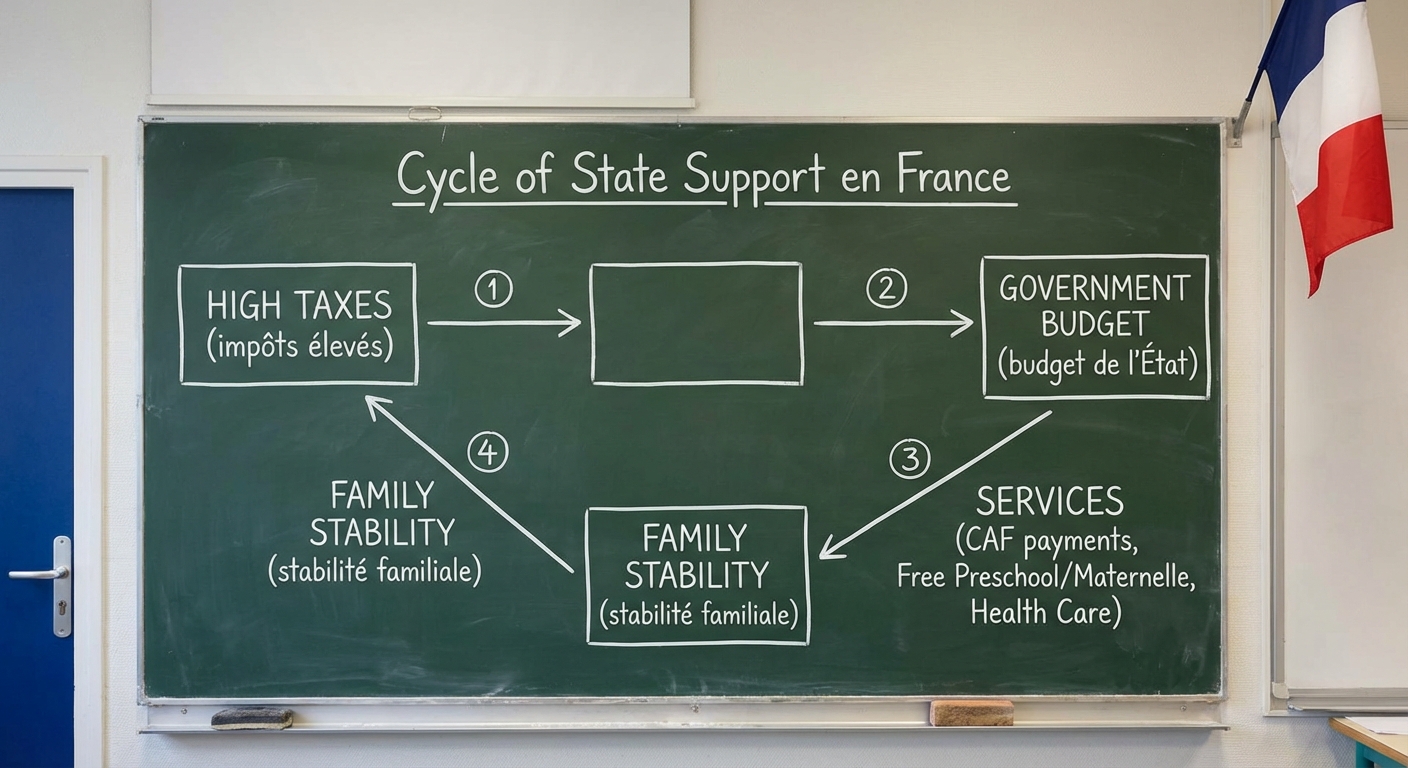
Unlike the US, the French government plays a massive role in family logistics:
- Les Allocations Familiales: Monthly payments from the government to families with 2+ children to help with costs. This encourages higher birth rates (la natalité).
- L'École Maternelle: Free public preschool starting at age 3. It is not just daycare; it is the beginning of the national curriculum.
Secularism (La Laïcité)
In public schools in France, religious symbols (headscarves, large crosses, kippahs) are banned. This affects how families practice their religion and interact with the community.
Values in Francophone Africa (Sub-Saharan)
In contrast to the individualism of Europe:
- Solidarity (La solidarité): The group/family needs come before the individual.
- Respect for Elders (Le respect des aînés): Elders are the guardians of tradition and wisdom. Sending parents to a retirement home (maison de retraite) is often culturally frowned upon, though urbanization is changing this.
4. AP Exam Strategy: Applying Unit 1
A. The Email Reply (Interpersonal Writing)
- Task: Read an email (e.g., from a host family or a study abroad program) and reply.
- Time: 15 minutes.
- Unit 1 Application: You might be asked about your family preferences, dietary restrictions, or daily routine.
- Key Phrase: "Je suis impatient(e) de faire la connaissance de votre famille…" (I can't wait to meet your family).
B. The Conversation (Interpersonal Speaking)
- Task: 5 exchanges, 20 seconds each.
- Register: Usually informal (tu) because it's often a friend or family member.
- Strategy: If asked about your family, give details beyond the basics. Instead of "I have a brother," say "I have an older brother who is annoying but we get along well."
C. Cultural Comparison (Presentational Speaking)
This is the hardest part. You must compare a Francophone community to your own.
Template for Family Topics:
"Dans ma communauté aux États-Unis, la famille nucléaire reste le modèle standard, bien que le taux de divorce soit élevé. Par contre (However), en France, le PACS est devenu une alternative très populaire au mariage traditionnel. Les Français choisissent souvent le PACS car c'est moins cher et plus flexible que le mariage. Cela montre que les Français valorisent la liberté individuelle au sein du couple, alors que dans ma communauté, le mariage religieux garde une importance symbolique forte."
(The 3 P's Framework)
- Product: Le PACS.
- Practice: Signing a contract at the tribunal/mairie instead of a church wedding.
- Perspective: Valuing pragmatism and secularism over religious tradition.
5. Essential Vocabulary & False Friends
Family Members
- Le beau-père / La belle-mère: Step-father/mother OR Father/Mother-in-law. Context is key.
- Les aïeux: Ancestors.
- Un(e) conjoint(e): Partner/Spouse (works for marriage or PACS).
- La progéniture: Offspring (formal/literary).
Verbs & Collocations
- Élever des enfants: To raise children (NOT grandir - grandir means to physically grow).
- S'entendre bien/mal avec: To get along well/badly with.
- Se disputer: To argue (NOT disputer alone).
- Concilier vie familiale et vie professionnelle: To balance family and work life.
Common Mistakes (Don't do this!)
- "Visiter" a person:
- Wrong: Je vais visiter ma grand-mère.
- Right: Je vais rendre visite à ma grand-mère. (Use visiter only for places/monuments).
- "Parents" vs. "Relatives":
- Wrong: J'ai beaucoup de parents en Californie (meaning cousins/uncles).
- Right: J'ai beaucoup de proches / membres de la famille en Californie. (Parents usually implies strictly mom and dad).
- "Marier" vs. type "Se marier":
- Wrong: Je veux marier Paul.
- Right: Je veux me marier avec Paul / Je veux épouser Paul.
6. Real-World Applications & Examples
- Example 1 (Literature): In L'Etranger by Camus, the protagonist sends his mother to a maison de retraite. This highlights societal tensions regarding the care of the elderly.
- Example 2 (Cinema): The movie Qu'est-ce qu'on a fait au Bon Dieu? is a perfect study of a traditional bourgeois Catholic couple dealing with their daughters marrying men of different religions and races. It covers racism, mixed marriages (mariage mixte), and family acceptance.
- Example 3 (Sociology): Le congé maternité/paternité (Maternity/Paternity leave). France offers generous leave compared to the US, reflecting the perspective that child-rearing is a supported public good, not just a private burden.
