AP Physics C: Unit 7 Study Guide - Orbital Mechanics
Orbital Mechanics and Gravitation
This guide covers the crucial interactions between celestial bodies, focusing on how gravity governs motion in space. In AP Physics C: Mechanics, this section relies heavily on combining Newton's Law of Universal Gravitation with centripetal force and conservation of energy.
Circular Orbits and Dynamics
Most introductory orbital problems assume the orbit is a perfect circle. While real orbits are elliptical, the circular approximation simplifies the math and is the foundation for deriving Kepler's Laws.
The Dynamics of Circular Motion
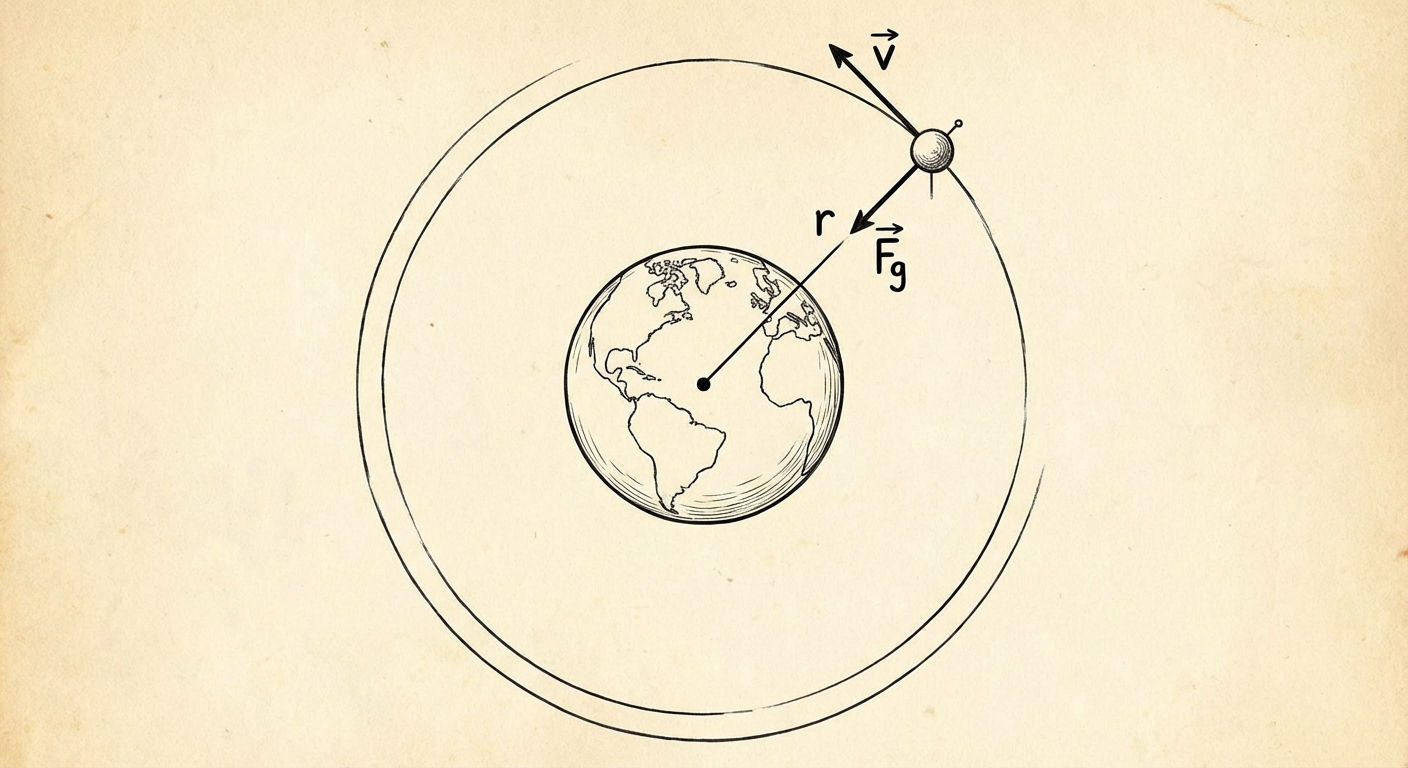
To maintain a circular orbit, a satellite must experience a net force directed toward the center of the massive body it orbits. Gravity provides this centripetal force.
Fundamental Derivation:
By setting the gravitational force equal to the centripetal force (Newton's Second Law), we can derive orbital speed.
Where:
- $G$ is the universal gravitational constant ($6.67 \times 10^{-11} \text{ N}\cdot\text{m}^2/\text{kg}^2$)
- $M$ is the mass of the central body (e.g., Earth)
- $m$ is the mass of the orbiting satellite
- $r$ is the center-to-center distance
Orbital Speed
Solving the equation above for $v$, the mass of the satellite ($m$) cancels out:
Key Takeaways:
- Mass Independence: The speed of a satellite does not depend on its own mass, only on the mass of the planet ($M$) and the orbital radius ($r$).
- Relationship: Speed is inversely proportional to the square root of the radius. Satellites in lower orbits (smaller $r$) must move faster to stay in orbit.
Orbital Period ($T$)
The period is the time it takes to complete one full revolution. Since the path is a circle (circumference $2\pi r$) and speed is constant:
Substituting $\sqrt{GM/r}$ for $v$ and solving for $T$:
Kepler’s Laws of Planetary Motion
Before Newton, Johannes Kepler derived three empirical laws based on observational data. In AP Physics C, you must understand both the concepts and the calculus-based derivations (specifically for the 2nd and 3rd laws).
1. Kepler’s First Law (The Law of Ellipses)
Definition: All planets move in elliptical orbits with the Sun at one focus.
- Eccentricity ($e$): Describes how "stretched" the ellipse is. A circle has $e=0$. most planetary orbits have $e \approx 0$.
- Foci: The central mass is not in the center of the ellipse, but at one of the two focal points.
2. Kepler’s Second Law (The Law of Areas)
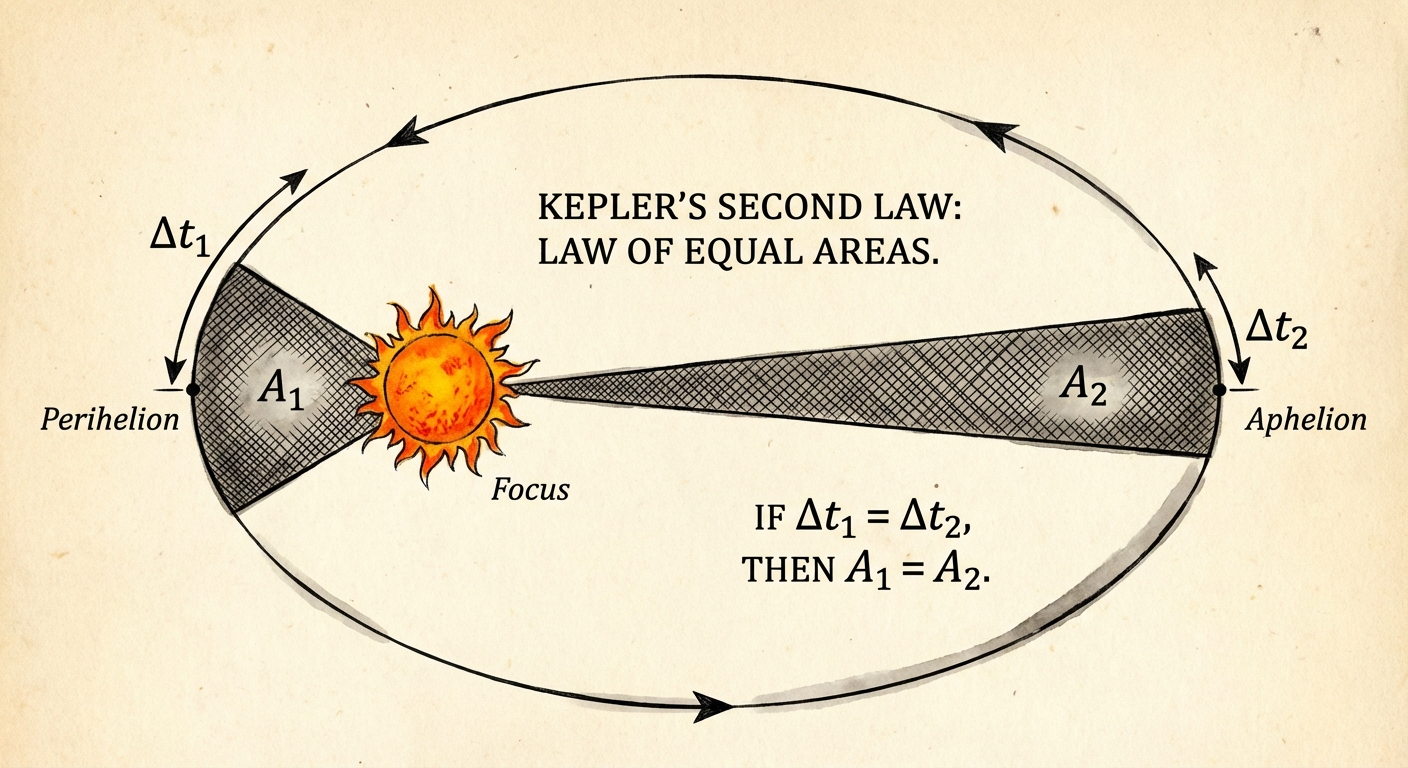
Definition: A line that connects a planet to the Sun sweeps out equal areas in equal times.
Physics Explanation (Crucial):
This law is a direct consequence of the Conservation of Angular Momentum.
- Gravity acts radially toward the center (the pivot point).
- Therefore, the torque ($\tau = r \times F$) is zero because the force is parallel to the position vector.
- If $\tau_{net} = 0$, then angular momentum $L$ is constant.
This implies that when a planet is closer to the star (perihelion, small $r$), it must move faster (large $v$) to conserve $L$. When it is far away (aphelion), it moves slower.
3. Kepler’s Third Law (The Law of Harmonics)
Definition: The square of the period of any planet is proportional to the cube of the semi-major axis of its orbit.
From our earlier derivation of the period for a circular orbit, we found the proportionality constant:
Application: You can use this to compare two satellites orbiting the same body:
Orbital Energy and Escape Speed
Analyzing orbits using energy is often more powerful than using forces, especially when the orbit changes altitude.
Gravitational Potential Energy ($U_g$)
In Unit 7, we stop using $mgh$ (which assumes constant $g$). We must use the universal formula, which is derived by integrating the force of gravity from infinity to distance $r$:
Important Notes:
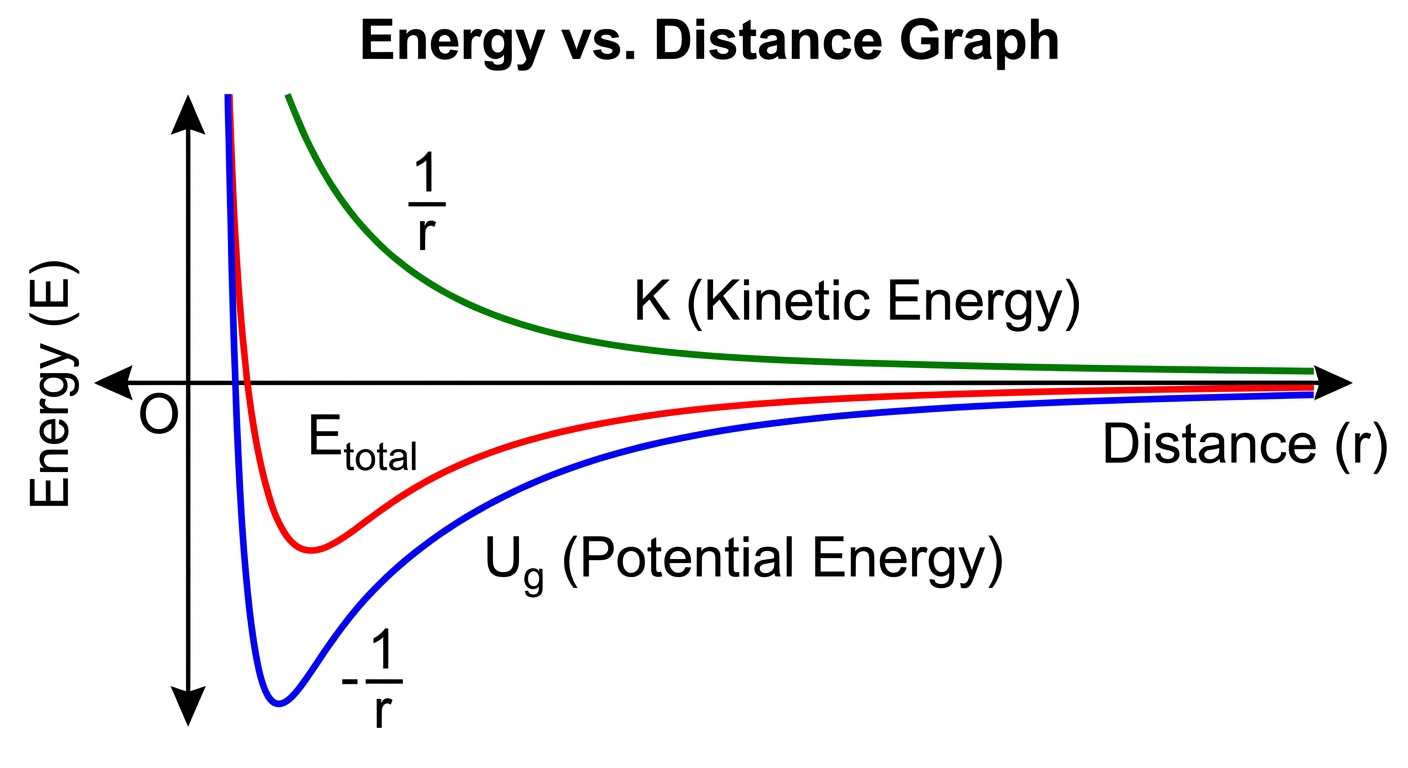
- The Negative Sign: Crucial. It indicates that the system is bound. Energy is zero at infinity. As you get closer to the planet, potential energy decreases (becomes more negative).
Total Mechanical Energy ($E$)
The total energy of an orbiting satellite is the sum of its kinetic and potential energies.
For a Circular Orbit ONLY:
We know that $mv^2 = \frac{GMm}{r}$ (from the centripetal force equation). If we substitute this into kinetic energy $K = \frac{1}{2}mv^2$, we get:
Note that $K = -\frac{1}{2}U_g$. Now, combining them for total energy:
| Energy Type | Formula (Circular Field) | Sign | Interpretation |
|---|---|---|---|
| Kinetic | $K = \frac{GMm}{2r}$ | Positive (+) | Motion energy |
| Potential | $U_g = -\frac{GMm}{r}$ | Negative (-) | Position within field |
| Total | $E = -\frac{GMm}{2r}$ | Negative (-) | Bound system implies $E < 0$ |
Escape Speed
Definition: The minimum speed an object needs to break free from a planet's gravitational attraction without further propulsion.
Mathematically, the object must reach $r = \infty$ with $v = 0$. This means total energy at infinity is zero.
Using Conservation of Energy:
Solving for $v_{esc}$:
Comparison: $v{esc} = \sqrt{2} \times v{orbit}$.
Example: Satellite Orbit Calculation
Problem:
A satellite of mass $m$ is in a circular orbit at an altitude of $h = R_E$ above the Earth's surface. What is the ratio of its potential energy to its kinetic energy?
Solution:
- Determine $r$: The formula requires distance from the center. $r = RE + h = RE + RE = 2RE$.
- Write $Ug$: $Ug = -\frac{GMm}{2R_E}$.
- Write $K$: For a circular orbit, $K = \frac{GMm}{2r} = \frac{GMm}{2(2RE)} = \frac{GMm}{4RE}$.
- Ratio $Ug / K$:
Answer: The potential energy is always negative twice the kinetic energy in a circular orbit ($U = -2K$).
Common Mistakes & Pitfalls
Radius Confusion ($r$ vs. $h$):
- Mistake: Using the altitude (height above surface) as $r$ in formulas.
- Correction: Always use the distance from the center of the planet. $r = R_{planet} + \text{altitude}$.
The Negative Sign in Potential Energy:
- Mistake: Writing $U_g = \frac{GMm}{r}$ or assuming $\Delta U = mgh$.
- Correction: $Ug$ is always negative. As you move away from a planet (increase $r$), $Ug$ becomes less negative (increases toward zero). Force $\vec{F} = -\frac{dU}{dr}$.
Conservation of Energy vs. Momentum:
- Mistake: Assuming linear momentum is conserved in orbit.
- Correction: Linear momentum is NOT conserved because an external force (gravity) acts on the system. However, Angular Momentum is conserved because gravity exerts zero torque relative to the center.
Escape Speed vs. Orbital Speed:
- Mistake: Mixing up $\sqrt{GM/r}$ and $\sqrt{2GM/r}$.
- Correction: Remember the factor of $\sqrt{2}$. It takes more energy to leave entirely than to stay in a circle.
"Weightlessness":
- Mistake: Thinking gravity is zero in orbit.
- Correction: Astronauts feel weightless because they are in constant freefall, not because gravity is absent. If gravity were zero, they would fly off in a straight line.