Unit 4: The Modern Freedom Struggle (Movements and Debates)
Unit 4: The Modern Freedom Struggle (Movements and Debates)
Overview
This unit covers the Long Civil Rights Movement (roughly 1940s–1970s) and contemporary debates in African American history. It moves beyond the standard narrative of "Dr. King and the dream" to explore the tactical diversity within the movement, the rise of Black Power, the pivotal role of Black women, and the shift from fighting for legal rights to fighting for economic and systemic justice.
4.1 The Long Civil Rights Movement (1940s–1950s)
Origins and the "Double V"
While the 1960s are famous for protests, the groundwork was laid much earlier. The movement was catalyzed by World War II and the Double V Campaign.
- Concept: "Victory abroad against fascism, Victory at home against racism."
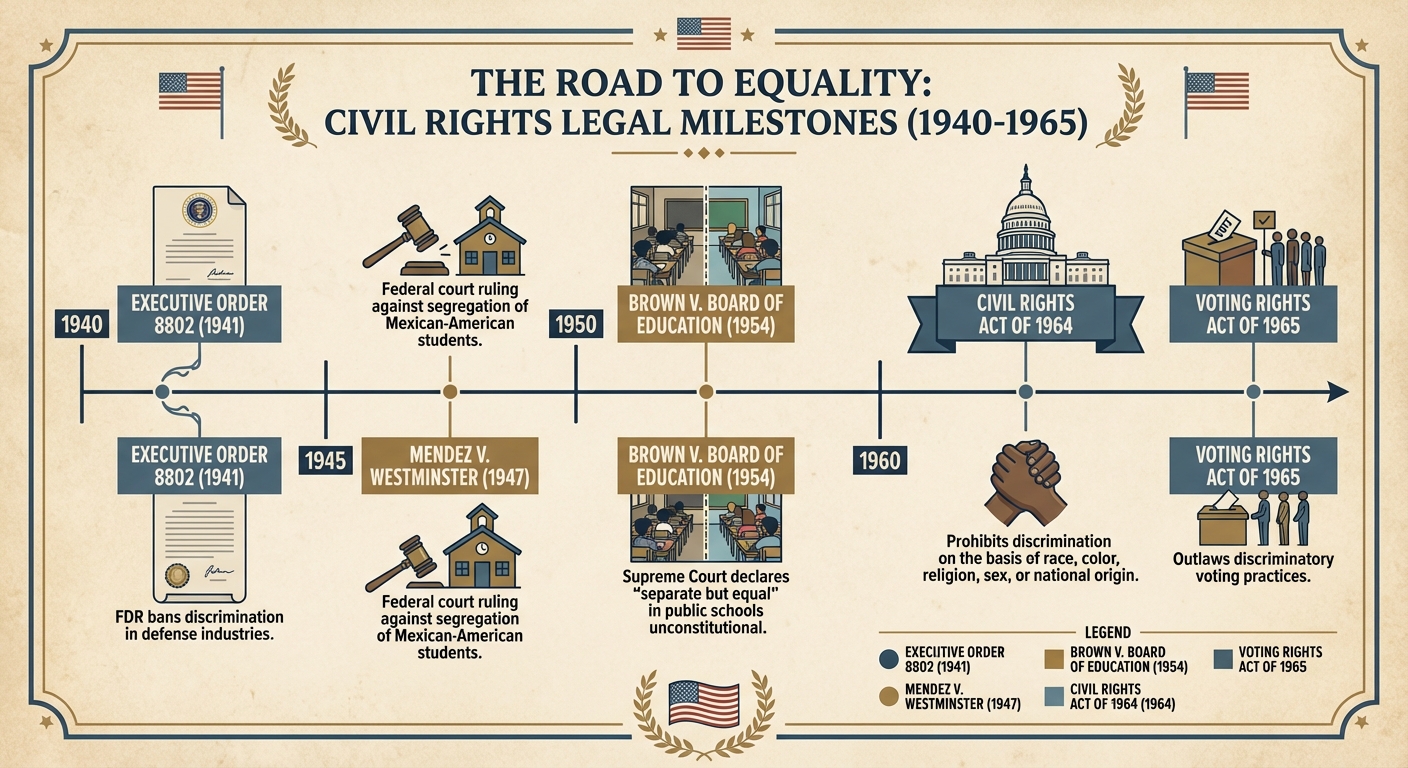
- Key Figure: A. Philip Randolph. He threatened a March on Washington in 1941 to protest discrimination in defense industries.
- Result: President FDR signed Executive Order 8802, banning discrimination in defense industries and creating the Fair Employment Practices Committee (FEPC).
Legal Battles: The Road to Brown
The NAACP (National Association for the Advancement of Colored People) pursued a legal strategy to dismantle Jim Crow, led by Thurgood Marshall and the Legal Defense Fund.
- Key Precedent: Mendez v. Westminster (1947) – Desegregated schools in California (Mexican-American focus), setting a precedent for Brown.
- Key Case: Brown v. Board of Education (1954).
- Holding: Segregation in public schools is unconstitutional. It overturned the 1896 Plessy v. Ferguson doctrine of "separate but equal."
- Argument: Used sociological evidence (the "Doll Test" by Kenneth and Mamie Clark) to prove segregation caused psychological inferiority in Black children.
- Implementation: Brown II (1955) ordered desegregation to occur with "all deliberate speed," a vague phrase that allowed Southern states to delay (e.g., The Massive Resistance campaign).
4.2 Major Civil Rights Organizations & Philosophies
Students must distinguish between the "Big Four" organizations. The movement was not a monolith; these groups often collaborated but also competed over tactics (Legal vs. Direct Action).
| Organization | Key Leaders | Philosophy/Tactics | Demographics |
|---|---|---|---|
| NAACP | Roy Wilkins, Thurgood Marshall | Legal Gradualism: Lobbying, lawsuits, court cases. Top-down approach. | Middle-class, older professionals |
| SCLC (Southern Christian Leadership Conference) | Martin Luther King Jr., Ralph Abernathy | Nonviolent Direct Action: Marches, boycotts, moral suasion. Christian-centered. | Church leaders, older adults |
| SNCC (Student Nonviolent Coordinating Committee) | Ella Baker, John Lewis, Stokely Carmichael | Grassroots Organizing: Sit-ins, voter registration drives. "Group-centered leadership." | College students, youth |
| CORE (Congress of Racial Equality) | James Farmer | Pacifism/Interracial: Freedom Rides. Modeled after Gandhi's Satyagraha initially. | Northern students initially |
The Philosophy of Nonviolence (Dr. King)
Reference material highlights Dr. King's analysis of the "Crisis in American Race Relations." His philosophy rested on several pillars:
The Cause of Crisis: The tension in the U.S. was caused by a "revolutionary change in the Negro's evaluation of himself."
- Historical context: The Dred Scott decision (1857) depersonalized Black people as property. Plessy (1896) exploited them.
- The Shift: As Black people migrated to urban areas and improved economic conditions, they rejected subservience. This self-respect undermined the South's social order.
Types of Peace:
- Negative Peace: The absence of tension (order maintained by oppression).
- Positive Peace: The presence of justice.
- Significance: King argued that white moderates preferred negative peace (order) over positive peace (justice).
The Rejection of Violence:
- King argued violence solves no social problems; it only creates "new and more complicated ones" and a legacy of chaos/hatred.
4.3 Tactics on the Ground (1955–1965)
Direct Action Campaigns
- Montgomery Bus Boycott (1955): Sparked by Rosa Parks, organized by the Women's Political Council (Jo Ann Robinson). Launched MLK to national prominence.
- The Sit-Ins (1960): Started in Greensboro, NC. Led to the formation of SNCC. Challenged segregation in public accommodations.
- The Freedom Rides (1961): CORE and SNCC activists rode buses into the Deep South to test Supreme Court rulings banning segregation in interstate travel. Met with extreme violence (burning buses).
- Birmingham Campaign (1963): Project C (Confrontation). Produced the "Letter from Birmingham Jail" and images of fire hoses/dogs attacking children. Pushed JFK to draft the Civil Rights Act.
Freedom Summer (1964)
A massive voter registration drive in Mississippi organized by COFO (Council of Federated Organizations).
- Goal: To register Black voters in the most segregated state.
- Tragedy: The murder of Chaney, Goodman, and Schwerner galvanized national attention because two victims were white northerners.
- Outcome: Led to the creation of the Mississippi Freedom Democratic Party (MFDP).
4.4 Black Women’s Leadership & Intersectionality
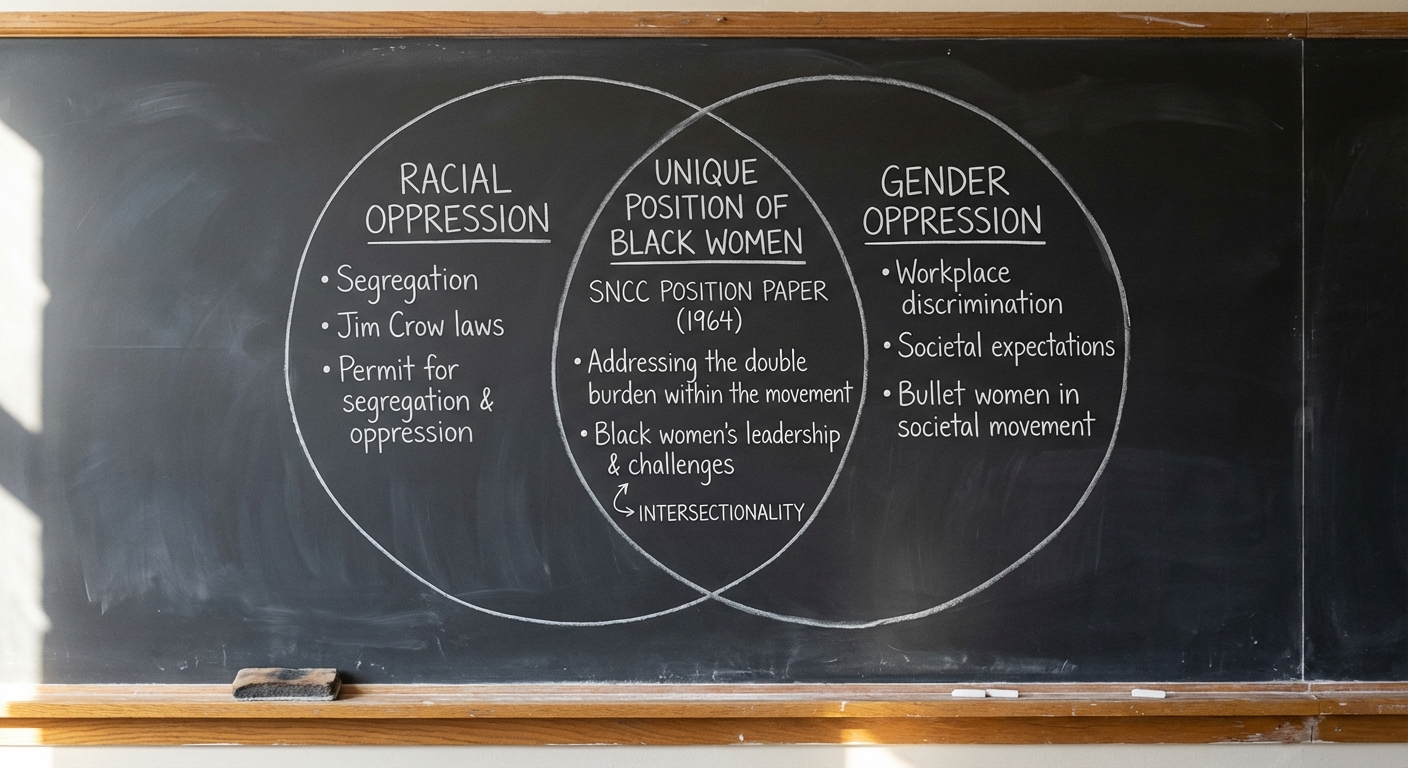
Despite being the "backbone" of the movement, Black women were often excluded from formal leadership roles and visibility. This tension sowed the seeds for modern Black Feminism.
Key Conceptual Figures
- Ella Baker: The "Mother of the Civil Rights Movement." She disliked the "charismatic leader" model (like MLK) and believed in participatory democracy—strong people don't need strong leaders.
- Fannie Lou Hamer: A sharecropper turned activist. Famously testified at the 1964 Democratic National Convention, asking, "Is this America?" when the MFDP was denied seats.
Primary Source: "SNCC Position Paper: Women in the Movement" (1964)
This document (referenced historically) reveals the internal sexism within the movement. It listed specific grievances showing that while the movement fought racism, it perpetuated sexism:
- Job Assignment Bias: Male organizers immediately assigned clerical work to female organizers, even if the women had equal experience.
- Leadership Exclusion: In COFO (Mississippi), the leadership group was entirely male, despite women working just as long in the field.
- The "Three Girls" Report: A personnel report listed staff numbers for men but referred to women simply as "three girls," diminishing their agency.
- Tokenism: Women were rarely asked to chair meetings. One SNCC leader apologized for appointing a woman as an interim project director, viewing it as a lapse in judgment rather than a merit-based choice.
- Conclusion: The paper argued that capable women were forced to defer to men for final decision-making, mirroring the same "paternalism" the movement claimed to fight against in white society.
4.5 The Shift to Black Power (1966–1970s)
By 1966, frustration grew over the slow pace of change and the persistence of economic inequality despite the Civil Rights Act (1964) and Voting Rights Act (1965).
Key Pivot Point: The Meredith March (1966)
During this march, Stokely Carmichael (later Kwame Ture) popularized the slogan "Black Power."
Philosophies of Black Power
- Self-Determination: Black people should control their own communities, politics, and economics rather than seeking integration into white structures.
- Self-Defense: Contrasted with King's nonviolence. Influenced by Malcolm X, who argued for freedom "by any means necessary."
- Cultural Pride: The "Black is Beautiful" movement. Rejection of straightening hair (Afros), adoption of African names, and the Black Arts Movement (Amiri Baraka, Nikki Giovanni).
The Black Panther Party (1966)
Founded in Oakland by Huey P. Newton and Bobby Seale.
- Ten-Point Program: Demanded full employment, decent housing, education, and an end to police brutality.
- Survival Programs: Free Breakfast for Children, health clinics, and legal aid.
- Misconception: They were often portrayed solely as violent thugs by the media/FBI, but they were actually a Marxist-revolutionary group focused on community service and self-policing.
4.6 Contemporary Debates
Unit 4 connects history to current issues.
- Affirmative Action:
- Debate: Is it a necessary tool to correct past discrimination, or "reverse discrimination"? (See Regents v. Bakke).
- Mass Incarceration:
- Concept: The disproportionate imprisonment of African Americans, often linked to the War on Drugs (Michelle Alexander's The New Jim Crow).
- Reparations:
- Debate: Should the U.S. government provide financial compensation to descendants of enslaved people? (H.R. 40 bill).
Common Mistakes & Pitfalls
- Monolith Mistake: Assuming all civil rights leaders agreed. Correction: King (SCLC) and Carmichael (SNCC) had fierce disagreements about nonviolence vs. self-defense.
- Timeline Confusion: Thinking the movement started in 1963 or ended in 1968. Correction: Use the "Long Civil Rights Movement" framework (1940s–1970s).
- Role of Women: Thinking women were just "helpers." Correction: Women like Septima Clark and Ella Baker were the tactical "brains" behind the mobilization, even if men were the "face."
- Black Power = Violence: Believing Black Power was just about riots. Correction: It was primarily about economic self-sufficiency, cultural pride, and political autonomy.