Unit 7 Study Guide: Empire, Reform, Crisis, and Global War (1890–1945)
Unit 7: Empire, Reform, Crisis, and Global War (1890–1945)
This unit covers a transformative period in United States history, marked by the transition from a developing industrial nation to a dominant global superpower. It encompasses the rise of American imperialism, the domestic reforms of the Progressive Era, two World Wars, the cultural shifts of the 1920s, and the economic collapse of the Great Depression.
7.1 Imperialism and Expansionism (1890–1917)
Definition: Imperialism is the policy of extending a nation's rule over foreign countries, often for economic markets, military bases, or ideological superiority.
The Shift from Isolationism
In 1890, the Census Bureau declared the American frontier "closed." With internal expansion complete, American business and political leaders looked outward.
- Economic Motives: Industrialists needed new raw materials and markets for expanding production.
- Military Strategy: Alfred Thayer Mahan's The Influence of Sea Power Upon History argued that a strong navy and overseas naval bases were essential for global power. This led to the construction of the "Great White Fleet."
- Ideological Motives: Social Darwinism and the concept of the "White Man's Burden" were used to justify American expansion as a duty to "civilize" non-Western nations.
The Spanish-American War (1898)
Often called a "splendid little war," this conflict marked the U.S. emergence as a world power.
- Causes:
- Cuban rebellion against Spanish rule.
- Yellow Journalism: Sensationalized reporting by Hearst and Pulitzer that inflamed public opinion.
- The De Lôme Letter: A Spanish diplomat criticized President McKinley.
- The U.S.S. Maine: exploded in Havana Harbor; the press blamed Spain without evidence.
- Effects: The Treaty of Paris (1898) granted the U.S. control of Puerto Rico, Guam, and the Philippines. Cuba became independent but was subject to U.S. intervention via the Platt Amendment.
The Imperialism Debate
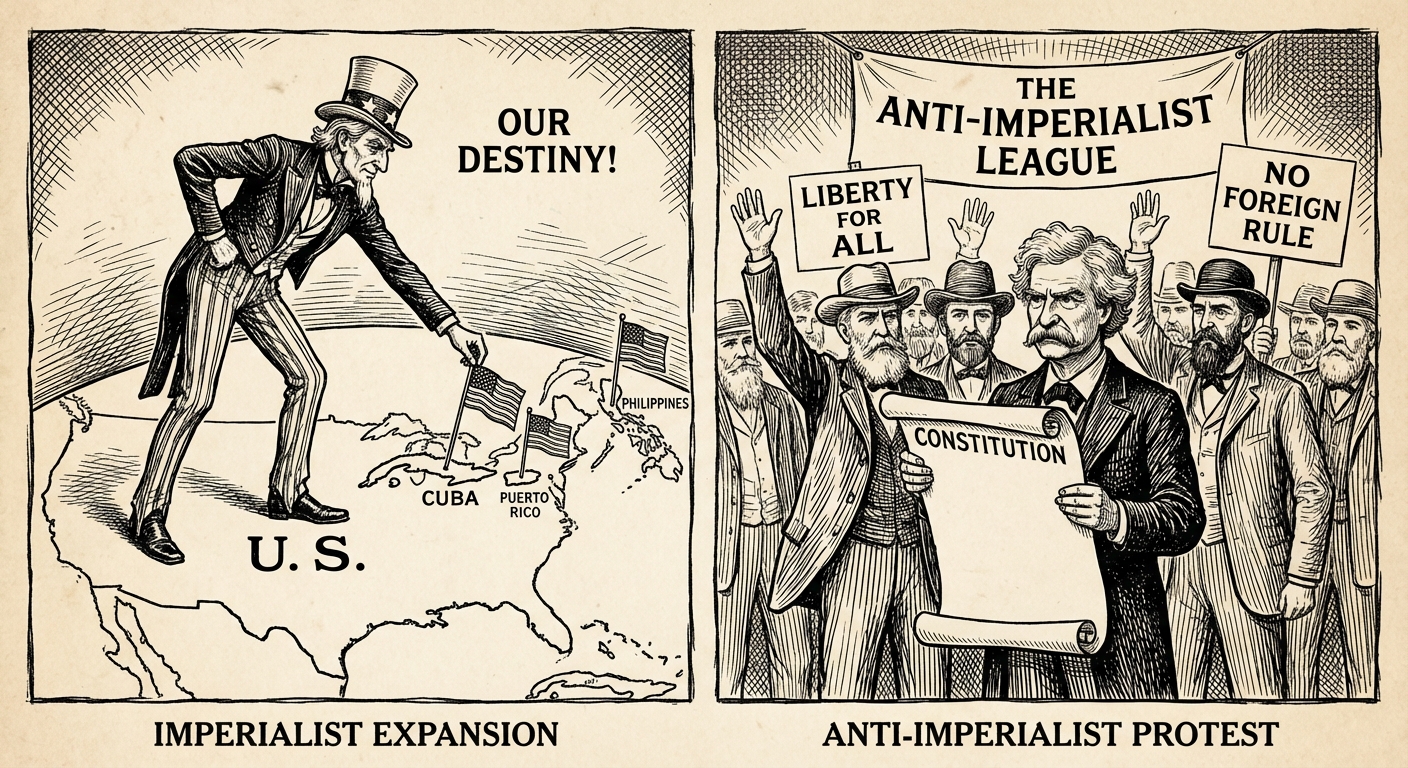
- Imperialists: (e.g., Theodore Roosevelt, McKinley) Argued for economic expansion and military necessity.
- Anti-Imperialist League: (e.g., Mark Twain, Andrew Carnegie) Argued that ruling people without their consent violated the foundational ideals of the Declaration of Independence and the Constitution.
- The Insular Cases: The Supreme Court ruled that constitutional rights do not automatically extend to people in territorial possessions.
Intervention in Asia and Latin America
- Open Door Policy (1899): Secretary of State John Hay unilaterally declared that all nations should have equal trading rights in China to prevent European monopolies.
- The Panama Canal: TR supported a revolution in Panama against Colombia to secure rights to build the canal, drastically cutting shipping times.
- Roosevelt Corollary: An extension of the Monroe Doctrine. TR declared the U.S. had the right to intervene in Latin American nations to keep order and prevent European intervention. (Essentially, the U.S. became the "policeman" of the hemisphere).
Common Mistakes
- Mistake: Thinking the Monroe Doctrine and Roosevelt Corollary are the same.
- Clarification: The Monroe Doctrine (1823) told Europe to stay out. The Roosevelt Corollary (1904) said the U.S. would actively intervene internally in Latin American nations to ensure they paid debts and maintained order.
7.2 The Progressive Era (1890–1920)
Definition: Progressivism was a diverse movement of predominantly middle-class, urban reformers who sought to use government power to solve the problems created by industrialization, urbanization, and corruption.
Roots of Progressivism
Progressives were different from the earlier Populists (who were rural farmers). Progressives were typically educated urbanites.
- The Social Gospel: Protestant movement applying Christian ethics to social problems (poverty, slums).
- Muckrakers: Investigative journalists who exposed corruption.
- Upton Sinclair (The Jungle): Meatpacking sanitation.
- Jacob Riis (How the Other Half Lives): Tenement poverty.
- Ida Tarbell: Standard Oil monopoly.
- Lincoln Steffens: Political machine corruption.
Political Reforms
Progressives aimed to return power to the people and destroy political machines.
| Democratic Reform | Definition |
|---|---|
| Initiative | Voters can propose laws directly. |
| Referendum | Voters can vote on laws proposed by the legislature. |
| Recall | Voters can remove an elected official before their term ends. |
| Direct Primary | Voters, not party bosses, choose candidates. |
Progressive Amendments
- 16th: Federal Income Tax (allowed for wealth redistribution).
- 17th: Direct election of Senators (previously chosen by state legislatures).
- 18th: Prohibition of alcohol (driven by the Temperance movement).
- 19th: Women's Suffrage (1920), achieved after service in WWI proved women's patriotism.
The Progressive Presidents
Theodore Roosevelt (TR) - The Square Deal:
- Corporations: Distinguish between "good" and "bad" trusts. Used the Sherman Antitrust Act to break up monopolies (e.g., Northern Securities).
- Consumer Protection: Passed the Meat Inspection Act and Pure Food and Drug Act after The Jungle.
- Conservation: Protected millions of acres of federal land; distinguished from preservation (John Muir) by advocating sustainable use.
William Howard Taft:
- True "Trustbuster" (busted more than TR), but lacked TR's political charisma. Split the Republican vote in 1912, allowing Wilson to win.
Woodrow Wilson - New Freedom:
- Attacked the "Triple Wall of Privilege": Tariffs, Banks, and Trusts.
- Federal Reserve Act (1913): Created a central banking system to regulate the money supply.
- Clayton Antitrust Act: Strengthened the Sherman Act and exempted unions from being prosecuted as trusts.
Limits of Progressivism
- Civil Rights: Progressives generally failed African Americans. Wilson re-segregated the federal government.
- Booker T. Washington vs. W.E.B. Du Bois: Washington advocated vocational training and economic self-reliance (gradualism). Du Bois demanded immediate equality and helped found the NAACP.
7.3 World War I (1914–1919)
From Neutrality to War
President Wilson won the 1916 election on the slogan "He Kept Us Out of War." However, neutrality became impossible.
- Unrestricted Submarine Warfare: Germany declared they would sink all ships, including neutral American ones (e.g., Lusitania impact).
- Zimmerman Telegram: Germany proposed an alliance with Mexico to recover Texas/SW USA if the U.S. joined the war.
- Democratic Values: Wilson framed the war as a fight to "make the world safe for democracy."
The Homefront: Total War
- Role of Government: Expanded drastically. The War Industries Board directed production.
- Civil Liberties:
- Espionage and Sedition Acts: Made it a crime to criticize the government or war effort.
- Schenck v. United States (1919): SCOTUS ruled that speech creating a "clear and present danger" is not protected by the First Amendment.
- Great Migration: African Americans moved from the rural South to the urban North for industrial jobs, fleeing Jim Crow (and boll weevil infestations).
The Treaty of Versailles & League of Nations
- Wilson’s Fourteen Points: A vision for peace including free trade, self-determination, and a League of Nations.
- The Fight for Ratification:
- The Senate, led by Henry Cabot Lodge, feared the League (specifically Article X) would force the U.S. into foreign wars without Congressional approval.
- Result: The U.S. Senate rejected the Treaty of Versailles and never joined the League of Nations, initiating a period of isolationism.
7.4 The Roaring Twenties (1920–1929)
Definition: A decade marked by economic prosperity, cultural conflict (