AP Calculus AB Unit 4: Rates of Change in Context (Derivative Interpretation, Motion, and Applied Rates)
In AP Calculus AB, Unit 4 shifts focus from the mechanics of calculating derivatives (Power Rule, Chain Rule, etc.) to using derivatives to describe the real world. This unit bridges the gap between abstract math and physical reality, especially through careful interpretation, units, and common application settings like motion, flow, and economics.
Interpreting the Meaning of the Derivative in Context
What the derivative means (beyond “slope”)
In Algebra, “slope” describes how a straight line changes: rise over run. In Calculus, most real-world relationships are not perfectly linear, so the rate of change usually changes as the input changes. The derivative captures the instantaneous rate of change at a specific input value.
If you have a function
then the derivative at
is written as
Conceptually,
answers: “At the instant when
how fast is
changing?” and “If I zoom in near
so the curve looks almost like a line, what is the slope of that line?” That “zoomed-in line” is the tangent line, and its slope is the derivative.
Why it matters in contextual problems
In context, the derivative is rarely asked for its own sake. It’s used because it connects a changing quantity to a real interpretation such as how fast a car is moving at a specific time, how quickly a tank’s volume is increasing at a specific water height, or how rapidly revenue is changing when production is at a specific level. In all of these, the derivative represents a rate, and rates must be interpreted with units.
Units: the fastest way to interpret correctly
A powerful habit is to derive meaning by tracking units. If
has units “output units” and
has units “input units,” then
has units
For example, if
is height in meters and
is time in seconds, then
is meters per second. This prevents a common mistake: giving a correct derivative value with the wrong interpretation.
The “NUT” method for full-credit interpretations
On Free Response Questions, you typically need a complete sentence interpretation, not just a number. A reliable checklist is N.U.T.
- Number: state the numerical value of the derivative.
- Units: include correct rate units.
- Time (or Input): specify the instant (or input value) where it applies.
A related grading detail: if you use the word “decreasing,” it’s usually clearer to state the rate with a positive magnitude (and let “decreasing” communicate the direction). If you use the word “changing,” you should use the signed value.
Average rate of change vs instantaneous rate of change
Students often confuse these because both involve “change divided by change.” The difference is whether you look over an interval or at a moment.
The average rate of change of
on
is
This is the slope of the secant line through the two points.
The instantaneous rate of change at
is
This is the slope of the tangent line at
You can view the derivative definition as the average rate of change on a tiny interval:
In context, this is like average speed over a trip versus speed at exactly 3 seconds.
Interpreting the sign and size of the derivative
In many contexts, three ideas matter more than the exact value.
If
then the quantity is increasing at
If
then the quantity is decreasing at
If
then it is momentarily not changing (but this does not automatically mean there is a maximum or minimum in context).
Magnitude matters too: larger
means faster change. Comparing
and
tells you where the quantity changes faster.
A subtle misconception to avoid is thinking
means “the function stops changing forever” or “the function is flat everywhere.” It’s a local, instant statement.
Notation you must recognize (equivalent ideas)
AP questions freely switch notation. Treat these as different languages for the same concept.
| Meaning | Common notations | Notes |
|---|---|---|
| Derivative function | %%LATEX30%%, %%LATEX31%%, | A new function giving slope or rate at each input |
| Derivative at a number | %%LATEX33%%, %%LATEX34%% | A single value: a rate at a specific input |
| Second derivative | %%LATEX35%%, %%LATEX36%% | Rate of change of the rate of change |
Example 1: Derivative meaning and units (geometry context)
Suppose
is the area of a circle (square centimeters) as a function of radius
(centimeters):
Differentiate:
Interpretation:
tells you how fast the area is changing per unit change in radius.
Units check: area is square centimeters and radius is centimeters, so
has units “square centimeters per centimeter” (which simplifies to centimeters, but the unsimplified interpretation is usually clearer).
At
Meaning: when the radius is 5 cm, increasing the radius by about 1 cm increases the area by about
square centimeters. More generally, for a small change
Example 2: Using a derivative value given in words
A tank’s volume
(liters) depends on time
(minutes). You are told
Interpretation: at 12 minutes, the volume is increasing at 3.5 liters per minute. A common mistake is to say “the volume is 3.5 liters at 12 minutes.” The derivative is not the amount; it’s the rate.
Example 3: NUT interpretation with a negative rate (water tank)
Let
represent the amount of water in a tank (gallons) at time
(minutes). If
then a complete interpretation is: at
minutes, the amount of water in the tank is decreasing at a rate of 12 gallons per minute.
If instead you phrase it as “changing,” then you would keep the signed value: at
minutes, the amount of water is changing at
gallons per minute.
Exam Focus
Typical question patterns include interpreting
in a complete sentence with units; estimating
from a table or graph by reading a tangent slope; and comparing
and
to decide where a quantity changes faster.
Common mistakes include confusing
with
(amount versus rate), forgetting or mixing up units (especially when the input is not time), and interpreting an average rate of change (secant slope) as an instantaneous rate (tangent slope). Another frequent scoring issue is giving only a number: on FRQs, use N.U.T. so the grader sees the number, units, and the specific input value.
Straight-Line Motion: Position, Velocity, and Acceleration
Building the motion model (the PVA hierarchy)
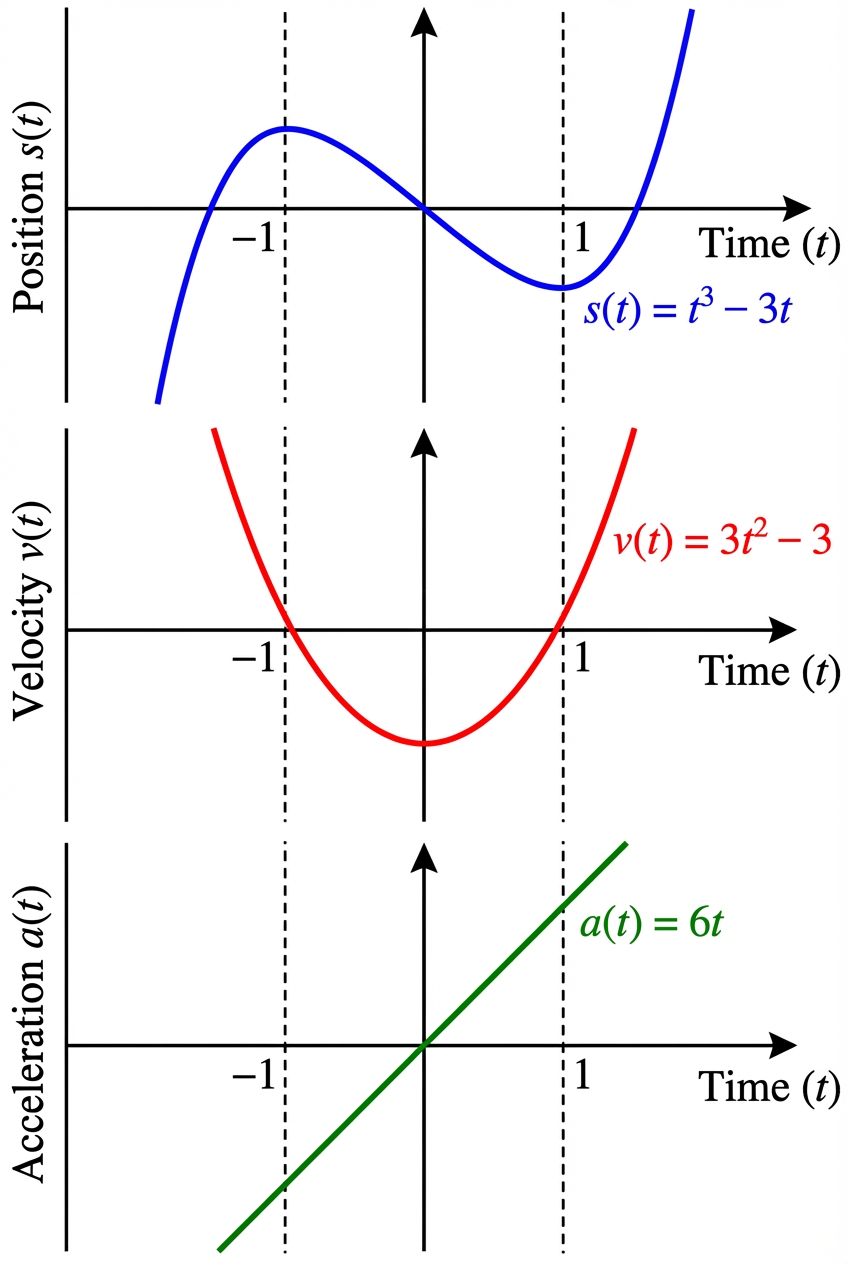
One of the most common applications of differentiation is rectilinear motion (motion along a straight line). You typically have position as a function of time:
where
might be measured in meters (or feet) and
in seconds.
From this single function, derivatives generate two key rates:
The hierarchy is the main conceptual point: position changes, velocity measures how position changes, and acceleration measures how velocity changes.
Interpreting signs: position vs velocity vs acceleration
A common confusion is to read sign information from the wrong function. Position tells location relative to the origin; velocity tells direction of motion; acceleration tells whether velocity is increasing or decreasing.
| Function | Positive value | Negative value | Zero |
|---|---|---|---|
| %%LATEX68%% (or %%LATEX69%%) | Right of (or above) the origin | Left of (or below) the origin | At the origin |
| Moving right (or up) | Moving left (or down) | At rest | |
| Velocity is increasing | Velocity is decreasing | Velocity is constant |
Velocity vs speed
Students often use “speed” and “velocity” interchangeably, but calculus problems are precise. Velocity can be positive or negative (direction). Speed is magnitude only.
So if
ft/sec, the speed is 50 ft/sec, and speed is always nonnegative.
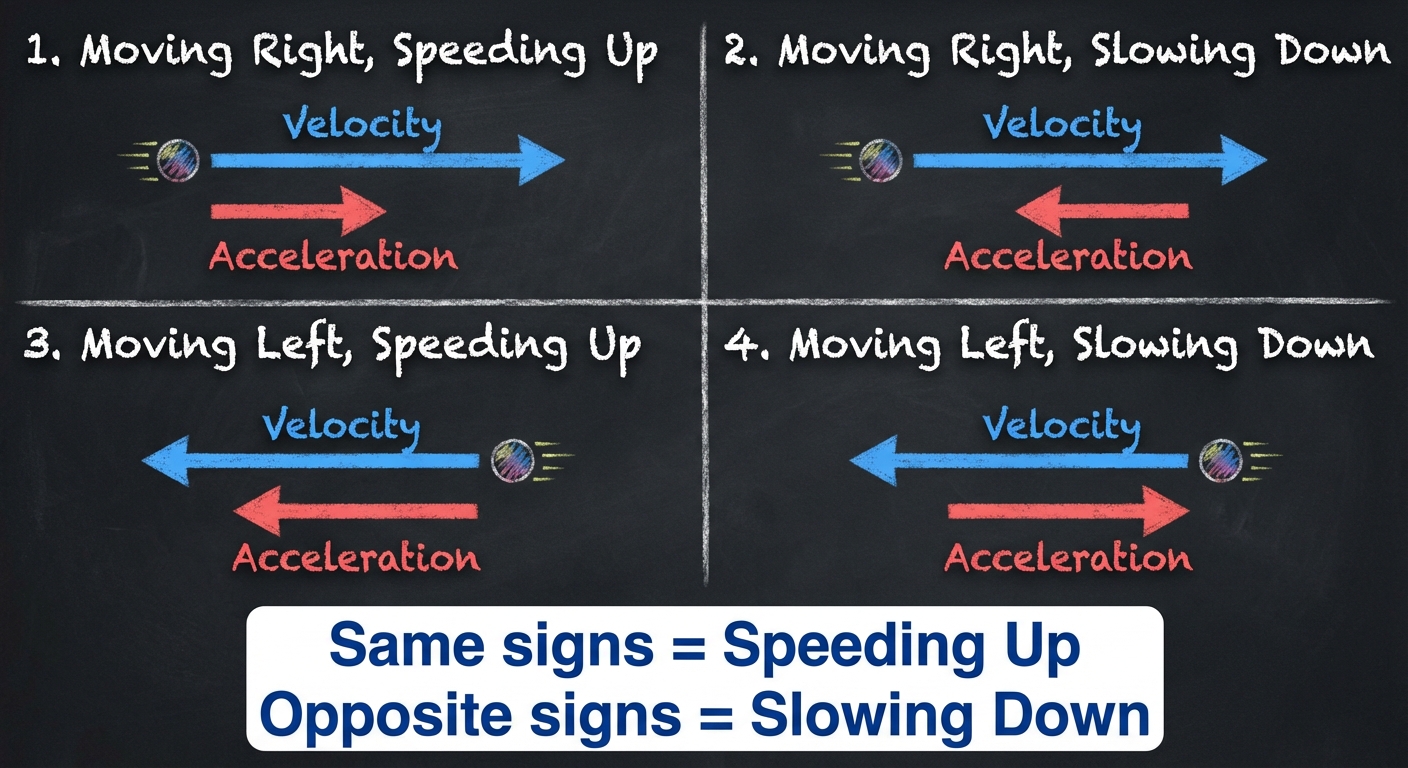
Speeding up vs slowing down
Speed increases when
increases. A practical rule:
- The particle is speeding up when
and
have the same sign.
- The particle is slowing down when
and
have opposite signs.
This is a frequent exam trap: “positive acceleration” does not automatically mean “speeding up.” You must check velocity’s sign.
Displacement vs distance traveled
These are frequently tested and easy to mix up.
Displacement from
to
is net change in position:
Distance traveled is the total length of the path. In one-dimensional motion, you compute it by integrating speed:
A common mistake is to compute distance traveled as
which ignores turning around.
Example 1: From position to velocity and acceleration (with interpretation)
Let position be
for
in seconds and
in meters.
Velocity:
Acceleration:
When is the particle at rest? “At rest” means
So solve
Divide by 3:
Factor:
So the particle is at rest at
and
seconds.
Interpret acceleration at
Meaning: at 1 second, velocity is decreasing at 6 meters per second per second (equivalently, near that instant the velocity changes by about
meters per second each second).
Example 2: Speeding up vs slowing down (using signs)
Using the same functions, determine whether the particle is speeding up at
Compute:
At
both are positive, so the particle is speeding up. If instead
but
it would be slowing down.
Example 3: Interpreting velocity and acceleration at a time
If
m/s and
m/s², then the particle is moving left (since velocity is negative) and slowing down (since velocity and acceleration have opposite signs).
Exam Focus
Typical question patterns include: given
find
and
and interpret values like
or
with units; determine when a particle is moving right or left (sign of
), at rest (zeros of
), or speeding up (compare signs of
and
); and distinguish displacement from total distance by noticing turning points where
.
Common mistakes include mixing up position and velocity interpretations (for example, saying “position is negative so the object moves left”), claiming “acceleration is positive so the object speeds up” without checking velocity, and forgetting that speed is
not
. If asked for maximum speed, you must consider the maximum value of
, not just the maximum value of
. Also, on FRQs, a sign chart alone is usually not sufficient: write a justification sentence such as “The particle is speeding up at
because
and
are both negative.”
Rates of Change in Applied Contexts
The big idea: derivatives as rates between real quantities
Outside of motion, AP Calculus uses derivatives to describe how one quantity changes relative to another. The structure is consistent: identify what depends on what (input versus output), then interpret the derivative as an instantaneous rate with units.
If
models a context, then
is the instantaneous rate of change of
with respect to
A key conceptual point is that the derivative is not inherently “per time.” It is “per input unit.” If
is gallons, then
is “per gallon.” If
is dollars, then “per dollar.”
Reading derivative meaning from wording
AP problems often describe derivatives in sentences rather than giving explicit formulas. For example, “the rate at which the temperature is changing at time 10 minutes” means
“marginal cost when 200 items are produced” means
and “the rate at which the area changes with respect to radius” means
A frequent student mistake is to compute a derivative correctly but interpret it as a new total amount instead of “a rate at that input.” Always finish with a sentence that includes units.
Rates from tables and graphs (estimating derivatives)
Often you are not given a formula. You must estimate from data.
From a graph,
is the slope of the tangent line at
You may be expected to sketch a tangent and estimate its slope using two points on the tangent.
From a table,
can be estimated using a symmetric difference quotient when possible:
If you only have one side, you might use a one-sided estimate:
but you should recognize it is generally less accurate than a symmetric estimate.
Interpreting “rate in” and “rate out”
Many applied setups involve some amount
changing because something flows in and out (water in a tank, people entering and leaving, charge in a capacitor). Then
is the net rate of change, and it is often modeled as “rate in minus rate out.” Even if you are not solving a differential equation in AB, interpreting that meaning is essential.
Common application types you should recognize
Economics, biology, and environmental science show up frequently, and the derivative plays the same role: it gives a rate.
In population contexts, if
is population size, then
is the growth rate (individuals per year).
In flow rate contexts, if
is volume, then
is the rate of flow (for example, cubic feet per minute).
Marginal analysis (economics-style contexts)
AP Calculus AB sometimes uses the term “marginal” to mean “derivative-based rate.” If
is the cost to produce
items, then
is the instantaneous rate of change of cost with respect to production level. It is interpreted as the approximate additional cost of producing one more item when you are currently producing
items.
This links directly to linear approximation: for small
In particular, for one additional item,
so
You may also see this written as an approximation to a discrete difference:
A misconception to avoid is thinking
is the average cost per item. Average cost is
which is a different quantity.
Example 1: Estimating a derivative from a table and interpreting
Suppose
is the height of water in a tank (centimeters) at time
(minutes). A table gives:
| (min) | 4 | 5 | 6 |
|---|---|---|---|
| (cm) | 18.2 | 19.0 | 20.1 |
Estimate
Because values are given on both sides of 5 with equal spacing, use a symmetric difference quotient with
Substitute:
Interpretation: at 5 minutes, the water height is increasing at about 0.95 centimeters per minute.
A common mistake is using
automatically. That estimates an average rate from 5 to 6; it can be acceptable if that’s all you have, but symmetric is typically better when available.
Example 2: Marginal cost interpretation
Let
be the cost (dollars) to produce
items, and suppose
Interpretation: when producing 200 items, the cost is increasing at about 4.7 dollars per item. In practical terms, producing the 201st item costs approximately 4.7 dollars (assuming the model is smooth and the change is small).
This does not mean the total cost at 200 items is 4.7 dollars, and it does not mean the average cost per item is 4.7 dollars.
Example 3: Interpreting a derivative from a graph description
Suppose
is temperature (degrees Celsius) and at
minutes, the tangent line to the graph has slope -2. Then
meaning: at 10 minutes, temperature is decreasing at 2 degrees Celsius per minute.
A subtle interpretation issue is that the tangent slope is an instantaneous rate. It does not guarantee the temperature will keep decreasing at that rate for the next several minutes.
Exam Focus
Typical question patterns include identifying what
represents in a real situation and stating it with correct units, estimating derivatives from tables (difference quotients) or graphs (tangent slopes), and interpreting “marginal” quantities such as
or
as instantaneous “per additional item” rates.
Common mistakes include unit confusion (writing dependent-variable units instead of “per input unit”), treating a derivative value as a total amount rather than a rate, mixing up per-minute and per-hour style units, and using an average rate formula when the question asks for an instantaneous rate (or failing to use a symmetric estimate when it’s clearly available). When writing interpretations, aim for a full N.U.T. sentence so it’s unambiguous what the number means, at what input value, and in what units.