Mastering Key Ideas and Details in ACT Reading
Determining Central Ideas and Themes
The Key Ideas and Details reporting category accounts for over 50% of the questions on the ACT Reading section. These questions ask you to identify what a passage is actually saying, either explicitly (directly stated) or implicitly (suggested).
The Hierarchy of Meaning
To answer these questions correctly, you must distinguish between three levels of scope:
- Topic: The broad subject of the passage (e.g., Honeybees).
- Central Idea (Main Idea): The specific argument or point the author makes about the topic (e.g., Honeybee populations are declining due to a combination of pesticides and habitat loss).
- Theme: An abstract, universal concept, usually found in Literary Narrative passages (e.g., The fragility of nature or The interdependence of living systems).
The "Goldilocks Principle" for Answer Choices
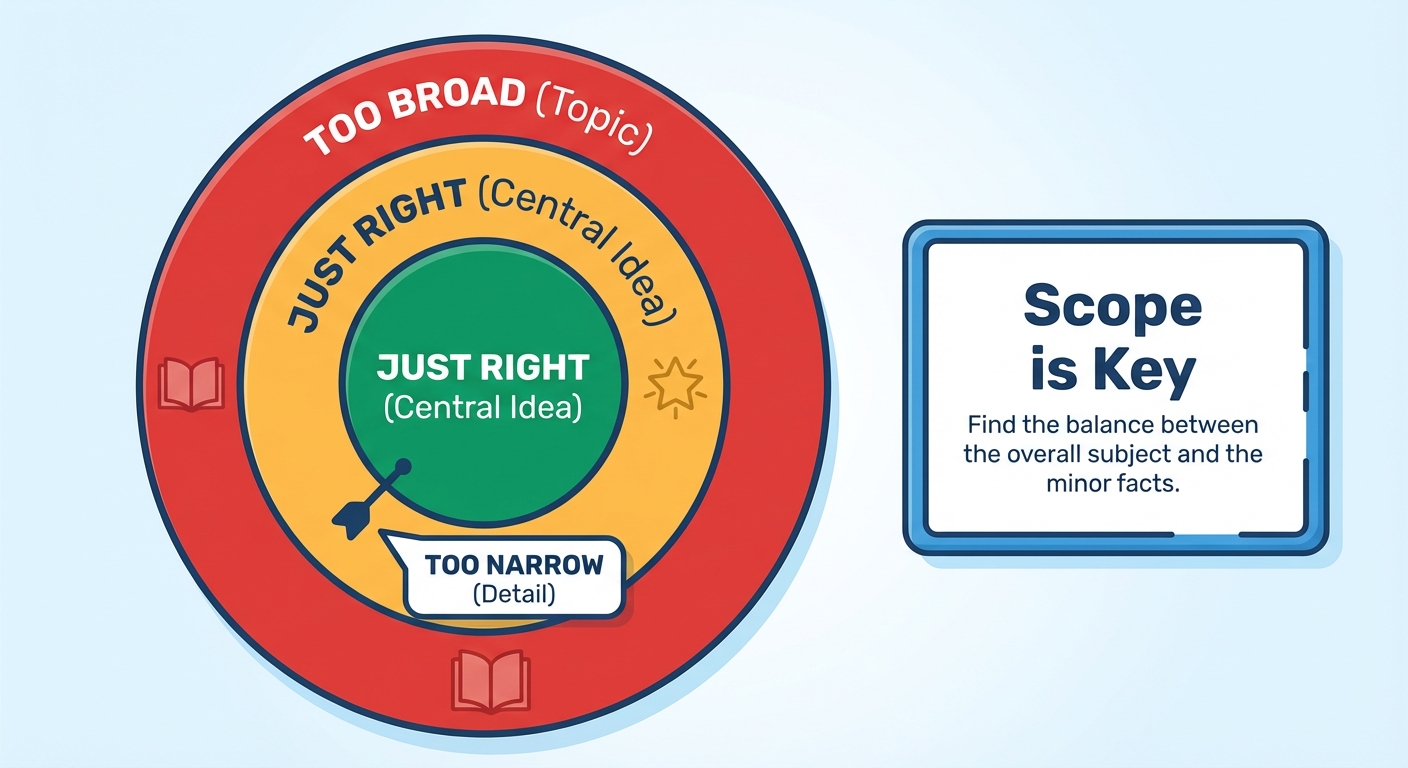
When selecting the central idea, you are looking for the answer that fits "just right."
- Too Broad: Captures the topic but misses the specific argument. (e.g., The history of insects in agriculture).
- Too Narrow: Focuses on a single detail or paragraph rather than the whole text. (e.g., Neonicotinoids are a specific type of pesticide that affects bee neurology—this might be true, but it's only one supporting detail).
- Just Right: Encapsulates the author's primary thesis across the majority of the text.
Strategy: The First and Last Rule
For non-fiction passages (Social Science, Natural Science, Humanities), the central idea is often located in the introductory paragraphs (the thesis statement) or the concluding paragraphs (the synthesis). In Literary Narratives, the theme typically emerges from the resolution of the conflict.
Summarizing Information and Ideas
Summarization questions ask you to identify the best paraphrase of a specific section or the entire passage. On the ACT, a correct summary must account for the key points without including extraneous details or inaccuracies.
Characteristics of a Good Summary
- Neutrality: It does not insert opinions that aren't in the text.
- Completeness: It touches on the beginning, middle, and end of the section in question.
- Accuracy: It does not misattribute actions or events.
Application Example
Text: "While early bicycles known as penny-farthings were perilous due to their high center of gravity, the invention of the 'Safety Bicycle' in the 1880s, featuring equal-sized wheels and a chain drive, democratized cycling for the general public."
Bad Summary: Penny-farthings were dangerous.
Correct Summary: The shift from dangerous penny-farthings to the more stable Safety Bicycle made cycling accessible to more people.
Understanding Sequential Relationships
These questions test your ability to track the chronology of events or the steps in a process. You must distinguish between the order in which events happened and the order in which they are told.
Timeline vs. Narrative Arc
Especially in Literary Narrative (Prose Fiction) or Humanities (Memoirs), authors often use non-linear storytelling.
- Flashback: The narrative jumps back in time to explain a character's motivation.
- In Media Res: The story begins in the middle of the action, filling in the backstory later.
Study Tip: When reading a narrative, mentally number the events 1, 2, 3 as they actually occurred in time, regardless of when they appear in the text.
Process Sequences
In Natural Science passages, you may be asked to trace a biological or mechanical process. Look for transition words:
- Initially / First
- Subsequently / Then
- Finally / Ultimately
Understanding Cause-Effect Relationships
Cause-effect questions ask why something happened or what the result of an event was. The ACT often obscures the connection by separating the cause and the effect by several sentences or paragraphs.
Identifying Causality
Look for explicit markers of causality:
- Because, since, due to (indicate Cause)
- Therefore, consequently, as a result (indicate Effect)
The Correlation Trap
Just because two events are discussed near each other doesn't mean one caused the other. You must find text evidence linking them.
Example:
"The factory closed in 1995. The town's population dropped by 20% in 1996."
- Inferential Cause-Effect: It is reasonable to infer the closure caused the drop, but only if the text supports that link (e.g., mentions job loss).
- Direct Causality: "The population dropped because the factory closure eliminated jobs."
Understanding Comparative Relationships
Comparative questions ask you to analyze connections between characters, ideas, or theories. These relationships generally fall into two categories: Analogy (Similarity) or Contrast (Difference).
Common Comparative Scenarios
- Person A vs. Person B: How do two scientists differ in their interpretation of data?
- Before vs. After: How did the landscape change after the industrial revolution?
- Theory vs. Reality: How does the experimental result differ from the initial hypothesis?
Notation Strategy
When reading passages involving two distinct viewpoints (common in Social Science), create a mental or physical T-Chart.
| Perspective A | Perspective B |
|---|---|
| Traditional view | Modern revisionist view |
| Focuses on economics | Focuses on sociology |
Drawing Logical Inferences and Conclusions
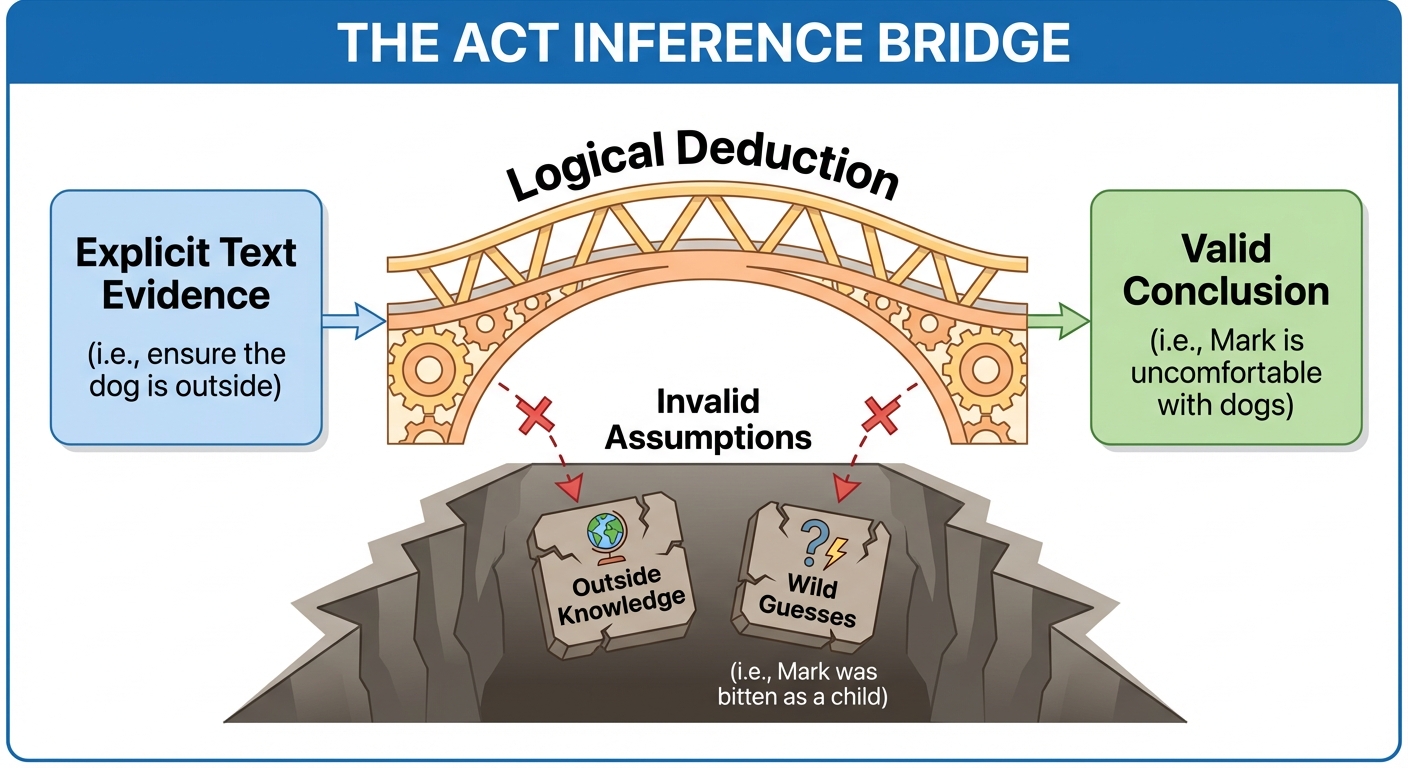
Inference questions are often the most challenging because the answer is not directly stated in the text. However, on the ACT, an inference is not a guess; it is a logical deduction based on strict evidence.
The Inference Formula
To solve these, use the following mental model:
Example:
- Text: "Mark refused to enter the room until he had verified that the dog was secured in the backyard."
- Valid Inference: Mark is likely afraid of or uncomfortable around dogs.
- Invalid Inference: Mark was bitten by a dog when he was five. (This is a narrative guess, not a logical necessity. We don't know why he is uncomfortable, only that he is distinctively cautious).
"Reading Between the Lines"
Authors imply ideas through:
- Tone: Sarcastic word choices imply the author disagrees with the subject.
- Omission: What the character doesn't say can define their relationship with another character.
Common Mistakes & Pitfalls
Even prepared students lose points on details due to these specific traps:
The "Recycled Language" Trap
- The Trap: An answer choice uses the exact phrasing found in the passage (e.g., "the blue curtains") but uses it in the wrong context or assigns it to the wrong character.
- The Fix: Verify the meaning, not just the matching words.
Extreme Language
- The Trap: Answers containing words like always, never, completely, impossible, or best.
- The Fix: The ACT prefers moderate language (e.g., often, rarely, suggests, primarily). Usually, the extreme answer is widely too strong to be supported by the text.
Outside Knowledge
- The Trap: Choosing an answer because it is chemically/historically true in the real world, even though the passage does not discuss it.
- The Fix: If it's not in the passage, it doesn't exist. Treat the passage as your only source of information.
Half-Right Answers
- The Trap: An answer choice where the first clause is perfect, but the second clause (after the "and") is slightly wrong.
- The Fix: Read every answer choice to the very last word. If any part of the answer is wrong, the whole answer is wrong.