Unit 3: Conflict, Nation-Building, and the New Republic (1754–1800)
3.1 The Seven Years’ War & The End of Salutary Neglect
The French and Indian War (1754–1763)
The Seven Years' War (known in the colonies as the French and Indian War) was a global conflict that fundamentally altered the balance of power in North America. It marked the turning point in relations between Great Britain and its colonies.
Causes:
- Imperial Competition: Britain and France were the two dominant powers fighting for global supremacy.
- The Ohio River Valley: The immediate cause was conflict over land. British colonists (like the Ohio Company) pushed west into the Ohio Valley, clashing with French efforts to build forts (e.g., Fort Duquesne) to link their Canadian and Mississippi holdings.
- George Washington: A young Washington led a colonial militia to stop French construction. He was defeated at Fort Necessity (1754), sparking the war.
Alliances:
- The French: Allied with the majority of Native American tribes (e.g., Huron, Ottawa) due to a history of trade and less intrusive settlement patterns.
- The British: Allied with the colonists and eventually the Iroquois Confederacy, who sought to maintain neutrality but sided with the probable winner.
The Tide Turns: Early British defeats were reversed when Prime Minister William Pitt poured resources into the war, promising to reimburse the colonies for their military efforts.
The Albany Plan of Union (1754)
Before the war fully escalated, representatives from seven colonies met in Albany, NY.
- Benjamin Franklin proposed the Albany Plan of Union: A system for an intercolonial government to collect taxes and organize a common defense.
- Outcome: It was rejected by every colonial legislature (feared losing taxation power) and the British Crown (feared too much colonial unity).
- Significance: It established the concept of colonial unity, famously depicted in Franklin’s "Join or Die" snake cartoon.
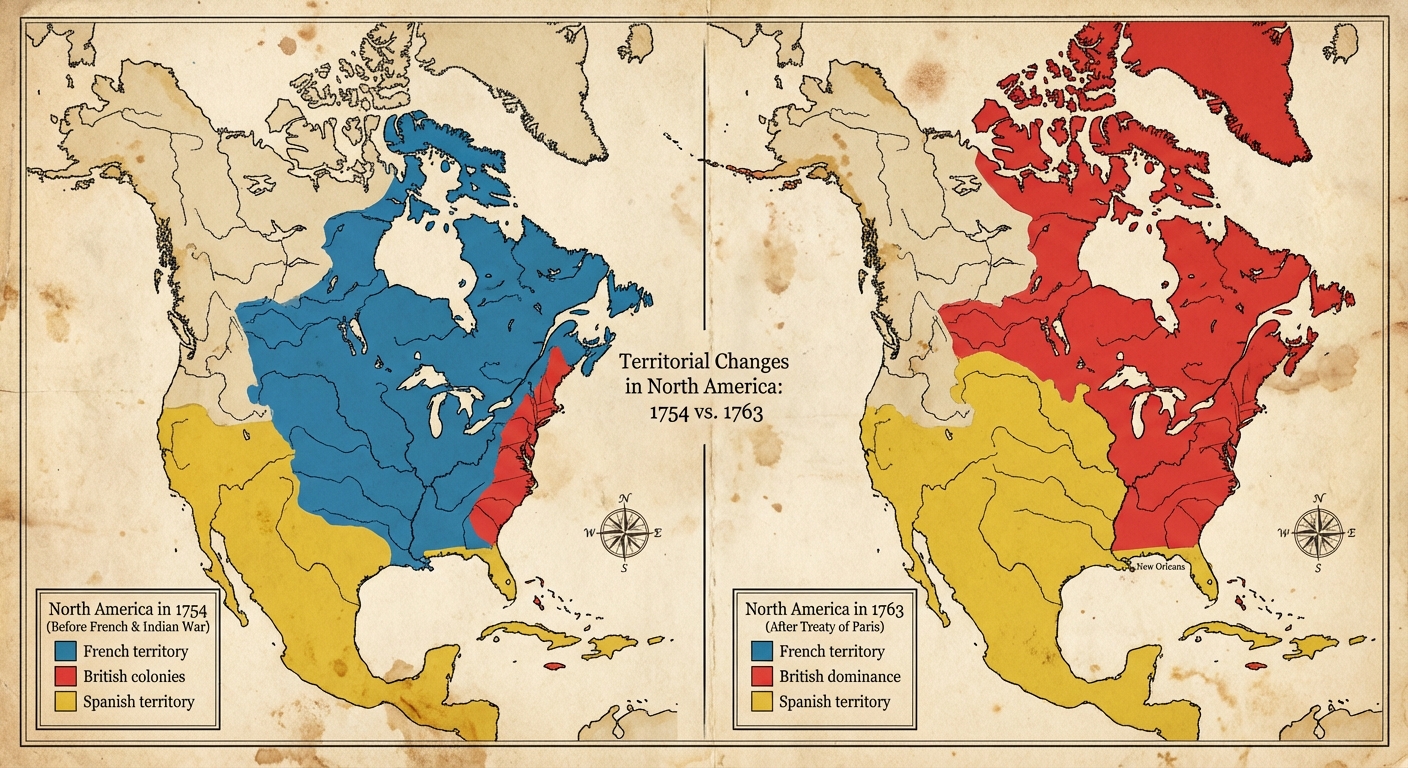
Consequences: The Treaty of Paris (1763)
The British victory reshaped the map:
- France: Removed from North America entirely. They ceded Canada to Britain and Louisiana to Spain.
- Britain: Gained Canada and Florida; became the dominant naval and colonial power.
- Spain: Gained land west of the Mississippi (New Orleans).
Pontiac’s Rebellion & The Proclamation of 1763
With the French gone, Native Americans lost their ability to play European powers against each other.
- Pontiac’s Rebellion (1763): Ottawa Chief Pontiac led a coalition of tribes attacking British forts in the Ohio Valley, resisting British encroachment and higher goods prices.
- The Paxton Boys: In retaliation, a vigilante group of Scots-Irish frontiersmen in Pennsylvania massacred peaceful Susquehannock Indians, highlighting growing racial violence and frontier-vs-government tensions.
- Proclamation of 1763: To prevent further conflict and save money on defense, King George III prohibited colonial settlement west of the Appalachians.
- Colonial Reaction: Anger. Colonists felt they had fought the war to gain this land; they ignored the line and moved west anyway, marking the first major defiance of British authority.
3.2 The Road to Revolution (1763–1776)
The End of Salutary Neglect
Prior to 1763, Britain practiced Salutary Neglect—enforcing trade laws loosely and allowing colonies self-governance. After the war, Britain faced massive debt. Prime Minister George Grenville decided the colonists must pay for their own defense.
The Era of Taxation
- Sugar Act (1764): Replaced the Molasses Act. While it actually lowered the duty on molasses, it established strict enforcement to stop smuggling. Violators were tried in Vice-Admiralty Courts (no juries), violating the right to a trial by peers.
- Stamp Act (1765): The tipping point. A direct tax on all printed materials (newspapers, legal docs, playing cards).
- Argument: Colonists argued "No Taxation Without Representation."
- British Counter-Argument: Virtual Representation—members of Parliament represented the interests of the entire empire, not just their specific districts.
- Response: Formation of the Sons of Liberty (harassed tax collectors), the Stamp Act Congress (first successful intercolonial unity against Britain), and non-importation agreements (boycotts).
- Outcome: Parliament repealed the Stamp Act (1766) but passed the Declaratory Act, asserting Parliament's right to tax the colonies "in all cases whatsoever."
Escalation
- Townshend Acts (1767): Taxed imports (tea, glass, paper). Revenues paid royal officials (removing the colonies' "power of the purse"). Also instituted Writs of Assistance (blanket search warrants).
- Response: Massachusetts Circular Letter urging unity. Boycotts expanded. Women played a key role (Daughters of Liberty) by spinning their own cloth (homespun) to replace British textiles.
- Boston Massacre (1770): British troops fired on a heckling crowd, killing five. Paul Revere’s engraving was used as propaganda to fuel anti-British sentiment.
- Tea Act & Boston Tea Party (1773): Britain granted the East India Company a monopoly on tea. Despite cheaper prices, colonists saw it as a trick to accept the tax. The Sons of Liberty dumped tea into the harbor.
- Coercive Acts (Intolerable Acts) (1774): Punitive response to the Tea Party.
- Closed Boston Harbor.
- Revoked the Massachusetts charter.
- Expanded the Quartering Act.
The First Continental Congress (1774)
Delegates met in Philadelphia to address grievances.
- Adopted the Suffolk Resolves (declared Intolerable Acts void).
- Created the Continental Association to enforce a total boycott of British goods.
- Note: Independence was NOT yet the goal; they wanted a return to the days of Salutary Neglect.
3.3 Philosophy and Independence
The Influence of the Enlightenment
Revolutionary ideas were grounded in European philosophy:
- John Locke: Wrote about Natural Rights (life, liberty, property) and the Social Contract (government derives power from the consent of the governed; if the government fails to protect rights, people have a duty to overthrow it).
- Republicanism: A political ideology emphasizing liberty, civic virtue, and opposition to monarchy.
Thomas Paine’s Common Sense (Jan 1776)
While elites read Locke, the masses read Paine. Common Sense was a pamphlet written in plain language that argued:
- It defies logic for a tiny island (Britain) to rule a vast continent.
- The King was a "Royal Brute."
- America should form a republic.
- Impact: Shifted public opinion from reconciliation to independence.
The Declaration of Independence (July 1776)
Drafted by Thomas Jefferson.
- Preamble: Asserted unalienable rights (Life, Liberty, Pursuit of Happiness).
- List of Grievances: Specific complaints against George III (taxation without representation, removing trial by jury, cutting off trade).
- Significance: It turned the civil war into a war for independence, allowing the US to seek foreign aid (France).
3.4 The Revolutionary War (1775–1783)
Military Comparison
| Colonial Advantages | British Advantages |
|---|---|
| Familiarity with the land (defense) | Professional, well-trained army/navy |
| Deep political commitment (Cause) | Strong manufacturing and financial resources |
| Foreign Aid (France) | Support from Loyalists/Native Americans |
| Leadership of George Washington |
Key turning Points
- Lexington & Concord (1775): "Shot Heard 'Round the World." First skirmish.
- Battle of Saratoga (1777): The decisive turning point. The American victory convinced France to sign the Franco-American Alliance (1778), providing money, troops, and a navy.
- Battle of Yorktown (1781): French navy trapped British General Cornwallis; he surrendered to Washington, effectively ending the fighting.
The Treaty of Paris (1783)
- Britain recognized US independence.
- US boundary set at the Mississippi River.
- Americans promised to stop persecuting Loyalists and repay debts to British creditors (largely ignored).
Social Changes During the Revolution
- Women: "Camp followers" aided armies. The concept of Republican Motherhood emerged—women were tasked with raising virtuous sons to be good citizens of the republic. This increased access to education for women but did not grant political rights.
- African Americans: Britain promised freedom to enslaved people who joined them (Lord Dunmore's Proclamation). Consequently, the US Continental Army (after hesitation) allowed free blacks to serve.
- Post-War: Northern states began gradual emancipation; Southern states tightened control over slavery.
- Native Americans: Most sided with the British to stop expansion. The American victory was a disaster for tribal sovereignty.
3.5 The Articles of Confederation (1781–1789)
The first constitution created a decentralized government reflecting the fear of tyranny.
Structure and Weaknesses
- Unicameral Legislature: One vote per state, regardless of size.
- No Executive or Judicial Branch.
- Supermajority Required: 9/13 to pass laws; 13/13 to amend.
- Taxation: Federal government could not tax; could only request money from states.
- Commerce: Federal government could not regulate interstate or international trade.
Achievements: The Northwest Ordinance (1787)
A major success. It established the process for admitting new states (rather than expanding existing ones) in the Northwest Territory (OH, MI, IN, IL, WI).
- Crucial Provision: It banned slavery in the Northwest Territory, establishing the first geographical boundary between free and slave territory.
Failure: Shays’ Rebellion (1786)
- Context: Farmers in western Massachusetts, crushed by debt and taxes, rebelled under Daniel Shays.
- Crisis: The federal government could not raise an army to stop it; private citizens had to hire a militia.
- Impact: Proved the Articles were too weak to maintain order or economy. Led to the call for the Constitutional Convention.
3.6 The Constitution (Ratified 1788)
55 delegates met in Philadelphia to "revise" the Articles but ended up writing a new Constitution.
Key Compromises
- The Great Compromise (Connecticut Compromise):
- Virginia Plan (Large States): Bicameral legislature based on population.
- New Jersey Plan (Small States): Unicameral legislature with equal representation.
- Result: Bicameral Congress. House of Representatives (population-based) and Senate (equal: 2 per state).
- The Three-Fifths Compromise:
- Southern states wanted enslaved people counted for representation but not taxation.
- Result: Each enslaved person counted as 3/5 of a person for both representation and taxation.
- Slave Trade Compromise: Congress could not ban the international slave trade until 1808.
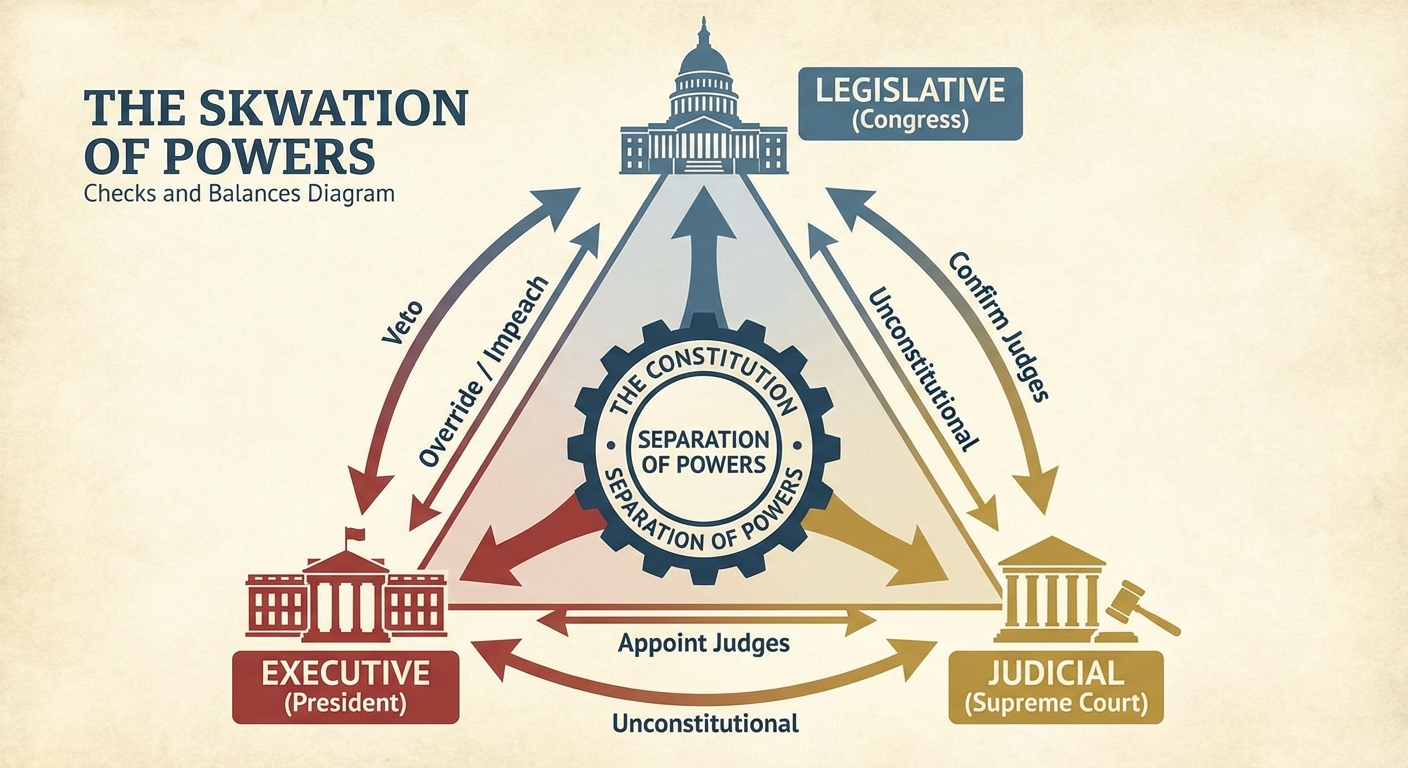
Ratification Debate: Federalists vs. Anti-Federalists
| Feature | Federalists | Anti-Federalists |
|---|---|---|
| Leaders | Hamilton, Madison, Jay | Jefferson, Patrick Henry, George Mason |
| View of Gov | Strong Central Government | States' Rights / Weak Central Gov |
| Supporters | Urban, wealthy, merchants | Rural, farmers, frontiersmen |
| Key Writing | The Federalist Papers (No. 10 & 51 argued distinct interests & checks and balances prevent tyranny) | Brutus No. 1 |
| Main Argument | Constitution is necessary for stability/economy | Constitution gives too much power; lacks Bill of Rights |
- Result: Federalists promised to add a Bill of Rights (first 10 amendments) to protect individual liberties, securing ratification.
3.7 The New Republic: Washington & Adams
George Washington (1789–1797)
Established precedents: The Cabinet, the two-term limit, and executive privilege.
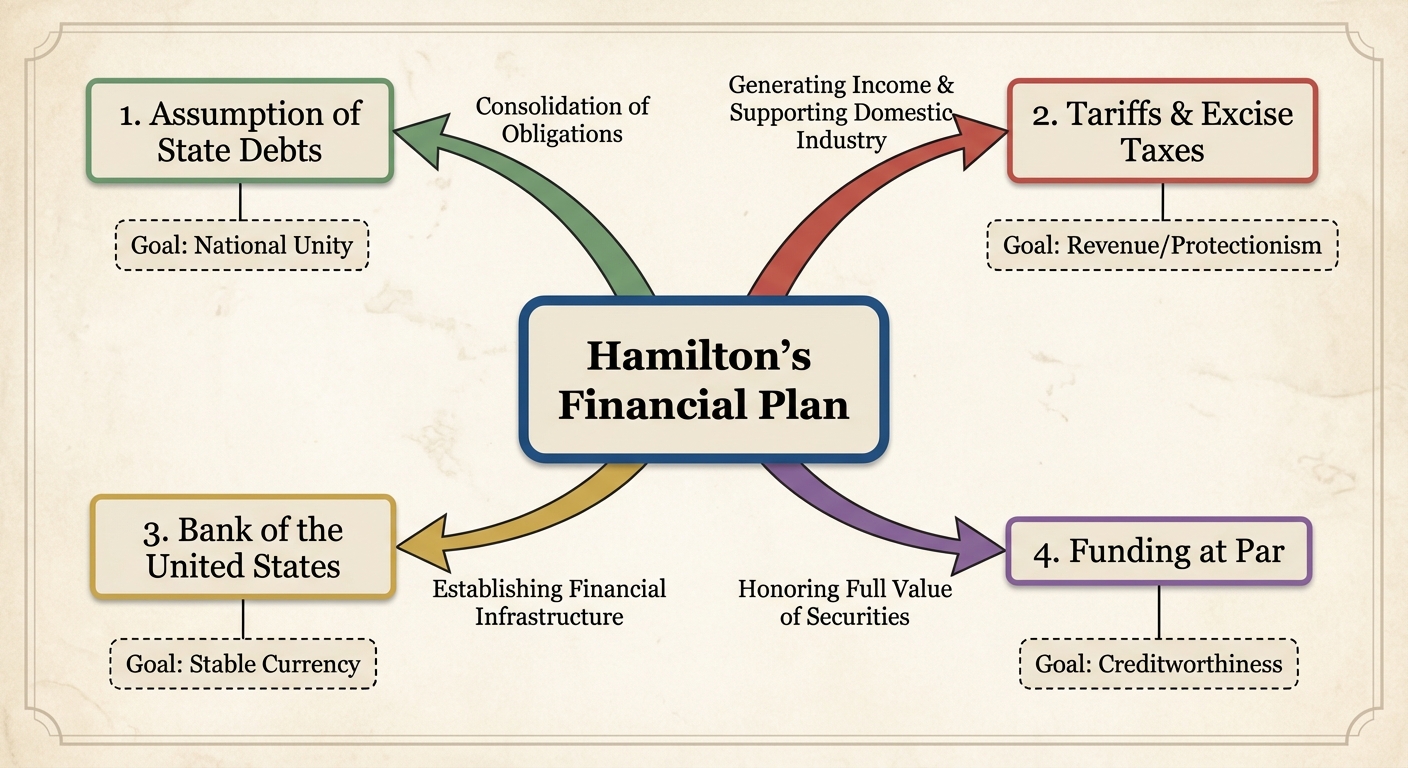
Hamilton’s Financial Plan
Secretary of Treasury Alexander Hamilton wanted to stabilize the economy.
- Assumption: Federal government assumes state war debts.
- Funding at Par: Pay debts at face value to build credit.
- National Bank (BUS): To hold funds and regulate currency.
- Constitutional Debate: Jefferson argued Strict Construction (not in Constitution = can't do it). Hamilton argued Loose Construction (Necessary and Proper Clause / Elastic Clause).
- Excise Taxes: Tax on whiskey.
The Whiskey Rebellion (1794)
Farmers in PA refused to pay the whiskey tax. Washington helped lead 13,000 troops to crush it.
- Significance: Demonstrated the power of the new federal government (contrast with Shays' Rebellion).
Foreign Policy
- French Revolution: Jefferson wanted to support France; Hamilton wanted to support Britain (trade). Washington issued the Proclamation of Neutrality (1793).
- Jay’s Treaty (1794): Unpopular treaty with Britain. Buying time to avoid war, but Britain did not stop seizing US ships (impressment).
- Pinckney’s Treaty (1795): Popular treaty with Spain. US gained right of deposit at New Orleans and access to the Mississippi River.
Washington’s Farewell Address (1796)
Warned against:
- Permanent foreign alliances (set the precedent for isolationism).
- Political parties (factions).
The First Party System
Despite warnings, two parties formed:
- Federalists (Hamilton/Adams): Strong central gov, pro-British, loose construction, supported manufacturing/bank.
- Democratic-Republicans (Jefferson/Madison): States' rights, pro-French, strict construction, supported the "yeoman farmer."
John Adams (1797–1801)
- XYZ Affair: French diplomats demanded a bribe to talk to US negotiators. Sparked the "Quasi-War" (undeclared naval war) and anti-French sentiment.
- Alien and Sedition Acts (1798): Made it harder for immigrants to vote (Alien) and illegal to criticize the government (Sedition). A violation of the 1st Amendment aimed at weakening Democratic-Republicans.
- Virginia and Kentucky Resolutions: Written secretly by Madison and Jefferson. Argued the Theory of Nullification—states could void federal laws they deemed unconstitutional.
The Revolution of 1800
Thomas Jefferson defeated John Adams.
- Significance: The First Peaceful Transfer of Power between opposing political parties. Proved the Constitutional system worked.
Common Mistakes & Pitfalls
- Mistake: Confusing the Declaration of Independence with the Constitution. The Declaration (1776) was a breakup letter/statement of ideals; it established no government. The Constitution (1788) established the legal framework of the US.
- Mistake: Thinking the American Revolution radicalized the social order. While political ideals were radical, the social hierarchy remained largely intact (slavery continued, women couldn't vote, wealthy elites still ruled).
- Mistake: Mixing up the First and Second Continental Congress. First (1774) = boycott/grievances. Second (1775) = managed the war/Declaration of Independence.
- Mistake: Forgetting the Northwest Ordinance when discussing the Articles of Confederation. It is the one major thing the Articles did right.
- Mistake: Assuming all colonists were Patriots. It was roughly 1/3 Patriot, 1/3 Loyalist, and 1/3 Neutral.