Executive Branch Structure, Powers, and Bureaucratic Function
Understanding the American Presidency
The Presidency is often viewed as the center of the American political system, yet the Constitution establishes it as an office of limited, enumerated powers interlaced with checks and balances. To master this unit, you must understand not just what the President can do according to Article II, but how the office has expanded over time through informal powers, media manipulation, and the vast federal bureaucracy.
The Foundational Document: Federalist No. 70
Before diving into specific powers, you must understand the rationale for a single executive. In Federalist No. 70, Alexander Hamilton argues for a unitary executive (a single president) rather than a committee.
- Key Argument: A single executive ensures "energy" in the government.
- Benefits: Decision-making, secrecy, and dispatch (speed) are easier with one person.
- Accountability: It is easier to assign blame and fix corruption in a single person than in a council where leaders can shift the blame.
Presidential Powers: Formal vs. Informal
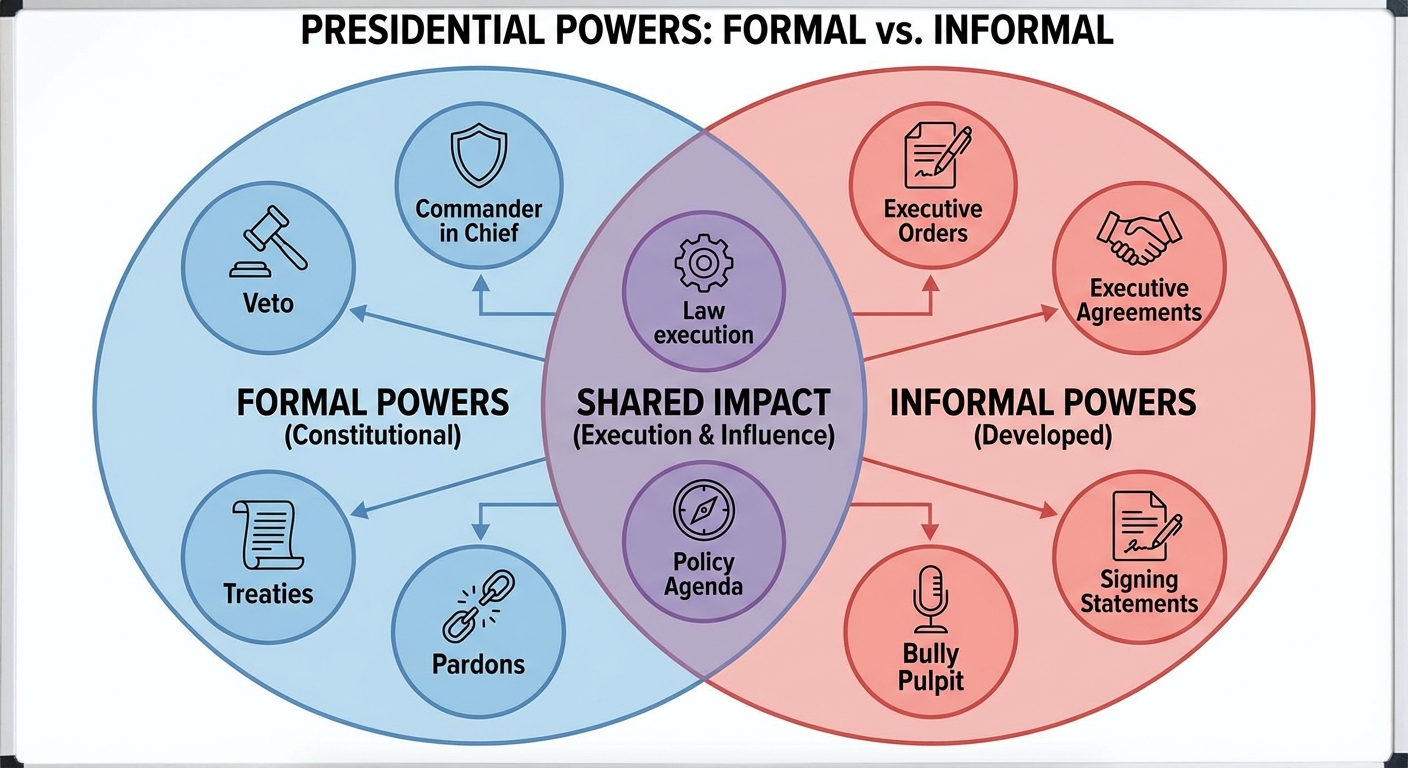
The powers of the President are categorized into Formal Powers (found explicitly in Article II of the Constitution) and Informal Powers (implied or established by custom/tradition).
Formal (Constitutional) Powers
These are powers strictly granted by the Constitution.
- Veto Power: The President can reject bills passed by Congress. Congress can override a regular veto with a 2/3 vote in both houses.
- Pocket Veto: If the President takes no action for 10 days and Congress adjourns during that period, the bill dies. This cannot be overridden.
- Commander in Chief: The President is the head of the armed forces, though only Congress can declare war.
- Treaties: The President creates treaties with foreign nations, but they require Senate ratification (2/3 vote).
- Appointments: The President nominates judges, cabinet members, and ambassadors. These require Senate confirmation (simple majority).
- Pardons: The power to forgive federal crimes (except in cases of impeachment).
Informal (Inherent) Powers
Presidents have interpreted their role to include powers not written in the Constitution to effectively execute the law.
- Executive Orders: Directives to the federal bureaucracy that carry the force of law without congressional approval. These are often used to bypass a gridlocked Congress, but they can be overturned by the next President.
- Executive Agreements: International agreements with foreign heads of state that do not require Senate ratification. These are politically binding but not legally binding on future presidents.
- Signing Statements: Written comments issued by a President while signing a bill into law, often indicating that they will not enforce certain provisions they believe are unconstitutional.
- Executive Privilege: The right to keep communications with advisors confidential to ensure candid advice (limited by United States v. Nixon—not absolute in criminal investigations).
| Feature | Treaty | Executive Agreement |
|---|---|---|
| Requires Senate Approval? | Yes (2/3 Vote) | No |
| Binding on Future Presidents? | Yes | No |
| Constitutional Basis? | Article II (Formal) | Implied (Informal) |
Presidential Communication and the Bully Pulpit
The President uses the media to influence public opinion, which in turn pressures Congress to pass the President's legislative agenda.
The Bully Pulpit
Coined by Theodore Roosevelt, the Bully Pulpit refers to the President's ability to use the prestige to the office to speak out on any issue. Because the President is the only nationally elected official, they command media attention unmatched by any member of Congress.
Modern Communication Tools
- State of the Union: A constitutionally mandated speech used to set the policy agenda for the coming year.
- Social Media & Broadcasts:
- Historically, FDR used "Fireside Chats" (radio) to speak directly to the people.
- Modern Presidents use social media (Twitter/X, Instagram) to bypass traditional media "gatekeepers" and communicate rapidly with the base.
The Executive Bureaucracy and Policy Implementation
The Bureaucracy is the collection of agencies, departments, and commissions that implement and ENFORCE federal laws. While the President heads the executive branch, power over the bureaucracy is shared with Congress.
Organization of the Bureaucracy
- Cabinet Departments: The 15 major departments (e.g., State, Defense, Education). Leaders (Secretaries) are appointed by the President and confirmed by the Senate.
- Independent Regulatory Commissions: Agencies that create industry rules (e.g., FCC, SEC, Federal Reserve). Commissioners have fixed terms and cannot be easily fired by the President, insulating them from political pressure.
- Government Corporations: Agencies that provide a service that could be private but is government-run (e.g., USPS, Amtrak).
Discretionary and Rule-Making Authority
Congress specifically writes laws broadly because they lack the technical expertise or time to micromanage details. They delegate discretionary power to bureaucrats.
- Discretionary Authority: The extent to which appointed bureaucrats can choose courses of action and make policies that are not spelled out in advance by laws.
- Rule-Making: The process by which the bureaucracy creates regulations (rules that have the force of law) to implement federal statutes.
- Example: Congress passes the Clean Air Act (broad goal). The EPA (bureaucracy) writes the specific scientific regulations on how many particles of carbon can be in the air (implementation).
Controlling the Bureaucracy (Checks and Balances)
Presidential Checks:
- Appointing agency heads who agree with their ideology.
- Issuing Executive Orders to shift agency priorities.
Congressional Checks (Oversight):
- Power of the Purse: Congress determines the budget for each agency.
- Committee Hearings: Congress summons agency heads to testify regarding their performance.
- Legislation: Congress can rewrite laws to restrict an agency's power.
Iron Triangles vs. Issue Networks
Bureaucracies do not work in isolation. They form relationships to secure power and funding.
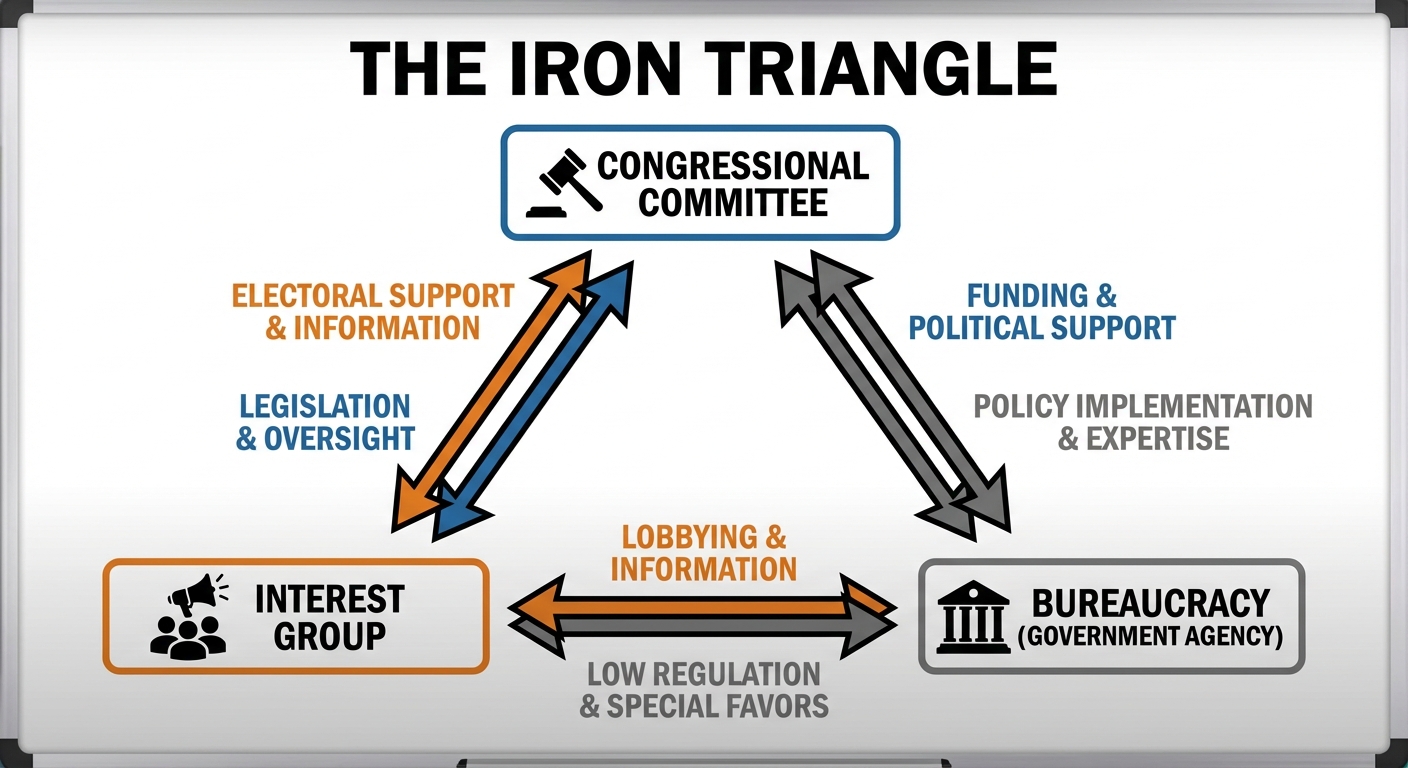
Iron Triangles: A long-standing, mutually beneficial relationship between three entities:
- A Bureaucratic Agency (Implements policy)
- A Congressional Committee (Makes laws/funding)
- An Interest Group (Lobbies/provides info)
- Characteristics: Stable, hard to break, transactional.
Issue Networks: A more fluid, complex network that includes lawyers, consultants, academics, and media members who debate a specific issue. Unlike Iron Triangles, these are temporary and dissolve once an issue is resolved.
Common Mistakes & Pitfalls
Confusing "Declaration of War" with "Making War":
- Mistake: Thinking the President can declare war.
- Correction: Only Congress declares war. The President is Commander in Chief and creates military strategy, but officially entering a state of war is a legislative power. While the War Powers Resolution (1973) attempted to limit the President's ability to deploy troops, it has generally been ineffective.
Treaties vs. Executive Agreements:
- Mistake: Thinking they are the same.
- Correction: Treaties survive after a President leaves office but are hard to pass (Senate 2/3 vote). Executive agreements are easier (no Senate) but can be canceled immediately by the next President.
Impeachment vs. Removal:
- Mistake: Thinking impeachment means the President is fired.
- Correction: Impeachment is merely the accusation (indictment) by the House of Representatives (simple majority). Removal happens only after a trial in the Senate (2/3 vote).
Cabinet Loyalty:
- Mistake: Assuming Cabinet secretaries always do exactly what the President wants.
- Correction: Cabinet secretaries often suffer from "divided loyalties." They are loyal to the President, but also to their department's goals and to the Congressional committees that fund them.