Exploiting Earth: Resource Extraction & Sustainability
Exploiting Earth: Resource Extraction & Sustainability
Resource extraction forms the backbone of industrial society, but the methods used to acquire materials—whether minerals, fish, or land space—have profound environmental consequences. This unit examines how humans remove resources from the lithosphere and hydrosphere, the ecological costs of doing so, and the frameworks necessary to manage these resources for the future.
Impacts of Mineral Resources: Mining
Mining is the extraction of valuable minerals or other geological materials from the Earth. The target material is known as the ore, while the waste rock removed to access the ore is called overburden or spoil.
Surface vs. Subsurface Mining
Mining methods fall into two broad categories based on the depth of the resource.
- Surface Mining: Used for shallow deposits. The vegetation and soil are removed to access minerals.
- Strip Mining: Removing strips of soil/rock to expose ore (common for coal).
- Open-pit Mining: Creation of a large hole to extract massive deposits (common for copper).
- Mountaintop Removal: Using explosives to remove the top of a mountain to access coal seams.
- Subsurface Mining: Used for deep deposits. Tunnels and shafts are dug underground.
- Pros: Disturbs less land surface area than surface mining.
- Cons: Much more dangerous for workers (collapse, lung disease) and expensive.
Environmental Impacts of Mining
The processing of ore creates tailings—the liquid and solid waste left over after the valuable metal is separated from the rock. Tailings often contain toxic chemicals like cyanide or mercury.
Acid Mine Drainage (AMD)
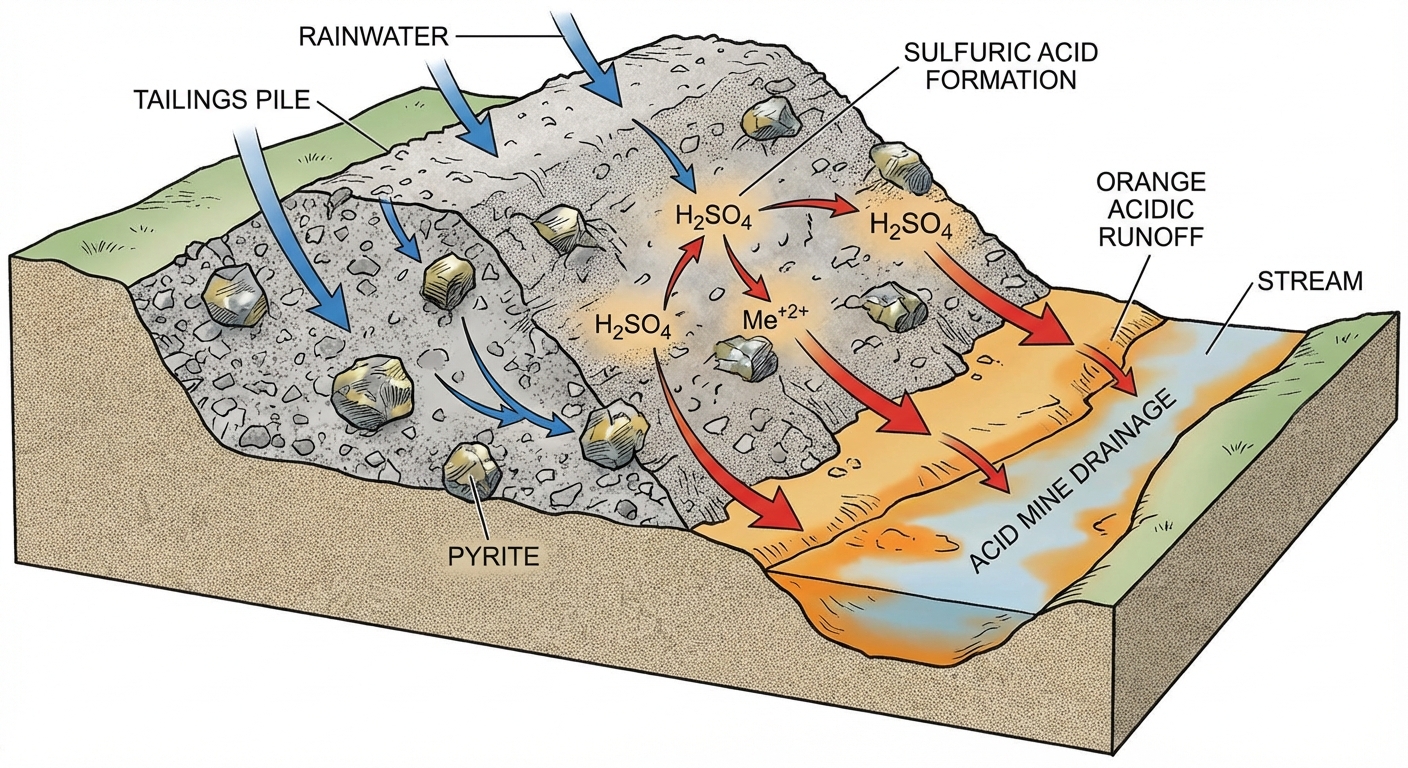
One of the most destructive impacts is Acid Mine Drainage. This occurs when sulfur-compounds (like iron pyrite) in mine tailings or abandoned tunnels are exposed to air and water.
In this process, Iron Sulfide ($FeS2$) reacts to form Sulfuric Acid ($H2SO_4$). This lowers the pH of nearby streams, killing aquatic life and leaching heavy metals like lead and arsenic into the water supply.
| Feature | Surface Mining | Subsurface Mining |
|---|---|---|
| Cost | Lower | Higher |
| Safety | Safer for workers | Dangerous (cave-ins, black lung) |
| Environmental Impact | High habitat destruction; heavy erosion | Acid mine drainage; subsidence (ground sinking) |
Remediation
Reclamation is the process of restoring land that has been mined to a natural or economically usable state. This involves:
- Re-contouring the land to its original topography.
- Replacing topsoil.
- Planting native vegetation to prevent erosion.
Impacts of Overfishing
Fishery collapse is a classic example of the Tragedy of the Commons, where individual fishers deplete a shared resource for personal gain, leading to the collapse of the resource for everyone.
Industrial Fishing Methods
To maximize catch, commercial fleets use aggressive techniques:
- Bottom Trawling: Dragging heavy nets along the ocean floor. This scrapes away coral reefs and benthic habitats, essentially clear-cutting the ocean floor.
- Long-line Fishing: Putting out lines up to 50 miles long with thousands of baited hooks.
- Drift Nets/Gill Nets: Massive nets that hang vertical in the water column.
The Problem of Bycatch
Bycatch refers to the unintentional capture of non-target species. Roughly one-third of the global catch is bycatch.
- Examples: Sea turtles caught in shrimp trawls, or dolphins caught in tuna nets.
Fishery Collapse
A fishery is considered "collapsed" when the annual catch declines to less than 10% of its historic average. This disrupts the food web; for example, overfishing shark populations can lead to an explosion of ray populations, which then deplete scallop fisheries (a top-down trophic cascade).
Impacts of Urbanization
Urbanization is the shift of populations from rural to urban areas. As of 2008, more than 50% of the human population lives in cities. While high-density living can be energy-efficient, the process of building cities alters the environment drastically.
Impervious Surfaces and the Water Cycle
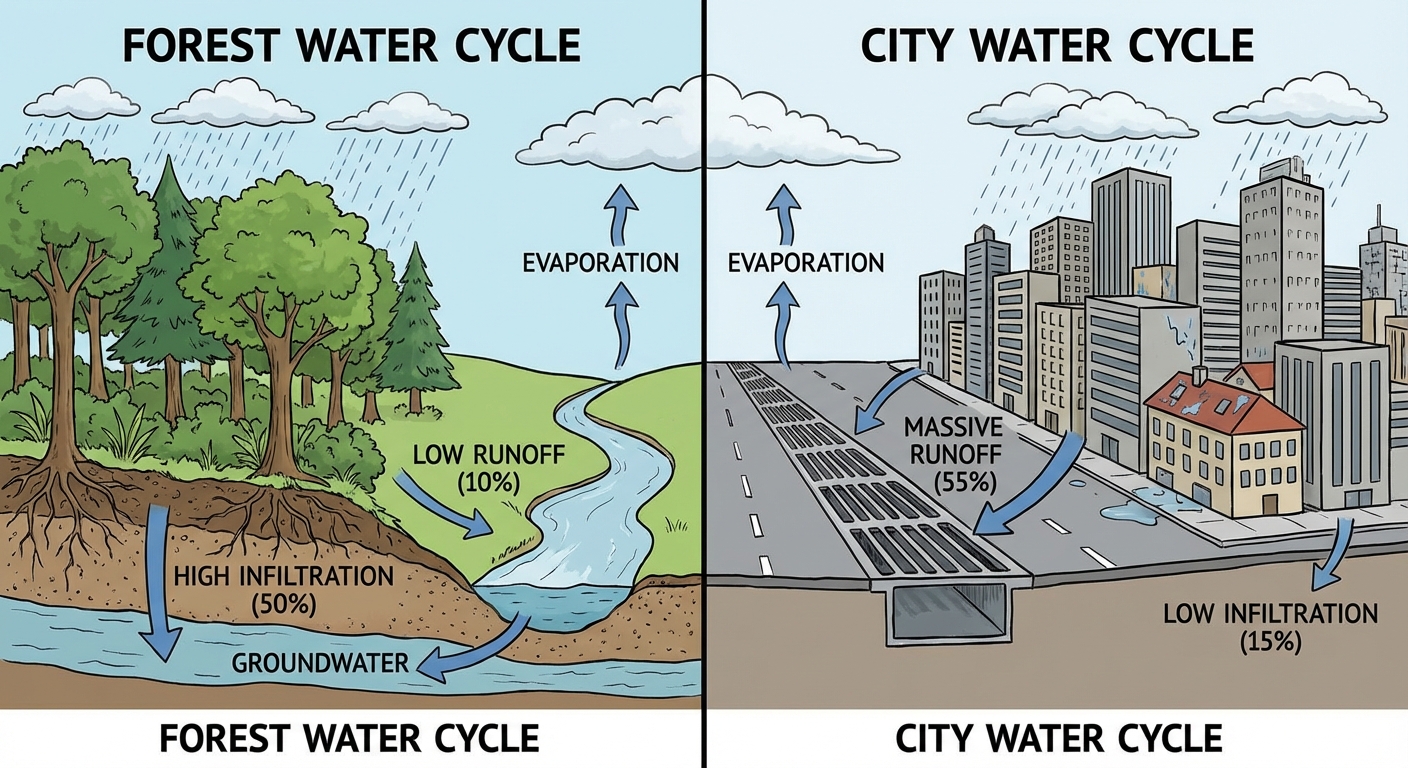
Natural landscapes (soil, trees) are replaced by impervious surfaces—man-made structures like roads, parking lots, and rooftops that do not allow water to penetrate the soil.
- Reduced Infiltration: Water cannot recharge groundwater aquifers.
- Increased Runoff: Stormwater moves rapidly across pavement, picking up oil, gasoline, and fertilizers, delivering them directly to local waterways.
- Flooding: Without soil to act as a sponge, flash floods become frequent.
Urban Sprawl
Urban Sprawl is the low-density expansion of cities into surrounding agricultural or wild lands. It is characterized by:
- Unlimited outward expansion.
- zoning laws that separate residential and commercial areas.
- Car Dependence: Because homes are far from businesses, mass transit is inefficient, leading to increased fossil fuel consumption and $CO_2$ emissions.
Urban Heat Island Effect
Cities are generally hotter than surrounding rural areas. Asphalt and concrete have a low albedo (they absorb solar energy rather than reflecting it). Waste heat from cars, air conditioners, and industry further raises the temperature.
Introduction to Sustainability
Sustainability is defined as using resources in a way that meets current human needs without compromising the ability of future generations to meet their own needs.
Maximum Sustainable Yield (MSY)
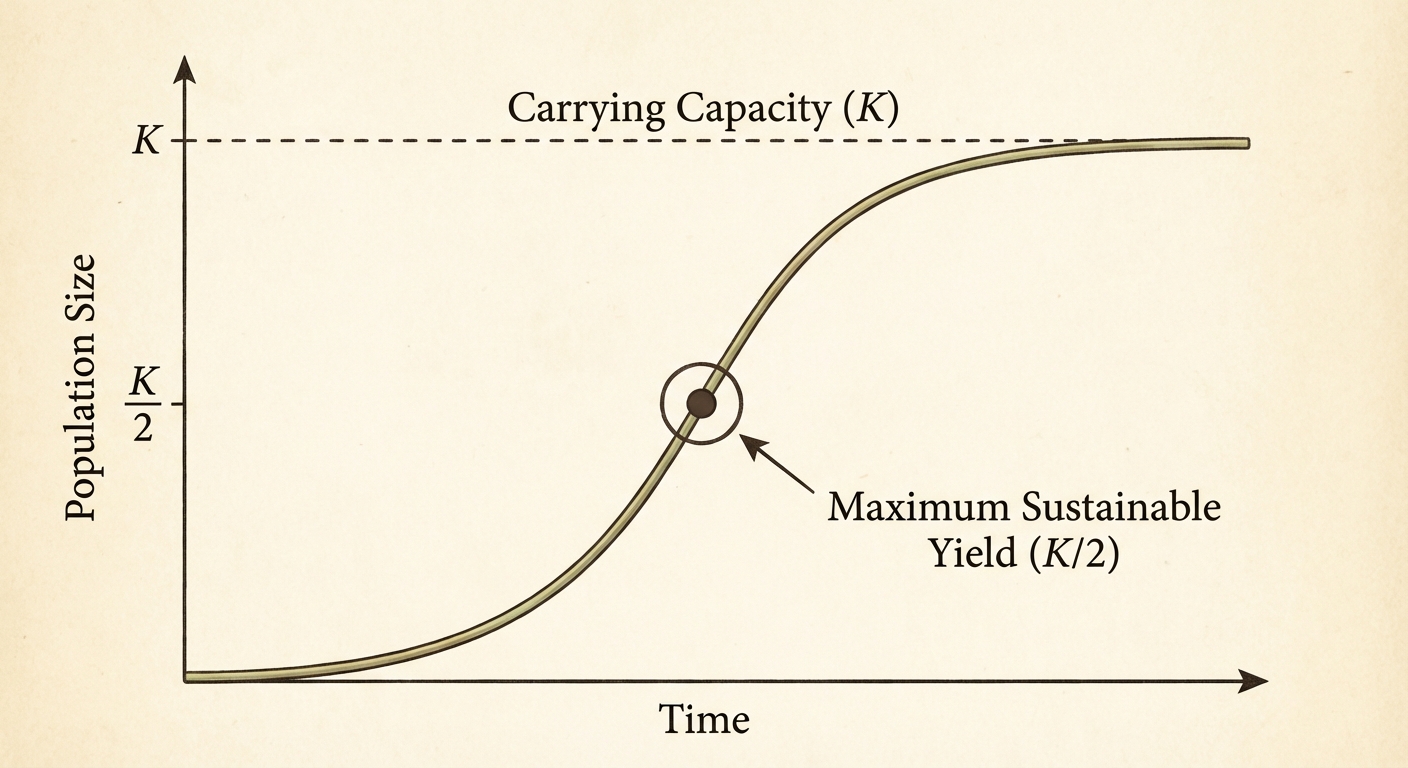
Resource managers must calculate the Maximum Sustainable Yield (MSY). This is the maximum amount of a renewable resource that can be harvested without reducing the available supply for future generations.
In population ecology, the fastest growth rate occurs when the population is at half of its carrying capacity ($K$).
- If you harvest below MSY, you are under-utilizing the resource (economically inefficient).
- If you harvest above MSY, the population cannot replenish fast enough, leading to depletion.
Indicators of Sustainability
To determine if a practice is sustainable, environmental scientists look at:
- Biodiversity: High diversity suggests a healthy ecosystem.
- Food Production per Capita: Must remain stable or increase.
- Global Surface Temperature: High $CO_2$ levels indicate unsustainable fossil fuel use.
Common Mistakes & Pitfalls
- Resource vs. Reserve:
- Mistake: Using these terms interchangeably.
- Clarification: A Resource is the total amount of a material that exists. A Reserve is the amount that can be extracted economically with current technology. If prices rise, reserves increase, even if the total resource doesn't change.
- Generalizing "Pollution":
- Mistake: Saying "Mining causes pollution."
- Clarification: Be specific. Use terms like Acid Mine Drainage, Particulate Matter (dust), or Heavy Metal Leaching.
- Urbanization vs. Sprawl:
- Mistake: Thinking all urbanization is bad.
- Clarification: High-density vertical cities (urbanization) actually have a lower per-capita carbon footprint than low-density suburbs (Urban Sprawl) because of reduced driving and shared heating/cooling walls.
- MSY Misconception:
- Mistake: Thinking MSY is at the maximum population size.
- Clarification: At maximum population (Carrying Capacity, $K$), growth is zero because resources are limited. MSY occurs where the slope of the growth curve is steepest ($K/2$), not at the top.