Chronicles of Catastrophe: Pliny the Younger and the Destruction of Pompeii
Historical and Biographical Context
To understand the gravity of Pliny's letters, you must first understand the cast of characters, the setting, and the unique nature of the primary source material. Unlike the impersonal histories of Livy or Caesar, these are personal correspondences.
The Dramatis Personae
- Gaius Plinius Caecilius Secundus (Pliny the Younger): The author of the letters. At the time of the eruption (79 CE), he was approximately 17 or 18 years old. He writes these letters years later to the historian Tacitus.
- Gaius Plinius Secundus (Pliny the Elder): The author’s uncle and adoptive father. He was a famous naturalist (author of the Natural History), admiral of the Roman fleet at Misenum, and strict scholar. He dies during the eruption.
- Cornelius Tacitus: The famous Roman historian and recipient of these letters. He asked Pliny to provide an account of his uncle's death so he could record it accurately for posterity.
- Rectina: The wife of Tascus, whose message serves as the catalyst changing Pliny the Elder's scientific mission into a rescue mission.
- Pomponianus: A friend located at Stabiae whom Pliny the Elder tries to rescue and eventually stays with before dying.
Geography of the Bay of Naples
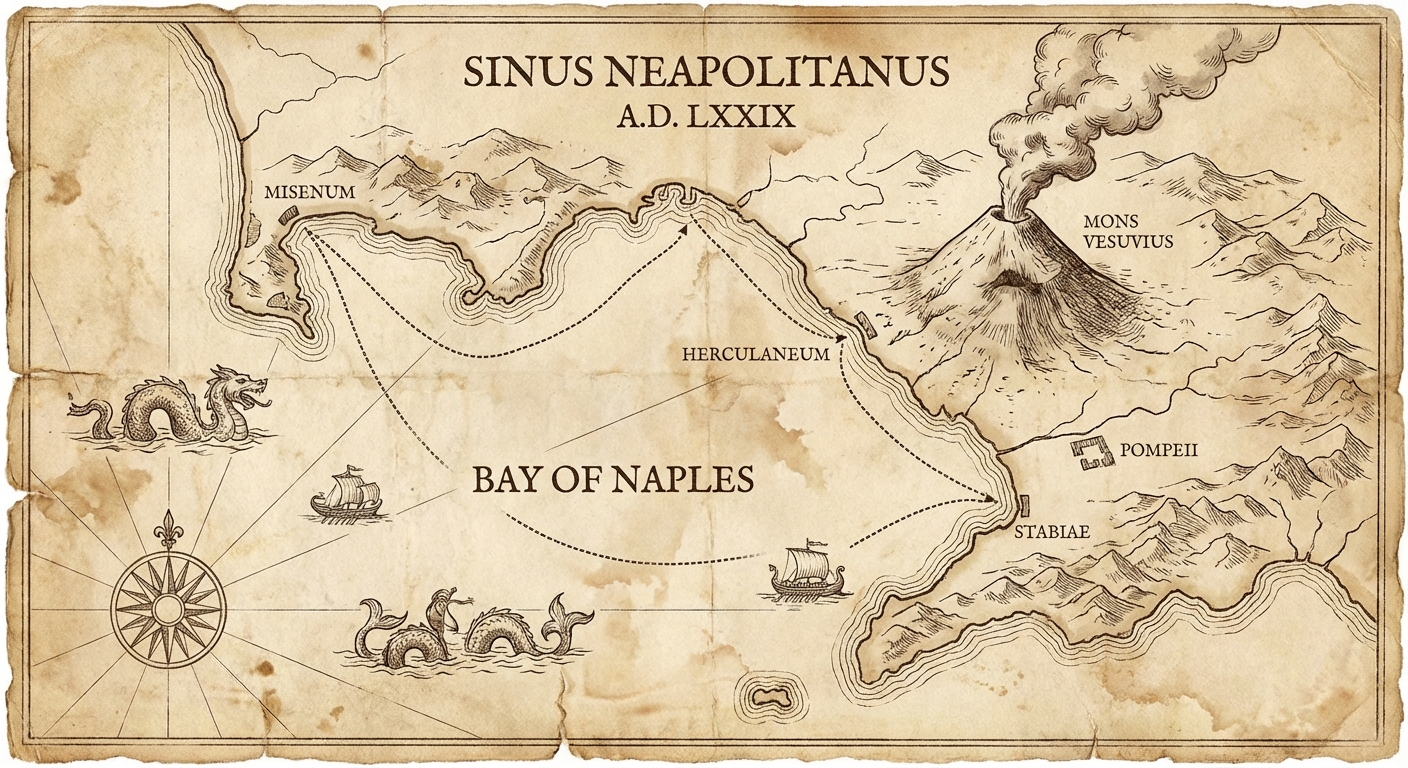
Understanding the geography is crucial for tracking the movement in Letter 6.16:
- Misenum: The naval base where the Plinys are stationed (Northwest of Vesuvius across the bay). This is where the story begins.
- Mt. Vesuvius: The epicenter.
- Herculaneum: A town at the foot of the volcano (buried by pyroclastic surges).
- Pompeii: Southeast of the volcano (buried by ash and pumice).
- Stabiae: South of Pompeii. Pliny the Elder sails here to join Pomponianus.
The Date and Event
- Date: Traditionally August 24, 79 CE (though archaeological evidence suggests October/Autumn).
- Phenomenon: Plinian Eruption. The term "Plinian" in modern volcanology describes explosive eruptions with a high column of gas and ash, named specifically after Pliny's description.
Epistulae 6.16: The Death of Pliny the Elder
This letter focuses on the actions of the uncle. It is a tribute to his heroism and scientific curiosity. Pliny structures the narrative to show his uncle shifting from a scholar to a hero.
The Appearance of the Cloud
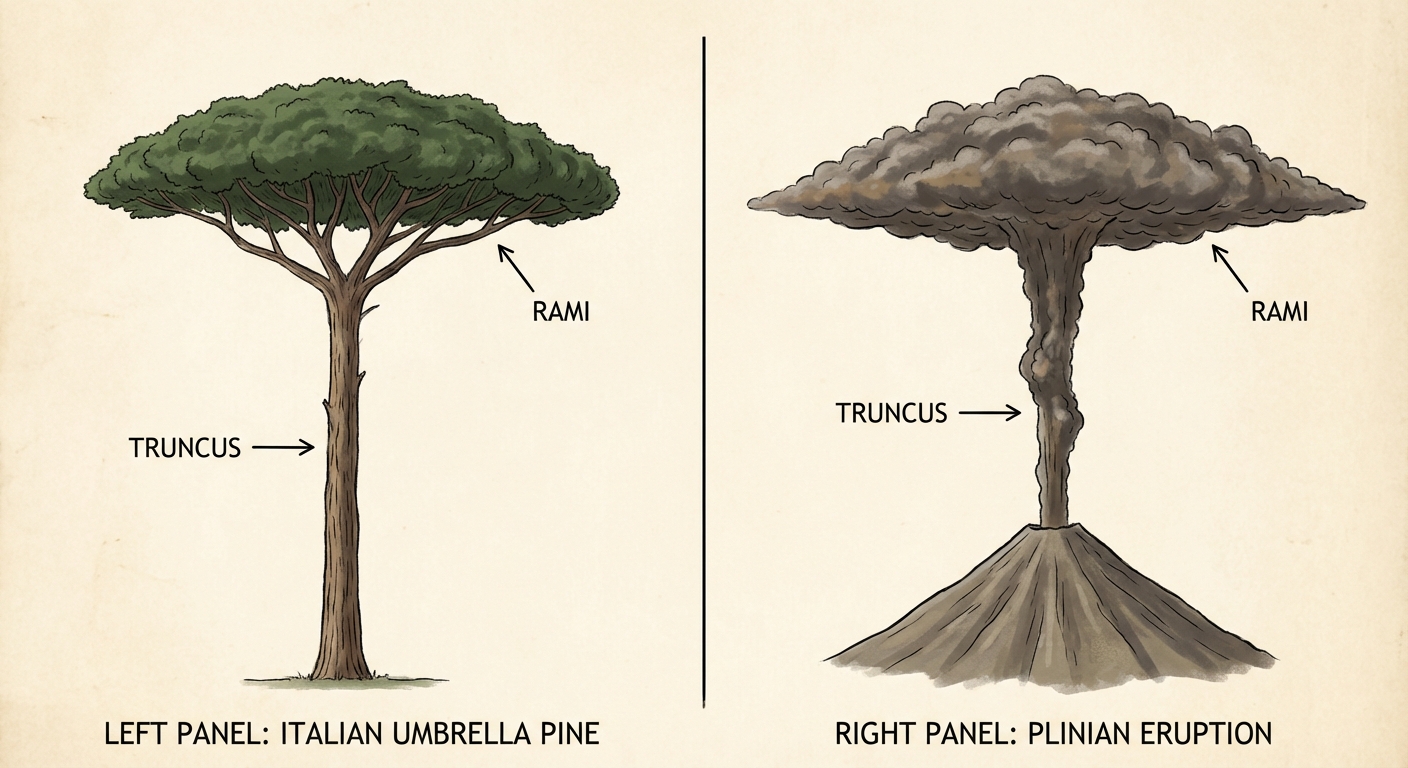
Pliny vividly describes the initial eruption cloud using a famous simile: the Umbrella Pine (pinus).
"Nubes — incertum procul intuentibus ex quo monte … — similitudinem et formam non alia magis arbor quam pinus expresserit."
Analysis:
- The cloud rose high on a "trunk" (the blast column) and spread out into "branches" (the ash mushrooming out as it lost momentum).
- It appeared sometimes bright white (candida), sometimes dirty and spotted (sordida et maculosa), depending on if it carried earth or ash.
The Shift in Motivation
- Scientific Curiosity: Initially, the Elder wants to take a fast boat (liburnica) to inspect the phenomenon closer.
- The Call to Duty: He receives a note (codicillos) from Rectina, who is terrified and trapped at the foot of the mountain. Her only escape is by boat.
- Heroism: "He changed his plan; what he had begun with a studious spirit, he carried out with a huge [heroic] one" ("vertit ille consilium et quod studioso animo inchoaverat obit maximo").
The Journey to Stabiae
As he sails toward the danger, Pliny emphasizes his uncle's fearlessness using the rhetorical device of Asyndeton (lack of conjunctions) to speed up the narrative.
- The Danger: Ashes (cinis) fall on the ships, hotter and thicker (calidior et densior). Then pumice (pumices) and black stones.
- The Helmsman: Advises turning back.
- The Famous Quote: "Fortes fortuna iuvat: Pomponianum pete!" ("Fortune favors the brave/strong: seek Pomponianus!"). Note: This is frequently mistranslated. It is present tense (iuvat), not future.
The Death Scene
At Stabiae, the situation worsens. The courtyard fills with ash. They tie pillows (cervicalia) to their heads with linen cloths (linteis) as protection against falling stones.
- The Environment: It is daytime elsewhere, but there it is the blackest night (nox omnibus noctibus nigrior densiorque).
- The End: Pliny the Elder, possibly suffering from asthma or a heart condition, collapses from the toxic fumes (crassiore caligine spiritu obstructo). His body is found later, looking more like a sleeper than a corpse (quiescenti quam defuncto similior).
Epistulae 6.20: The Survivor's Perspective
While 6.16 is heroic and objective, 6.20 is subjective, psychological, and terrifying. It engages with the concept of pathos.
The Atmosphere of Terror
Pliny the Younger remains at Misenum with his mother. The earthquakes (tremor terrae) become so violent that everything seems not just to move, but to be overturned.
The Decision to FLEE
- The Friend: A friend from Spain insists they leave. He chides Pliny for reading Livy while the world ends.
- The Departure: They leave the town. A panicked crowd follows (vulgus), pushing and shoving. This is described as a "semblance of prudence" (prudentiae species)—following the crowd rather than thinking for oneself.
The Phenomena on the Road
Pliny experiences three distinct terrors:
- Carriages running wild: Even on flat ground, vehicles wouldn't stay still, even when blocked with stones.
- The Sea: The sea is sucked back (mare in se resorberi), leaving marine life stranded on dry sand.
- The Cloud: A black, scary cloud (nubes atra) broken by zig-zag fire (lightning), compared to "sheets of lightning" (fulguribus).
The Darkness (Tenebrae)
The cloud descends. Pliny urges his mother to leave him, but she refuses.
"Vix consideramus, et nox — non qualis illunis aut nubila, sed qualis in locis clausis lumine exstincto."
Simile Analysis: The darkness was not like a moonless or cloudy night (natural darkness), but like being in a closed room with the lamp put out (unnatural, suffocating darkness).
Auditory Imagery
Pliny uses sound to heighten the fear:
- The wailing of women (ululatus feminarum)
- The crying of infants (infantum quiritatus)
- The shouting of men (clamor virorum)
- People seeking parents, children, or spouses by voice alone (vocibus requirebant, vocibus noscitabant).
Some prayed for death out of fear of dying (mortem precarentur). Many believed it was the eternal night of the world (aeternam illam… noctem).
Grammar and Syntax Review
Pliny's Latin is "Silver Age"—it is more rhetorical and slightly different from the "Golden Age" Latin of Cicero or Caesar. Master these structures.
1. The Ablative Absolute
Pliny loves using these to set the scene or describe the sequence of events without using a full clause.
The Formula:
- Example: Cinere mixto (With ash having been mixed in)
- Translation Tip: Start with "With…" or convert to a clause like "When the ash was mixed in…" or "Because the ash…"
2. Indirect Statement (Oratio Obliqua)
Frequent in these letters because Pliny reports what people said, thought, or heard.
The Formula:
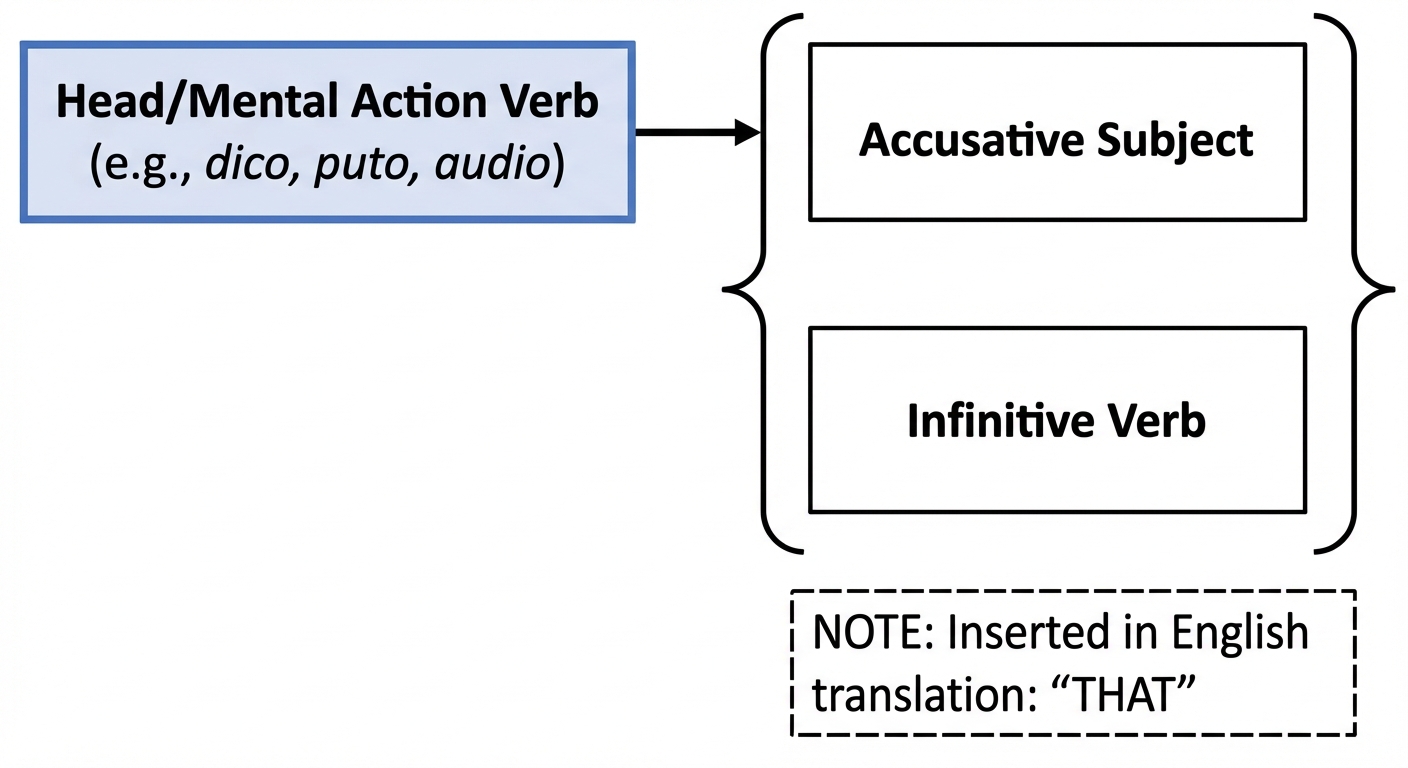
- Example: Credit se evasurum esse. (He believes that he will escape.)
- Rule: The tense of the infinitive is relative to the main verb.
- Present Inf = Same time as main verb.
- Perfect Inf = Time before main verb.
- Future Inf = Time after main verb.
3. Asyndeton and Polysyndeton
- Asyndeton: No conjunctions (e.g., "We ran, we fell, we cried"). creates panic, speed, or chaos.
- Polysyndeton: Many conjunctions (e.g., "We ran and we fell and we cried"). Creates a sense of overwhelming magnitude or an endless list.
4. Supine (Accusative)
Used to express purpose with verbs of motion.
- Example from syllabus: felicitati suae (dative) vs. cases where visum (to see/view) might be used as a supine (e.g., venit visum - he came to see).
Common Mistakes & Pitfalls
1. Confusing the Plinys
- Mistake: Thinking the narrator dies.
- Correction: The narrator is Pliny the Younger. He survives and writes the letter. Pliny the Elder is the uncle who dies at Stabiae. Always check who the subject of the verb is.
2. "Frequens" False Friend
- Mistake: Translating frequens as "frequent."
- Correction: In descriptions of people or places (like frequens tegeticula), it usually means crowded, thick, or numerous.
3. Relative Time in Participles
- Mistake: Translating a perfect participle as happening now.
- Correction: Perfect passive participles happen before the main verb. Present active participles happen at the same time.
- Timorem precans (Praying [while] fearing)
- Timore superato (With fear [having been] overcome)
4. The "Pine Tree" Simile
- Mistake: Thinking Pliny compares the cloud to a Christmas tree (coniferous cone shape).
- Correction: It is an Umbrella Pine (Pinus pinea)—a tall, bare trunk with a flat, spreading canopy at the top. This nuance is critical for the visual accuracy of the translation.
5. Historic Present
- Mistake: Losing points on translation for switching tenses randomly.
- Correction: Pliny uses the Present Tense to describe past actions to make them vivid (Historic Present). You may translate as past tense in English for flow, OR keep it present for vividness, but be consistent within the sentence.