AP Biology Study Notes: Organismal Regulation
Introduction to Homeostasis and Feedback
Before diving into specific loops, we must define the ultimate goal of these systems: Homeostasis.
In biological systems, homeostasis does not mean keeping conditions exactly the same at all times. Instead, it refers to dynamic homeostasis (or dynamic equilibrium). Conditions within an organism (like temperature, pH, or glucose levels) fluctuate within a viable range around a set point.
To maintain this internal stability despite external changes, organisms rely on feedback loops. A feedback loop is a self-regulatory system where the output of a process affects the input.
The Components of a Feedback Loop
Regardless of the type, most loops share three specific components:
- Receptor (Sensor): Detects the stimulus (a change in the internal environment).
- Control Center: Processes the signal and compares it to the set point.
- Effector: The organ or tissue that carries out the response to adjust the condition.
Negative Feedback Mechanisms
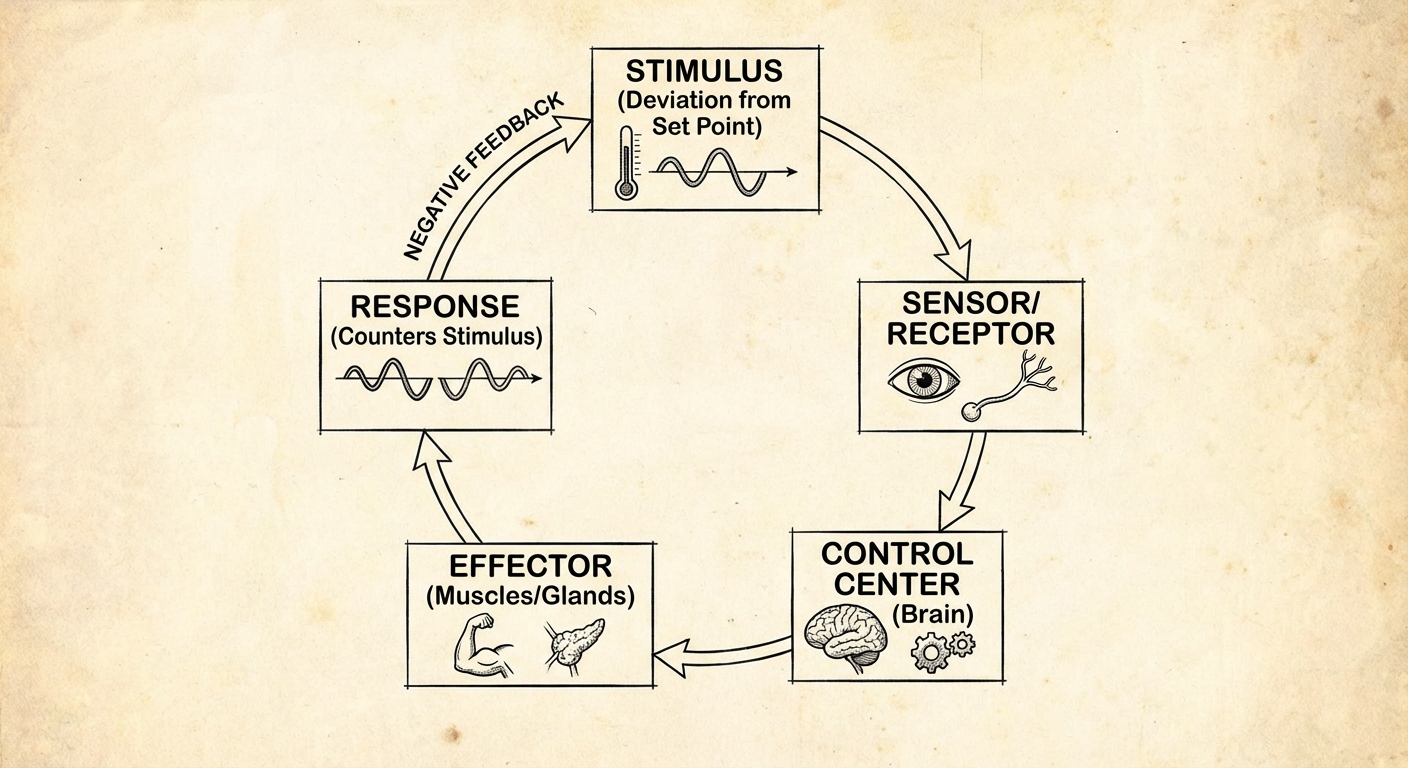
Negative Feedback is the primary mechanism of homeostasis.
Definition
In negative feedback, the system responds to a stimulus by reducing or opposing it. The response counteracts the disruption, returning the system to its set point. If a level is too high, the body lowers it; if it is too low, the body raises it.
Key Characteristics
- Goal: Stabilization.
- Graph pattern: Oscillation (wavy lines) around a flat set point line.
- Prevalence: Most common type of biological regulation.
Real-World Example 1: Thermoregulation
Humans maintain a body temperature around 37°C.
- Stimulus: Body temperature rises (e.g., exercise).
- Response: Blood vessels dilate (vasodilation) and sweat glands secrete fluid (evaporative cooling).
- Result: Body temperature drops back to the set point.
- Opposite: If the body is cold, vessels constrict (vasoconstriction) and muscles shiver to generate heat.
Real-World Example 2: Blood Glucose Regulation
This is a classic AP Biology exam topic. It involves the pancreas acting as both sensor and effector, utilizing two antagonistic hormones: Insulin and Glucagon.
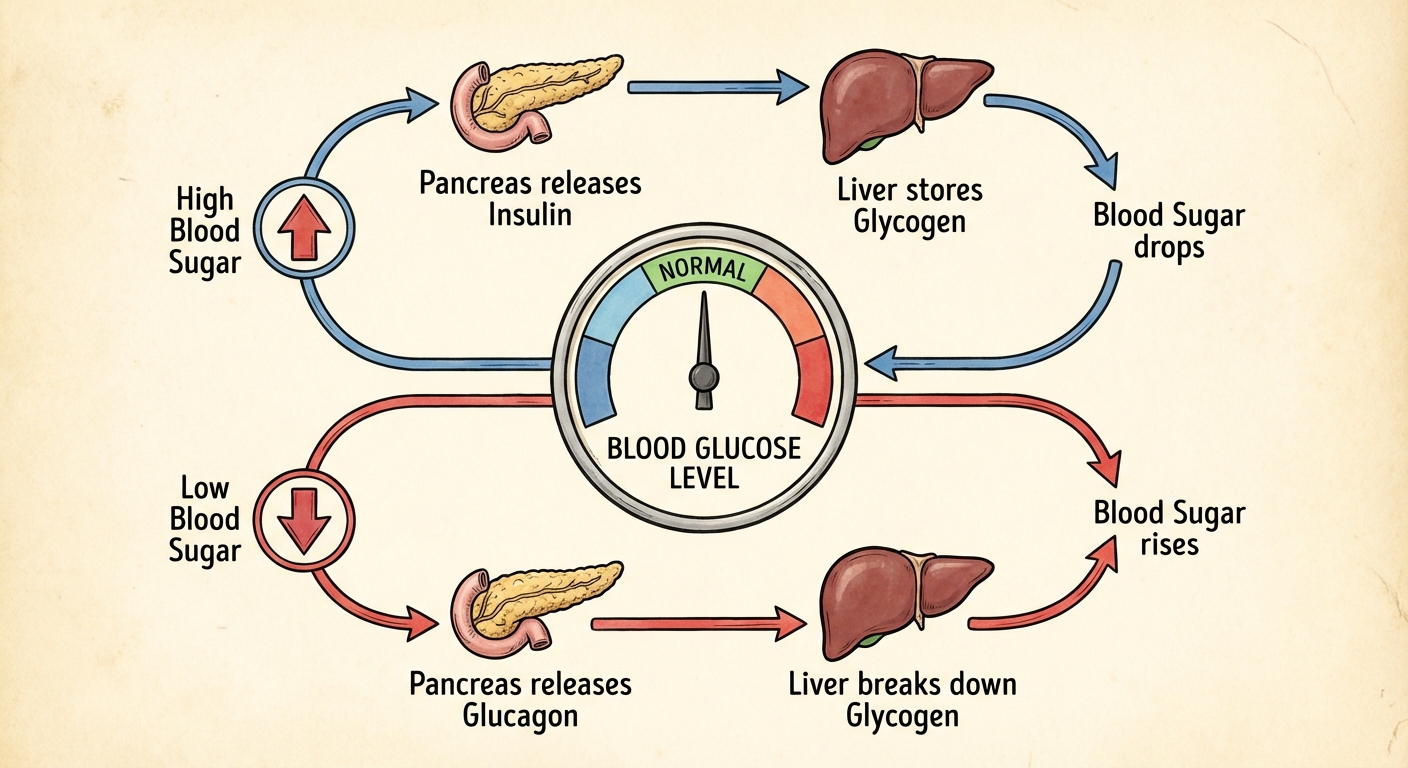
Scene A: High Blood Sugar (After a meal)
- Stimulus: Blood glucose levels rise.
- Sensor/Effector: Beta cells in the pancreas promote the release of insulin.
- Action: Insulin signals cells to take in glucose and the liver to store glucose as glycogen.
- Result: Blood glucose levels decrease.
Scene B: Low Blood Sugar (Fasting)
- Stimulus: Blood glucose levels drop.
- Sensor/Effector: Alpha cells in the pancreas promote the release of glucagon.
- Action: The liver breaks down glycogen into glucose and releases it into the blood.
- Result: Blood glucose levels increase.
Memory Aid:
- Insulin makes glucose go INto cells.
- Glucagon is secreted when glucose is GONe.
Positive Feedback Mechanisms
Positive Feedback mechanisms amplify responses and processes.
Definition
In positive feedback, the response reinforces or exaggerates the stimulus, moving the system away from its initial set point. Instead of shutting off the stimulus, the system increases the intensity of the stimulus until a specific outcome takes place.
Key Characteristics
- Goal: Amplification to reach a completion point.
- Graph pattern: Exponential growth or a sharp spike followed by a drop-off.
- Prevalence: Less common; usually associated with specific lifecycle events or emergencies.
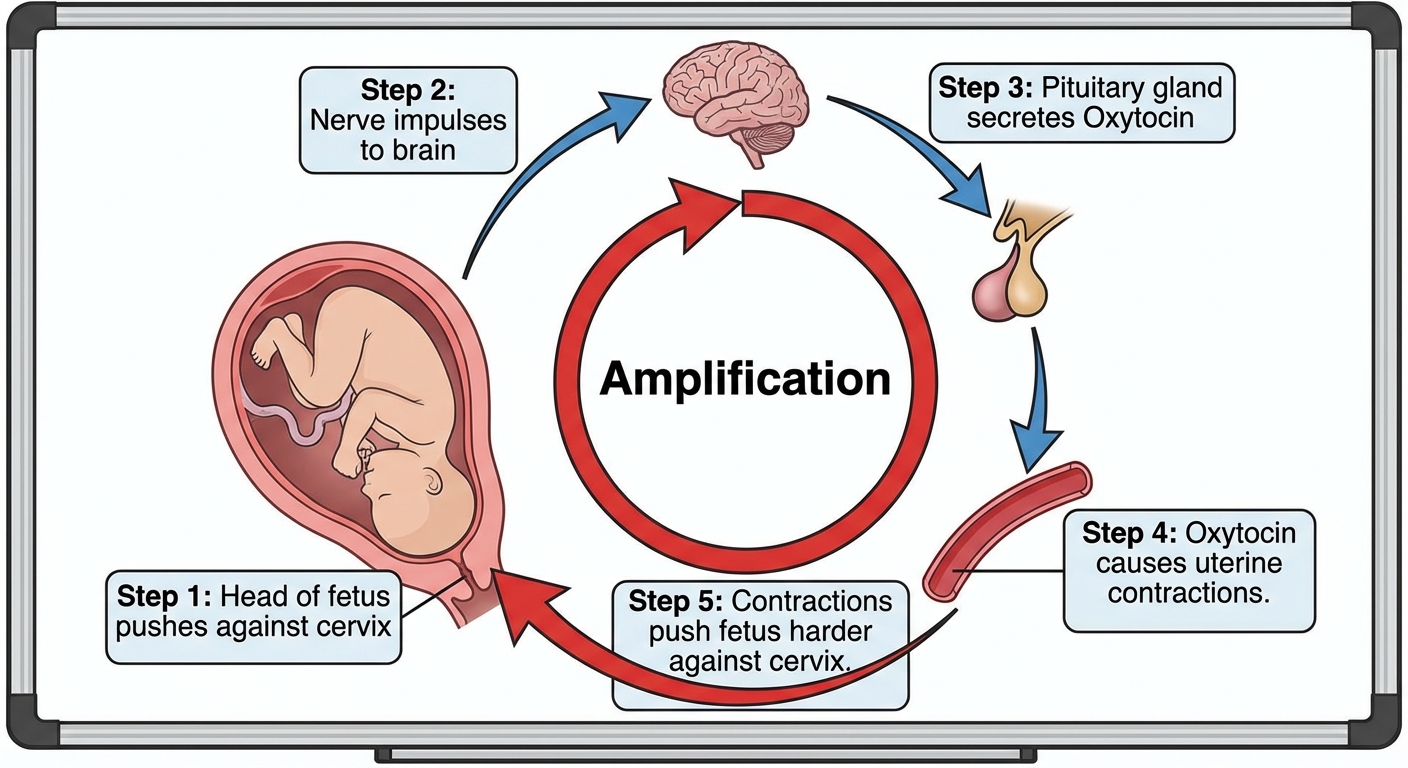
Real-World Example 1: Childbirth (Labor)
- Stimulus: The baby's head pushes against the cervix.
- Signal: Nerve impulses transmit to the brain.
- Response: The pituitary gland releases oxytocin.
- Amplification: Oxytocin causes the uterus to contract more forcefully, pushing the baby's head harder against the cervix.
- Loop: This triggers more oxytocin release. The cycle stops only when the baby is born (the stimulus is removed).
Real-World Example 2: Fruit Ripening
- Stimulus: An apple ripens and releases ethylene gas.
- Response: Ethylene signals neighboring apples (or parts of the same apple) to ripen.
- Amplification: Ripening fruit produces more ethylene.
- Result: The entire batch ripens (and eventually rots) simultaneously.
Alteration of Feedback Loops
The curriculum (IST-1.C) explicitly requires understanding what happens when these systems fail. A disruption in a feedback loop can lead to disease or death.
Diabetes Mellitus
Diabetes is a failure of the negative feedback loop regulating insulin.
| Type | Mechanism of Failure | Consequence |
|---|---|---|
| Type 1 | Autoimmune destruction of pancreatic beta cells. | The body cannot produce insulin. Glucose remains high in the blood but cells cannot access it. |
| Type 2 | Cells stop responding to insulin signal (Insulin Resistance). | The pancreas makes insulin, but the signal pathway fails to uptake glucose. |
Graves' Disease
An autoimmune disorder affecting the thyroid. Antibodies mimic TSH (Thyroid Stimulating Hormone), continuously stimulating the thyroid to release Thyroxine. The negative feedback mechanism that usually shuts off TSH fails to stop the antibodies, leading to hyperthyroidism.
Summary Comparison
| Feature | Negative Feedback | Positive Feedback |
|---|---|---|
| Direction of Change | Opposes the initial stimulus | Amplifies the initial stimulus |
| Relation to Homeostasis | Maintains stability (Set Point) | Moves away from stability to complete a task |
| Duration | Continuous/Long-term maintenance | Short-term/Episodic |
| Examples | Thermoregulation, Blood Sugar, Osmoregulation | Childbirth, Blood Clotting, Lactation |
Common Mistakes & Pitfalls
"Positive is good, Negative is bad"
- Correction: In Biology, "Negative" means negation (subtraction/reversal) of a stimulus, not "bad outcomes." "Positive" means addition/amplification, not "good outcomes." In fact, uncontrolled positive feedback (like a runaway fever) can be fatal.
Confusing Homeostasis with Stagnation
- Correction: Never describe homeostasis as a flat line. Always describe it as a fluctuation within a narrow range. If you flatline, you are dead.
Misinterpreting Graphs
- Correction: If a graph shows a variable going up and down around an average, it is negative feedback. If a graph shows a variable shooting up exponentially until an event occurs, it is positive feedback.
Forgetting the "Stop" Signal in Positive Feedback
- Correction: Students often forget that positive feedback must have a definitive end point (e.g., the baby is born, the cut is clotted). Without an endpoint, the organism exhausts its resources.