Strategies for Mastery in Unit 1: Latin Prose
Vocabulary and Word Frequency
Unit 1 is unique in the AP Latin curriculum as it is "Teacher's Choice." This means you aren't tied to the specific syllabus of Bellum Gallicum (Caesar) or the Aeneid (Vergil) just yet. Instead, this unit functions as a boot camp for the skills required to read unadapted Latin prose. Success here begins with moving away from looking up every single word.
The Importance of High-Frequency Vocabulary
In AP Latin, efficiency is key. You cannot rely on a dictionary during the exam, and checking a dictionary every ten seconds during homework breaks your cognitive flow. You must master the Core Vocabulary.
- The 50% Rule: In typical Latin prose (like Caesar or Cicero), approximately 300 words account for nearly 50% of the total text text.
- Function Words: Prioritize pronouns (hic, ille, is, qui), conjunctions (sed, enim, tamen), and prepositions. These provide the skeletal structure of the sentence.
Dealing with Compounds
Latin prose authors love compound verbs. Instead of memorizing infero, confero, refero, and praefero as separate unique entries, analyze the Morphology.
- Identify the Root: fero, ferre, tuli, latus (to bring/bear/carry).
- Analyze the Prefix:
- in- (into/against)
- con- (together/with/completely)
- re- (back/again)
Example: If you encounter coniciunt and don't know it, break it down: con- (together/forcefully) + iacio (throw). Meaning: They throw together (or hurl forcefully).
Syncope and Shortened Forms
In poetry, words are shortened for meter, but in prose, they are often shortened for efficiency or style. Recognized shortened forms prevents confusion.
- Perfect Tense syncope: laudavisse $\rightarrow$ laudasse.
- Third Plural Perfect: fecerunt $\rightarrow$ fecere (This looks like an infinitive to the untrained eye, but it is a main verb!).
Morphology and Syntax
Reading prose requires a rigorous understanding of sentence mechanics. Unlike poetry, where word order is flexible for artistic effect, prose often follows logical, albeit complex, syntactic patterns.
The "Big Three" of Latin Prose
To survive AP Latin prose, you must immediately recognize and translate these three constructions without hesitation.
1. The Indirect Statement (Oratio Obliqua)
This is the standard way to report speech or thought. It is triggered by a Head Verb (Speaking, Thinking, Percieving, Sensing).
Subject (Accusative) + Infinitive
- Translation Formula: "[Main Subject] says THAT [Accusative Subject] [Infinitive Verb]…"
- The Tense Trap: The tense of the infinitive is relative to the main verb.
- Present Inf.: Same time as main verb.
- Perfect Inf.: Time before main verb.
- Future Inf.: Time after main verb.
Example:
Dicit se venisse.
Literal: He says himself to have come.
Better: He says that he came.
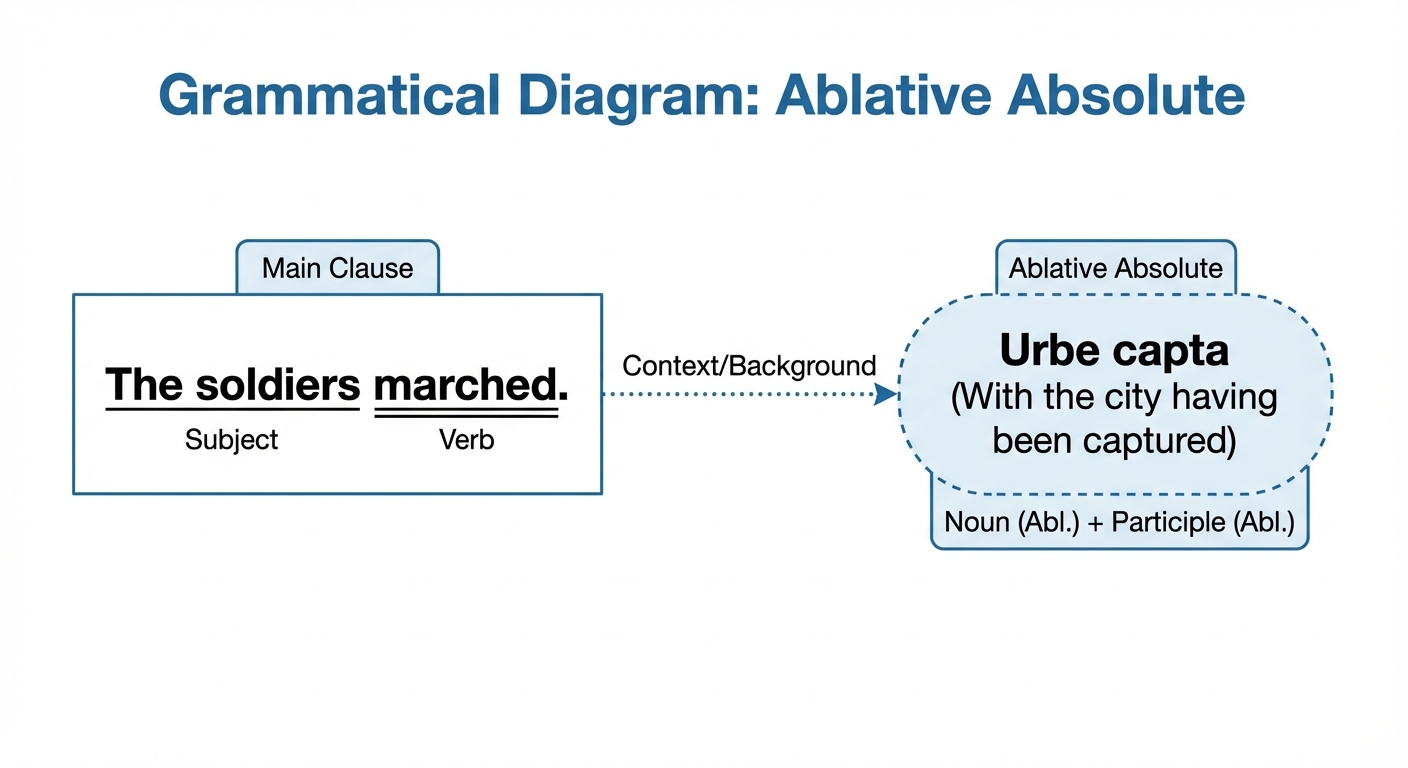
2. The Ablative Absolute
This construction provides context—time, cause, or circumstance—detached grammatically from the main sentence.
Noun (Ablative) + Participle (Ablative)
- Literal Translation: "With the [Noun] having been [Verbed]…"
- Refined Translation: "Because/When/After/Since the [Noun] was [Verbed]…"
3. The Subjunctive in Subordinate Clauses
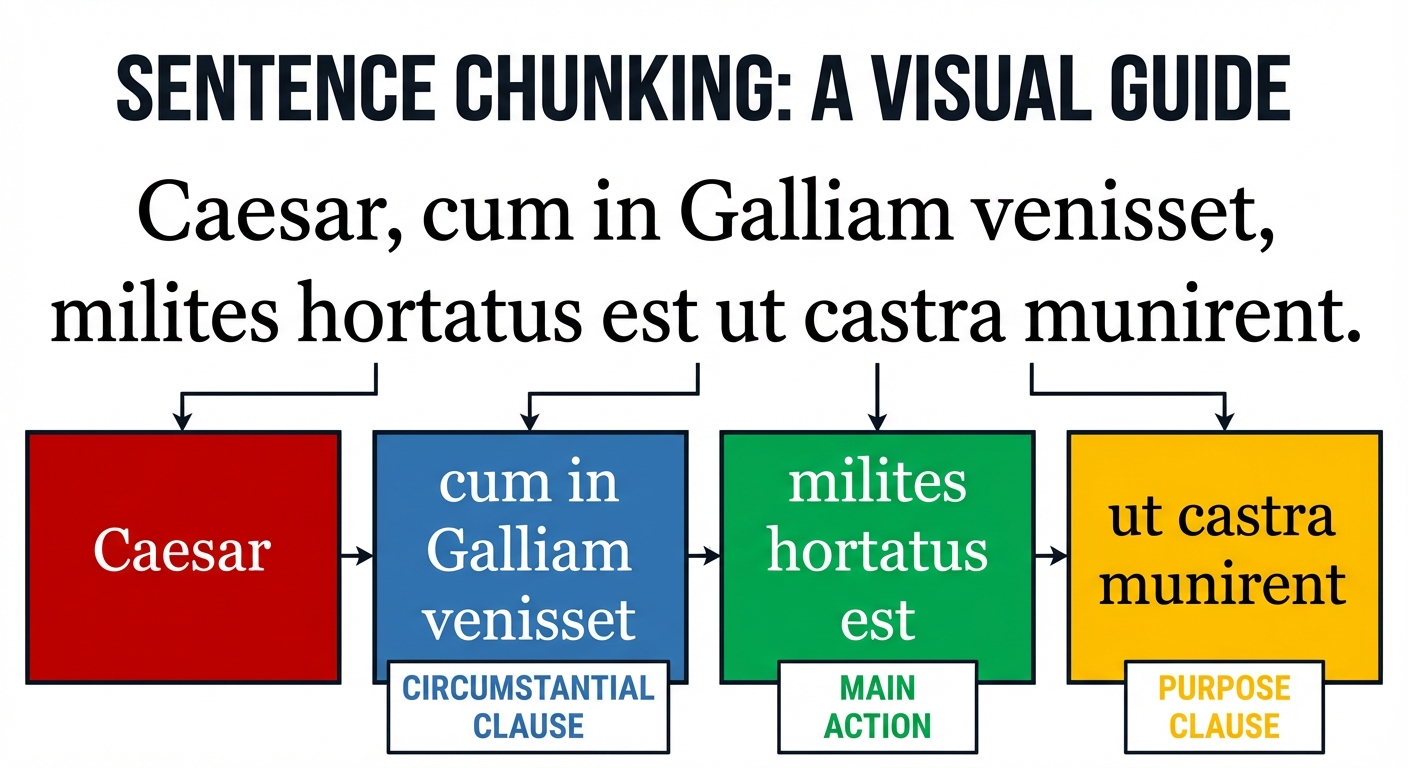
In prose, the subjunctive mood rarely translates as "would/should/might." It usually just indicates that a clause is subordinate. You must identify the clause type based on the signpost word.
| Signpost Word | Subjunctive Use | Translation Strategy |
|---|---|---|
| ut | Purpose | …in order to / to… |
| ut | Result | …that / so that… (Look for tam, ita, sic in main clause) |
| cum | Circumstantial/Causal | When / Since / Although |
| ne | Negative Purpose | …so that … not / lest… |
Gerunds and Gerundives
These verbal nouns and adjectives are frequent in philosophical and military prose (like Caesar).
- Gerund: Verbal Noun (Active meaning). Amandi (of loving).
- Gerundive: Verbal Adjective (Passive meaning). Amandus (to be loved).
Memory Aid: The Gerundive is an Adjective (both end in -ive).
Special Construction: Purpose
Both gerunds and gerundives are used with ad + Accusative or causa/gratia + Genitive to show purpose.
- Ad proficiscendum: For the purpose of setting out.
Contextual Reading and Comprehension
The goal of Unit 1 is to stop translating word-by-word and start reading.
The "Linear Reading" Method
Novice students "hunt and peck" (look for the nominative, then jump to the end for the verb, then look for the object). Do not do this. This destroys the author's intended emphasis and rhetorical structure.
Instead, read left-to-right, processing the information as it comes. This is known as Metaphrasing.
Example Sentence:
Caesar, acceptis litteris, nuntium mittit.
- Caesar: Okay, subject. Caesar is doing something.
- …acceptis litteris…: Comma, ablative words. Wait, don't translate yet. Hold it in memory. It's background info. "With letters received…"
- …nuntium…: Accusative direct object. He is doing something to a messenger.
- …mittit.: Verb. Sends.
Synthesis: Caesar, having received the letters, sends a messenger.
Chunking
Complex prose sentences can be 5-10 lines long. You must break them into manageable "chunks" based on punctuation and connective words.
- Prepositional Phrases: Bracket them mentally. $[In
akte]$ - Subordinate Clauses: Identify the openers (qui, cum, ubi, ut) and read until the verb of that clause.
Connecting Sentences
Prose is a continuous stream of thought. Look for Linking Qu- words (Relative Connection) at the start of a sentence.
- Quae cum ita sint… $\rightarrow$ "Since these things are so…"
- Quod ubi… $\rightarrow$ "And when this…"
Here, the Qui/Quae/Quod is not starting a relative clause inside a sentence, but connecting back to the previous sentence. Translate it as "this" or "these things."
Common Mistakes & Pitfalls
1. Confusing Participle Voice
- Mistake: Translating a Perfect Passive Participle (PPP) as active.
- Correction: Missus means "having been sent," not "having sent." Exception: Deponent verbs! Locutus means "having spoken" (Active meaning) because deponents passives look passive but act active.
2. The "Et… Et" Trap
- Mistake: Seeing et and immediately saying "and."
- Correction: Look ahead. If you see et… et…, it means both… and…. The same applies to aut… aut… (either/or) and neque… neque… (neither/nor).
3. Misidentifying the Case of Fourth Declension
- Mistake: Seeing manus or exercitus and assuming it is Nominative Singular.
- Correction: In the 4th Declension, -us can be Nom. Sing, Gen. Sing, Nom. Pl., or Acc. Pl. Check the verb number and context!
4. Ignoring the "Tiny Words"
- Mistake: Skipping words like quidem, autem, or vero because they seem small.
- Correction: These postpositive particles show the logical flow of the argument (Indeed, however, but truly). Ignoring them makes the logic fall apart.