AP Chinese Unit 1: Dynamics of Families and Communities
Family Structures in China: Tradition vs. Modernity
Defining the Family (家庭 — jiātíng)
In Chinese culture, the family is the fundamental unit of society, often taking precedence over the individual. Understanding the evolution of the Chinese family is essential for the AP Cultural Presentation task.
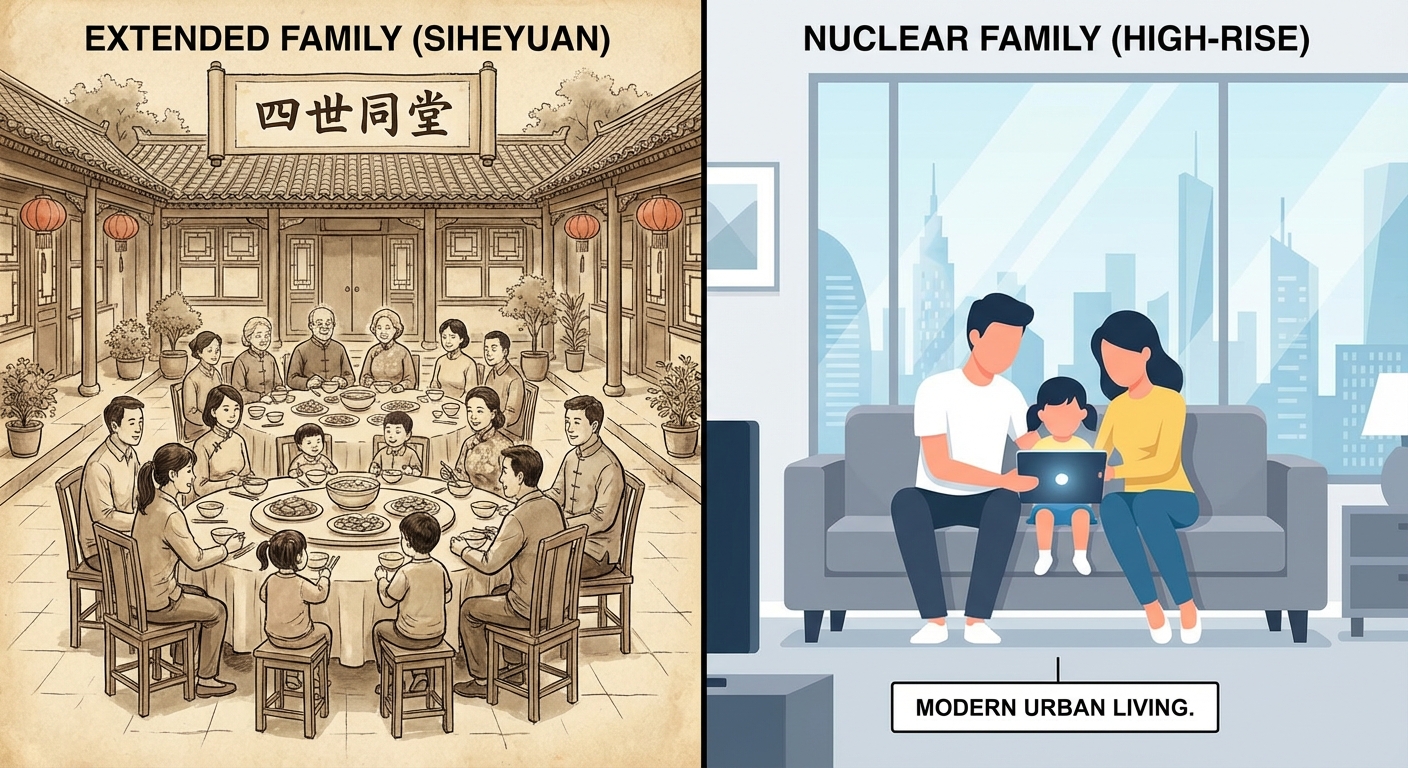
- Traditional Structure: Historically, the ideal was "Four Generations Under One Roof" (四世同堂 — sì shì tóng táng). Families were large, extended, and patrilineal.
- Patriarchy: The father is the traditional head of the household.
- Lineage: Women historically did not pass on their surname, and the eldest son was responsible for carrying the family name and caring for aging parents.
- Modern Structure: rapid urbanization and policy changes have shifted the norm.
- The Nuclear Family (核心家庭 — héxīn jiātíng): Now the most common structure in cities, consisting of only parents and children.
- DINK Families: "Double Income, No Kids" (丁克族 — dīngkè zú) are becoming more common among young professionals, though traditional pressure to have children remains.
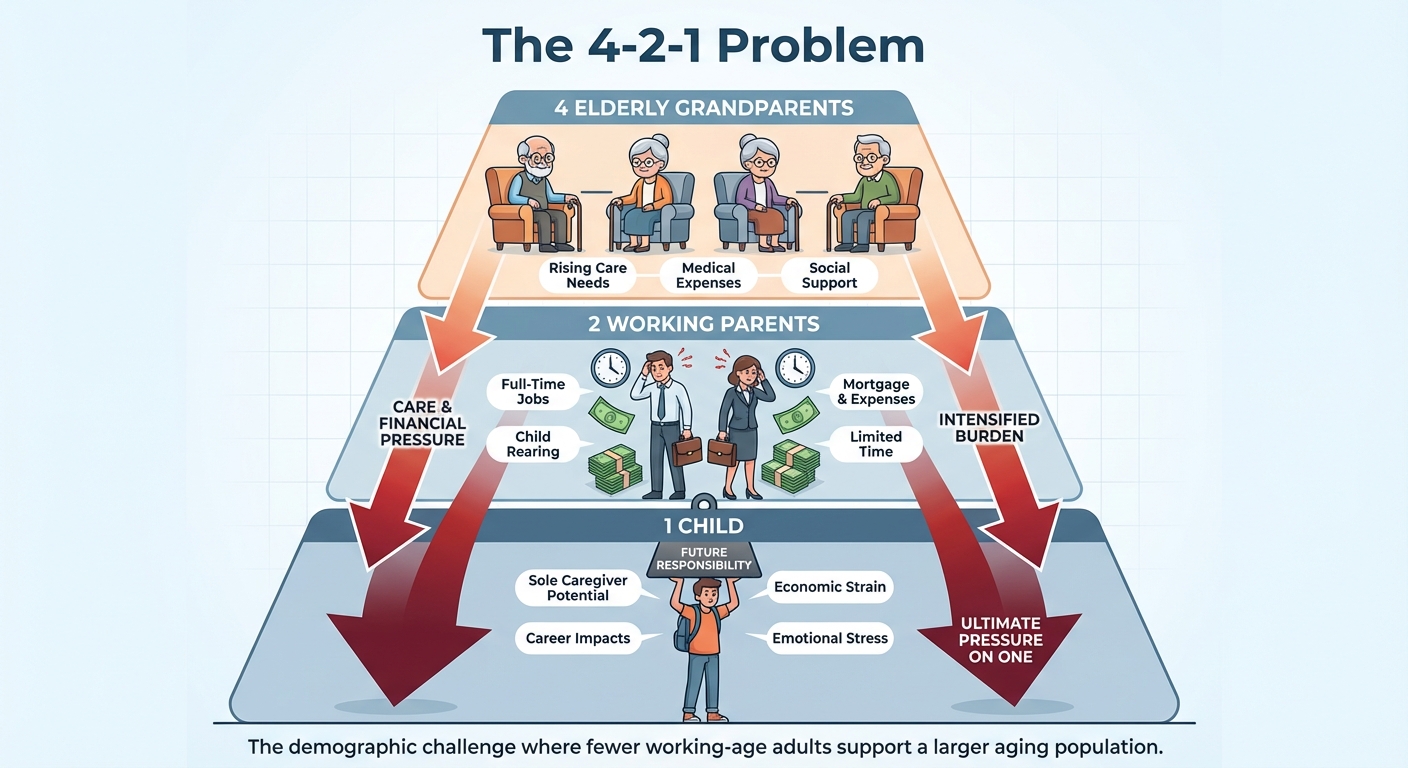
- The "4-2-1" Structure: A direct result of the One-Child Policy, where 4 grandparents and 2 parents rely on 1 child.
Gender Roles and Domestic Life
- Traditional: Men focused on the public sphere (making money), while women managed the domestic sphere (raising children). This is summarized by the idiom "Men plow, women weave" (男耕女织 — nán gēng nǚ zhī).
- Contemporary:
- Women are active participants in the workforce and increasingly take leadership roles.
- However, the "double burden" exists: women are often expected to work full-time and manage household chores.
- Grandparents' Role: In modern China, grandparents often assume the role of primary caregivers for grandchildren while both parents work.
Core Values: The Confucian Foundation
Despite structural changes, the underlying values of the Chinese family remain deeply rooted in Confucianism.
Filial Piety (孝 — xiào)
This is the most critical concept in Unit 1. It encompasses respect, obedience, and care for one's parents and ancestors.
- Key Responsibilities:
- Caring for parents in their old age (physically and financially).
- Bringing honor to the family name.
- Confucius (551–479 BCE) codified this in the Classic of Filial Piety (孝经).
- Modern Conflict: Young people often work in distant cities, making daily care for parents difficult. This has led to the rise of nursing homes, which were traditionally stigmatized as "unfilial."
Education and Expectations
- Wang Zi Cheng Long (望子成龙): Literally "Hoping the son becomes a dragon." This idiom encapsulates the immense pressure parents place on children to succeed academically.
- Education is viewed not just as personal betterment, but as a way to elevate the family's social status.
Harmony and Face
- Harmony (和** — hé):** Families avoid direct confrontation. Mediation is preferred over argument.
- Face (面子** — miànzi):** A family's collective reputation. The actions of one member affect the "face" of the entire group.
Common Mistakes: Values
- Mistake: Assuming "Filial Piety" only means obeying parents.
- Correction: It also implies reciprocal love and the parent's duty to raise the child well. It is a lifelong debt of gratitude.
- Mistake: Thinking arranged marriages are still the norm.
- Correction: deeply outdated. While parents may pressure children to marry (see "Marriage Markets" in parks), individuals choose their partners.
Demographics and Social Challenges
The Legacy of the One-Child Policy
Implemented from 1980 to 2016 to curb population growth, this policy has profoundly shaped modern families.
- Little Emperors (小皇帝): Single children who are the sole focus of six adults (parents + grandparents), often resulting in being spoiled but also facing immense pressure.
- Gender Imbalance: A cultural preference for boys (to carry the family line) led to a skew in the population ratio, making it difficult for many men to find wives today.
- Aging Population (老龄化): China is getting old before it gets rich. The workforce is shrinking while the number of retirees grows.
The Urban-Rural Divide
- Left-Behind Children (留守儿童): When parents migrate to cities for work (migrant workers), they often leave children in the village with grandparents. This creates emotional and educational gaps.
Societal Context: Identity, Transportation, and Heroes
Note: While Unit 1 focuses on Family, the AP exam often connects family life to broader societal trends (Unit 3 & 4).
Identities and National Figures
National identity in China is often framed as a "large family" (大家庭).
- Ethnic Diversity: 56 ethnic groups. Han is the majority (92%). The government promotes unity, though tensions exist regarding cultural assimilation.
- Key Figures (Cultural Literacy):
- Confucius: The philosopher who defined the family hierarchy.
- Sun Yat-sen: "Father of Modern China," respected for ending imperial rule.
- Mao Zedong: Established the PRC (1949). His tenure challenged traditional family values (loyalty to the state over family), though those values have since rebounded.
Transportation Affecting Families
Transportation is the "bloodline" keeping families connected across vast distances.
- Spring Festival Travel Rush (Chunyun): The largest annual human migration on Earth. Millions travel by High-Speed Rail (Gaotie), planes, and buses to return home for Chinese New Year.
- Daily Life: Families use Electric Scooters and Metros for efficiency. owning a car is a status symbol for a family but contributes to traffic and pollution.
Global Challenges Impacting Families
- Environmental Issues: Air and water pollution concern parents deeply regarding their children's health.
- Cost of Living: High housing costs and education expenses are major reasons why couples benefit from the recent "Three-Child Policy" but are hesitant to actually have more children.
Cultural Comparison: China vs. The West
Use this table for the Cultural Comparison free-response section of the AP Exam.
| Aspect | Chinese Culture (Collectivist) | Western/US Culture (Individualist) |
|---|---|---|
| Elder Care | Children are expected to care for aging parents (co-habitation is common). Nursing homes are a last resort. | Independence is valued. Seniors often live in retirement communities or alone; not seen as unfilial. |
| Independence | Interdependence is valued. Grandparents help raise grandkids; parents pay for college/weddings. | Financial and social independence is expected around age 18-21. |
| Communication | High-context/Indirect. "I love you" is rarely spoken; love is shown through cutting fruit or cooking food. | Low-context/Direct. Verbal expressions of affection and direct confrontation are normal. |
| Dining | Shared dishes (Lazy Susan). The host orders for everyone. | Individual plates. Everyone orders for themselves. |
Key Vocabulary for Unit 1
- 四世同堂 (sì shì tóng táng): Four generations under one roof.
- 孝顺 (xiàoshùn): Filial piety/obedience.
- 尊老爱幼 (zūn lǎo ài yòu): Respect the old and cherish the young.
- 重男轻女 (zhòng nán qīng nǚ): Regarding men as superior to women (traditional attitude).
- 望子成龙 (wàng zǐ chéng lóng): To hope one's child becomes successful.
- 独生子女 (dúshēng zǐnǚ): Only child.
- 相亲 (xiāngqīn): Matchmaking / Blind date (arranged with parental intent).
Common Mistakes: General
- Over-generalizing: Do not say "All Chinese families…" Instead, use "Traditionally…" or "In modern cities…" to show nuance.
- Confusing Festivals: Do not mix up the Moon Festival (Family reunion, mooncakes) with Dragon Boat Festival (Patriotism/Qu Yuan). The Mid-Autumn Festival is the second most important family holiday after CNY.
- Ignoring Regional Differences: Urban Shanghai families live very differently from rural families in Gansu. Acknowledge this gap to score higher on Cultural Knowledge.