Unit 3 Mastery: Harmony Fundamentals
The Architecture of Triads
At the core of Western tonal harmony lies the triad, a three-note chord consisting of a root, a third, and a fifth. In AP Music Theory, you must be able to identify and construct these chords instantly by analyzing the interval structure between the notes.
Building Blocks: Stacking Thirds
A triad is constructed by stacking two intervals of a third. The specific quality of these thirds determines the quality of the chord.
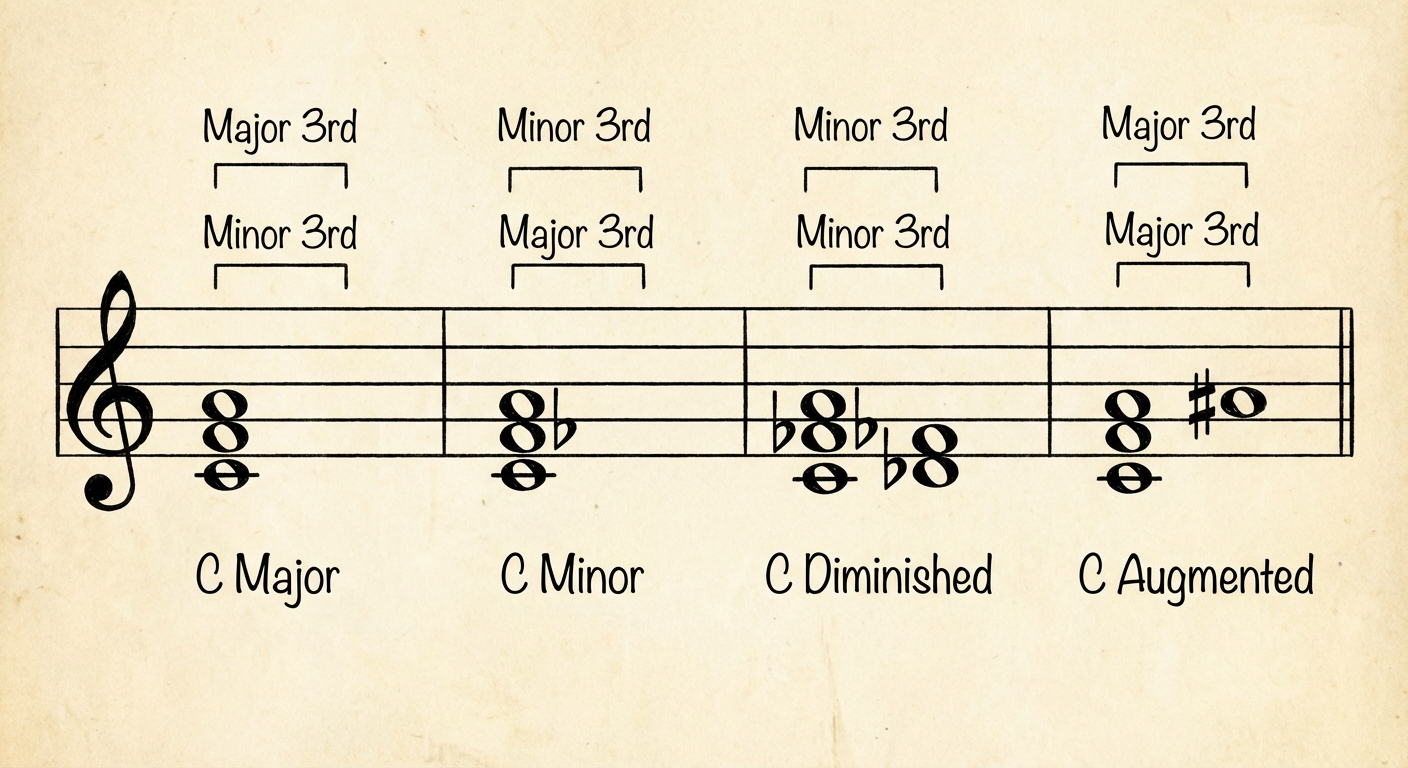
The Four Triad Qualities
There are four distinct qualities of triads you need to master.
Major Triad (M)
- Structure: Major 3rd (bottom) + Minor 3rd (top).
- Outer Interval: Perfect 5th.
- Sound: Bright, stable, consonant.
- Example in C: C - E - G
Minor Triad (m)
- Structure: Minor 3rd (bottom) + Major 3rd (top).
- Outer Interval: Perfect 5th.
- Sound: Darker, stable, consonant.
- Example in C: C - Eb - G
Diminished Triad (d or °)
- Structure: Minor 3rd (bottom) + Minor 3rd (top).
- Outer Interval: Diminished 5th (Tritone).
- Sound: Tense, unstable, wants to resolve inward.
- Example in C: C - Eb - Gb
Augmented Triad (A or +)
- Structure: Major 3rd (bottom) + Major 3rd (top).
- Outer Interval: Augmented 5th.
- Sound: Dreamy, ungrounded, highly dissonant.
- Example in C: C - E - G#
Memory Aid:
- Major: Happy (M3 first)
- Minor: Sad (m3 first)
- Diminished: Squashed (small intervals)
- Augmented: Expanded (large intervals)
Seventh Chords
A seventh chord adds one more note to a triad—a seventh above the root. This results in a stack of three thirds. Seventh chords add harmonic tension and are crucial for the drive of tonal music.
Naming Convention
Seventh chords are generally named based on two factors: the Quality of the Triad (Root, 3rd, 5th) and the Quality of the 7th interval (Root to 7th).
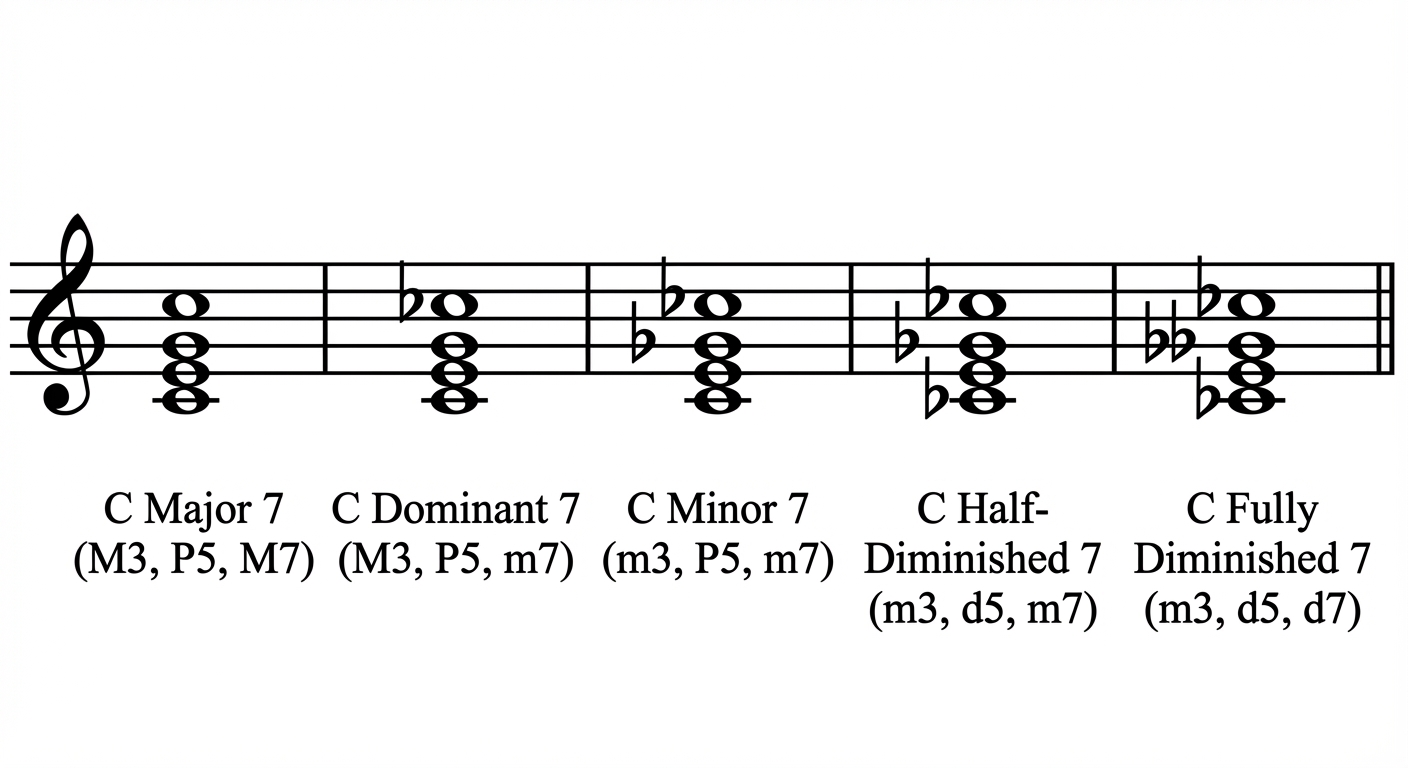
The Five Common Types
| Chord Name | Common Symbol | Triad Quality | 7th Interval | Interval Stack Structure | Example (Root C) |
|---|---|---|---|---|---|
| Major Seventh | M7, maj7, $\Delta$ | Major | Major 7th | M3 - m3 - M3 | C - E - G - B |
| Dominant Seventh | Mm7, 7 | Major | Minor 7th | M3 - m3 - m3 | C - E - G - Bb |
| Minor Seventh | m7, -7 | Minor | Minor 7th | m3 - M3 - m3 | C - Eb - G - Bb |
| Half-Diminished | $^{\varnothing}7$, dm7 | Diminished | Minor 7th | m3 - m3 - M3 | C - Eb - Gb - Bb |
| Fully Diminished | $^{\circ}7$, dd7 | Diminished | Diminished 7th | m3 - m3 - m3 | C - Eb - Gb - Bbb |
The "Dominant" Distinction
The Dominant Seventh (V7) is the most important chord in tonal harmony. Note that it is often just labeled with a "7" (e.g., G7). Do not confuse this with a Major 7th (Gmaj7).
- G7 = Major Triad + Minor 7th (Dominant function)
- Gmaj7 = Major Triad + Major 7th (Tonic/Predominant function)
Inversions and Figured Bass
Chords are not always played with the root in the bass. When a chord tone other than the root is the lowest note, the chord is inverted. We use Figured Bass (numbers below the staff) to indicate these inversions.
Crucial Concept: Figured bass numbers represent the intervals above the bass note, not the root.
Triad Inversions
Root Position
- Bass: Root
- symbol: None (or rarely 5/3)
- The snowman is standing upright.
First Inversion
- Bass: Third
- Symbol: 6 (short for 6/3)
- Example: C major chord with E in the bass.
Second Inversion
- Bass: Fifth
- Symbol: 6/4
- Example: C major chord with G in the bass.
- Note: This is considered dissonant/unstable in classical theory (specifically the interval of the 4th with the bass).
Seventh Chord Inversions
Seventh chords have four notes, so they have three possible inversions.
- Root Position: 7
- First Inversion: 6/5 (Bass is the 3rd)
- Second Inversion: 4/3 (Bass is the 5th)
- Third Inversion: 4/2 or just 2 (Bass is the 7th)
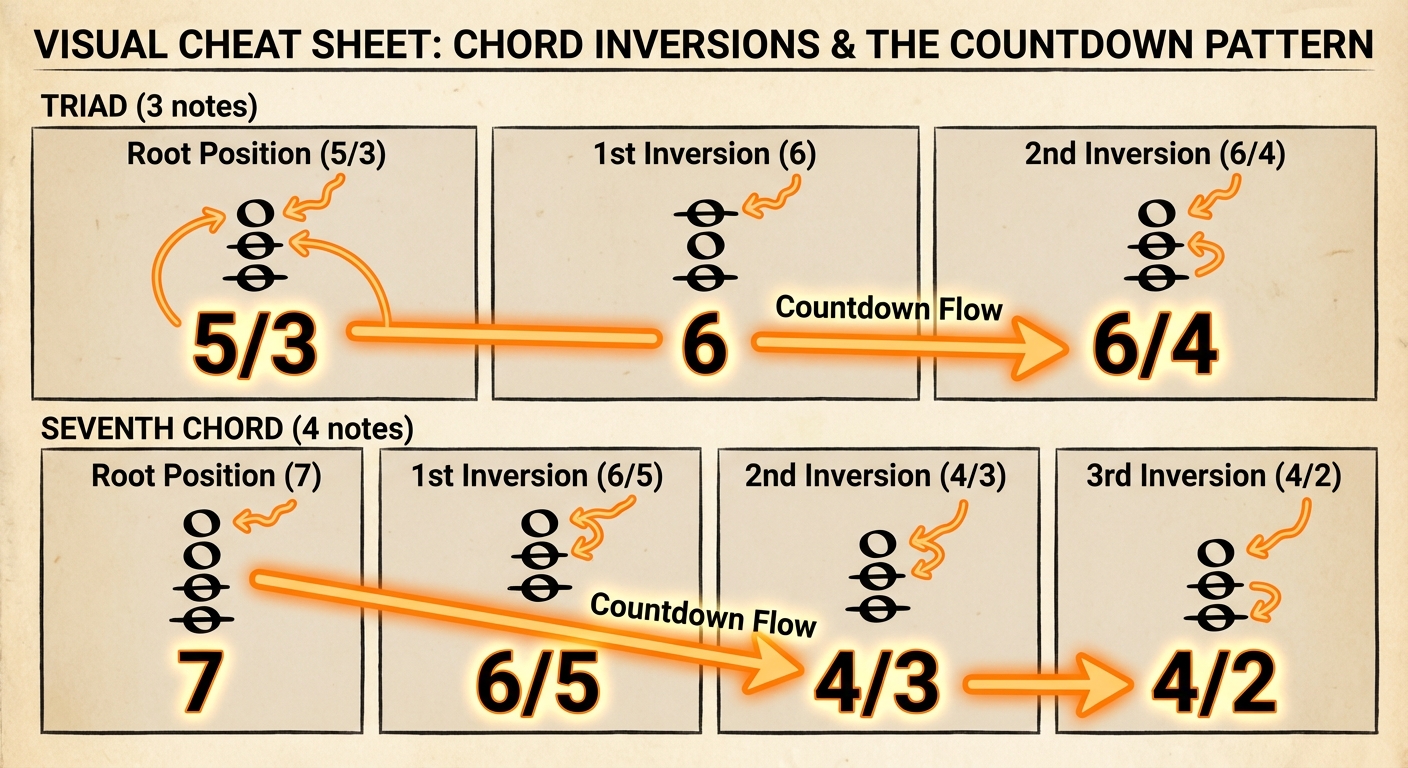
Mnemonic for 7th Chords: "7 — 65 — 43 — 2" (Think of a countdown).
Roman Numeral Analysis
In AP Music Theory, you must analyze chords functionally using Roman Numerals to show their relationship to a specific key.
Notation Rules
- Uppercase: Major Triads (e.g., I, IV, V)
- Lowercase: Minor Triads (e.g., ii, iii, vi)
- Lowercase + °: Diminished Triads (e.g., vii°)
- Uppercase + +: Augmented Triads (e.g., III+)
Diatonic Chords in Major Keys
In a major key, the pattern of chord qualities is fixed:
- I (Major)
- ii (Minor)
- iii (Minor)
- IV (Major)
- V (Major)
- vi (Minor)
- vii° (Diminished)
Diatonic Chords in Minor Keys
Minor keys are tricky because we usually use the Harmonic Minor scale to build chords. This means we must raise the leading tone (the 7th scale degree) to create a major Dominant chord.
- i (Minor)
- ii° (Diminished - Note the difference from major keys!)
- III (Major)
- iv (Minor)
- V (Major - Requires accidental to raise the 3rd of the chord)
- VI (Major)
- vii° (Diminished - Requires accidental for the root of the chord)
Combining Numerals and Inversions
When analyzing, combine the Roman numeral (ROOT) with the Figured Bass (BASS position).
- Example: A C Major chord in 1st inversion within the key of F Major.
- Root is C (V in key of F).
- Bass is E (1st inversion = 6).
- Symbol: V6
Common Mistakes & Pitfalls
Confusing Half vs. Fully Diminished
- Students often mix up $^{\varnothing}7$ and $^{\circ}7$.
- Check: Measure the interval from the Root to the 7th. If it is a Minor 7th (10 semitones), it's Half-Diminished. If it is a Diminished 7th (9 semitones), it's Fully Diminished.
- Tip: Half-diminished is the natural diatonic 7th chord on scale degree 7 in Major keys (vii$^{\varnothing}7$). Fully diminished occurs on scale degree 7 in Harmonic Minor keys (vii$^{\circ}7$).
The "Minor V" Error
- In a minor key, if you see a V chord (Five chord), it is almost always Major (V), not minor (v). You must check for the raised leading tone accidental. If the question asks you to write a V chord in c minor, you must write G-B$\natural$-D, not G-Bb-D.
Root Hunting in Inversions
- When a chord is inverted (especially 6/4 or 4/2), students often identify the bass note as the root.
- Fix: Look at the stack of notes. If you see an interval of a 2nd (step), the top note of that 2nd is the Root of the chord.
Figured Bass vs. Intervals
- Don't confuse the figured bass numbers (inversion shorthand) with the actual intervals present in the chord structure. The figure "6" implies a 6th and a 3rd above the bass, but the symbol only shows the 6.