Comprehensive ACT Geometry Review: Plane, Coordinate, and Trigonometry
Angles and Parallel Lines
Geometry on the ACT starts with the fundamental building blocks of space: points, lines, and angles. You must quickly identify specific angle relationships to solve for unknowns in complex diagrams.
Angle Relationships
- Vertical Angles: Angles opposite each other when two lines intersect. They are always congruent (equal in measure).
- Supplementary Angles: Two angles that add up to $180^\circ$. Angles forming a straight line (a Linear Pair) are supplementary.
- Complementary Angles: Two angles that add up to $90^\circ$.
Parallel Lines and Transversals
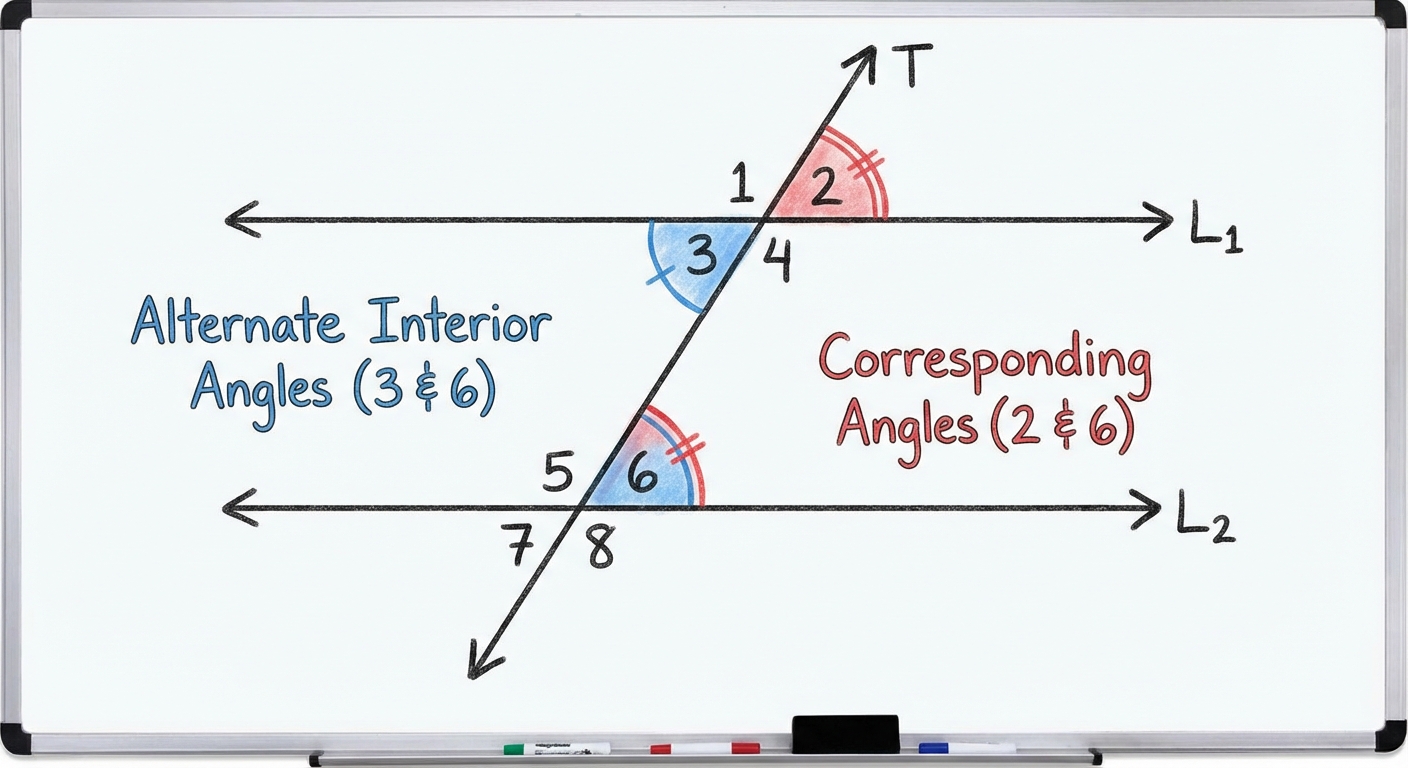
When two parallel lines are cut by a third line (the transversal), specific angle pairs are formed. If the lines are parallel, the following rules apply:
- Alternate Interior Angles: Equal ($1 = 2$).
- Corresponding Angles: Equal ($1 = 3$).
- Consecutive Interior Angles: Supplementary (sum to $180^\circ$).
Polygons
- Interior Angle Sum: For any polygon with $n$ sides, the sum of interior angles is $(n-2) \times 180^\circ$.
- Exterior Angles: The sum of exterior angles of any convex polygon is always $360^\circ$.
Congruence and Similarity
Congruence ($\cong$)
Two geometric figures are congruent if they have the exact same shape and size. For triangles, congruence is proven by criteria such as Side-Side-Side (SSS), Side-Angle-Side (SAS), and Angle-Side-Angle (ASA). CPCTC (Corresponding Parts of Congruent Triangles are Congruent) means once you prove congruence, all matching sides and angles are equal.
Similarity ($\sim$)
Two figures are similar if they have the same shape but different sizes.
- Criteria: The most common proof is AA (Angle-Angle)—if two triangles share two angle measures, they are similar.
- Properties:
- Corresponding angles are equal.
- Corresponding sides are proportional.
Key Concept: If the ratio of side lengths is $k$, the ratio of areas is $k^2$ and the ratio of volumes is $k^3$.
Properties of Triangles and Pythagorean Theorem
Triangle Basics
- Sum of Angles: The interior angles of any triangle always sum to $180^\circ$.
- Triangle Inequality Theorem: The sum of the lengths of any two sides must be strictly greater than the length of the third side ($a + b > c$).
- Exterior Angle Theorem: An exterior angle of a triangle is equal to the sum of the two opposite interior angles.
The Pythagorean Theorem
Applied only to right triangles:
Where $c$ is the hypotenuse (the side opposite the $90^\circ$ angle).
Common Pythagorean Triples (Memorize these to save time!):
- 3-4-5
- 5-12-13
- 8-15-17
- 7-24-25
Special Right Triangles
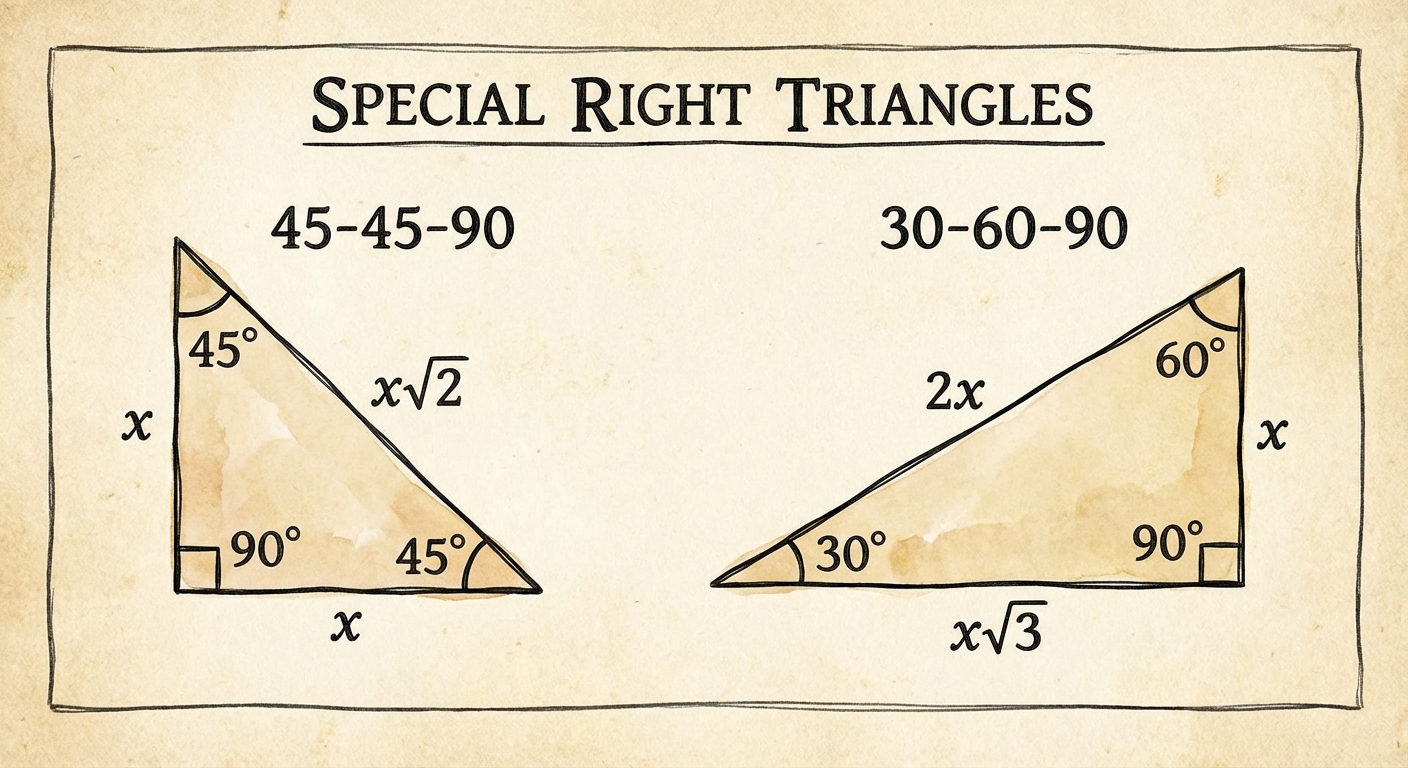
Instead of using the Pythagorean theorem, use these ratios for specific angles:
- 45-45-90 Triangle: Isosceles right triangle.
- Sides ratio: $x : x : x\sqrt{2}$
- 30-60-90 Triangle: Half of an equilateral triangle.
- Sides ratio: $x : x\sqrt{3} : 2x$ (short leg : long leg : hypotenuse)
Trigonometric Ratios and Right Triangles
For the ACT, trigonometry focuses heavily on right triangles. Remember the mnemonic SOH CAH TOA.
Ratios
For an angle $\theta$ in a right triangle:
- $\sin(\theta) = \frac{\text{Opposite}}{\text{Hypotenuse}}$
- $\cos(\theta) = \frac{\text{Adjacent}}{\text{Hypotenuse}}$
- $\tan(\theta) = \frac{\text{Opposite}}{\text{Adjacent}}$
Fundamental Identities
- $\tan(\theta) = \frac{\sin(\theta)}{\cos(\theta)}$
- $\sin^2(\theta) + \cos^2(\theta) = 1$ (Pythagorean Identity)
Reciprocal Functions:
- $\csc(\theta) = \frac{1}{\sin(\theta)}$
- $\sec(\theta) = \frac{1}{\cos(\theta)}$
- $\cot(\theta) = \frac{1}{\tan(\theta)}$
Properties of Circles
Basic Formulas
For a circle with radius $r$ and diameter $d$:
- Circumference: $C = 2\pi r$ or $C = \pi d$
- Area: $A = \pi r^2$
Arcs and Sectors
Often you need to calculate a portion of the circle. Let $n^\circ$ be the central angle.
- Arc Length (portion of circumference): $\frac{n}{360} \times 2\pi r$
- Sector Area (portion of total area): $\frac{n}{360} \times \pi r^2$
Angle Properties in Circles
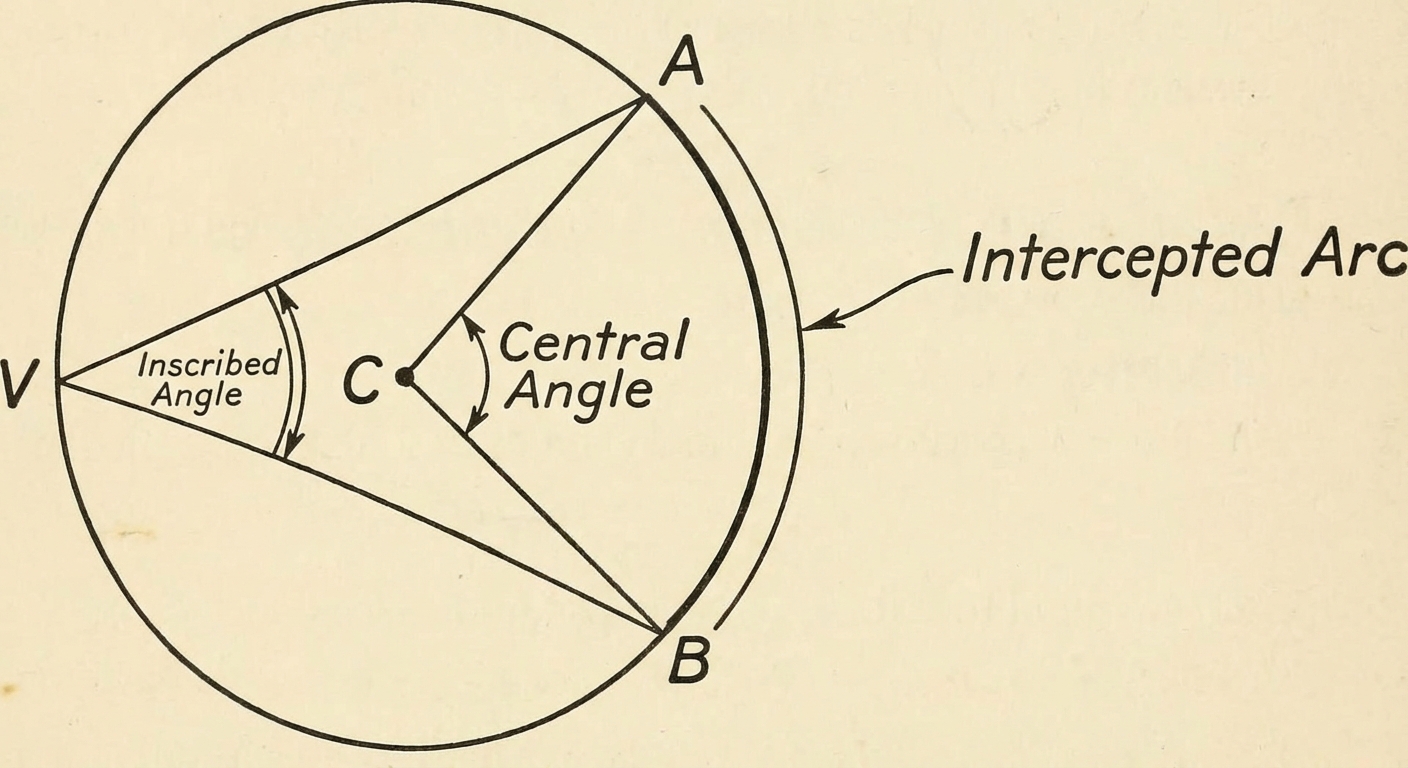
- Central Angle: The vertex is at the center. The measure of the angle equals the measure of the intercepted arc.
- Inscribed Angle: The vertex is on the circle itself (perimeter). The angle measure is half the intercepted arc.
Surface Area and Volume of Solids
While some formulas may be provided, knowing them ensures speed.
| Shape | Volume Formula | Surface Area Notes |
|---|---|---|
| Rectangular Prism | $V = l \times w \times h$ | Sum of areas of all 6 faces |
| Cylinder | $V = \pi r^2 h$ | $SA = 2\pi r^2 + 2\pi rh$ |
| Cone | $V = \frac{1}{3} \pi r^2 h$ | Base area + Lateral Area |
| Sphere | $V = \frac{4}{3} \pi r^3$ | $SA = 4\pi r^2$ |
| Pyramid | $V = \frac{1}{3} (\text{Area}_{\text{base}}) h$ | Add up triangular faces |
Note: A prism or cylinder volume is area of base $\times$ height. A cone or pyramid is $\frac{1}{3}$ of that.
Coordinate Geometry
This connects algebra with geometry on the $(x,y)$ plane.
Formularies
- Distance Formula: $d = \sqrt{(x2 - x1)^2 + (y2 - y1)^2}$
- (Note: This is just the Pythagorean Theorem disguised)
- Midpoint Formula: $(\frac{x1 + x2}{2}, \frac{y1 + y2}{2})$
- (Note: This is just the average of the coordinates)
- Slope ($m$): $m = \frac{y2 - y1}{x2 - x1} = \frac{\text{rise}}{\text{run}}$
Lines
- Slope-Intercept Form: $y = mx + b$
- Parallel Lines: Have equal slopes ($m1 = m2$).
- Perpendicular Lines: Have negative reciprocal slopes ($m1 = -\frac{1}{m2}$). Their product is $-1$.
Equations of Conic Sections
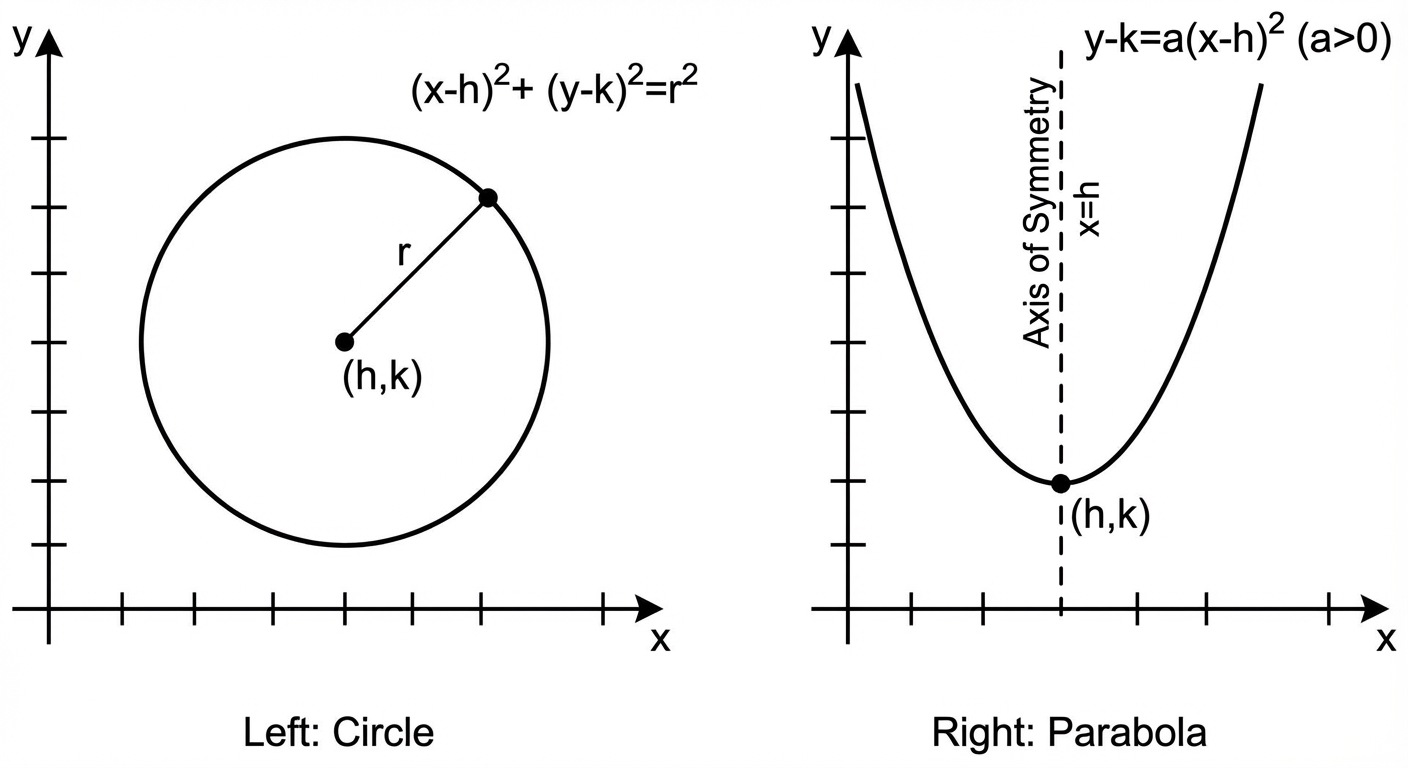
The most common conics on the ACT are circles and parabolas. Occasionally ellipses or hyperbolas appear.
Circle Equation
Standard form for a circle with center $(h, k)$ and radius $r$:
Parabola Equation
Vertex form for a parabola with vertex $(h, k)$:
- If $a > 0$, it opens upward (minimum).
- If $a < 0$, it opens downward (maximum).
Ellipse Equation
- Center at $(h, k)$. $a$ and $b$ determine the horizontal and vertical stretch.
Common Mistakes & Pitfalls
- Radius vs. Diameter: Always double-check if the question gives $r$ or $d$. In the circle equation, remember the right side is $r^2$, not $r$. If the equation equals 16, the radius is 4, not 16.
- Degree vs. Length: Don't confuse arc measure (in degrees) with arc length (in units like cm or inches). Measure relates to 360; length relates to circumference.
- Drawing Scale: Diagrams on the ACT are usually drawn to scale unless stated otherwise. However, never rely entirely on visual estimation. Use the numbers.
- Shadow Problems: When setting up similarity ratios for shadows (a tree and a person), ensure you match corresponding sides: $\frac{\text{Height}1}{\text{Height}2} = \frac{\text{Shadow}1}{\text{Shadow}2}$.
- Negative signs in Coordinates: When calculating distance or slope, watch your double negatives (e.g., $5 - (-3) = 8$).