AP Calculus AB Unit 8: Applications of Integration (Comprehensive Study Notes)
Average value of a function
What “average value” means (and why it’s not just the midpoint)
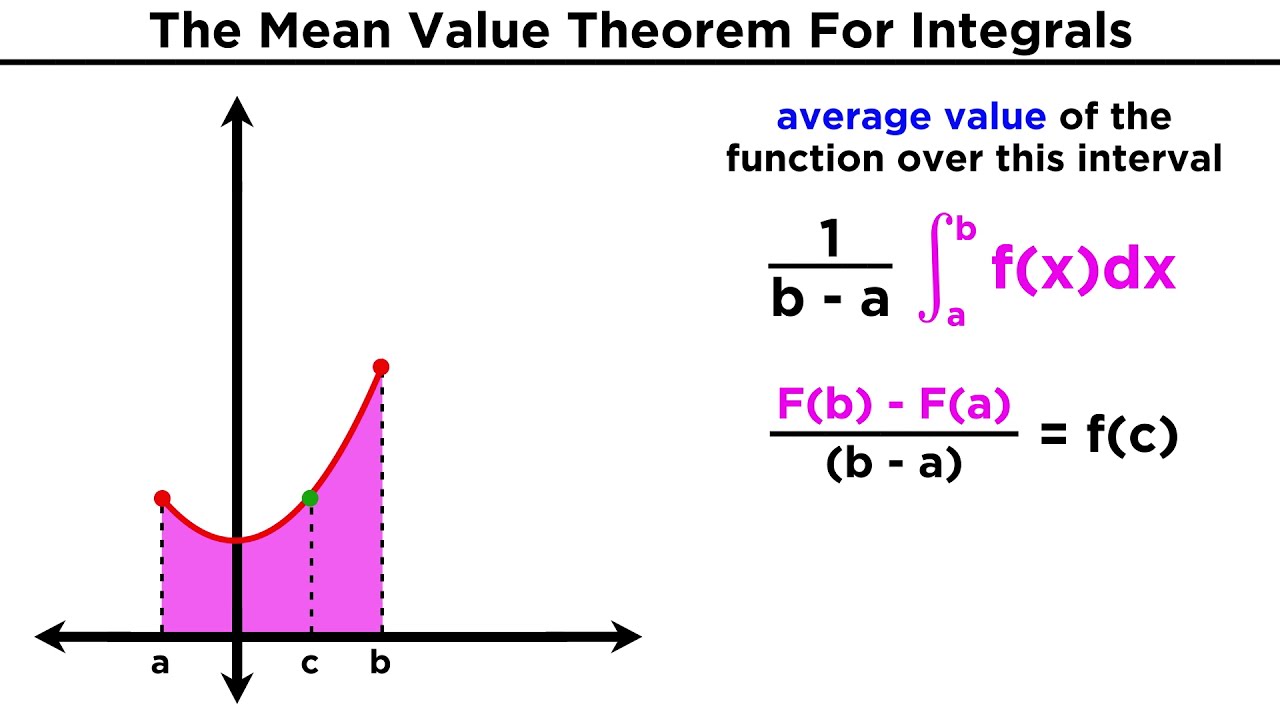
The average value of a function on an interval is the continuous-function version of “average height.” With a finite list, you average by “add everything up, then divide by how many.” For a function, you have infinitely many outputs between %%LATEX0%% and %%LATEX1%%, so you use a definite integral to “add up continuously,” and then you divide by the interval length to turn that total into an average.
A powerful way to picture this is with area. The integral %%LATEX2%% represents the signed area between the graph and the %%LATEX3%%-axis. If %%LATEX4%% is nonnegative on %%LATEX5%%, then it is literally the area under the curve. If you “spread that same area out” into a rectangle of width , the rectangle’s height is the average value. In other words, average value creates a constant function that has the same accumulated total over the interval.
The formula and what each piece is doing
If %%LATEX7%% is integrable on %%LATEX8%%, the average value of %%LATEX9%% on %%LATEX10%% is
Here, %%LATEX12%% is the total (signed) accumulation, and dividing by %%LATEX13%% converts “total” into “per unit of .” If the function dips below the axis, the integral includes negative contributions, so the average value is a signed average, not an average of magnitudes.
“Add and divide” quick example (from a simple interval)
If your interval is , the average value setup is
This matches the basic “sum then divide” idea: the integral is the continuous sum, and is the interval length.
Average value vs average rate of change
These sound similar but are different.
Average rate of change from %%LATEX18%% to %%LATEX19%% is the secant slope:
Average value is the average output level over the interval:
A common confusion is to treat average value as “just plug in the midpoint.” That can be a rough estimate in some symmetric situations, but it is not the definition and is often wrong.
Worked example 1: average value from an integral
Find the average value of %%LATEX22%% on %%LATEX23%%.
Interpretation: the “equal-area rectangle” over has height 3.
Worked example 2: average value when the function is sometimes negative
Let %%LATEX28%% on %%LATEX29%%.
This makes sense because the positive area cancels the negative area.
Connecting average value to “average velocity”
If %%LATEX33%% is velocity, then the average velocity on %%LATEX34%% is the average value of :
This is distinct from average speed, which uses .
Exam Focus
- Typical question patterns:
- “Find the average value of %%LATEX38%% on %%LATEX39%%” given a formula, graph, or table.
- “Find a value %%LATEX40%% such that %%LATEX41%%” (often tied conceptually to the Mean Value Theorem for Integrals).
- Average velocity from a velocity function using an integral.
- Common mistakes:
- Forgetting the division by (computing the integral and stopping).
- Using average rate of change instead of average value.
- Ignoring sign and using geometric area instead of the signed integral when the function goes below the axis.
Net change, accumulation, and motion (position, velocity, acceleration)
The “net change” idea: integrals as total effect
A core application of integration is that an integral measures net change, meaning increases and decreases combine into one overall result.
If a quantity %%LATEX44%% changes at rate %%LATEX45%%, then the net change in %%LATEX46%% from %%LATEX47%% to is
This matters because many real situations give you a rate (a derivative) rather than the original quantity.
Accumulation functions: building a new function from an integral
An accumulation function is defined by a variable upper limit, such as
Conceptually, %%LATEX51%% is the accumulated signed area from %%LATEX52%% to %%LATEX53%%. By the Fundamental Theorem of Calculus (FTC), if %%LATEX54%% is continuous, then
So differentiating an accumulation function returns the integrand.
Motion: position, velocity, acceleration (derivatives and integrals)
In one-dimensional motion:
- Position:
- Velocity:
- Acceleration:
Just like derivatives take you from position to velocity to acceleration, integrals take you back the other way, up to constants (initial conditions).
Displacement, distance traveled, and velocity change (key integral relationships)
The following relationships show up constantly. (A common note format lists “Position” with , but what that integral actually gives is total distance traveled; position itself is displacement plus an initial position.)
| Quantity you want | Integral you use | What it represents |
|---|---|---|
| Displacement | Net change in position | |
| Distance traveled (total) | Adds motion in both directions | |
| Change in velocity | Net change in velocity |
The FTC connection for acceleration and velocity is especially important:
And similarly,
How to compute distance traveled in practice
To integrate , you typically:
- Find where on the interval.
- Split the interval wherever the sign can change.
- Add up absolute displacements on each subinterval (or integrate piecewise).
Worked example 1: displacement and distance
Let %%LATEX68%% on %%LATEX69%%. Find displacement and distance.
First find zeros:
So %%LATEX71%% at %%LATEX72%% and .
Displacement:
So displacement is .
Distance traveled: determine the sign.
- On %%LATEX77%%, %%LATEX78%%.
- On %%LATEX79%%, %%LATEX80%%.
- On %%LATEX81%%, %%LATEX82%%.
So
With :
Distance is larger than displacement because backtracking counts positively.
Worked example 2: interpreting an accumulation function
Suppose
Then and
So the slope at is
A common exam trap is trying to evaluate the integral when FTC makes the question immediate.
Units: the hidden correctness check
AP problems often include units (meters, seconds, gallons, dollars). Units are an excellent self-check:
- If %%LATEX94%% is meters per second, then %%LATEX95%% is meters.
- If a rate is gallons per minute, the integral is gallons.
- Average value divides by time or length, so it returns the same units as the original function.
Exam Focus
- Typical question patterns:
- “Given %%LATEX96%%, find displacement and distance traveled on %%LATEX97%%.”
- “A quantity changes at rate ; find the total change/amount accumulated.”
- “Given %%LATEX99%%, find %%LATEX100%% or interpret where is increasing/decreasing.”
- Common mistakes:
- Computing distance as %%LATEX102%% instead of %%LATEX103%%.
- Forgetting to split at sign changes where .
- Mixing up what is given: integrating position instead of velocity, or integrating velocity when acceleration was given without using an initial condition when needed.
Area between curves (integration as “total vertical or horizontal thickness”)
Why “area between curves” is an integration problem
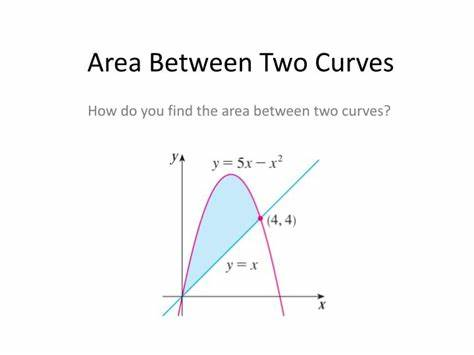
The integral gives area under a curve by adding up thin rectangles. For area between two curves, you still add rectangles, but each rectangle’s height is the distance between the curves.
There are two standard slicing directions:
- Vertical slices (integrate with respect to ): height is “top minus bottom.”
- Horizontal slices (integrate with respect to ): width is “right minus left.”
Vertical slicing: functions of
If the region is bounded by %%LATEX108%% (top) and %%LATEX109%% (bottom) on , then
You must ensure on the interval; if the curves cross, split the integral at the intersection points.
Horizontal slicing: functions of
If boundaries are easier as %%LATEX114%% and %%LATEX115%% over , then
This is especially helpful for sideways parabolas or when vertical slicing would require multiple integrals.
Finding intersection points (where to split)
To find where to start/stop (and where “top” might switch), set the curves equal. Those intersection values define bounds and/or splitting points.
Worked example 1: area enclosed by %%LATEX118%% and %%LATEX119%%
Intersection points:
So %%LATEX122%% and %%LATEX123%%.
On %%LATEX124%%, %%LATEX125%%, so
Worked example 2: area is easier with respect to
Find the area enclosed by %%LATEX129%% and %%LATEX130%%.
Intersection points:
So %%LATEX133%% and %%LATEX134%%.
Right minus left is , so
Worked example 3: “integrate the top minus the bottom” in two equivalent ways
For a typical setup like the one shown in many examples, if the top curve is %%LATEX138%% and the bottom curve is %%LATEX139%% on (they intersect at 0 and 4), you can write the area either as one integral of a difference or as a difference of two integrals:
Equivalently,
Evaluating gives
A setup decision guide (conceptual, not a checklist)
If the region is naturally described as “between two %%LATEX144%%-values for each %%LATEX145%%,” vertical slicing is simplest. If it’s “between two %%LATEX146%%-values for each %%LATEX147%%,” horizontal slicing is simplest. When either works, choose the approach that avoids splitting into multiple integrals or solving messy inverses.
Exam Focus
- Typical question patterns:
- “Find the area of the region enclosed by …” with two curves; you must find intersections.
- “Set up (but do not evaluate) an integral for the area …” testing correct bounds and order (top minus bottom or right minus left).
- A graph is provided; you must read bounds and choose the correct integrand.
- Common mistakes:
- Not splitting when curves cross, leading to negative contributions that cancel area.
- Reversing the subtraction (bottom minus top, left minus right) and getting a negative answer.
- Using the wrong variable: integrating in %%LATEX148%% when boundaries are given more cleanly in %%LATEX149%%, or vice versa.
Volumes of solids with known cross sections
The big idea: volume as “sum of slice volumes”
A 2D region can generate a 3D solid if you build up slices (cross sections) or rotate the region around an axis. The main integration idea is the same: cut the solid into many thin slices, compute each slice’s volume, and add them.
If a solid has cross-sectional area %%LATEX150%% perpendicular to the %%LATEX151%%-axis, then
If cross sections are perpendicular to the -axis, then
It’s helpful to think of the differential %%LATEX155%% or %%LATEX156%% as the thickness of each slice.
Rectangular cross sections as a “formula template”
If a cross section is a rectangle, then its area is length times width, so a common template is
where the integral runs over the interval of the slicing variable. This is just the general rule %%LATEX158%% with %%LATEX159%%.
Common cross-section shapes (and how to build their area)
Many AP problems use squares, rectangles, semicircles, or equilateral triangles. The key modeling steps are:
- Identify the “base segment” inside the region at a given slice location (often a distance between curves).
- Convert that base length into the needed dimension (side length, radius, etc.).
- Use the correct geometry area formula.
A frequent pitfall is confusing the “base of the region” with the “base of a cross section.” The cross-section base is the segment inside the region at that slice.
Worked example 1: square cross sections
The base of a solid is the region in the first quadrant bounded by %%LATEX160%%, the %%LATEX161%%-axis, and the %%LATEX162%%-axis. Cross sections perpendicular to the %%LATEX163%%-axis are squares. Find the volume.
The square’s side length is the vertical distance from %%LATEX164%% to %%LATEX165%%:
So
Bounds: goes from 0 to 2.
Worked example 2: semicircular cross sections
The base is the region between %%LATEX174%% and %%LATEX175%% from %%LATEX176%% to %%LATEX177%%. Cross sections perpendicular to the %%LATEX178%%-axis are semicircles with diameter from %%LATEX179%% to .
Diameter:
Radius:
Semicircle area:
Volume:
Typical pitfalls in cross-section problems
Students often make avoidable modeling mistakes:
- Using the wrong base length (for example, using instead of the distance between curves).
- Forgetting to convert diameter to radius.
- Mixing up “perpendicular to the %%LATEX186%%-axis” (integrate in %%LATEX187%%) versus “perpendicular to the %%LATEX188%%-axis” (integrate in %%LATEX189%%).
Exam Focus
- Typical question patterns:
- “The base is the region bounded by … Cross sections perpendicular to the -axis are squares/semicircles/equilateral triangles. Find the volume.”
- “Set up the integral for volume” focusing on correct expression for and bounds.
- A graph is provided and the cross-section type is described in words.
- Common mistakes:
- Choosing bounds from the wrong variable (using %%LATEX192%%-values when integrating in %%LATEX193%%).
- Using full circle area instead of semicircle, or using diameter in place of radius.
- Writing %%LATEX194%% correctly but forgetting the integral (treating %%LATEX195%% as the volume).
Volumes of revolution: disk and washer methods
Why rotation creates a “stack of circles”
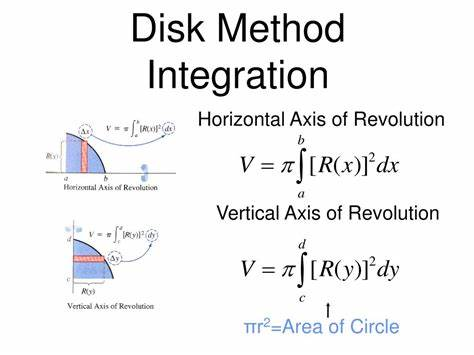
When you rotate a region around an axis, each thin slice sweeps out a circle (or ring). If the slice touches the axis of rotation, the cross section is a disk (also commonly written “disc”). If there is a hole because the region does not reach the axis, the cross section is a washer.
This method is a special case of “volume by cross-sectional area,” where the cross-sectional area comes from circles:
- Area of a circle is %%LATEX196%%, so disk volume often looks like %%LATEX197%%.
- For washers, you subtract inner from outer (a difference of circle areas).
Disk method (no hole)
If each slice forms a disk of radius , then
Or, if integrating with respect to ,
Washer method (hole present)
If rotation produces washers with outer radius %%LATEX202%% and inner radius %%LATEX203%%, then
So
A common equivalent way to write the washer setup (matching the “subtract two things” instinct) is
These are the same algebraically; the key is that you subtract areas of circles.
How to choose between integrating in %%LATEX207%% or %%LATEX208%%
For disk/washer, your slices must be perpendicular to the axis of rotation.
- Rotate around a horizontal line (like %%LATEX209%% or %%LATEX210%%): slices are typically vertical, integrate in .
- Rotate around a vertical line (like %%LATEX212%% or %%LATEX213%%): slices are typically horizontal, integrate in .
You can sometimes do it either way, but one choice may avoid solving for inverses.
Distances to shifted axes (common exam detail)
If rotating around (a horizontal line), radius is a vertical distance:
If rotating around (a vertical line), radius is a horizontal distance:
Often the region stays on one side of the axis, so you can remove the absolute value by reasoning which quantity is larger.
Notation reference: radii in common situations
| Rotation axis | Integrate with respect to | Radius is a distance in | Typical form |
|---|---|---|---|
| %%LATEX219%%-axis ( %%LATEX220%% ) | (vertical slices) | vertical | if above axis |
| %%LATEX223%%-axis ( %%LATEX224%% ) | (horizontal slices) | horizontal | |
| usually | vertical | %%LATEX229%% (if top above %%LATEX230%%) | |
| usually | horizontal | %%LATEX233%% (if right of %%LATEX234%%) |
Worked example 1: disk method about the -axis
Rotate the region under %%LATEX236%% from %%LATEX237%% to %%LATEX238%% about the %%LATEX239%%-axis.
Radius:
Volume:
Worked example 2: washer method about the -axis
Rotate the region between %%LATEX244%% and %%LATEX245%% on %%LATEX246%% about the %%LATEX247%%-axis.
On %%LATEX248%%, %%LATEX249%%, so
Worked example 3: rotating around a shifted horizontal line
Rotate the region under %%LATEX254%% from %%LATEX255%% to %%LATEX256%% about %%LATEX257%%.
Radius is the distance from to the curve:
Volume:
Rotating around a vertical axis (use if using washers)
If you rotate around the %%LATEX267%%-axis using disk/washer, you typically integrate with respect to %%LATEX268%% because slices must be perpendicular to the vertical axis.
Example setup (no full computation): rotate the region bounded by %%LATEX269%% and %%LATEX270%% for %%LATEX271%% about the %%LATEX272%%-axis. Then
Common misconceptions in disk/washer problems
- “Top minus bottom” is for area, not volume. For rotation volume you need radii and squaring.
- Forgetting to square the radii.
- Mixing up outer and inner radii (a quick sketch prevents this).
- Forgetting to adjust the radius for shifted axes like .
Exam Focus
- Typical question patterns:
- “Find the volume of the solid obtained by rotating region … about …” where “about” may be the %%LATEX277%%-axis, %%LATEX278%%-axis, or a shifted line.
- “Set up an integral for volume” emphasizing correct identification of %%LATEX279%% and %%LATEX280%%.
- A region bounded by two curves rotated about an axis, requiring washers and correct bounds.
- Common mistakes:
- Treating the radius as the function itself when rotating about a shifted line (forgetting the distance to the axis).
- Using %%LATEX281%% when the axis is vertical and washers would be simpler in %%LATEX282%% (or vice versa), leading to wrong bounds or extra splitting.
- Swapping inner/outer radii, producing incorrect volumes.
Putting applications together: modeling workflow and interpretation
A consistent problem-solving workflow
Most applications-of-integration questions are more about correct modeling than difficult antiderivatives. A reliable workflow is:
1) Name the quantity you want (area, volume, total change, distance, average value).
2) Decide what a “thin slice” represents.
- For area: rectangle with height “top minus bottom” or “right minus left.”
- For volume by known cross sections: slice area determined by geometry.
- For volume by rotation: disk or washer area.
- For total change: the rate function times a small time/length, then integrate.
3) Write the integral with correct bounds.
- Bounds come from intersections (geometry) or a time interval (rates).
4) Check units and reasonableness.
- Does the unit match what was asked?
- Should the answer be positive (area, volume, distance)?
This matters on AP free-response questions: a correct setup with clear communication earns substantial credit even if algebra slips later.
Example: interpreting the sign of an integral in context
Suppose is the net rate (dollars per day) at which money is added to a fund (deposits minus withdrawals). Then
is the net change in dollars over 30 days. If the integral is negative, it means withdrawals exceeded deposits overall. You should not automatically use absolute value just because you see the word “total.”
Example: when “total area” differs from “net area”
If a graph crosses the axis, %%LATEX285%% gives net signed area. If a problem asks for total area between the curve and the %%LATEX286%%-axis, you must split at zeros and add geometric areas (equivalently, integrate with sign corrected):
when %%LATEX288%% changes sign at %%LATEX289%%.
This is the same theme as displacement versus distance.
About the shell method
You may hear about the shell method for volumes of revolution (cylindrical shells). In AP Calculus AB, disk and washer methods are the primary assessed rotation techniques. If shell method appears in your class as enrichment, treat it as an extra tool, but make sure disk/washer is solid first.
Exam Focus
- Typical question patterns:
- Multi-part free-response questions combining interpretation (units/meaning) with setup and evaluation.
- “Set up an integral” questions where the main grading is correct model and bounds.
- Questions asking you to explain what a definite integral represents in context.
- Common mistakes:
- Not stating what the integral represents (especially in FRQs), losing communication points.
- Confusing “net” with “total” and adding absolute values without justification.
- Copying a memorized formula without matching it to the geometry (wrong radii, wrong slice orientation, wrong bounds).