AP World History: Unit 2 - Networks of Exchange (c. 1200–1450)
Unit Overview: Connectivity and Exchange
Between 1200 and 1450, the world became significantly more interconnected through the expansion of existing trade routes. This unit focuses on the "Big Three" networks: the Silk Roads, the Indian Ocean, and the Trans-Saharan routes. The driving force behind this era is the relationship between improved commercial practices, technological innovation, and the rise of powerful trading cities.
2.1 The Silk Roads
Origins and Mechanics
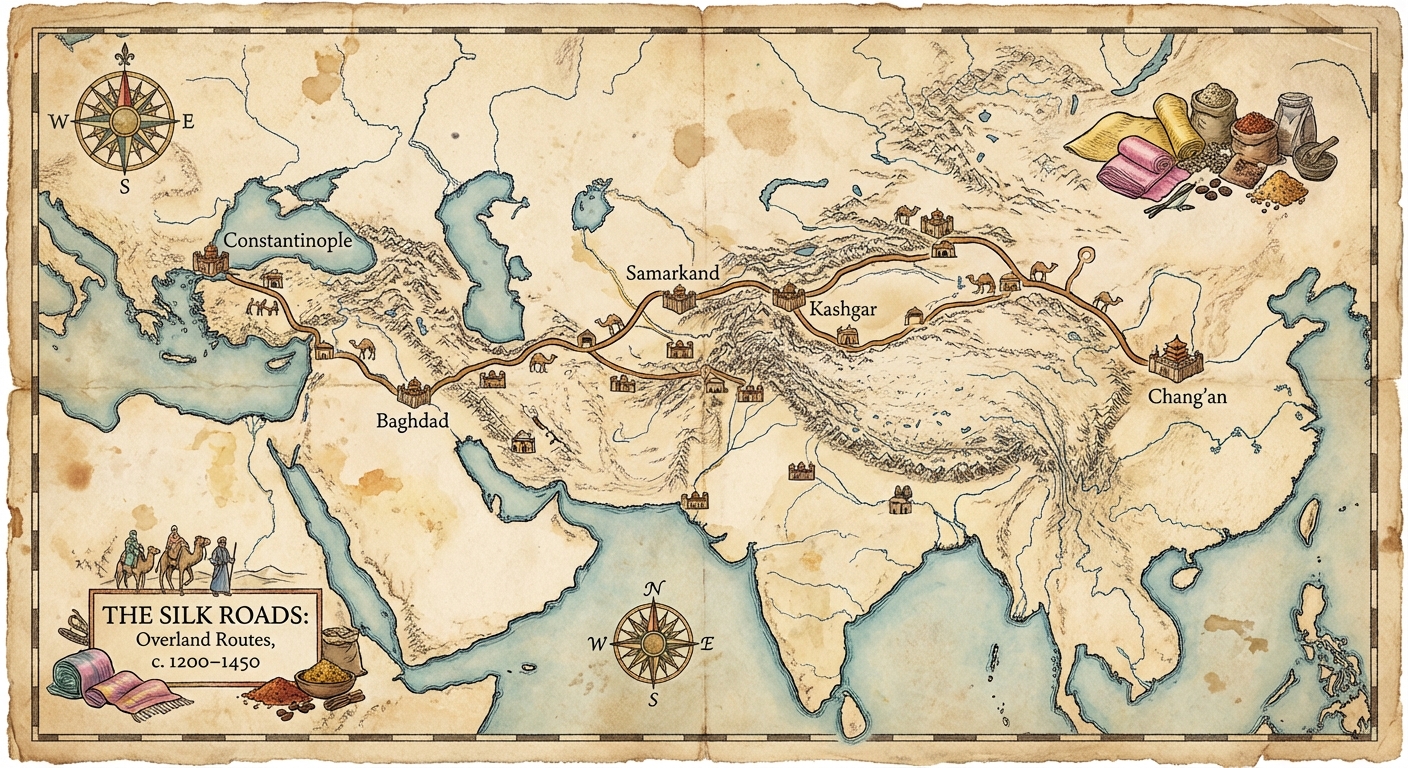
The Silk Roads were not a single road, but a network of overland land routes connecting East Asia, Central Asia, and Europe.
- Luxury Goods: Because overland travel was expensive and dangerous, merchants focused on high-value, low-weight goods: silk, porcelain (from China), textiles (from India), and steel/iron.
- Role of the Mongols: The unification of the Eurasian landmass under the Mongol Empire (see Section 2.2) vastly improved safety, leading to a golden age of trade.
Commercial Innovations
New financial systems made trade easier, moving beyond simple barter.
- Flying Cash: A system of credit developed in China (Tang/Song) allowing merchants to deposit paper money in one location and withdraw it in another.
- Banking House: Precursors to modern banks; established in Europe to handle bills of exchange.
- Bill of Exchange: A document stating the holder was legally promised payment of a set amount on a set date.
Trading Cities
Cities grew along routes as hubs of exchange, religious diffusion, and rest. Two critical cities to know are:
- Kashgar (Western China): Located at the point where the northern and southern Silk Roads crossed; a fertile oasis watered by the Kashgar River.
- Samarkand (Uzbekistan): A stopping point between China and the Mediterranean; a center of cultural exchange (Christianity, Buddhism, Zoroastrianism, and Islam) and artisan craft.
- Caravanserai: Fortified inns located about 100 miles apart (the distance a camel could travel) where travelers could rest and trade animals.
2.2 The Mongol Empire and the Making of the Modern World
Rise of the Mongols
Initially nomadic pastoralists north of the Gobi Desert, the Mongols became the largest continuous land empire in history.
- Genghis Khan (Temujin): Unified the tribes in 1206. Known for ruthlessness to enemies but intense loyalty to allies. He integrated conquered peasants into his army and promoted specialized labor.
- Military Tactics: Superb horsemanship, the short bow, and a messenger system that allowed rapid communication.
The Khanates
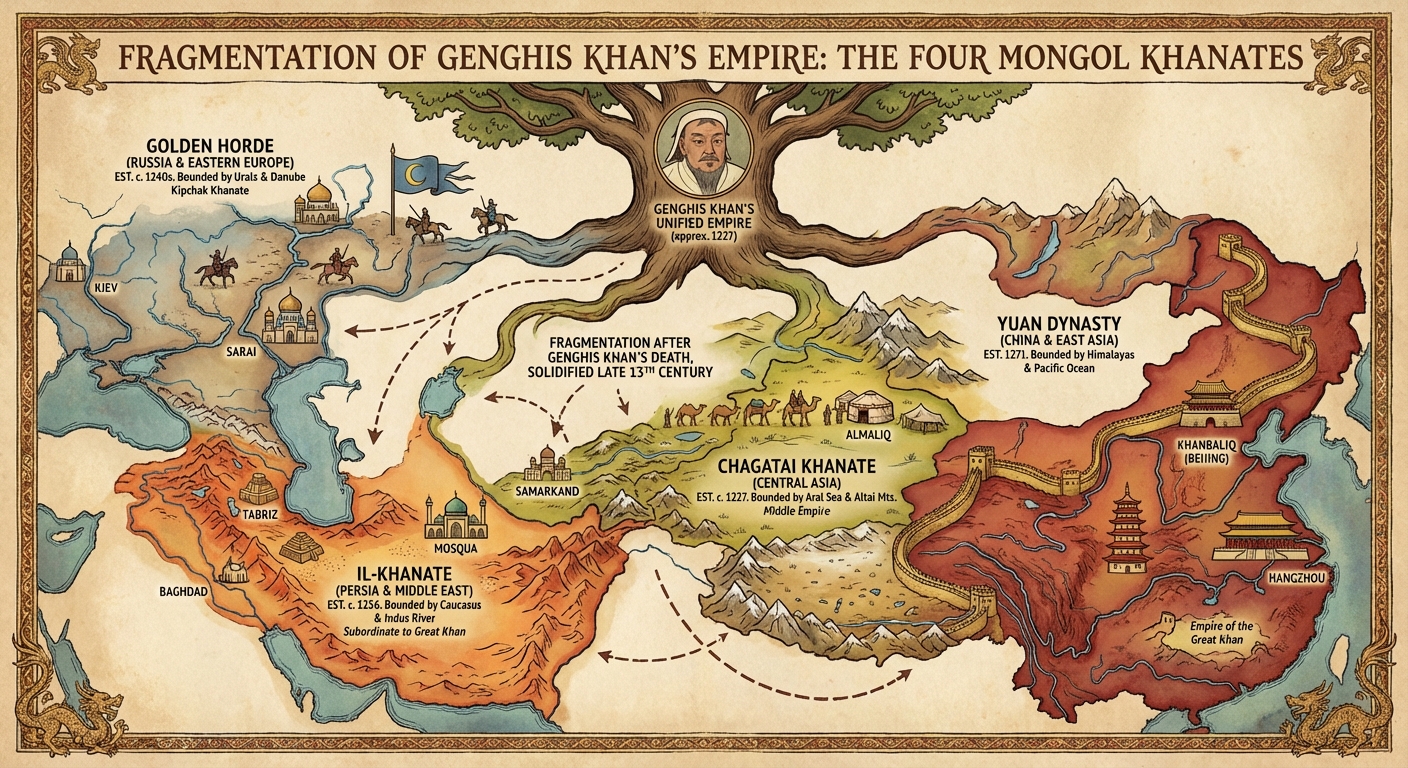
After Genghis Khan's death, the empire split into four key Khanates:
- Yuan Dynasty (China): Established by Kublai Khan. Dismantled the Civil Service Exam but promoted trade. Marco Polo visited here.
- The Golden Horde (Russia): Mongols demanded tribute from Russian princes (centered in Moscow). Indirect rule cut Russia off from the European Renaissance but centralized Russian political power.
- Il-Khanate (Middle East/Persia): Conquers of Baghdad (1258), ending the Abbasid Caliphate. Eventually converted to Islam.
- Chagatai Khanate (Central Asia): Controlled the Silk Road trade hubs.
The Pax Mongolica (Mongol Peace)
The period of Eurasian stability that fostered trade and exchange.
- Secure Routes: The Mongols policed the roads, making them safe for travelers (like Marco Polo and Ibn Battuta).
- Transfer of Tech: Gunpowder and paper moved from China to the Middle East and Europe.
- Uyghur Script: Genghis Khan tried to unify his empire with this alphabet; it is still used in Mongolia today.
- Centralized Power: Ironically, their brutal conquest helped centralize power in the regions they conquered (e.g., consolidating Russia, unifying China).
2.3 Exchange in the Indian Ocean
The Monsoon Marketplace
While the Silk Road was for luxury goods, the Indian Ocean allowed for the transport of bulk goods (timber, grain, spices) due to higher shop carrying capacity.
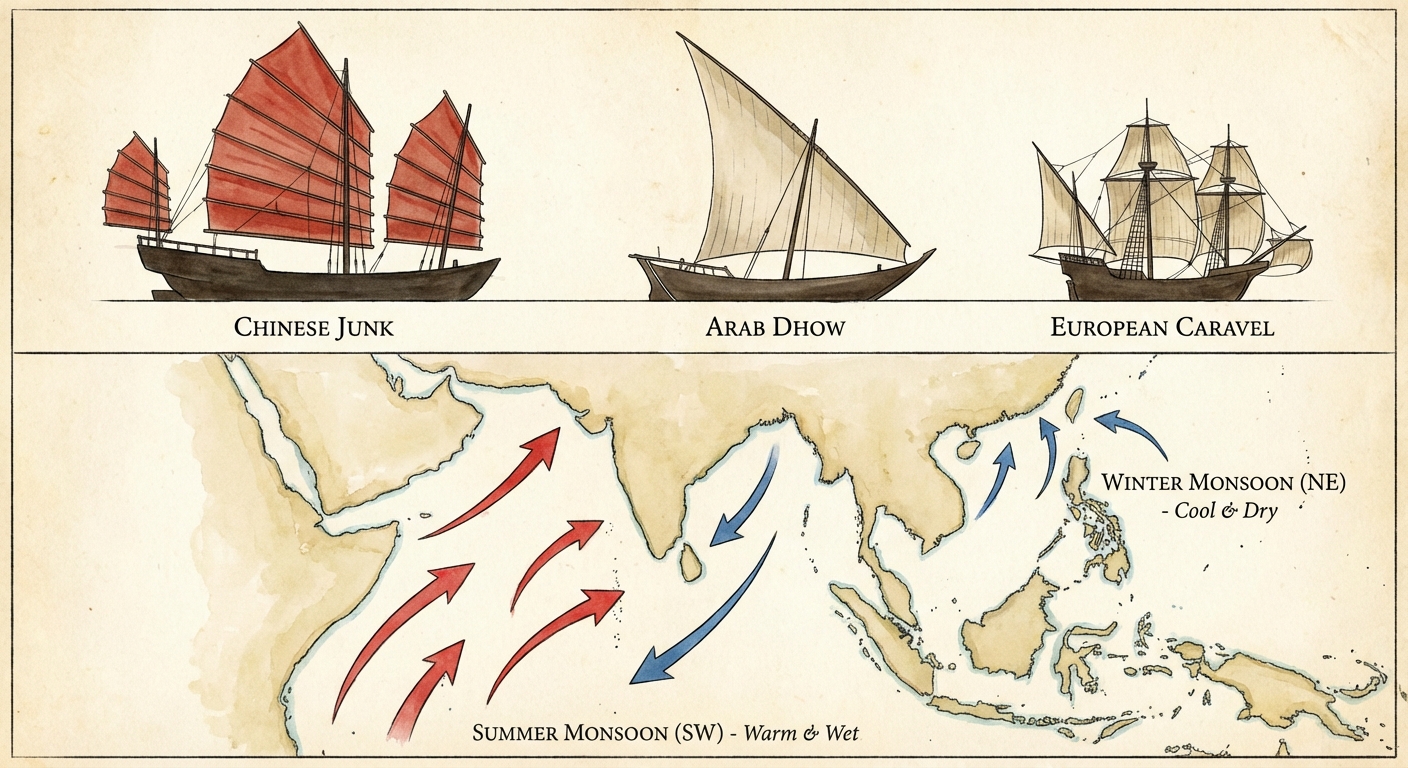
- Knowledge of Monsoon Winds: Essential for travel. Winds blew northeast in summer and southwest in winter. Merchants had to time their voyages, often staying in port cities for months, fostering cultural intermarriage.
Technological Advances
| Innovation | Origin | Function |
|---|---|---|
| Stern Rudder | China | Improved steering and stability |
| Lateen Sail | Arab/Malay | Triangular sail allowed ships to tack against the wind |
| Astrolabe | Islamic World | Allowed sailors to determine latitude by the stars |
| Dhow | Arab/India | Small/Medium ships dominating the western trade |
| Junk | China | Massive ships with watertight compartments |
Growth of States
Trade built powerful states that controlled key "choke points."
- Sultanate of Malacca: Controlled the Strait of Malacca (gateway to China). became wealthy by taxing ships. Islamic kingdom.
- Swahili City-States (East Africa): Kilwa, Mogadishu, Zanzibar. "Swahili" is a syncretic language (Bantu + Arabic). Traded gold, ivory, and slaves for porcelain and cotton.
- Gujarat (India): The go-to stopover for trade between the West (desiring textiles) and the East (desiring spices).
Diasporic Communities
Merchants settled in foreign lands to facilitate trade, introducing their own cultural traditions.
- Arab & Persian communities in East Africa.
- Chinese merchant communities in Southeast Asia.
- Malay communities in the Indian Ocean basin.
Voyages of Admiral Zheng He
(1405–1433) Ming Dynasty admiral who led 7 massive expeditions to display Chinese might and collect tribute. He brought back giraffes and exotic goods but the voyages were eventually stopped by officials who felt they were too expensive and violated Confucian values of isolationism.
2.4 Trans-Saharan Trade Routes
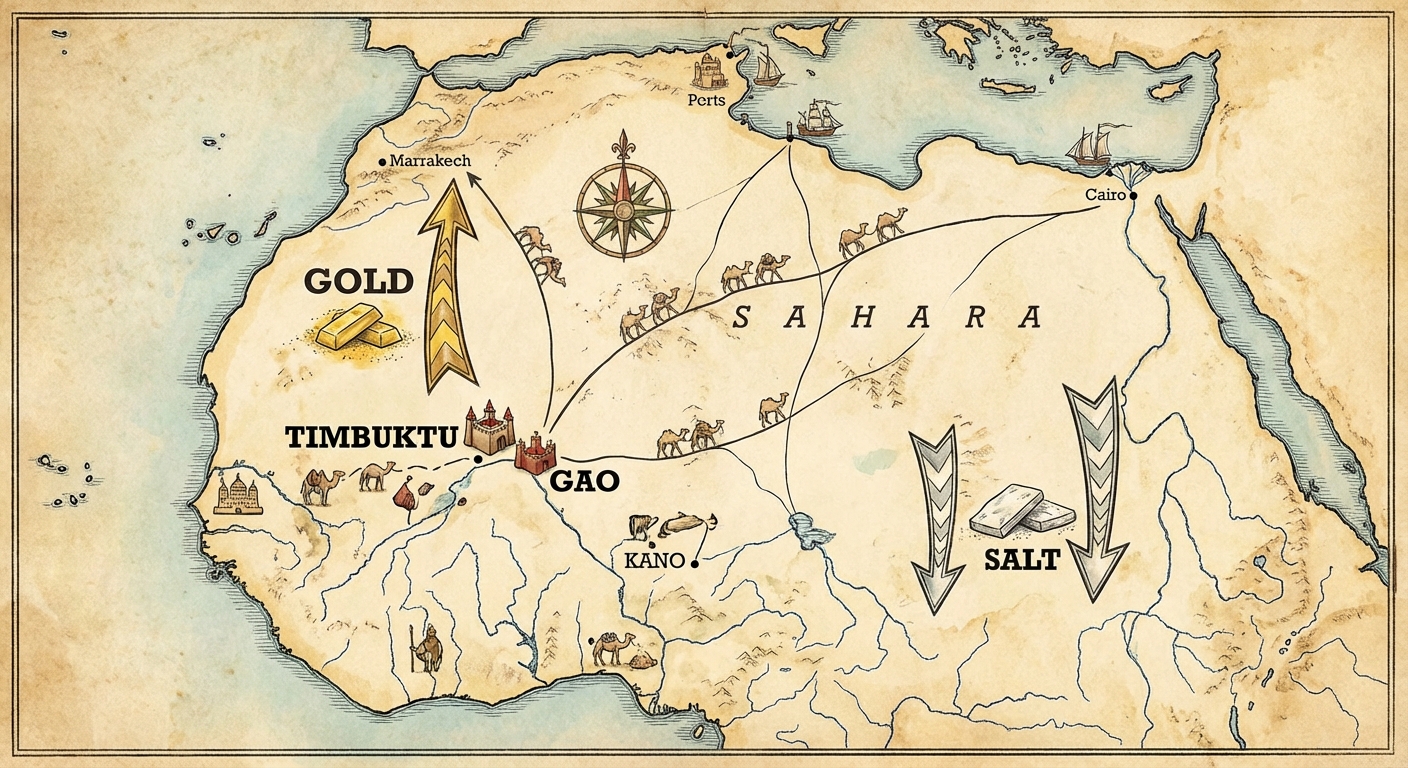
Technologies of the "Sand Roads"
- Camel Saddle: Allowed for heavy load-bearing and stability.
- Use of Camels: Adapted to dry conditions, unlike horses.
Goods Traded
- North to South: Salt, Cloth, Metalware.
- South to North: Gold, Ivory, Slaves.
West African Empire: Mali
Replaced Ghana as the dominant power.
- Mansa Musa: His pilgrimage to Mecca (Hajj) in 1324 displayed Mali's insane wealth (gold) to the world, causing gold inflation in Alexandria. He brought back architects and scholars to build mosques.
- Timbuktu: Became a world-renowned center of Islamic learning and trade.
- Sundiata: The "Lion Prince," founder of Mali, celebrated in oral tradition (griots).
2.5 Cultural Consequences of Connectivity
Diffusion of Religion
- Buddhism: Spread to China (Chan Buddhism) and then Korea/Japan. Also merged with Daoist ideas.
- Hinduism & Buddhism: Spread into Southeast Asia.
- Example: Angkor Wat (Cambodia) started as Hindu, turned Buddhist, showing the fusion.
- Islam: Spread to Africa (Swahili Coast, Timbuktu) and South Asia (via merchants and Sufi mystics, not just conquest).
Notable Travelers
- Ibn Battuta (Moroccan Muslim): Traveled 75,000 miles through the educated Islamic world (Dar al-Islam). His journals give us a view of the world through the lens of a devout Muslim.
- Marco Polo (Venetian Christian): Stayed in Kublai Khan's court. His book describing China's wealth amazed (and skepticism) Europe.
- Margery Kempe (English Mystic): Her autobiography gives insight into the life of a middle-class medieval woman traveling to Jerusalem.
2.6 Environmental Consequences
Diffusion of Crops
| Crop | From | To | Impact |
|---|---|---|---|
| Champa Rice | Vietnam | China | Drought-resistant, fast-ripening. Allowed 2 harvests/year. Result: Massive population boom in Song China. |
| Bananas | Indonesia | Sub-Saharan Africa | High-calorie food that grew where yams couldn't. Result: Bantu migrations expanded. |
| Sugar/Citrus | Caliphate | Europe | Increased demand for luxury foods; eventually led to slave labor on plantations. |
Diffusion of Disease: The Black Death
- Bubonic Plague: Spread via Mongol trade routes and fleas on rats.
- Impact: Killed 1/3 ~ 1/2 of Europe's population.
- Result: Labor shortage $\rightarrow$ Wages rose $\rightarrow$ Feudalism declined.
Comparison: The Hanseatic League
While the "Big Three" were in Asia/Africa, Europe organized the Hanseatic League (1358). It was an alliance of cities in Northern Germany and Scandinavia to control trade in the North Sea/Baltic.
- Key Difference: It was a sophisticated federation of independent cities, not a unified empire like the Mongols.
Common Mistakes & Misconceptions
- Mongol savagery vs. governance: Students focus only on Mongol destruction. Correction: The Mongols were ruthless conquerors but benevolent rulers who supported religious tolerance and safe trade (Pax Mongolica).
- Songhai vs. Mali: Students confuse the timeline. Correction: Mali (1200s-1400s) is the key Unit 2 state. Songhai rises as Mali falls, later in the timeline (Unit 3).
- Macro Polo vs. Ibn Battuta: Confusing their perspectives. Correction: Marco Polo was an outsider looking in (amazed by the "other"); Ibn Battuta was an insider traveling within his own religious community (criticizing lax Islamic practices).