Core Political Concepts: Power, Regimes, and Legitimacy
Power and Authority: The Foundations
In comparative politics, understanding how political entities convert raw capacity into accepted rule is essential. We begin by distinguishing between two frequently confused terms: Power and Authority.
Defining the Distinction
- Power: The ability of one person or group to get another person or group to do something they otherwise would not do. Power can be exercised through coercion (force) or incentives (money, resources).
- Authority: The legal right or recognized entitlement to exercise power.
Key Concept: A dictator may have power (guns and military support) but lack authority if the constitution or laws do not validate their rule. Conversely, a figurehead monarch might have authority (title and ritual status) but no real political power.
Sources of Power and Authority
According to the AP Comparative Government curriculum, power and authority are derived from specific sources within a country. These include:
- Constitutions: The supreme law defining the structure of government (e.g., The UK's unwritten constitution, Mexico's Constitution of 1917).
- Religions: Religious texts or leaders providing a mandate to rule (e.g., Sharia Law in Iran; the Supreme Leader).
- Military Forces: Control over the armed forces allows a leader to maintain order and coerce opponents (e.g., The PLA in China, historical military rule in Nigeria).
- Political Parties: Organization and mobilization of voters and elites (e.g., The Communist Party of China (CCP), United Russia).
- Legislatures: Law-making bodies that represent the people (e.g., The House of Commons in the UK).
- Popular Support: The will of the people, usually demonstrated through elections.
The State, The Regime, and The Government
Students often use these terms interchangeably, but in AP COGO, you must distinguish them rigorously.
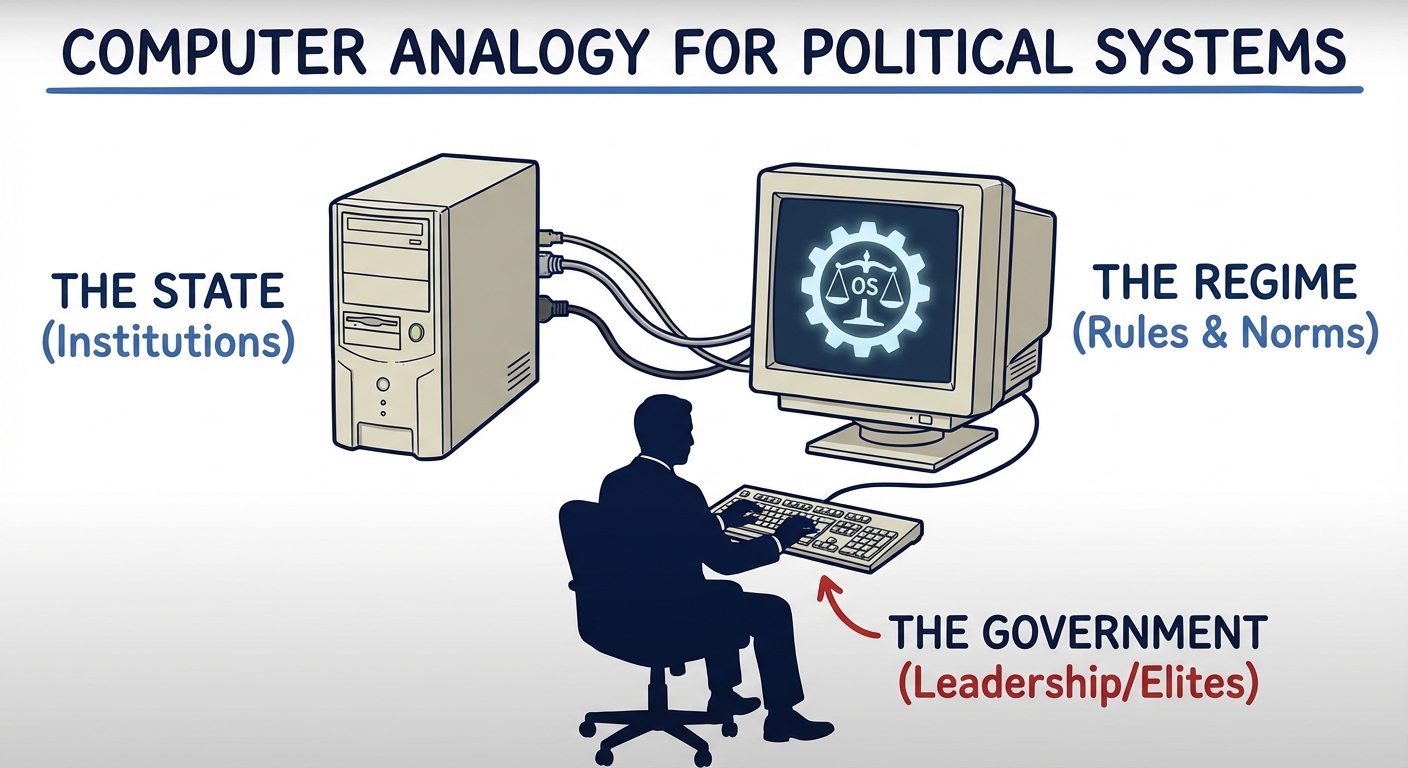
1. The State (The Hardware)
Definition: The set of political institutions that exercise management over the population and generate policy.
- Key Feature: Sovereignty (legal authority over valid territory).
- Characteristics: Highly institutionalized; difficult to change.
- Includes: The army, the police, the bureaucracy, the judiciary, and the tax systems.
2. The Regime (The Software/Operating System)
Definition: The fundamental rules and norms of politics. It determines how power is acquired and used.
- Key Feature: Can be democratic, authoritarian, or hybrid.
- Change: Regimes change less frequently than governments but more frequently than states (e.g., The transition from the USSR to the Russian Federation was a regime change).
- Stability: Regimes endure beyond individual leaders.
3. The Government (The User)
Definition: The leadership or elites in charge of running the state institutions.
- Key Feature: Weakly institutionalized; changes frequently.
- Examples: The Biden Administration, The Sunak Ministry, The Putin Administration.
Memory Aid:
- State = The Computer (Physical machinery, hard to replace).
- Regime = The Operating System (Windows vs. macOS; determines how the machine runs).
- Government = The User (The person typing on the keyboard; changes shifts often).
Types of Regimes
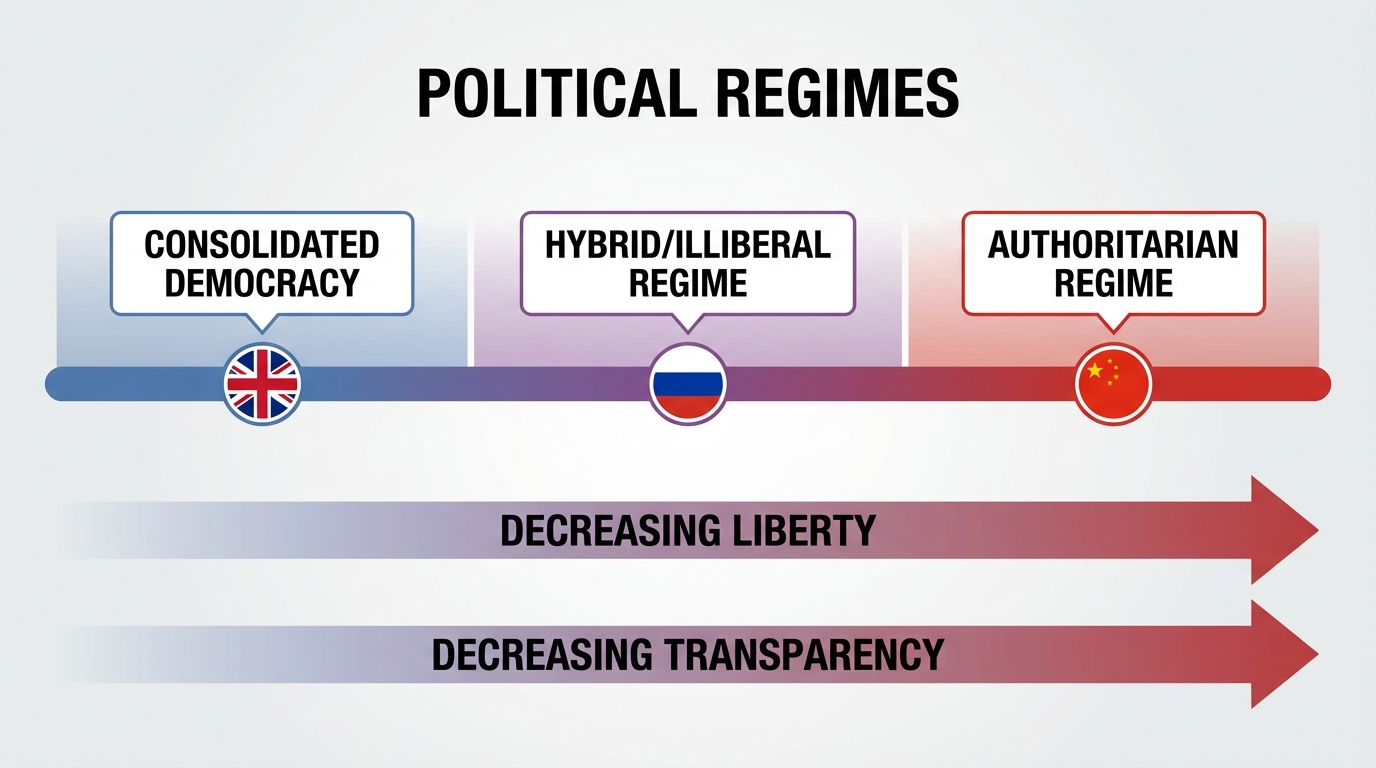
Regimes are categorized by how much power the people have versus the state, and how much transparency exists.
Democratic Regimes
Democracies bases their authority on the will of the people.
- Liberal Democracies: Systems that promote participation, competition, and liberty.
- Free, fair, and frequent elections.
- Civil society is allowed to flourish.
- Rule of Law: The law applies to everyone, including the government.
- Independent Judiciary: Courts can check the power of the executive.
- AP Course Example: United Kingdom.
Authoritarian Regimes
Regimes where a small group of individuals exercises power over the state without being constitutionally responsible to the public.
- Characteristics:
- Restriction of civil liberties.
- Rule BY Law: The law is used as a tool to control subjects, but the leaders are often above the law.
- State control of media.
- Types:
- Examples: China (One-party state), Iran (Theocracy).
Hybrid Regimes (Illiberal Democracies)
These regimes inhabit the gray area between democracy and authoritarianism.
- Characteristics:
- They hold elections, but they are not fully free or fair.
- Opposition parties exist but are harassed or disadvantaged.
- Constitutions exist but may be ignored.
- AP Course Example: Russia (often cited as the prime example), arguably some eras of Nigeria.
Legitimacy and Stability
Legitimacy is the general belief that the government has the right to rule and exercise authority. It is distinct from power; you can have power without legitimacy (a tyrannical warlord), but you cannot have stability for long without legitimacy.
Sources of Legitimacy (Max Weber's Typology)
| Type | Definition | Example |
|---|---|---|
| Traditional Legitimacy | "It has always been this way." Built on history, rituals, and continuity. | The Monarchy in the UK; Religious hierarchy in Iran. |
| Charismatic Legitimacy | Based on the dynamic personality of a leader or their ideas. Often short-lived (dies with the leader). | Mao Zedong in China; Ayatollah Khomeini in Iran (1979). |
| Rational-Legal Legitimacy | Based on a system of laws and procedures that are highly institutionalized. People obey the office, not the person. | The Constitution in the US or Mexico; Common Law in the UK. |
Maintaining and undermining Legitimacy
How is it maintained?
- Policy Effectiveness: delivering economic growth (e.g., China's economic boom).
- Political Efficacy: Citizens feeling their vote counts.
- Tradition: reinforcing national rituals.
How is it undermined?
- Corruption: When leaders use state resources for private gain (e.g., instability in Nigeria).
- Election Fraud: Rigged outcomes destroy trust (e.g., protests in Russia).
- Economic Collapse: If the state cannot provide basic needs, legitimacy crumbles.
Common Mistakes & Pitfalls
Conflating "Rule OF Law" and "Rule BY Law":
- Incorrect: Thinking China has Rule of Law because they have courts.
- Correct: China exercises Rule BY Law (law is a weapon of the state). The UK exercises Rule OF Law (the state is subject to the law).
State vs. Government:
- Incorrect: "The State of the UK changed when Boris Johnson resigned."
- Correct: The Government changed. The State (institutions) remained the same.
Defining Sovereignty:
- Incorrect: Thinking sovereignty just means "power."
- Correct: Sovereignty is the independent legal authority over a population in a specific territory, free from external control. (Note: The EU challenges UK sovereignty; colonization challenges Nigerian sovereignty).
Regime Change vs. Government Change:
- Incorrect: Calling an election a "regime change" in the UK.
- Correct: An election is a government change. A military coup (shifting from democracy to dictatorship) is a regime change.