Unit 3 Study Guide: El Barroco (The 17th Century)
Unit 3: El siglo XVII (Barroco)
Introduction to the Baroque Era
El Siglo XVII, strictly referring to the 1600s, represents the second half of the Spanish Siglo de Oro (Golden Age). While the 16th century (Renaissance) was characterized by optimism, expansion, and harmony, the 17th century (Baroque) is defined by pessimism, disillusionment, and complexity.
In the context of the AP Spanish Literature curriculum, this unit focuses on the literary movement known as El Barroco. This is a period of artistic splendor that paradoxically coincided with the political and economic collapse of the Spanish Empire. Writers responded to this crisis by rejecting simple harmony in favor of ornamentation, heavy symbolism, and philosophical depth.
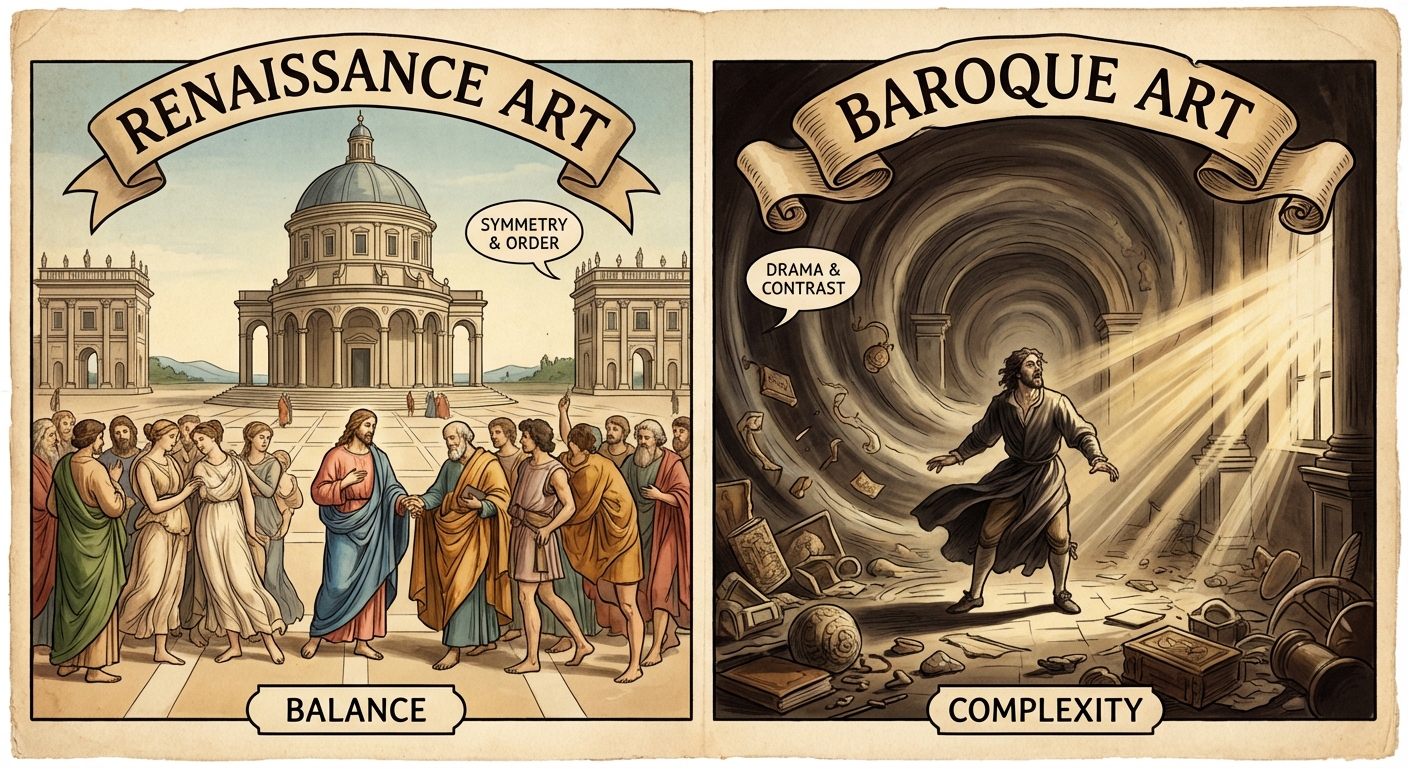
Essential Contrast: Renaissance vs. Baroque
To understand Unit 3, you must contrast it with Unit 2 (Renaissance):
| Feature | Renaissance (Unit 2 - 16th C.) | Baroque (Unit 3 - 17th C.) |
|---|---|---|
| Focus | Humanism, ideal beauty, balance | Pessimism, dark reality, excess |
| Themes | Carpe Diem (Enjoy the day) | Memento Mori (Remember you die) |
| Style | Natural, clear language | Artificial, complex, ornate language |
| Mood | Optimistic, imperial strength | Cynical, imperial decline (Desengaño) |
Historical Context: Crisis and Splendor
While art flourished, the geopolitical reality of Spain was grim. The Habsburg monarchs (Felipe III, Felipe IV, and Carlos II) oversaw the gradual disintegration of the empire.
- Political Decline: The loss of territories in Europe, the independence of Portugal and the Netherlands, and the devastating Thirty Years' War.
- Economic Ruin: Despite gold arriving from the Americas, the crown was bankrupt due to wars and mismanagement. There was extreme inequality between the aristocracy and the starving masses.
- Religious Rigor: The Counter-Reformation was in full effect. The Inquisition censored ideas, leading writers to use double meanings and metaphors to avoid persecution.
- El Desengaño (Disillusionment): This is the defining mood of the era. It is the realization that the world is false, deceitful, and fleeting. The optimism of the Renaissance was replaced by the certainty of death and decay.
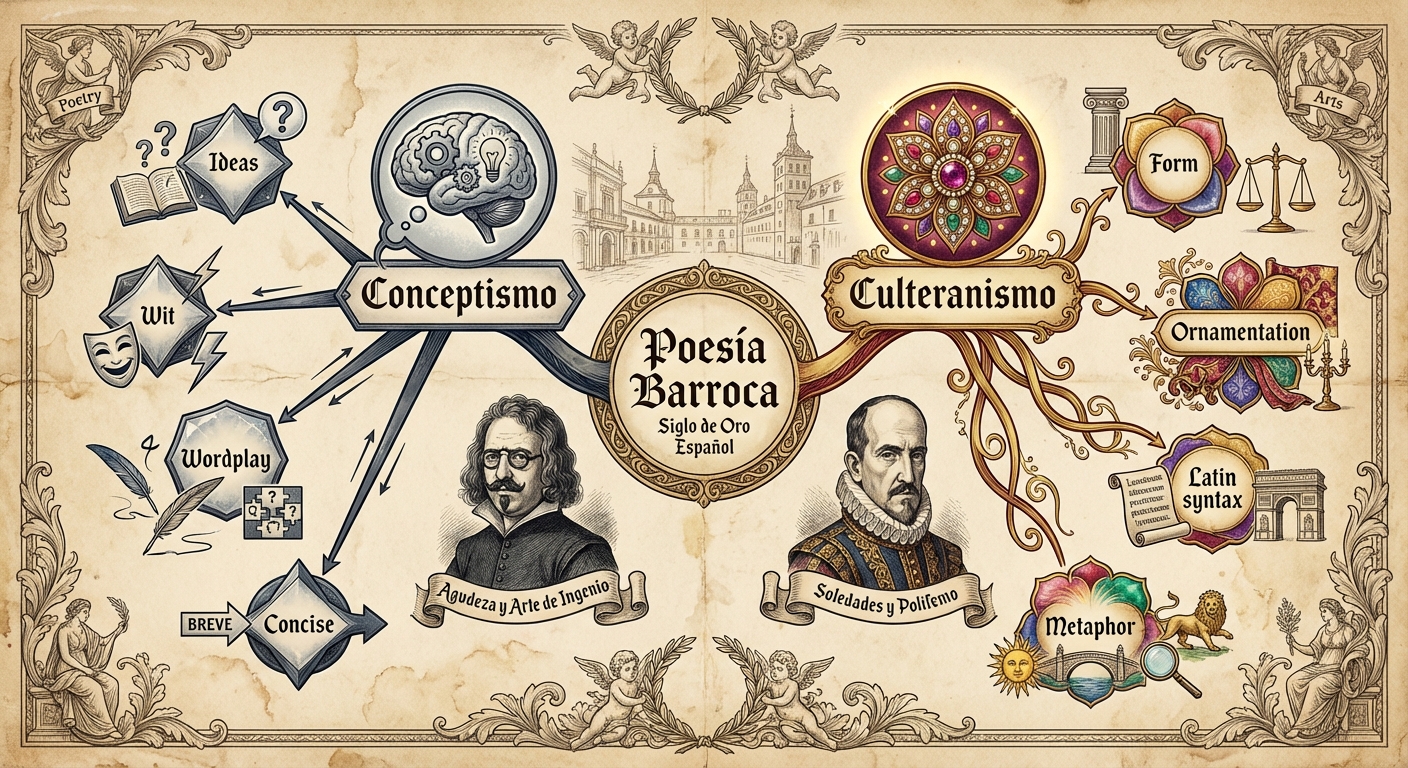
Literary Movements: Conceptismo vs. Culteranismo
The Baroque period in poetry is divided into two rival styles. Both are difficult to understand, but for different reasons.
1. Culteranismo (Gongorismo)
- Leader: Luis de Góngora y Argote.
- Focus: Beauty of form and language.
- Characteristics:
- Changing the natural order of words (Hipérbaton).
- References to Greek/Roman mythology (Alusiones).
- Neologisms (invented words usually from Latin).
- Appeal to the senses (color, light, sound).
- Goal: To create a world of absolute beauty away from reality, accessible only to the educated elite.
2. Conceptismo
- Leader: Francisco de Quevedo.
- Focus: Depth of meaning (concepts) and wit.
- Characteristics:
- Saying much with few words (Laconicism).
- Double meanings (Dilogía) and puns (Retruécano).
- Sharp satire and social critique.
- Strong contrasts (Antítesis and Paradoja).
- Goal: To express complex ideas and criticize society through intellectual games.
Required Authors and Works (AP Curriculum)
This unit focuses on specific required texts that exemplify the Baroque style. These are the texts you must know for the exam.
1. Luis de Góngora: Soneto CLXVI
- Full Title: "Mientras por competir con tu cabello"
- Genre: Poetry (Sonnet). Italian style (2 quartets, 2 tercets, ABBA ABBA CDC DCD).
- Key Literary Devices:
- Anáfora: Repetition of "mientras" (while).
- Hipérbaton: "Mientras por competir con tu cabello, oro bruñido al sol relumbra en vano" (syntax is inverted).
- Gradación (Climax): The poem ends with a descending gradation: "en tierra, en humo, en polvo, en sombra, en nada" (into earth, smoke, dust, shadow, nothingness).
- Theme: Memento Mori. It starts like a Carpe Diem poem (enjoy your beauty while you are young) but ends grimly (you will turn into nothing).
2. Francisco de Quevedo: Salmo XVII
- Full Title: "Miré los muros de la patria mía"
- Genre: Poetry (Sonnet).
- Context: Written during the decline of the Spanish Empire. It can be read as a personal reflection on aging OR a political reflection on Spain's ruins.
- Key Literary Devices:
- Metaphor/Symbolism: The "muros" (walls) represent both the borders of Spain (crumbling) and the poet's own aging body.
- Prosopopeya: The sun explicitly "drinking" the ice.
- Tone: Melancholic, pessimistic, resignation.
- Theme: El tiempo y el espacio (Time and Space). The inevitability of death and decay.
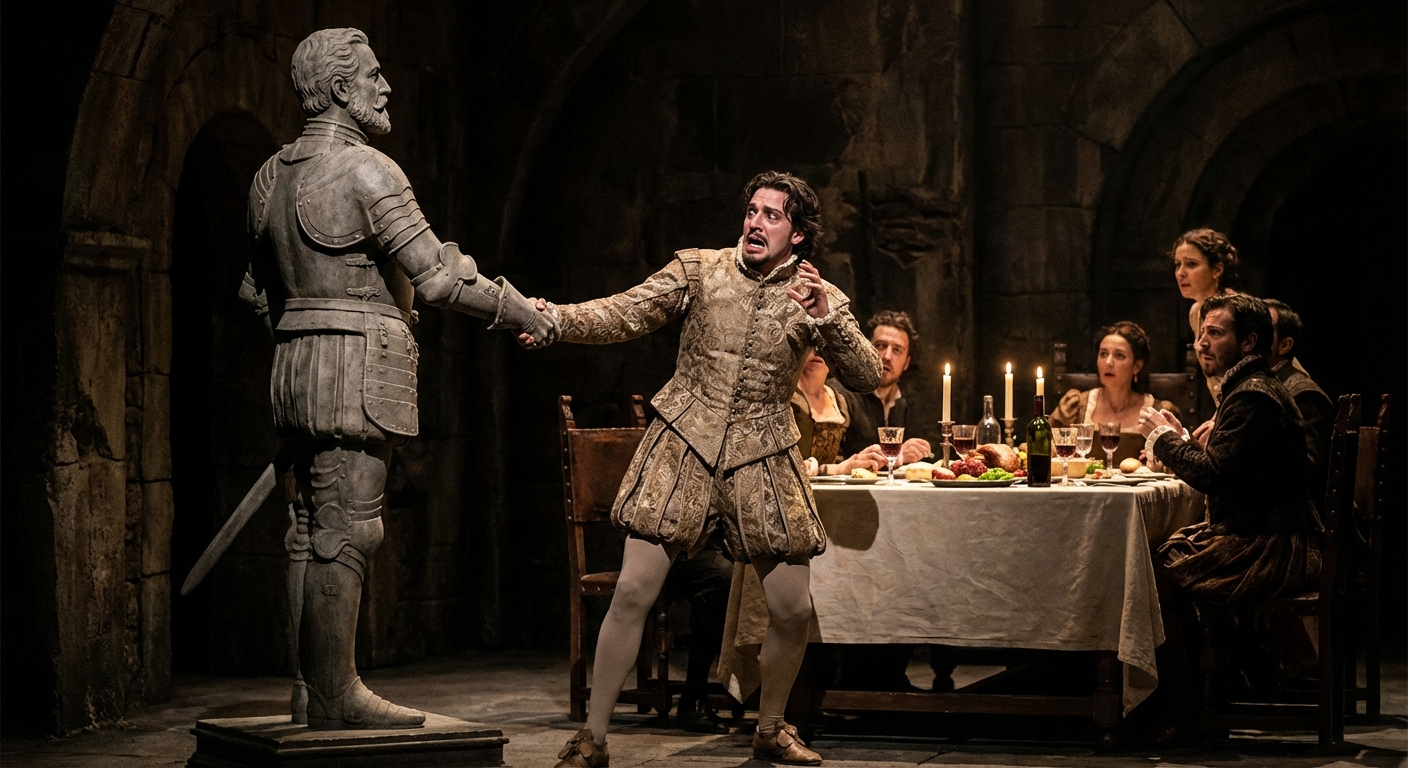
3. Tirso de Molina: El burlador de Sevilla y convidado de piedra
- Genre: Theater (Comedia del Siglo de Oro).
- Main Character: Don Juan Tenorio. He is the archetype of the "trickster" (burlador). He seduces women not out of love, but to trick them and damage their honor.
- Plot: Don Juan seduces four women (two noble, two commoners). He kills the father of one victim (Don Gonzalo). Later, he mocks the statue of Don Gonzalo, inviting it to dinner. The statue comes to life and drags Don Juan to hell.
- Key Concepts:
- Honor: In the 17th century, a woman's honor was physically located in her chastity. By taking it, Don Juan destroys her social standing.
- Justicia Divina (Divine Justice): Don Juan constantly says "Tan largo me lo fiáis" (You're giving me such a long time to pay/repent). He believes he has time to repent later. However, he dies without confession. The play teaches that God's justice is swift and inevitable.
- In Medias Res: The play opens in the middle of the action (Don Juan escaping a bedroom).
- Quote to Know: "Tan largo me lo fiáis." (Don Juan's catchphrase signifying his arrogance toward death).
4. Sor Juana Inés de la Cruz: Sátira filosófica
- Full Title: "Hombres necios que acusáis"
- Who is she? A nun from New Spain (Mexico). This is often called Barroco de Indias (Colonial Baroque). She is a feminist voice centuries ahead of her time.
- Genre: Poetry (Redondillas - stanzas of 4 lines, 8 syllables, abba).
- Key Literary Devices:
- Retruécano: "la que peca por la paga / o el que paga por pecar" (She who sins for pay / vs he who pays to sin).
- Antítesis: Contrasting expected behavior vs. actual behavior.
- Apostrophe: Addressing "Hombres necios" directly.
- Theme: La construcción del género (Gender construction). She exposes the hypocrisy of men who pressure women to have sex and then condemn them for being "loose" women.
Important Connections & Corrections
Clarifying the "Siglo de Oro" Timeline
Students often confuse authors from Unit 2 (Renaissance) and Unit 3 (Baroque) because both fall under the "Golden Age."
- Unit 2 (16th Century): Garcilaso de la Vega, Lazarillo de Tormes, Cervantes (Don Quixote Part 1).
- Unit 3 (17th Century): Góngora, Quevedo, Tirso de Molina, Sor Juana.
Note on Cervantes: While Miguel de Cervantes published the second part of Don Quixote in 1615 (Baroque era) and died in 1616, the College Board typically introduces him in the transition between Unit 2 and 3. His work contains elements of both: the humanism of the Renaissance and the cynicism/meta-fiction of the Baroque.
The New Theater (Comedia Nueva)
Initiated by Lope de Vega (though Tirso is the required author for this unit), 17th-century theater changed the rules:
- Breaking the 3 Units: It did not follow Aristotle's rules of time, place, and action.
- Mixing Genres: Blended tragedy and comedy (tragicomedy).
- Polymetry: Varied rhyme schemes depending on the situation/speaker.
- Stock Characters: The gracioso (funny servant), the dama (lady), the galán (gentleman), the burlador (trickster).
Common Mistakes & Pitfalls
Confusing Carpe Diem with Memento Mori:
- Carpe Diem (Renaissance/Garcilaso): "Enjoy youth because it is beautiful."
- Memento Mori (Baroque/Góngora): "Enjoy youth urgently because you are going to die and turn to dust."
Misunderstanding Don Juan:
- Mistake: Thinking Don Juan is a romantic lover.
- Reality: He is a predator. He enjoys the deception (el engaño), not the love. He represents a social threat to order and honor.
The "Picaresque" Timing:
- Lazarillo de Tormes is often cited in notes (like the reference text provided), but it is 1554 (Renaissance). For the Baroque picaresque, the example would be Quevedo's El Buscón, but Lazarillo is the Unit 2 prototype.
Sor Juana's Context:
- Remember she writes from Mexico (New Spain). She is defended the right of women to study and think, not just social behavior. Her criticism is intellectual.
Summary of Key Terminology (Glosario)
- Hipérbaton: Altering syntax (Yoda-speak) to create complexity (Góngora).
- Gradación: A list that ascends or descends in intensity (Góngora's "en tierra, en humo…").
- Retruécano: Puns/wordplay involving reversing a phrase (Sor Juana/Quevedo).
- Redondilla: A stanza of 4 lines of 8 syllables with ABBA rhyme (Sor Juana).
- Memento Mori: Latin for "Remember you must die."
- Desengaño: The lifting of the veil of illusion; realizing the harsh truth of life.