Global Shifts: Trade, Labor, and Migration (1750–1900)
Global Shifts: Trade, Labor, and Migration (1750–1900)
This study guide covers the profound economic and demographic shifts resulting from Industrialization, focusing on how industrialized nations extracted resources from the rest of the world and how this dynamic caused massive waves of human migration.
1. Global Economic Development & Export Economies
Industrialization accelerated the demand for raw materials and food supplies. As Western nations (and Japan) industrialized, they transformed the economies of Asia, Africa, and Latin America into Export Economies—economies specialized in the commercial extraction of natural resources and the production of food and industrial crops.
The Shift in Global Production
Unlike the earlier Mercantilist era where colonies were general distinct markets, in this period, non-industrialized nations became specialized suppliers. The value was added in the factories of the U.S. and Europe, while the suppliers remained dependent on selling low-cost raw materials.
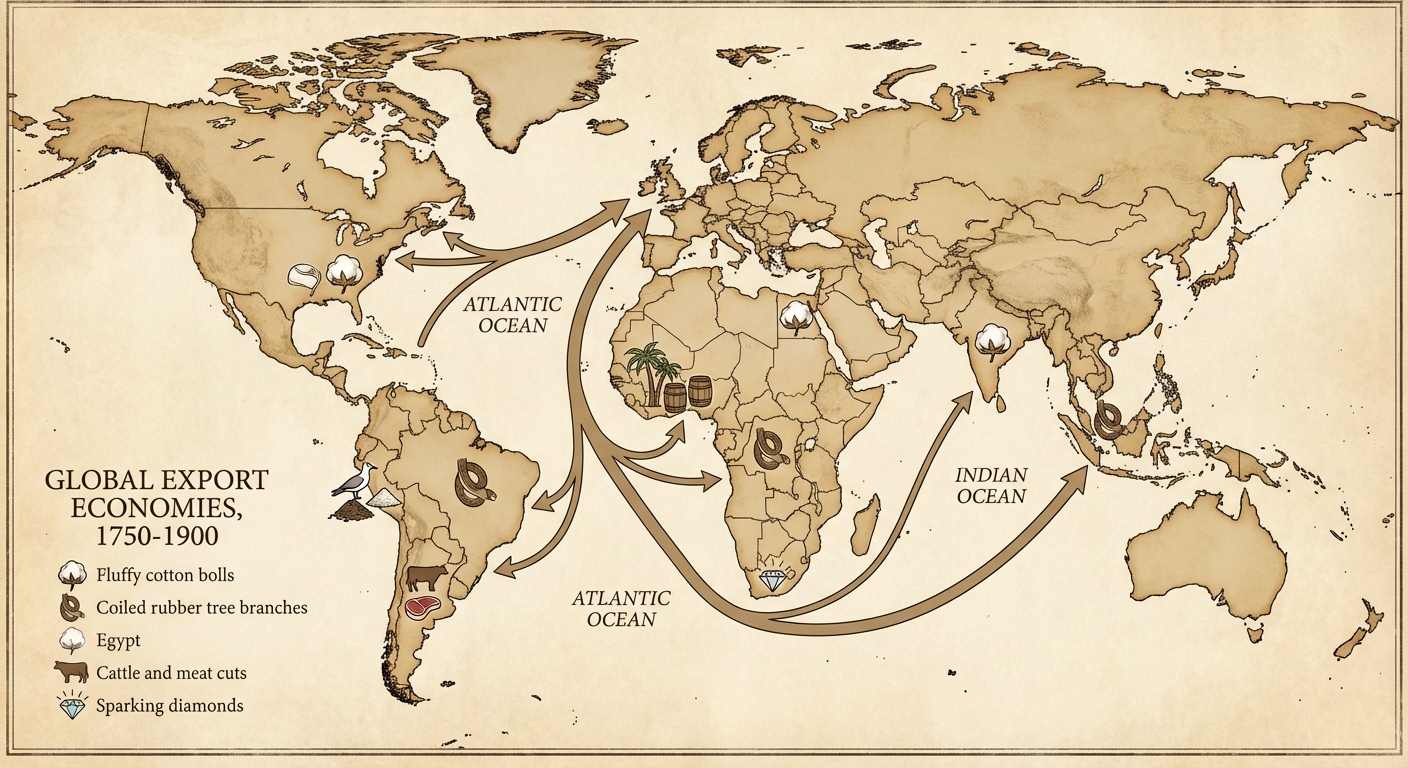
Key Commodities driving Trade
- Cotton: Vital for British textile mills. During the U.S. Civil War, Britain shifted reliance to Egypt and India, reshaping their agricultural landscapes.
- Rubber: Essential for tires, hoses, and gaskets in machines. Extracted from trees in the Amazon initially, then farmed intensively in the Congo (under Leopold II) and Southeast Asia.
- Palm Oil: Used as a lubricant for machinery and in soap production. Major export from West Africa.
- Guano: Bat and seabird excrement, rich in nitrates. Mined heavily in Peru and Chile, it was the premier agricultural fertilizer before artificial alternatives.
- Meat: The invention of refrigeration allowed Argentina and Uruguay to export beef to Europe.
- Diamonds: The De Beers company monopolized diamond mining in South Africa, illustrating corporate control over colonial resources.
2. Economic Imperialism
Economic Imperialism is a situation where foreign business interests have great economic power or influence, developed as businesses took advantage of natural resources beyond their borders.
Unlike traditional colonialism, which involves direct political administration, economic imperialism involves control through debt, investment, and trade leverage. The "colony" might technically be an independent nation.
Case Studies in Economic Imperialism
Asia: The Opium Wars
- The Context: Britain faced a trade deficit with China (buying too much tea, silk, and porcelain; selling too little).
- The "Solution": The British East India Company began forcing Indian farmers to grow Opium, which was then smuggled into China.
- The Conflict: When China tried to ban the drug, Britain went to war (First Opium War, 1839–1842) under the guise of "free trade."
- The Result: The Treaty of Nanking. This "unequal treaty" opened up 5 ports to foreign trade, gave Britain Hong Kong, and weakened China economically for a century.
Latin America: Neocolonialism
Although most of Latin America was politically independent by the mid-1800s, they were economically dependent on the U.S. and Britain.
- The United Food Company: An American corporation that traded in tropical fruit (mostly bananas), grown on Latin American plantations. They allied with landowners and politicians to keep regulations low and profits high, creating "Banana Republics"—unstable states dependent on the exportation of a limited-resource product.
- British Investment in Argentina: Britain invested heavily in Argentine breeding stock, fencing, and infrastructure (Port of Buenos Aires) to ensure a steady supply of cheap beef.
3. Causes of Migration (1750–1900)
Migration patterns changed drastically due to new modes of transport (steamships) and shifts in labor markets caused by the abolition of slavery.
Push and Pull Factors
| Push Factors (Why leave?) | Pull Factors (Why go there?) |
|---|---|
| Poverty & Famine: The Irish Potato Famine (1845–1849) forced millions to flee. | Economic Opportunity: Need for factory workers in the U.S. or agricultural laborers on plantations. |
| Political Instability: The Taiping Rebellion and chaotic conditions in late Qing China pushed many to leave. | Gold Rushes: Gold discoveries in Australia, California, and Alaska drew fortune seekers. |
| Overpopulation: Rapid population growth in India and China put pressure on land resources. | Subsidized Passage: Some governments or companies paid for the voyage in exchange for labor contracts. |
New Labor Systems
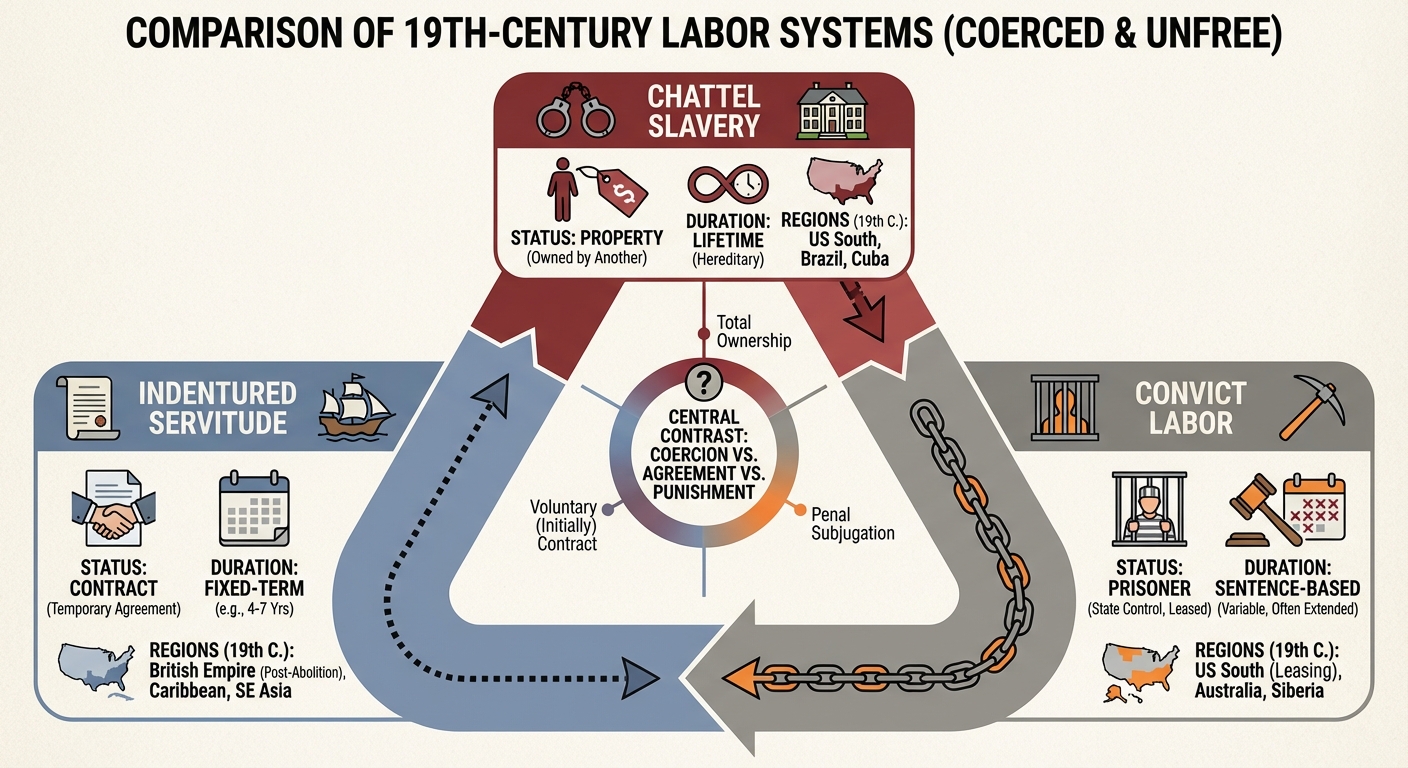
As the Trans-Atlantic Slave Trade ended (Britain abolished it in 1807, slavery itself in 1833; USA in 1865), specific labor vacuums appeared, specifically in sugar plantations.
- Indentured Servitude: A system where people worked for a set number of years (usually 5–7) in exchange for passage.
- Indian Laborers: Millions migrated to British colonies like Trinidad, Fiji, Mauritius, and South Africa.
- Chinese Laborers: Migrated to the U.S. (railroads), Cuba (sugar), and Peru (guano).
- Asian Contract Labor: Similar to indentured servitude but often involving more coercion and misleading contracts.
- Convict Labor: Britain used Australia as a penal colony. Convicts performed hard labor (road building, farming) and eventually earned freedom ("ticket of leave").
4. Effects of Migration
Migration permanently altered the demographics, culture, and laws of both receiving and sending societies.
Social Impact on Home Societies
- Gender Imbalance: Migrants were predominantly male. This often left women in home societies (like Africa and India) to take on new roles, managing finances, farms, and families, temporarily shifting gender norms.
Creation of Ethnic Enclaves
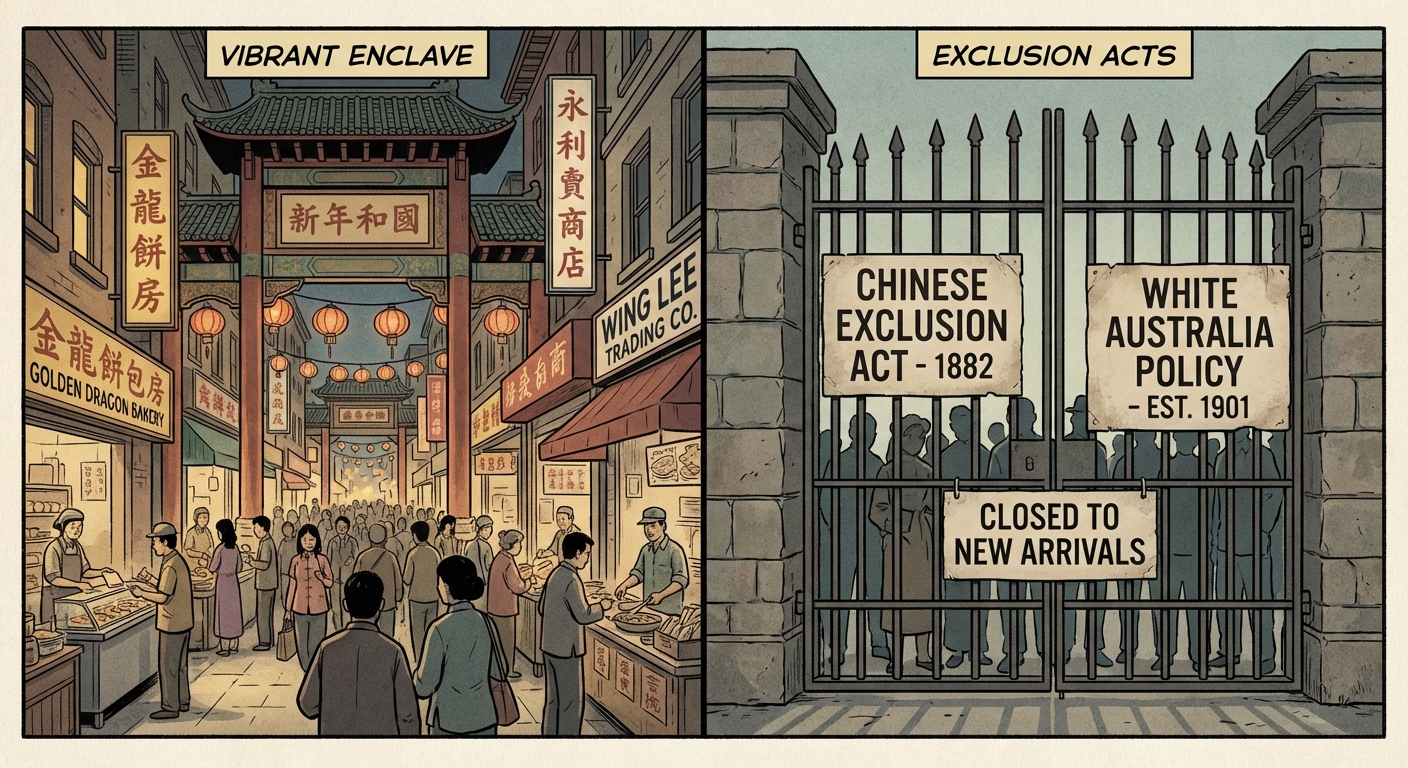
Migrants often congregated in specific neighborhoods to support one another, speak their language, and eat traditional foods. This helped transplant their culture to new environments.
- Chinatowns: Sprang up in major cities worldwide (San Francisco, New York, Melbourne).
- Indians in Africa: Mohandas Gandhi practiced law in South Africa, where a large Indian population existed due to indentured servitude.
- Italians in Argentina: Italian influence became so strong in Argentina that the local Spanish dialect adopted Italian intonations, and Italian culture deeply permeated the society.
Prejudice and Regulation of Immigrants
As immigrant populations grew, so did nativist resentment. Workers feared migrants would work for lower wages.
- Chinese Exclusion Act (1882): The U.S. banned strict Chinese immigration for decades—the first U.S. law to ban a specific ethnic group.
- White Australia Policy (1901): The new Australian parliament passed the Immigration Restriction Act to limit non-European immigration, aiming to preserve a "white British" identity.
Common Mistakes & Pitfalls
- Mistaking Economic Imperialism for Colonialism: Remember, in Economic Imperialism, the dominating power does not usually replace the government. They control the country through money (bribes, debt, corporate power). If there is a Viceroy or Governor-General, it's a Colony. If there is a corporate board and local puppet leaders, it's Economic Imperialism.
- Chronology of Slavery vs. Indenture: Students often think indentured servitude happened before slavery (like in early colonial Virginia). While true for the 1600s, in Unit 6 (1750–1900), the massive wave of Indian/Chinese indentured servitude happened after the abolition of African chattel slavery to replace that labor force.
- The Scope of Migration: Do not assume all migration was to the United States. Huge numbers of Italians went to Argentina, and millions of Indians went to the Caribbean and Africa.