AP Environmental Science: Human Impact on Land and Water Sources
5.1 The Tragedy of the Commons
Concept Overview
The Tragedy of the Commons is a concept introduced by Garrett Hardin in 1968. It suggests that individuals will use shared resources in their own self-interest rather than in keeping with the common good, thereby depleting the resource.
- The Commons: A shared, unregulated public resource (e.g., the atmosphere, the open ocean, unregulated grazing land).
- The Tragedy: Individuals act on a rational, short-term self-interest to maximize profit. However, the collective result is the degradation or depletion of the resource for everyone.
Examples & Consequences
- Overfishing: Trawlers catch as many fish as possible in international waters because "if I don't, someone else will." Result: Collapse of the Grand Banks cod fishery.
- Overgrazing: Sheep farmers add more animals to a public pasture to increase personal profit. Result: Soil erosion and desertification.
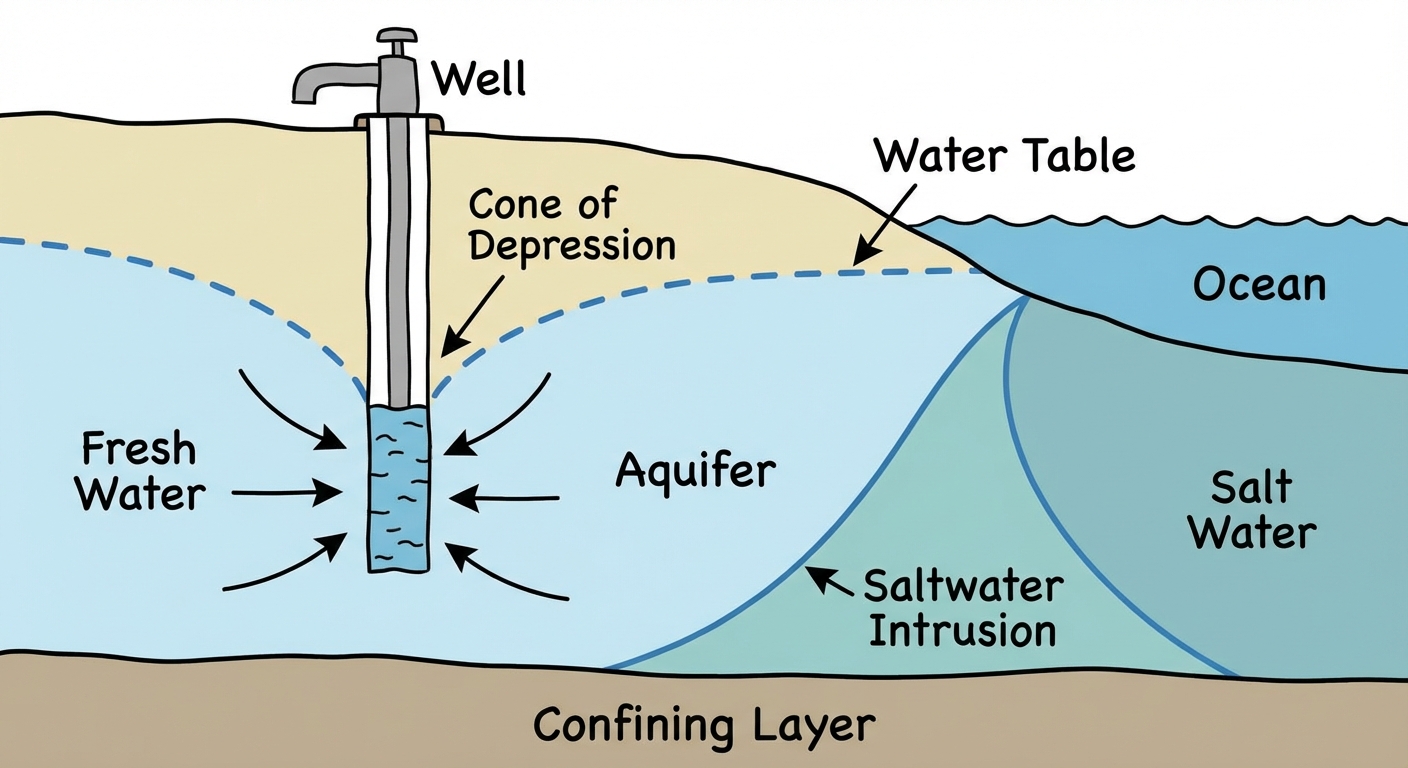
- Groundwater: Farmers pump from the Ogallala Aquifer faster than it recharges.
Solutions
- Privatization: Dividing the commons into private parcels (incentivizes owners to protect their land).
- Regulation: Government caps, quotas (e.g., fishing catch limits), or permits.
- Cooperative Management: Community-based rules and enforcement (common in small indigenous communities).
5.2 Forestry: Clearcutting and Sustainable Practices
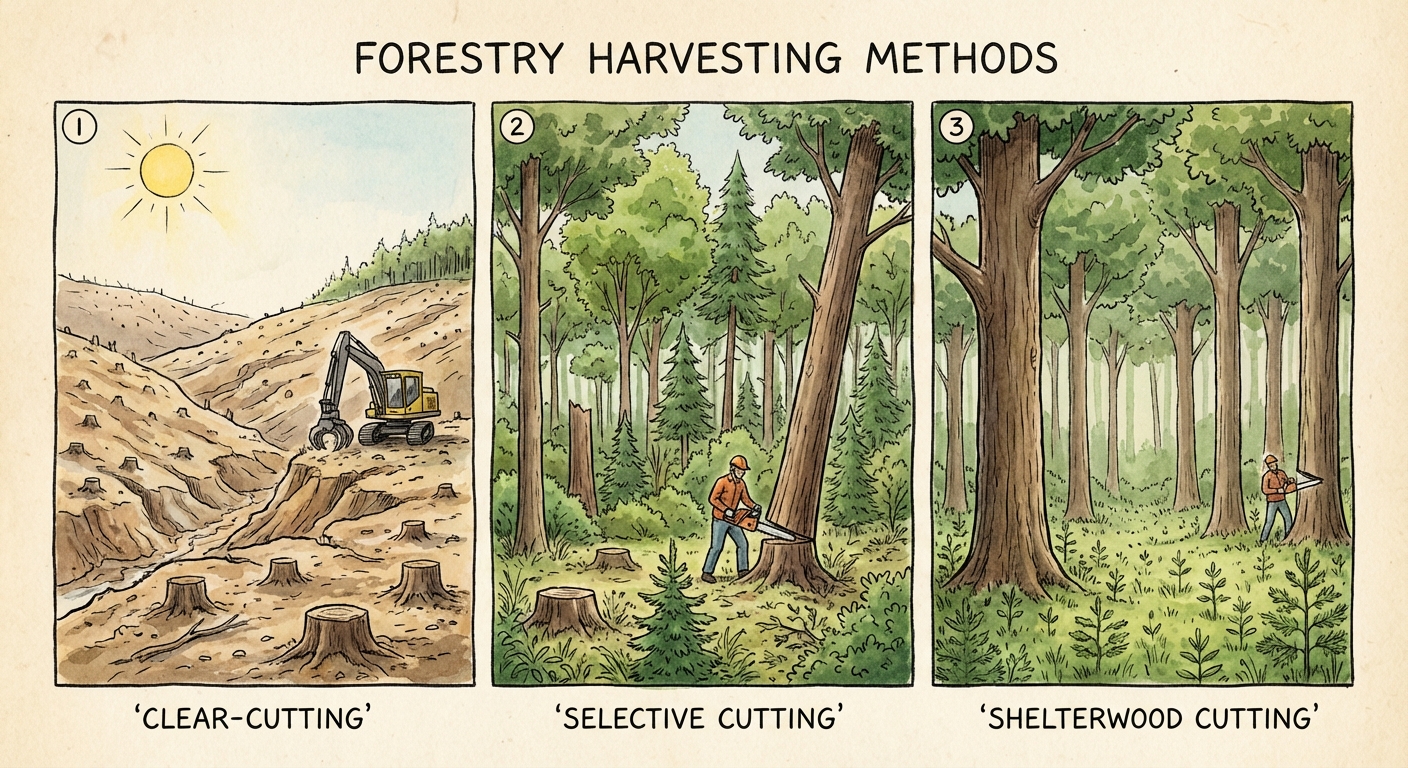
Clearcutting
Clearcutting is the commercial timber practice of removing all trees in an area at once. While it is the most economically efficient method, it causes significant environmental damage.
Environmental Impacts:
- Soil Erosion: Root systems that hold soil in place are removed. Topsoil washes into nearby waterways.
- Increased Water Turbidity: Runoff creates cloudy water, blocking sunlight for aquatic plants and clogging fish gills.
- Increased Soil Temperature: Loss of canopy shade raises soil temperature, drying it out and killing beneficial soil bacteria.
- Loss of Biodiversity: Habitat destruction leads to the loss of niche-specialized species.
- Edge Effect: Fragmentation creates more "edges" (boundaries between forest and open land), exposing species to predators and different abiotic conditions.
Sustainable Forestry
Methods to mitigate deforestation and maintain the ecosystem:
- Selective Cutting: Harvesting only intermediate-aged or mature trees singly or in small groups.
- Reforestation: Planting new trees to replace those harvested.
- Prescribed Burns: Intentionally setting small, controlled fires to remove dead biomass (fuel load). This prevents huge, uncontrollable wildfires later and releases nutrients back into the soil.
5.3 The Green Revolution
Definitions & History
The Green Revolution (1940s–1960s) shifted agriculture from small, local farms to large-scale industrial operations to feed a growing population. It is associated with Norman Borlaug.
(Note: Do not confuse this with "Green Energy" or the earlier Neolithic Agricultural Revolution).
Key Practices
- Mechanization: Use of tractors and combines. Increases efficiency and profit but relies heavily on fossil fuels.
- Monocropping: Planting a single species (e.g., corn) over a large area. Increases efficiency but makes crops highly vulnerable to pests and diseases.
- Synthetic Fertilizers: Haber-Bosch process creates Nitrogen fertilizer (N-P-K). Increases yield but causes eutrophication in runoff.
- Irrigation: Artificial water application.
- GMOs (Genetically Modified Organisms): Engineering crops to be drought-resistant, saline-tolerant, or pest-resistant (e.g., Bt Corn).
| Pros of Green Revolution | Cons of Green Revolution |
|---|---|
| Higher yields per acre | High fossil fuel consumption |
| Keeps food prices low | Soil degradation (compaction, salinization) |
| Prevented massive famine | Loss of genetic diversity in crops |
5.4 Impacts of Agricultural Practices
Soil Damage
- Tilling: Turning over the soil before planting. While it kills weeds, it disturbs the soil structure, increases erosion by wind and water, and releases sequestered carbon ($CO_2$) into the atmosphere.
- Slash-and-Burn: Cutting and burning tropical rainforests to create cropland. The ash provides temporary nutrients, but the soil is quickly depleted, leading to further deforestation.
Fertilizers
- Synthetic/Inorganic: Manufactured (ammonium nitrate). Highly soluble, fast-acting, but leaches easily into groundwater.
- Organic: Manure, compost, bone meal. Builds soil structure but releases nutrients slowly.
- Eutrophication: Excess Nitrogen/Phosphorus runoff $\rightarrow$ Algae bloom $\rightarrow$ Algae die $\rightarrow$ Bacteria decompose algae (using $O_2$) $\rightarrow$ Hypoxic (dead) zones.
5.5 Irrigation Methods
Agriculture accounts for nearly 70% of freshwater use. Choosing the right method balances cost vs. water conservation.
| Method | Description | Efficiency | Pros/Cons |
|---|---|---|---|
| Furrow | Cutting trenches between crop rows and filling with water. | ~65% | Easy/Cheap; Heavy waterlogging and salinization risk. |
| Flood | Flooding the entire field. | ~70-80% | Disrupts plant growth; Waterlogging; 20% lost to evaporation/runoff. |
| Spray | Pumping water into spray nozzles (sprinklers). | ~75-95% | More efficient; Expensive; Energy intensive. |
| Drip | Perforated hoses release water directly at roots. | >95% | Most efficient; Most expensive; Reduces weed growth. |
Water Issues related to Irrigation
- Waterlogging: Soil remains under water for prolonged periods; impairs root respiration because roots cannot get oxygen.
- Salinization: Small amounts of salts in irrigation water become highly concentrated on the soil surface after the water evaporates. Remedy: Flush the field with large amounts of fresh water to leach salts down.
- Aquifer Depletion: Overusing groundwater (e.g., Ogallala Aquifer) leads to saltwater intrusion in coastal areas.
5.6 Pest Control & IPM
The Pesticide Treadmill
A cycle of increasing pesticide use.
- Pesticide is applied.
- Most pests die, but resistant individuals survive (natural selection).
- Resistant survivors breed; the next generation is largely immune.
- Farmers must use higher doses or stronger chemicals.
Integrated Pest Management (IPM)
IPM is an ecosystem-based strategy that focuses on long-term prevention of pests through a combination of techniques. Chemical pesticides are used only as a last resort.
- Biological: Natural predators (e.g., Ladybugs eat aphids), parasites.
- Physical/Mechanical: Barriers, fences, traps, manual weeding.
- Cultural: Crop rotation (confuses pests), intercropping (push-pull systems).
- Chemical: Narrow-spectrum pesticides used sparingly.
Goal: Reduce pest damage to an economically manageable level, not total eradication.
5.7 Meat Production Methods
CAFOs (Concentrated Animal Feeding Operations)
High-density animal farming (feedlots) used for beef, poultry, and pork.
- Inputs: Grain/corn (requires cropland), antibiotics (to prevent disease in crowded conditions), growth hormones.
- Outputs: Cheap meat, massive volume of organic waste (manure lagoons).
- Impacts: Manure lagoons can leak into groundwater (E. coli, nitrates) or runoff into surface water. Antibiotic use contributes to resistant bacteria.
Free-Range Grazing
Animals graze on grass in open pastures.
- Pros: Animals eat natural diet (grass), no need for preventative antibiotics, waste is dispersed naturally as fertilizer.
- Cons: Requires much more land (land extensive), meat is more expensive, potential for overgrazing (leading to desertification).
The 10% Rule: It takes approximately 10 times more land/water/energy to produce 1 calorie of beef than 1 calorie of grain, because energy is lost as heat at each trophic level.
5.8 Mining Impacts
Mining is the extraction of nonrenewable resources (coal, oil, copper, gold).
Types
- Surface Mining (Strip mining, Open-pit, Mountaintop removal): Removes the overburden (soil/rock) to get to the ore. Displaces massive amounts of soil; high erosion.
- Subsurface Mining: Tunneling. More dangerous for humans, less surface destruction, but risk of acid mine drainage remains.
Key Environmental Terms
- Overburden: The soil and rock removed to get to the mineral.
- Spoil/Tailings: The waste material left over after the ore is extracted. Often toxic.
- Slag: Waste left from smelting (refining) metal.
- Acid Mine Drainage: When iron pyrite (fool's gold) in mines is exposed to air and water, it forms sulfuric acid. This lowers the pH of nearby streams, killing aquatic life and leaching heavy metals.
5.9 Urbanization & Runoff
Urban Sprawl
The expansion of human populations away from central urban areas into low-density, car-dependent communities.
- Causes: Cheaper land in suburbs, automobiles, highways.
- Consequences: Increased fossil fuel use (commuting), loss of agricultural land, Impervious Surfaces.
Urban Runoff
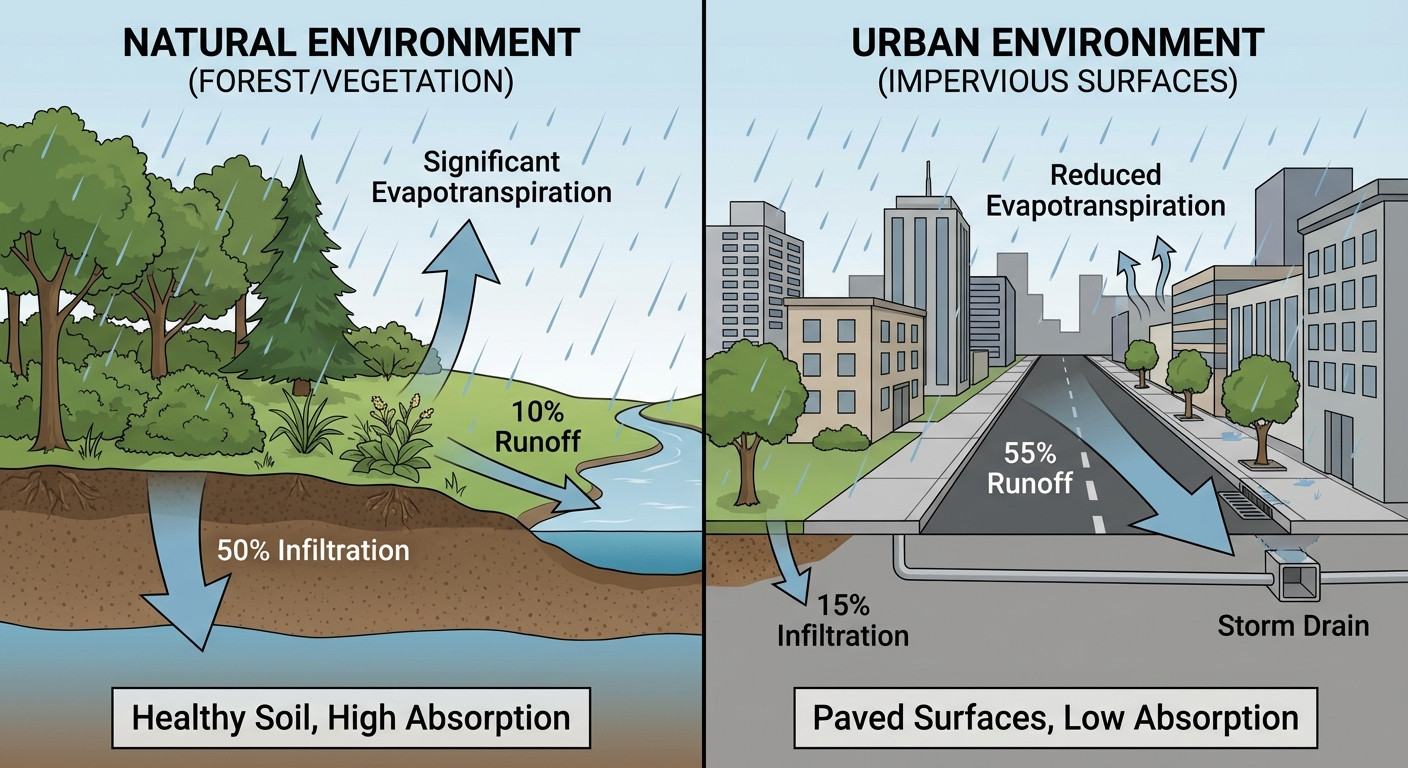
In natural systems, 50%+ of water infiltrates the soil. In cities, pavement and concrete (impervious surfaces) prevent infiltration.
- Result: Water rushes into storm drains, carrying oil, salt, grease, and pesticides directly to rivers (bypassing treatment).
Mitigation (Smart Growth)
- Permeable Pavement: Allows water to soak through.
- Planting Trees: Increases infiltration and reduces the Urban Heat Island Effect.
- Public Transit: Reduces car dependency.
- Building Up, Not Out: High-density housing preserves surrounding land.
5.10 Fisheries and Aquaculture
Wild Fisheries
- Overfishing: Catching fish faster than they can reproduce (Maximum Sustainable Yield).
- Bycatch: Unwanted species caught in nets (dolphins, turtles, juvenile fish).
- Trawling: Dragging weighted nets across the sea floor, destroying coral reefs and habitats.
Aquaculture (Fish Farming)
Raising fish in cages/enclosures (e.g., Salmon, Tilapia).
- Pros: highly efficient, requires small areas of water, reduces pressure on wild fisheries.
- Cons:
- High density of fish leads to disease; requires antibiotics.
- Accumulation of waste (feces) causes local eutrophication.
- Escaped fish (often GMO) may outcompete or breed with wild natives.
5.11 Sustainability & Ecological Footprints
Ecological Footprint
A measure of how much land and water is required to supply the resources a person or population consumes and to absorb the waste they produce. Measured in global hectares (gha).
- If the footprint > biocapacity, the population is living unsustainably (ecological deficit).
- Developed nations generally have much higher footprints due to meat consumption, energy use, and material goods.
IPAT Equation
A conceptual formula to estimate environmental impact:
- $I$ = Impact (Environmental)
- $P$ = Population size
- $A$ = Affluence (Consumption per person)
- $T$ = Technology (Destructive technology increases $T$; Green tech decreases $T$)
Common Mistakes & Exam Tips
- Bioaccumulation vs. Biomagnification:
- Bioaccumulation happens in one individual over time (e.g., a tuna accumulating mercury).
- Biomagnification happens up the food chain (e.g., shark eats tuna, shark gets all the tuna's mercury).
- Eutrophication Sources:
- Students often say "pesticides cause eutrophication." Incorrect. It is fertilizers (Nitrate/Phosphate) and animal manure. Pesticides are toxic, but they don't cause algae blooms.
- Weathering vs. Erosion:
- Weathering is the breakdown of rock.
- Erosion is the transport of that broken rock (by wind/water). Soil erosion is the movement of topsoil.
- Green Revolution: It is NOT about "green energy" (solar/wind). It is about the industrialization of agriculture in the mid-20th century.
- Drip Irrigation: While efficient, it is not feasible for large-scale grain crops (wheat/corn) due to the mechanics of plowing. It is mostly used for perennials (orchards, vineyards) and vegetables.