APUSH Period 8: Global Conflict & Domestic Anxiety (1945–1980)
APUSH Period 8: Global Conflict & Domestic Anxiety (1945–1980)
The Cold War Framework (1945–1980)
The Cold War was an ideological, political, and economic struggle between the capitalist United States and the communist Soviet Union (USSR). It involved proxy wars, nuclear arms races, and a competition for global influence, yet rarely involved direct military conflict between the two superpowers.
The Policy of Containment
The foundational strategy for US foreign policy during this period was Containment—the idea that the US should not try to destroy existing communist regimes but focused strictly on preventing the spread of communism to new areas.
- Architect: George Kennan (author of the "Long Telegram").
- The Truman Doctrine (1947): President Truman pledged to support "free peoples who are resisting attempted subjugation." This resulted in $400 million in aid to Greece and Turkey to prevent communist takeovers.
- The Marshall Plan (1948): A massive economic aid package to rebuild Western Europe. The goal was to remove the economic despair that fueled communism. It was highly successful, sparking the "economic miracle" in Western Europe.
Military Alliances and Structure
To solidify containment, the US moved away from its traditional isolationism:
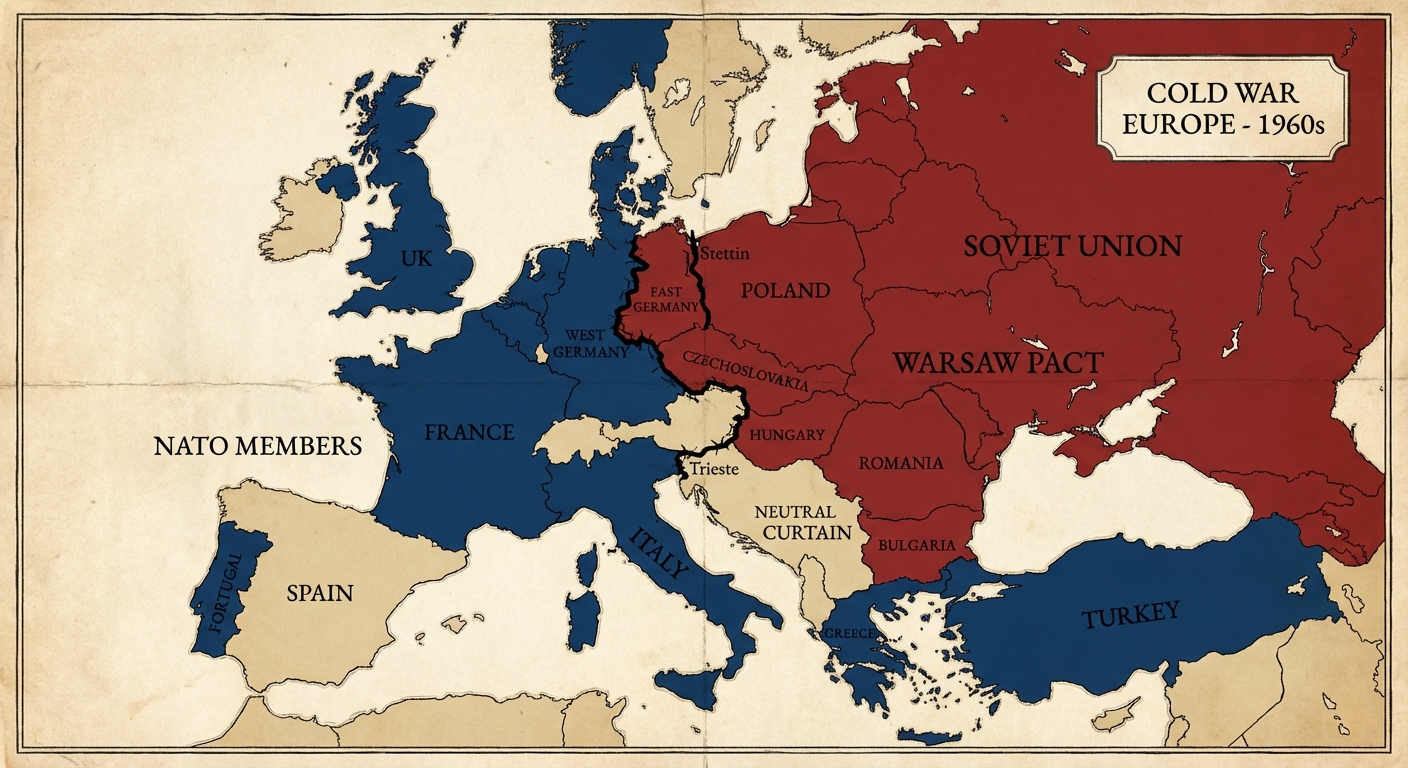
- NATO (North Atlantic Treaty Organization): A collective security alliance formed in 1949. An attack on one member was an attack on all. This was the first peacetime military alliance in US history.
- Warsaw Pact: The Soviet response to NATO, solidifying their control over Eastern Europe.
- NSC-68: A secret National Security Council report recommending a massive increase in defense spending to deter Soviet aggression. It militarized the Cold War.
Shifts in Strategy: Eisenhower to Détente
| President | Key Doctrine/Strategy | Description |
|---|---|---|
| Truman | Containment | Stop the spread; limited war (Korea). |
| Eisenhower | Brinkmanship & Massive Retaliation | Willingness to go to the edge of nuclear war; reliance on nuclear arsenal to save money on conventional troops. Warned of the Military-Industrial Complex upon leaving office. |
| Kennedy | Flexible Response | Moving away from exclusive reliance on nuclear weapons; building up conventional troops and special forces (Green Berets). |
| Nixon | Détente | A relaxation of tensions. Included visiting China (1972) and the SALT I treaty (Strategic Arms Limitation Talks) with the USSR to cap nuclear buildup. |
The Korean War (1950–1953)
Often called the "Forgotten War," this was the first military test of containment.
- Cause: North Korea (communist) invaded South Korea (democratic/capitalist).
- US Intervention: Truman went through the United Nations (police action), not a Congressional declaration of war.
- General MacArthur: Pushed North Koreans back to the Chinese border, provoking Chinese intervention. He was later fired by Truman for insubordination (asserting civilian control over the military).
- Outcome: Stalemate. The border remained at the 38th Parallel. Containment worked (South Korea remained free), but no territory was gained.
The Red Scare and McCarthyism
While the US fought communism abroad, fear of internal subversion gripped the nation at home. This is known as the Second Red Scare (distinguished from the post-WWI Red Scare).
Roots of Anxiety
Three major events in 1949 shocked the American public:
- The USSR successfully tested an atomic bomb.
- China fell to communism (Mao Zedong).
- High-profile espionage cases emerged (see below).
Joseph McCarthy and the Witch Hunt
The face of this era was Senator Joseph McCarthy.
- The Tactics: In 1950, he claimed to hold a list of 205 communists working in the State Department (the numbers famously kept changing). He used grandstanding, baseless accusations, and the media to destroy reputations.
- McCarthyism: Now defined as the practice of making accusations of subversion or treason without proper regard for evidence.
- The Downfall: The Army-McCarthy Hearings (1954). When McCarthy attacked the US Army, the hearings were televised. Millions saw his bullying tactics, and his popularity collapsed.
Key Institutions and Cases
- HUAC (House Un-American Activities Committee): A congressional committee that investigated communist influence inside and outside the government. They famously targeted Hollywood.
- The Hollywood Ten: Screenwriters and directors jailed for refusing to testify about their political affiliations.
- Alger Hiss: A high-ranking State Department official convicted of perjury (lying about passing documents to the Soviets).
- The Rosenbergs: Julius and Ethel Rosenberg were convicted and executed for passing atomic secrets to the Soviets. (Venona Papers later confirmed Julius's guilt, though Ethel's level of involvement remains debated).
The Vietnam War
The Vietnam War was the longest and most divisive conflict in this period, representing the ultimate application—and perhaps failure—of the containment policy.
Origins and Escalation
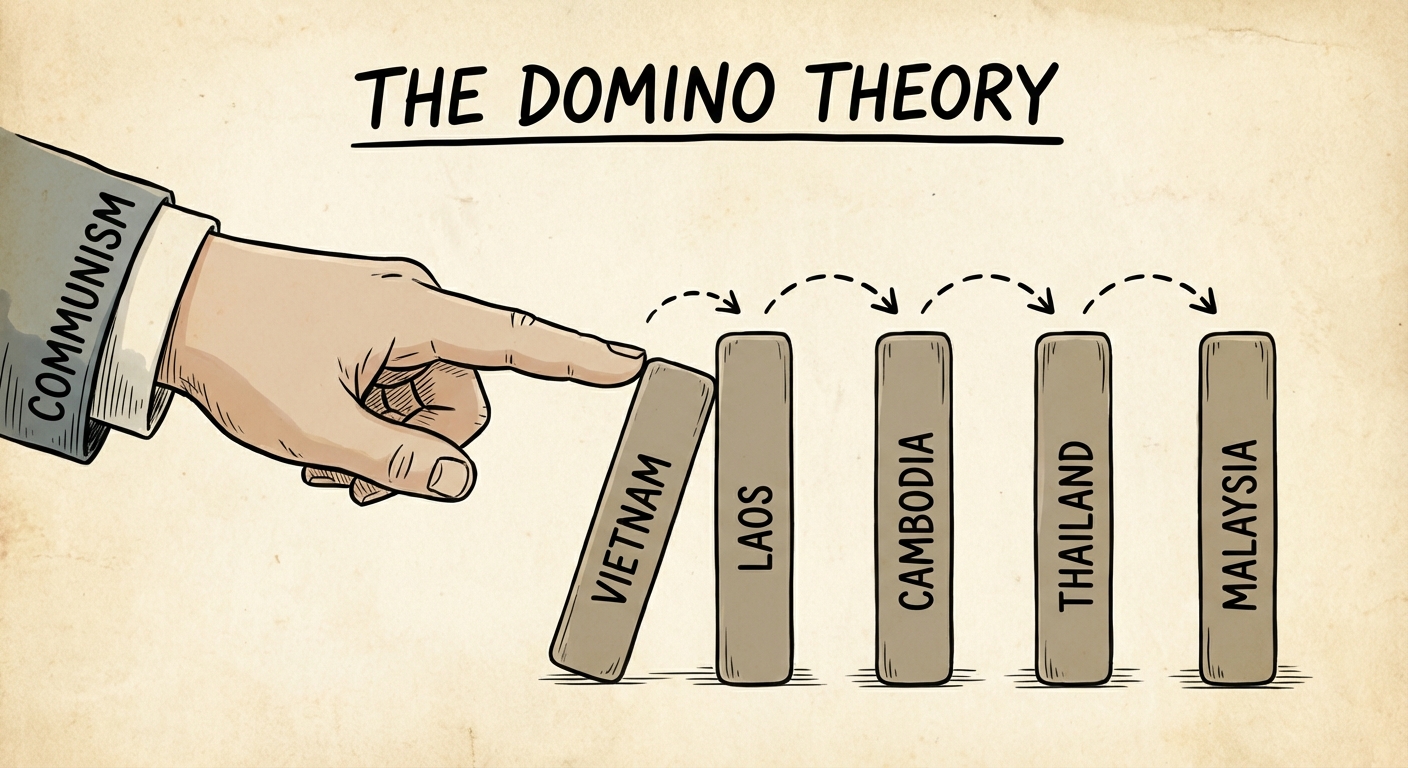
- The Domino Theory: The belief that if Vietnam fell to communism, neighboring countries (Laos, Cambodia, Thailand) would also fall like a row of dominos.
- Geneva Accords (1954): Divided Vietnam at the 17th parallel. The US supported the South (Diem) against the North (Ho Chi Minh).
- Gulf of Tonkin Resolution (1964): Following a reported impact on US ships, Congress gave President LBJ a "blank check" to use all necessary measures. This shifted war powers from Congress to the Executive branch.
The Nature of the War
- Jungle Warfare: The US faced a guerilla enemy (Viet Cong) that used tunnels, booby traps, and the Ho Chi Minh Trail to supply troops. The US used napalm and Agent Orange to clear jungles.
- Credibility Gap: The government (and General Westmoreland) told the public victory was near, but television footage showed a stalemate.
The Turning Point: 1968
1968 was a year of global upheaval and the turning point of the war.
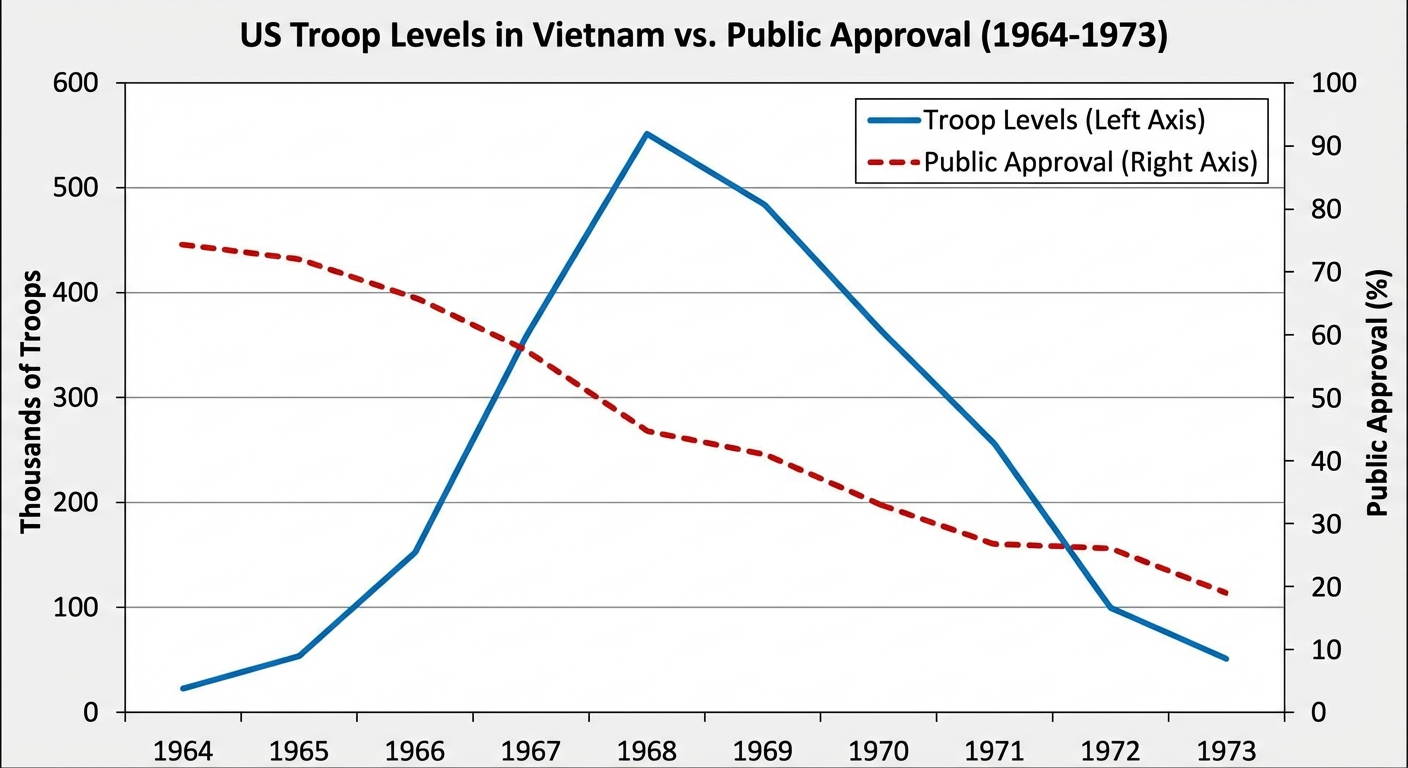
- The Tet Offensive: A massive coordinated attack by North Vietnam on South Vietnamese cities. Militarily, the US won (the North suffered huge casualties). Psychologically, it was a US defeat; it proved the war was nowhere near over.
- My Lai Massacre: US troops killed unarmed villagers, fueling anti-war sentiment when revealed in 1969.
The Anti-War Movement & Exit Strategies
- Protest: Primarily led by students (Students for a Democratic Society - SDS). Tensions peaked at Kent State (1970) where National Guard troops killed four students protesting the invasion of Cambodia.
- Vietnamization: President Nixon's policy to withdraw US ground troops while training South Vietnamese forces to take over the fighting.
- War Powers Act (1973): Passed over Nixon's veto. It requires the President to notify Congress within 48 hours of deploying troops and withdraw them after 60 days unless Congress declares war. This was an attempt to reverse the Gulf of Tonkin Resolution.
Outcome
The US withdrew in 1973. In 1975, the Fall of Saigon marked the end of the war as North Vietnam unified the country under communism.
Common Mistakes & Pitfalls
- Confusing the Red Scares: Do not confuse the First Red Scare (1919–1920, Palmer Raids, fear of anarchists/Bolsheviks after WWI) with the Second Red Scare (1947–1950s, McCarthyism, nuclear fear, infiltration of government).
- Korean vs. Vietnam Outcomes: Remember that the Korean War ended in a stalemate (armistice, still divided today), while the Vietnam War eventually resulted in a total communist takeover after the US left.
- NATO vs. United Nations: NATO is a military alliance (one side of the Cold War). The UN is a peacekeeping body (includes both the US and USSR). The US fought in Korea under the UN flag, not the NATO flag.
- Détente Misunderstanding: Détente did not mean the end of the Cold War. It was merely a "thawing" or lessening of tensions. The Cold War heated up again when the Soviets invaded Afghanistan in 1979.