AP Calculus AB: Related Rates Study Guide
Understanding Related Rates
Related Rates problems are one of the most significant applications of the Chain Rule in AP Calculus AB. They involve finding the rate at which one quantity changes by relating it to other quantities whose rates of change are known.
In these problems, almost every variable represents a quantity that is changing with respect to time ($t$).
The Core Concept: Implicit Differentiation with Respect to Time
Unlike standard differentiation where we often find $\frac{dy}{dx}$, in Related Rates, we differentiate both sides of an equation implicitly with respect to $t$.
If $y$ is a differentiable function of $t$, and $x$ is a differentiable function of $t$, the Chain Rule dictates:
Key Notation:
- $x, y, r, h$: These are instantaneous values (distances, volumes, etc.) at a specific moment in time.
- $\frac{dx}{dt}, \frac{dy}{dt}, \frac{dV}{dt}$: These represent the rate of change (velocity, flow rate, expansion rate).
- Positive Rate: The quantity is increasing.
- Negative Rate: The quantity is decreasing.
A Systematic Approach to Solving
To successfully solve any Related Rates problem on the AP exam, follow this five-step procedure. Just reading the problem and jumping to math often leads to "Snapshot Errors" (plugging in numbers too early).
Step 1: Draw and Label
Sketch the situation. Label variables (quantities that change) with letters (e.g., $x$, $y$, $h$) and constants (quantities that never change) with their numerical values.
Step 2: Identify "Given," "Find," and "When"
Translate the text of the problem into mathematical notation.
- Given: What rates or values do you know? (e.g., $\frac{dV}{dt} = 10$)
- Find: What derivative are you looking for? (e.g., $\frac{dr}{dt} = ?$)
- When: At what specific instant do you need the answer? (e.g., when $r = 5$)
Step 3: The Static Equation
Find an algebraic or geometric formula that relates the variables involved before differentiating. Common relationships include:
- Pythagorean Theorem: $a^2 + b^2 = c^2$
- Area/Volume Formulas: $A = \pi r^2$, $V = \frac{1}{3}\pi r^2 h$
- Trigonometric Ratios: $\tan(\theta) = \frac{opp}{adj}$
Step 4: Differentiate and Solve
Differentiate your Static Equation with respect to time $t$. Do not substitute the "When" values yet!
Step 5: Substitute and Evaluate
Now—and only now—plug in the instantaneous values (from the "When" step) and the known rates to solve for the unknown rate. Include units in your final answer.
Example 1: The Sliding Ladder (Pythagorean Theorem)
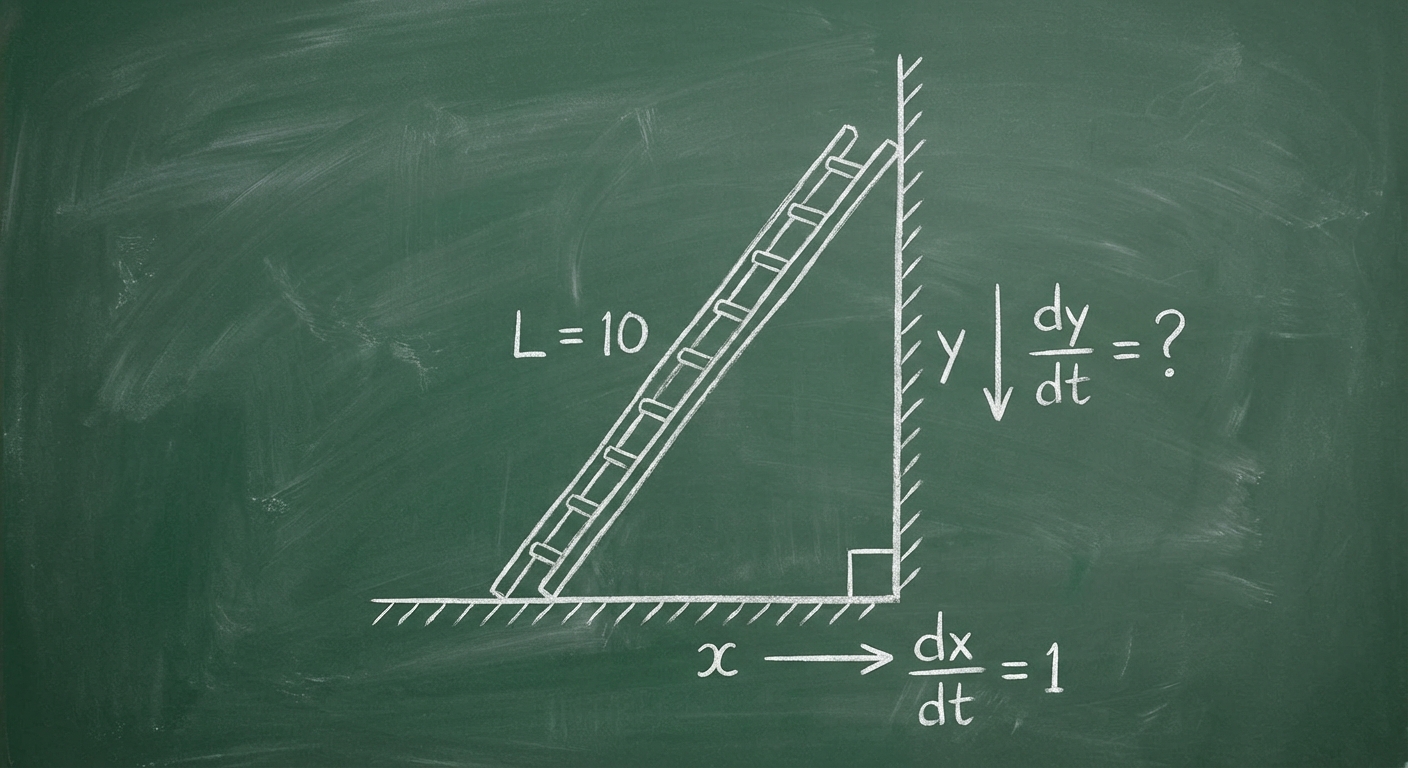
Scenario: A 10-foot ladder is leaning against a vertical wall. The bottom of the ladder slides away from the wall at a rate of 1 ft/sec. How fast is the top of the ladder sliding down the wall when the bottom of the ladder is 6 feet from the wall?
1. Identify Variables:
- Let $x =$ distance from the wall to the bottom of the ladder.
- Let $y =$ distance from the floor to the top of the ladder.
- Let $L =$ length of the ladder.
2. Given/Find/When:
- Given: $\frac{dx}{dt} = 1$ ft/sec (positive because $x$ is increasing).
- Constant: $L = 10$ (The ladder length does not change so its derivative is 0).
- Find: $\frac{dy}{dt}$.
- When: $x = 6$.
3. Static Equation:
4. Differentiate:
5. Substitute:
We need $y$ at the specific instant. Use the Pythagorean theorem: $6^2 + y^2 = 10^2 \rightarrow 36 + y^2 = 100 \rightarrow y = 8$.
Analysis: The negative sign indicates the top of the ladder is moving down.
Example 2: Inverted Cone (Similar Triangles)
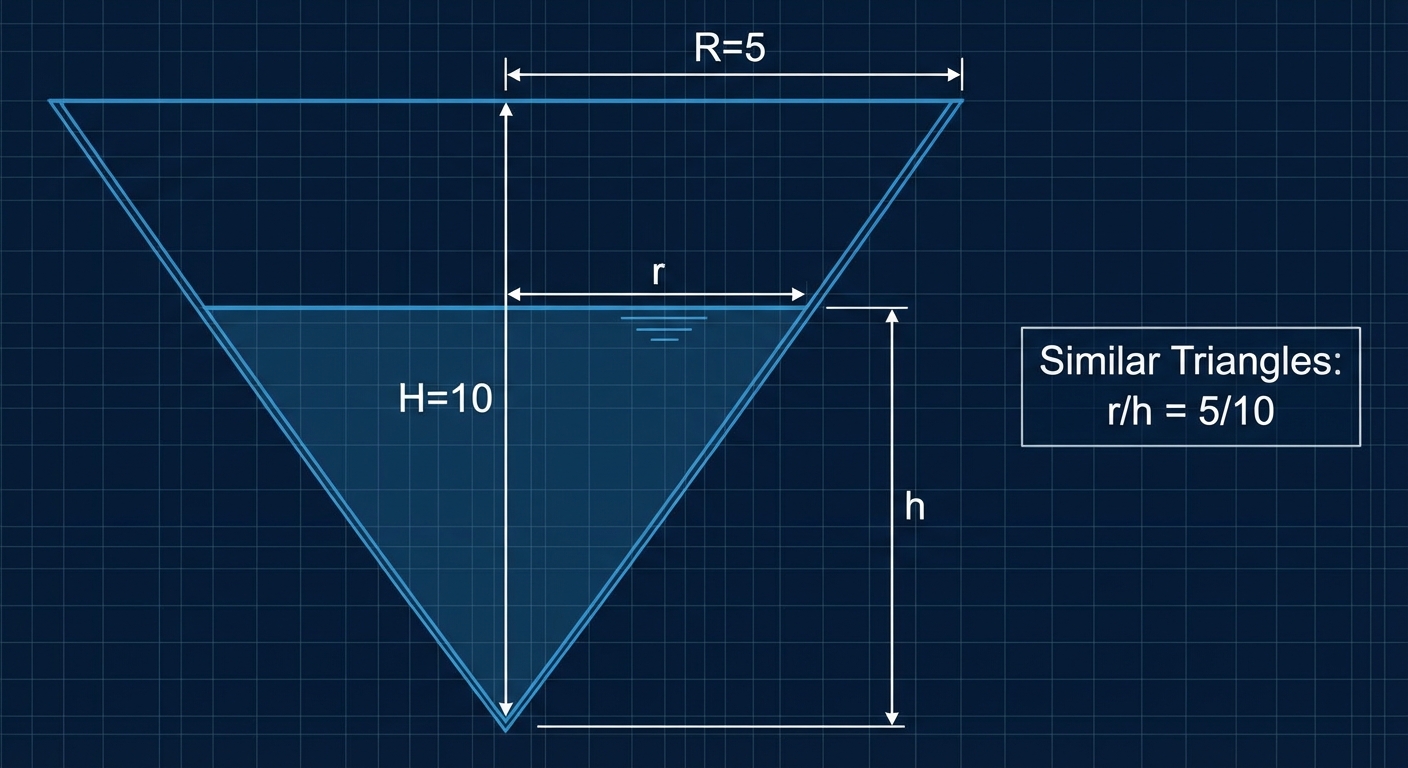
Scenario: Water is being poured into an inverted conical tank at a rate of $2 \text{ ft}^3/\text{min}$. The tank has a height of 10 ft and a radius at the top of 5 ft. How fast is the water level rising when the water is 4 ft deep?
1. Identify Variables:
- $V =$ volume of water.
- $h =$ height of water.
- $r =$ radius of water surface.
2. Given/Find/When:
- Given: $\frac{dV}{dt} = 2 \text{ ft}^3/\text{min}$.
- Constants: Tank dimensions (Radius $R=5$, Height $H=10$).
- Find: $\frac{dh}{dt}$.
- When: $h = 4$.
3. Static Equation:
Problem: We have three variables ($V, r, h$), but we only know information about $V$ and $h$. We must eliminate $r$ using Similar Triangles.
Ratio of the tank: $\frac{r}{h} = \frac{5}{10} = \frac{1}{2}$. Therefore, $r = \frac{h}{2}$.
Substitute back into the volume formula:
4. Differentiate:
5. Substitute:
Common Mistakes & Pitfalls
1. The "Snapshot" Error
This is the most common Related Rates (and AP Calculus) conceptual error.
- Mistake: Plugging in the "When" values (e.g., $x=6$) before differentiating.
- Result: You get a constant. The derivative of a constant is 0. You lose all the rates.
- Correction: NEVER substitute a variable value until AFTER you have taken the derivative with respect to $t$. Only substitute actual constants (like the length of the ladder or the dimensions of the tank) at the start.
2. Sign Errors
- Mistake: Treating a decreasing rate as positive.
- Result: Your final answer has the wrong sign, or the equation becomes unsolvable.
- Correction: If a distance is shrinking, a volume is leaking, or a snowball is melting, the rate ($\frac{dx}{dt}, \frac{dV}{dt}$) must be negative.
3. Missing the Product Rule
- Mistake: Differentiating an equation like Area = $xy$ as $\frac{dA}{dt} = \frac{dx}{dt}\frac{dy}{dt}$.
- Result: Incorrect derivative.
- Correction: Since both $x$ and $y$ are functions of $t$, you must use the Product Rule:
4. Forgetting the Chain Rule Term
- Mistake: Writing $\frac{d}{dt}(y^2) = 2y$.
- Result: Failing to relate the variables to time.
- Correction: Remember that you are differentiating with respect to time, not $y$. It must be $2y \frac{dy}{dt}$.