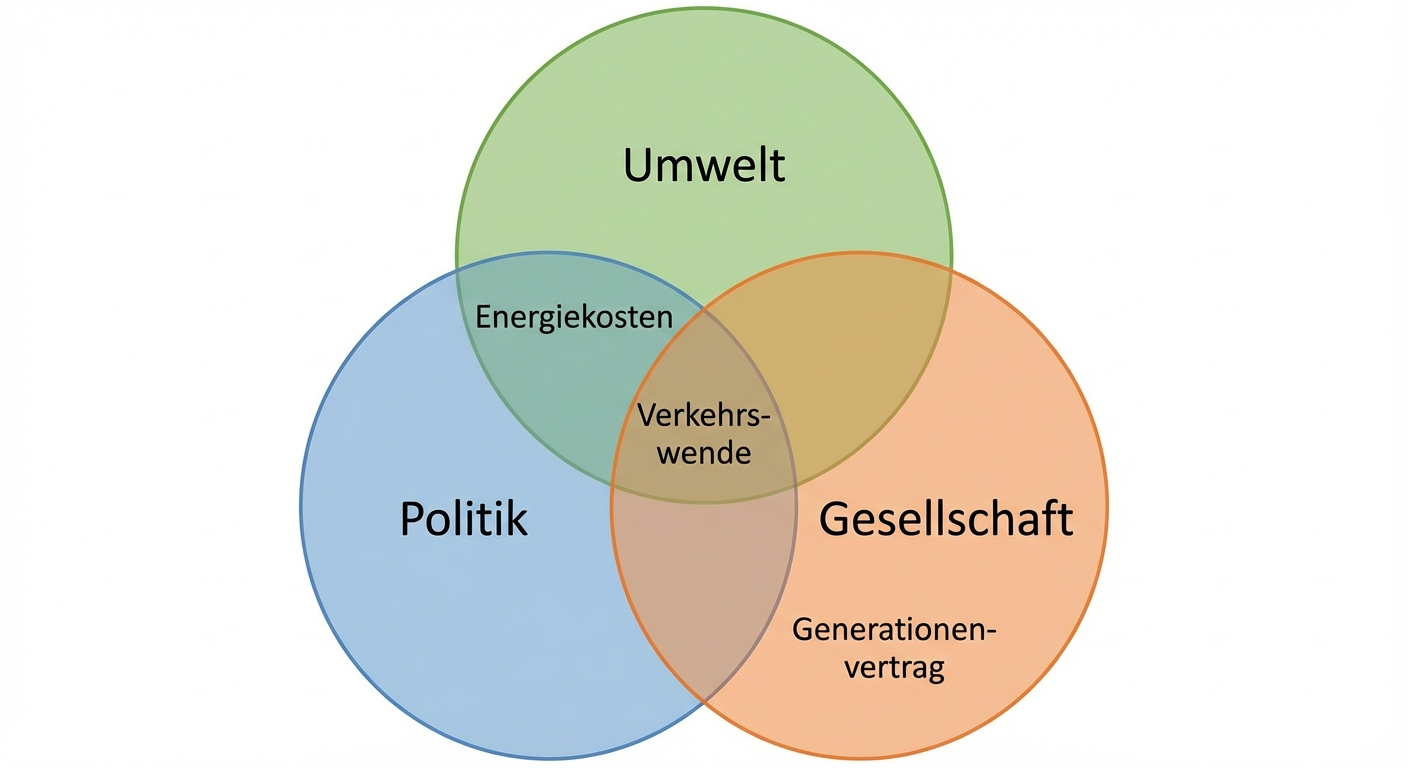
Unit 6: Global Challenges in the DACH Region
1. Environmental Issues (Umweltfragen)
This section focuses on how Germany, Austria, and Switzerland (the DACH region) address ecological crises. The central concept is Nachhaltigkeit (sustainability)—the idea of meeting present needs without compromising future generations.
The Energy Transition (Die Energiewende)
Definition: The Energiewende is Germany's long-term political and economic strategy to transition from nuclear and fossil-fuel energy to renewables.
- Key Goals:
- Phasing out nuclear power (Atomausstieg) completely (completed in April 2023).
- Phasing out coal (Kohleausstieg) ideally by 2030 or 2038.
- Achieving climate neutrality by 2045.
- Renewable Sources (Erneuerbare Energien):
- Windkraft: The primary renewable source, particularly in Northern Germany.
- Solarenergie: Heavily subsidized, common on residential rooftops.
- Wasserkraft: Crucial for Austria and Switzerland, where alpine geography allows hydroelectricity to provide the majority of power.
Waste Management and Recycling
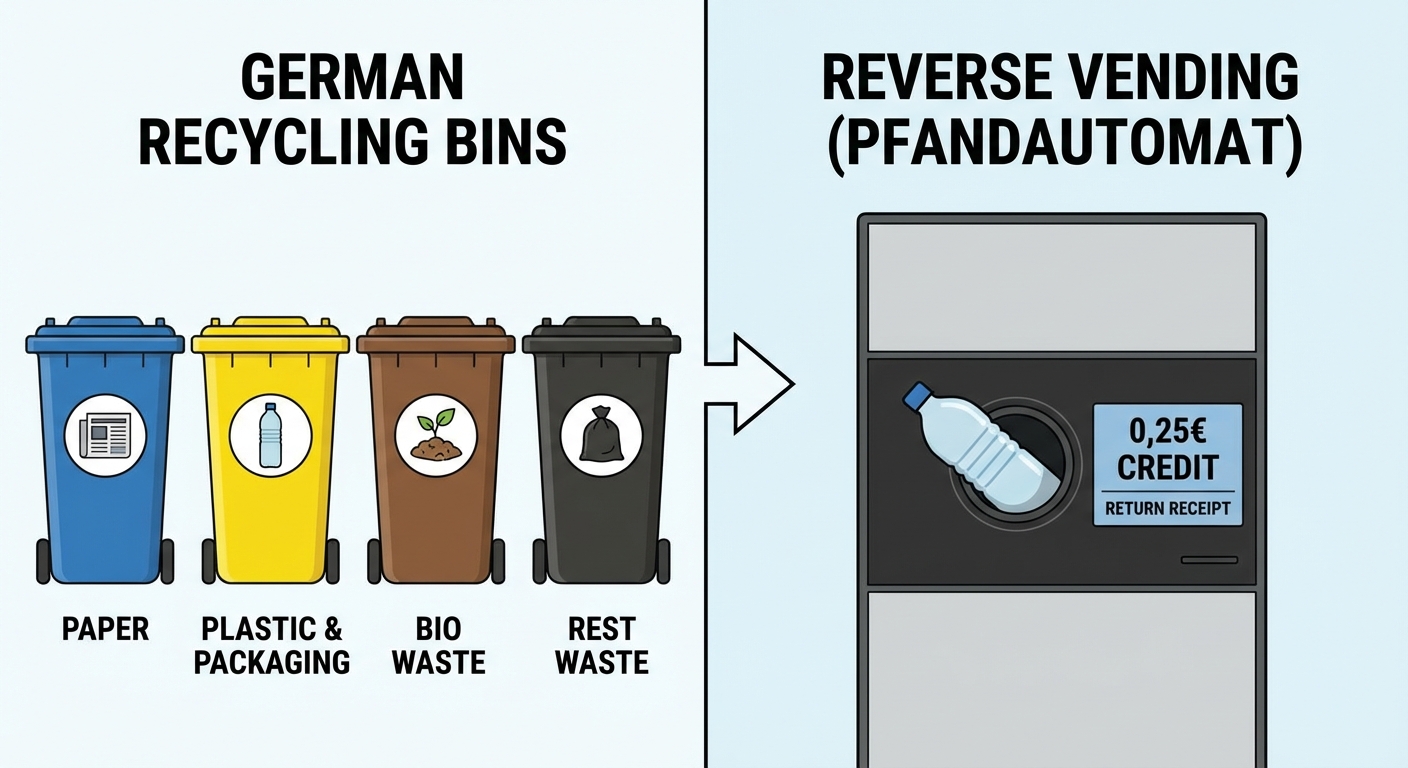
Waste separation (Mülltrennung) is a cultural cornerstone in the DACH region, viewed as a civic duty rather than just a chore.
- The Green Dot (Der Grüne Punkt): A dual system for recovering packaging waste.
- The Deposit System (Das Pfandsystem):
- Consumers pay a surcharge (8¢ to 25¢) on plastic bottles and cans.
- This money is refunded when the empty container is returned to a "Pfandautomat" in supermarkets.
- Impact: Germany achieves recycling rates of nearly 98% for single-use bottles.
- Paper and Glass: Strictly separated by color (white, green, brown) and disposed of in specific community containers.
Transportation and Mobility
Germany is famous for its car culture (Autokultur), but environmental concerns are shifting the focus toward the Verkehrswende (mobility transition).
- Public Transport (Öffentliche Verkehrsmittel): Highly developed train networks (Deutsche Bahn, ÖBB in Austria, SBB in Switzerland) frame travel as an eco-friendly choice.
- E-Mobility: Heavy investment in electric vehicles (EVs) and charging infrastructure to combat emissions from the automotive sector.
- The 9-Euro-Ticket / Deutschlandticket: An experiment to encourage public transit use by offering flat-rate regional travel (currently settled as the 49-Euro-Ticket).
Common Mistakes: Environment
- Mistake: Assuming all Germans support the Energiewende without reservation.
- Reality: There is significant debate over rising energy costs and the visual impact of wind turbines on landscapes (Verschandelung der Landschaft).
- Mistake: Using the word Umwelt (natural environment) interchangeably with Umfeld (social surroundings/setting).
2. Economic Wellbeing (Wirtschaftliches Wohlbefinden)
The economy (Die Wirtschaft) is deeply tied to political stability and societal health. Germany is the largest economy in the EU, often acting as the "engine of Europe."
Integration in the European Union
- The Single Market (Binnenmarkt): Allows for the free movement of goods, services, money, and people. This is vital for Germany's export-heavy economy.
- The Euro (Der Euro): Used by Germany and Austria (Switzerland retains the Swiss Franc - CHF), facilitating trade stability.
- Current Challenges:
- Supply Chains: Disrupted by global conflicts and pandemic aftershocks.
- Inflation: Rising costs of living, particularly energy prices.
The Labor Market (Der Arbeitsmarkt)
- Fachkräftemangel (Shortage of skilled workers): One of the biggest economic threats. Industries like healthcare, IT, and engineering lack qualified personnel.
- Vocational Training (Duale Ausbildung):
- A unique system where apprentices spend part of the week in school and part working.
- Often cited as the reason for low youth unemployment in DACH countries compared to southern Europe.
3. Societal Challenges (Gesellschaftliche Herausforderungen)
Modern German-speaking society faces rapid structural changes involving age, origin, and social cohesion.
Demographic Change (Demografischer Wandel)
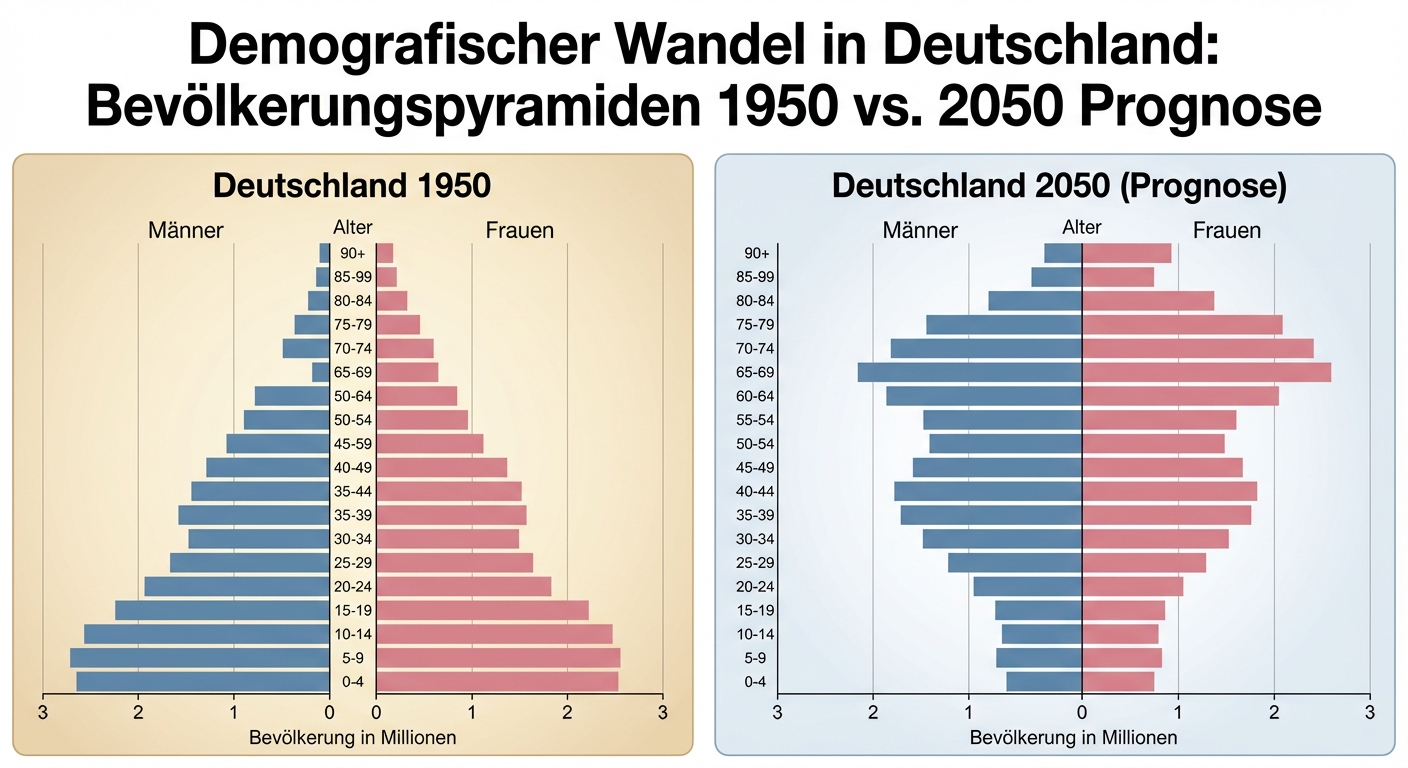
Germany, Austria, and Switzerland all face an aging population (Überalterung der Gesellschaft).
- The Trend: Low birth rates combined with high life expectancy lead to an inverted population pyramid.
- Consequences:
- Pension System (Rentensystem): Fewer young workers pay into the system to support a growing number of retirees. This is known as the Generationenvertrag (generational contract).
- Healthcare: Increased demand for geriatric care (Altenpflege).
Migration and Integration
Germany is an immigration country (Einwanderungsland), though this identity has been historically contested.
- Gastarbeiter (Guest Workers): In the 1960s/70s, workers were recruited from Turkey, Italy, and Greece. Many stayed, creating large multi-generational communities.
- 2015 Refugee Crisis: Germany accepted roughly 1 million refugees (mostly Syrian/Afghan).
- Successes: Language classes (Integrationskurse) and job market entry for many.
- Struggles: Housing shortages and cultural friction.
- Willkommenskultur: The culture of welcoming incomers, which fluctuates depending on the political climate.
Social Justice and Equity
- The Social State (Der Sozialstaat): The absolute belief that the state must protect citizens from existential risks. This includes universal healthcare (Krankenversicherung), unemployment benefits, and free tuition at public universities.
- Inequality: Despite wealth, there is a growing gap between rich and poor, and between the West and the former East Germany (Ost-West-Gefälle).
Common Mistakes: Society
- Mistake: Thinking "Multiculturalism" (Multikulti) is universally accepted.
- Reality: It is a polarizing topic. While urban centers like Berlin are melting pots, rural areas often lean more conservative regarding immigration.
- Mistake: Confusing Nationalität (citizenship) with Herkunft (origin/ethnicity). Germany recently reformed citizenship laws to allow dual citizenship more easily, reflecting a modernizing view.
4. Political Challenges (Politische Herausforderungen)
The Rise of Populism
- Parties: The Alternative für Deutschland (AfD) in Germany and the FPÖ in Austria are right-wing populist parties.
- Themes: These parties capitalize on skepticism toward migration, the EU, and climate measures.
- Impact: Political fragmentation makes forming stable coalitions (Koalitionen) more difficult. The traditional "Volksparteien" (major center parties) are losing dominance.
Global Responsibility vs. National Interests
- Defense: Historically pacifist, Germany announced a Zeitenwende (turning point) in 2022, increasing military spending in response to the war in Ukraine. This sparked intense societal debate about Germany's role in armed conflict.
5. Essential Vocabulary & Grammar for Unit 6
To score well on the AP exam, use these terms and structures in your Cultural Comparisons and Argumentative Essays.
Key Vocabulary Table
| German Term | English Meaning | Usage Context |
|---|---|---|
| Die Nachhaltigkeit | Sustainability | Environmental discussions |
| Der Klimawandel | Climate Change | Global warming topics |
| Die Überalterung | Aging (of society) | Demographics/Pensions |
| Die Zuwanderung | Immigration/Migration | Neutral term for incoming migration |
| Das Vorurteil | Prejudice | discrimination/social issues |
| Die Maßnahmen ergreifen | To take measures | Political solutions |
| Erneuerbare Energien | Renewable energies | Science/Environment |
Grammar Focus: The Passive Voice (Das Passiv)
In Unit 6, you often describe processes (how recycling is done, how laws are passed) rather than people acting. The Passive voice is essential here.
Structure:
- Active: Der Staat recycelt das Plastik. (The state recycles the plastic.)
- Passive: Das Plastik wird vom Staat recycelt. (The plastic is recycled by the state.)
Usage Example in an Essay:
"Um die Umwelt zu schützen, muss mehr Geld in Windparks investiert werden."
(In order to protect the environment, more money must be invested in wind farms.)
6. Exam Strategy: Cultural Comparison
When the AP exam asks for a cultural comparison on "Global Challenges," follow this structure:
- Define the Challenge: Briefly explain the issue (e.g., waste management).
- DACH Perspective: Give a specific detail (e.g., "In Germany, the Pfandsystem incentivizes returning bottles…").
- Home Culture Perspective: Contrast it with your own experience (e.g., "In my community in the US, recycling is voluntary and curbside only…").
- Analysis: Explain why this difference exists (e.g., stricter government regulations vs. emphasis on convenience).
Memory Aid for Topics: "PEG"
- Politics (EU, rise of right-wing, peace)
- Environment (Energy, recycling, cars)
- Gesellschaft (Society - Aging, migration, education)