AP English Language: Unit 4 Study Notes
Unit 4: How Writers Develop Arguments, Intros, and Conclusions
4.0 The Anatomy of an Argument
Definitions & Core Concepts
In AP English Language, an argument is not a fight or a disagreement. It is a cohesive movement from a claim to a conclusion, supported by evidence and reasoning.
- Argument: A position or viewpoint on a topic that requires support through reasoning, evidence, and logical explanations. It is not a statement of verifiable fact (e.g., "The sky is blue" is not an argument).
- Persuasion vs. Argument: While they overlap, persuasion often relies on emotional appeals (Pathos) to move an audience to action, while argument relies heavily on logic (Logos) and evidence to prove a point's validity.
The Thesis Statement
The thesis is the beating heart of your essay. It must be a defensible claim that establishes the line of reasoning.
Key Characteristics:
- Defensible/Arguable: It must be a statement that reasonable people could disagree with.
- Specific: It avoids vague generalizations (e.g., "pollution is bad") in favor of precise claims (e.g., "federal regulations are necessary to curb industrial pollution despite economic costs").
- Roadmap: It previews the structure of the argument.
Common Thesis Structures:
- The Closed Thesis: Lists the specific points of the essay.
- Example: "Harry Potter is a hero because he demonstrates courage, values friendship, and sacrifices himself for the greater good."
- The Open Thesis: States the overall position without listing every sub-point (ideal for longer, complex essays).
- Example: "While flawed, Harry Potter's willingness to embrace mortality defines his heroism."
- The Counter-Argument Thesis: Acknowledges the opposing view immediately to show nuance (High scoring potential).
- Example: "Although some critics argue that Harry Potter is reckless, his disregard for rules is actually a necessary component of his fight against a rigid, corrupt system."
4.1 The Line of Reasoning (LoR)
One of the most frequent comments from AP graders is that students have "good evidence, but no line of reasoning."
What is a Line of Reasoning?
The Line of Reasoning is the logical arrangement of claims and evidence that leads to a conclusion. It is the "connective tissue" of the essay. It answers the question: How does paragraph A lead to paragraph B, and how do they both prove the Thesis?
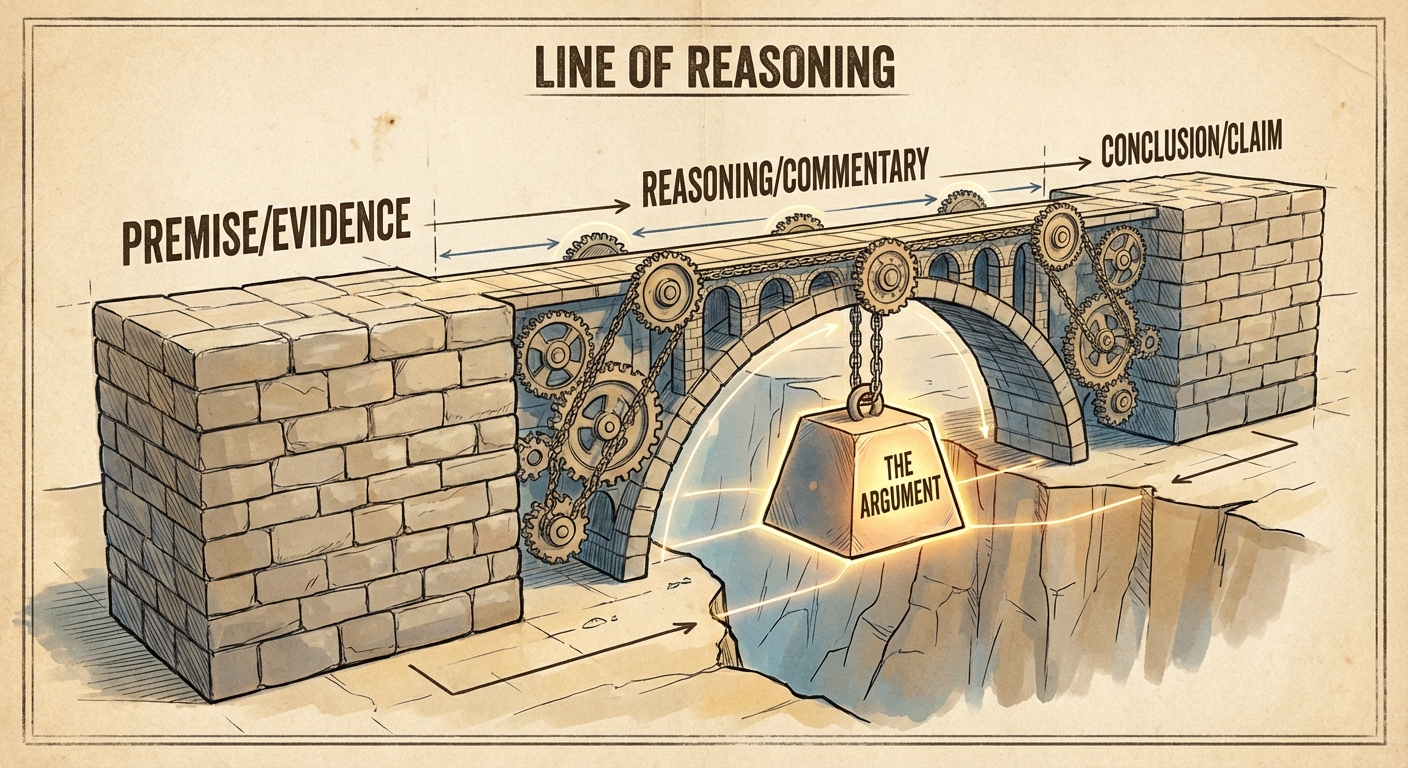
Structural Components of LoR
- Thesis: The foundation.
- Topic Sentences: The first sentence of a body paragraph must be a mini-argument that links back to the thesis, not just a summary of the plot or text.
- Transitions: Words or phrases that show the relationship between ideas (Contrast, Causation, Sequence).
- Weak: "Another example is…"
- Strong: "Consequently, this failure leads to…" or "Conversely, looking at the economic impact…"
- Commentary/Analysis: Explains why the evidence supports the claim. This is where the reasoning happens.
Inductive vs. Deductive Reasoning
- Inductive: Moves from specific examples to a general conclusion. (Data $\rightarrow$ Pattern $\rightarrow$ Conclusion).
- Deductive: Moves from a general premise to a specific conclusion. (General Rule $\rightarrow$ Specific Case $\rightarrow$ Conclusion).
4.2 Introductions
The introduction sets the stage. It must orient the reader (Context) and state the position (Thesis).
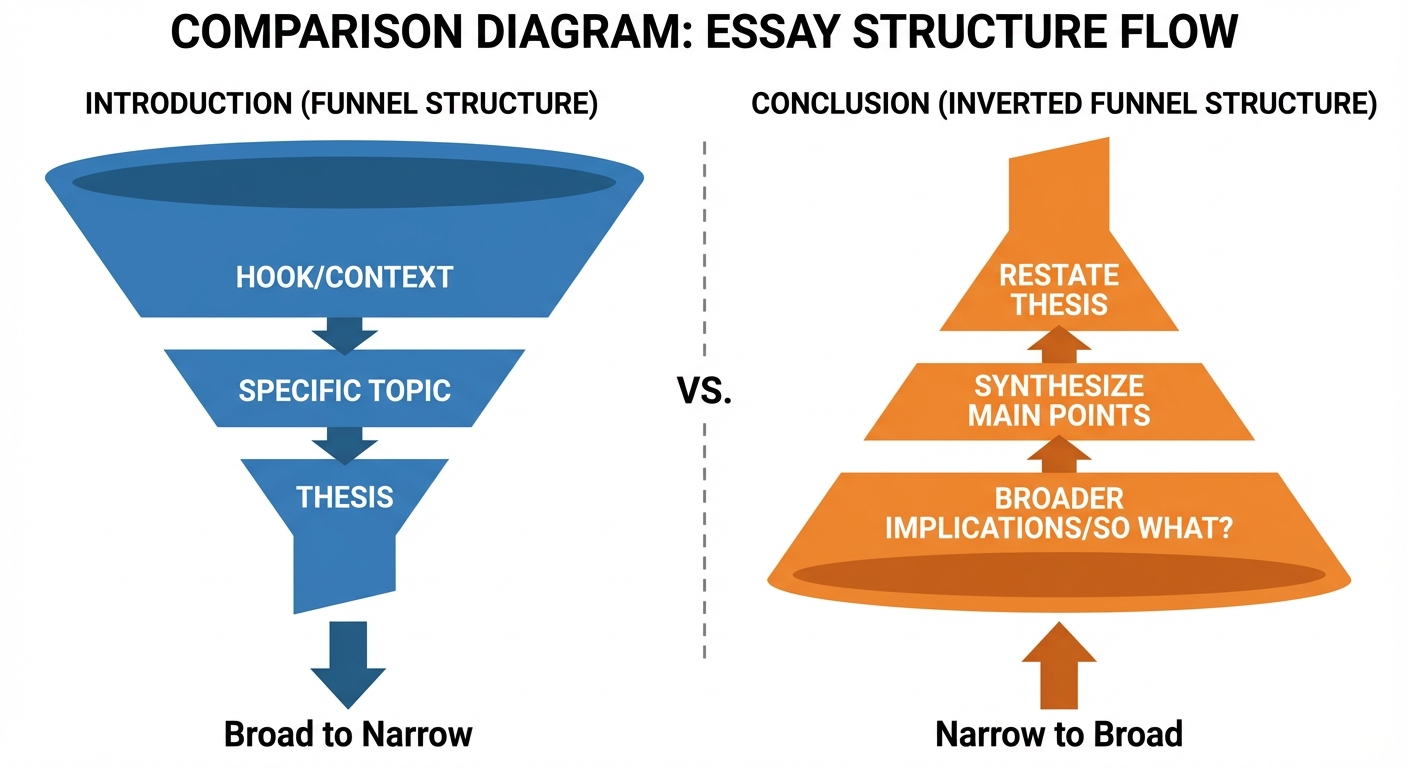
The "Funnel" Method
A standard effective introduction often follows a funnel shape: wide at the top, narrow at the bottom.
- The Hook (Use with Caution): Avoid cheesy dictionary definitions ("Webster defines heroism as…") or broad generalizations ("Since the dawn of time…"). Instead, use:
- A surprising statistic.
- A provocative question (that has an answer).
- A brief, relevant anecdote.
- Identifying a tension or conflict in the topic.
- Contextualization (The Bridge): Provide necessary background. Who is the author? What is the historical situation? Why does this issue matter now? Connecting the hook to the specific topic.
- The Thesis (The Neck): The final sentence(s) of the intro, stating your specific argument.
Strategy by Essay Type
- Rhetorical Analysis Intro: Must include the Rhetorical Situation (Speaker, Audience, Context, Exigence, Purpose).
- Template Concept: "In [Title], [Author] addresses [Audience] regarding [Subject] to [Purpose], driven by [Exigence]. Through the use of [Choice 1] and [Choice 2], the author argues…"
- Argument/Synthesis Intro: Acknowledge the complexity of the issue. Acknowledge the counter-argument early to establish credibility (Ethos).
4.3 Conclusions
A conclusion should not merely summarize what you just read. It should answer the question: "So What?"
The "Reverse Funnel" Method
- Restate Thesis (New Wording): Remind the reader of the claim, but do not copy-paste the original thesis. Refine it using the nuance gained regarding the essay.
- Synthesize Main Points: Show how your body paragraphs worked together to prove the point. Don't list; synthesize.
- Broader Implications (The Expansion): Move from the specific text/argument to the universal. How does this argument apply to society, human nature, or the future?
Effective Closing Moves
- Call to Action: Urge the audience to do something (common in Argument essays).
- Prediction: What will happen if this argument is ignored?
- Full Circle: Reference the hook used in the introduction to provide a satisfying sense of closure.
4.4 The Rhetorical Situation (SPACECAT)
Understanding the context is vital for both analyzing texts (Rhetorical Analysis) and writing them (Argument/Synthesis). The acronym SPACECAT is the industry standard for AP Lang.
| Element | Definition | Key Question to Ask |
|---|---|---|
| S - Speaker | The person/group creating the text. | What are their credentials, biases, or values? |
| P - Purpose | What the speaker wants the audience to do or think. | Is it to persuade, inform, mourn, or entertain? |
| A - Audience | The specific group the text is directed at. | What does the audience value? Start hostility? Friendly? |
| C - Context | The broad "atmosphere" (time, place, current events). | What is happening in the world at this time? |
| E - Exigence | The specific spark or catalyst. | Why write this NOW? What specifically happened? |
| C - Choices | The rhetorical devices/strategies used. | logical fallacies, diction, syntax, irony, etc. |
| A - Appeals | Ethos, Pathos, Logos. | How is the author persuading? |
| T - Tone | The author's attitude toward the subject. | Is it sarcastic, reverent, urgent? |
Correction on Exigence vs. Occasion:
- Context/Occasion: The general environment (e.g., The Civil Rights Movement).
- Exigence: The specific spark (e.g., MLK was arrested/jailed, prompting the "Letter from Birmingham Jail"). Exigence is the "why now."
4.5 Adjusting Arguments (Nuance)
Strong writers acknowledge that arguments are rarely 100% black or white.
Qualification
Qualifying an argument means acknowledging the limitations of your claim. It makes you sound reasonable and builds Ethos.
- Absolute: "Technology destroys social interaction."
- Qualified: "While technology facilitates global connection, it often superficially replaces the intimacy of face-to-face interaction in adolescent social groups."
Words to use for qualification:
- Primarily, often, in many cases, typically, to an extent, conversely.
Common Mistakes & Pitfalls
- The "Mystery" Thesis: Some students hide the thesis until the conclusion to build suspense. Do not do this in AP Lang. Put the thesis in the introduction so the grader can follow your Line of Reasoning.
- The "History of the World" Intro: Starting with "Since the beginning of time, mankind has…" is cliché and wastes time. Start relevant to the topic.
- Summarizing Instead of Concluding: A conclusion that just lists "In this essay I said A, B, and C" is weak. Focus on the implications of those points.
- Confusing Exigence with Purpose:
- Exigence = The Cause (The spark).
- Purpose = The Effect (The desired outcome).
- Disconnected Body Paragraphs: If you can rearrange your body paragraphs and the essay still makes sense, you likely have a weak Line of Reasoning. Good arguments build; they don't just stack.