AP Calculus AB Unit 3 Study Guide: Chain Rule, Implicit Differentiation, and Inverses
Unit Overview
In Units 1 and 2, you built the derivative from its definition and learned core rules (Power, Product, Quotient) for functions written explicitly. Unit 3 expands your toolkit to handle three major situations that show up constantly on the AP Exam: differentiating composite functions (the Chain Rule), differentiating relations where you cannot (or should not) isolate (implicit differentiation), and differentiating inverse and inverse trigonometric functions. These ideas are heavily tested in both Multiple Choice and Free Response because they combine skills: recognizing structure, choosing the correct rule quickly, and executing clean algebra.
Exam Focus
- Unit 3 questions often test recognition as much as computation: “What rule do I need here?” is frequently the hardest step.
- Many problems combine rules (for example, product rule plus chain rule; implicit differentiation plus trig derivatives).
Composite Functions and the Chain Rule (Topic 3.1)
What a composite function is (and why you care)
A composite function is what you get when the output of one function becomes the input of another. If you start with an “inner” function %%LATEX1%% and feed it into an “outer” function %%LATEX2%%, the composite is written
This matters in calculus because many real situations happen in layers. For example, if the radius of a balloon changes over time and the volume depends on the radius, then volume depends on time through radius. Derivatives measure rates of change, so to differentiate layered dependence correctly you need the Chain Rule.
Conceptually, the Chain Rule matches the idea: a small change in %%LATEX4%% causes a small change in %%LATEX5%%, and that small change in %%LATEX6%% causes a small change in %%LATEX7%%. The total effect multiplies those “change factors.”
The Chain Rule (core idea and formulas)
If and both functions are differentiable, then
A powerful way to remember the structure is Leibniz notation. If %%LATEX10%% depends on %%LATEX11%% and %%LATEX12%% depends on %%LATEX13%%, then
This looks like “canceling %%LATEX15%%.” That is not a formal algebra rule, but it is an extremely useful mental model: you multiply “rate of change of %%LATEX16%% per unit %%LATEX17%%” by “rate of change of %%LATEX18%% per unit .”
Conceptual approach: the “onion” analogy
Think of a composite function like an onion with layers. You peel from the outside in.
- Differentiate the outside function first, treating the inside as one chunk.
- Multiply by the derivative of the inside.
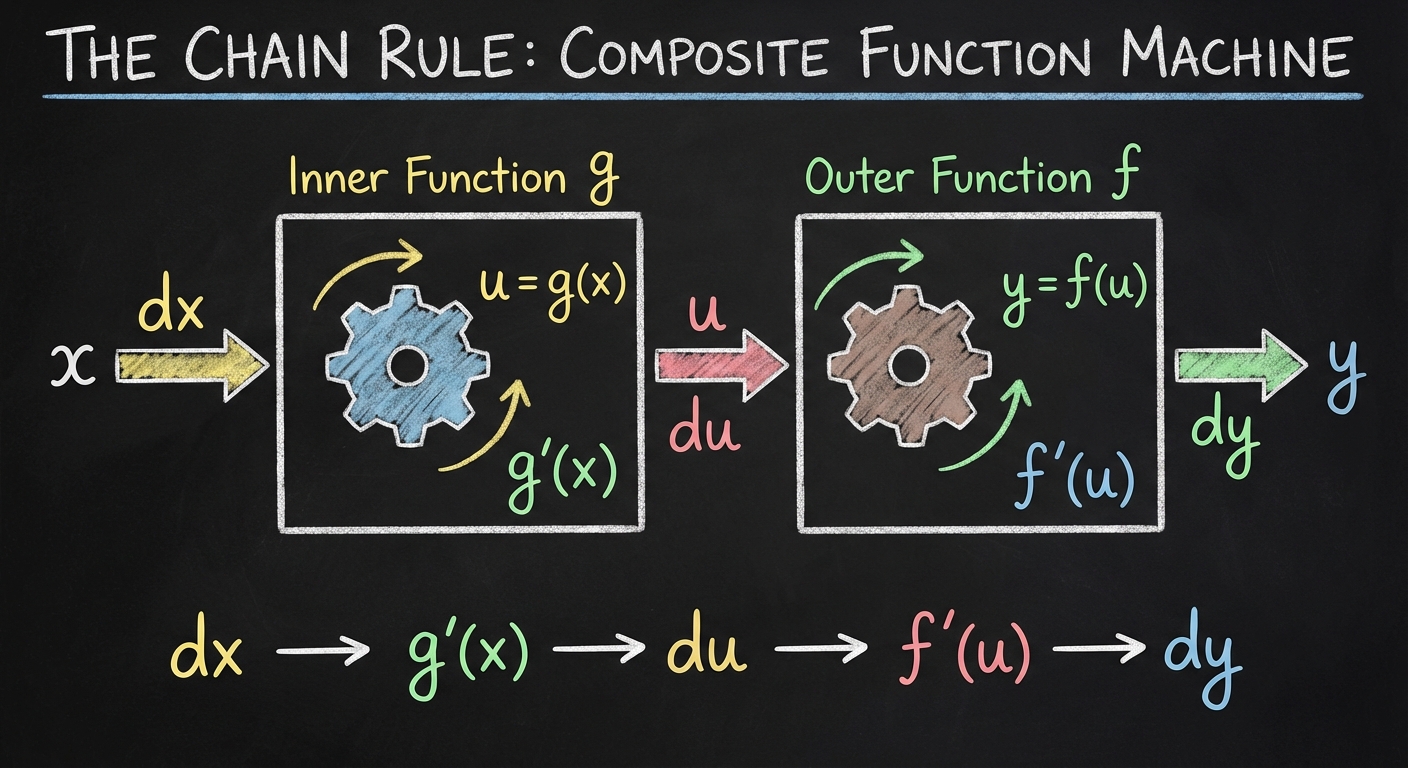
Mnemonic: “Douter, Inner, Dinner”
A helpful memory trick is “Douter, Inner, Dinner.”
- Douter: take the derivative of the outer function (leave the inner unchanged).
- Inner: keep the inner function inside parentheses.
- Dinner: multiply by the derivative of the inner function.
How to apply the Chain Rule (reliable process)
When you see “a function inside a function,” do this:
- Identify the outer operation (what is done last).
- Identify the inner expression (what is inside the outer function).
- Differentiate the outer function as if the inner expression were a single variable.
- Multiply by the derivative of the inner expression.
A common mistake is doing step 3 and forgetting step 4. Another common mistake is differentiating the inner expression correctly but attaching it to the wrong outer derivative. Labeling layers (outer, inner, inner-inner, etc.) prevents this.
Chain Rule with powers (generalized power rule)
If
then
This is the power rule plus the Chain Rule: the outer function is .
Multiple layers (Chain Rule more than once)
AP problems often nest functions multiple times, such as
You can apply the Chain Rule repeatedly, or think of it as a product of derivatives from each layer.
Worked example A: basic composite
Differentiate
Identify layers: outer is %%LATEX25%%, inner is %%LATEX26%%.
So
Worked example B: multiple layers
Differentiate
Let %%LATEX31%% so %%LATEX32%%.
Now let %%LATEX34%% so %%LATEX35%%.
Combine:
Substitute back:
Worked example C: Chain Rule with product rule
Differentiate
Use the product rule:
Each derivative needs the Chain Rule.
So
A factored form is
Worked example D: sine of a polynomial (common AP pattern)
Differentiate
Outer: %%LATEX47%%, derivative is %%LATEX48%%. Inner: %%LATEX49%%, derivative is %%LATEX50%%.
So
A common trap here is changing the inside while differentiating the outside. The derivative is not
Exam Focus
- Typical question patterns
- Differentiate %%LATEX54%% where %%LATEX55%% is polynomial, trig, exponential, and the nesting is 2 to 3 layers deep.
- Product or quotient problems where each factor needs the Chain Rule.
- Rate of change interpretation using language.
- Common mistakes
- Forgetting to multiply by the derivative of the inside function (missing ).
- Differentiating the inside correctly but attaching it to the wrong outer derivative (mixing layers).
- Dropping parentheses, especially with negative signs or powers like .
- In trig composites, changing the inside too early (for example, confusing %%LATEX59%% with %%LATEX60%%).
Implicit Differentiation (Topic 3.2)
What “implicit” means
Explicit functions are written with isolated, such as
Implicit relationships mix %%LATEX63%% and %%LATEX64%% in one equation, such as
This still describes %%LATEX66%% as a function of %%LATEX67%% on parts of the graph (like the top and bottom halves of a circle), but solving for %%LATEX68%% first can be inconvenient and can create extra algebra. Implicit differentiation lets you differentiate both sides with respect to %%LATEX69%% directly while treating %%LATEX70%% as a function of %%LATEX71%%.
The key idea: %%LATEX72%% depends on %%LATEX73%%
When you differentiate an expression containing %%LATEX74%% with respect to %%LATEX75%%, %%LATEX76%% is not a constant. It changes with %%LATEX77%%, so the Chain Rule appears automatically.
For example:
That factor %%LATEX79%% (or %%LATEX80%%) is the “signature” of implicit differentiation.
Standard workflow
- Differentiate both sides with respect to .
- Every time you differentiate a term containing %%LATEX82%%, multiply by %%LATEX83%%.
- Collect all terms on one side.
- Factor out and solve.
This method is essential whenever the variable you are differentiating with respect to does not match the variable inside the expression (for example, differentiating %%LATEX86%% with respect to %%LATEX87%%).
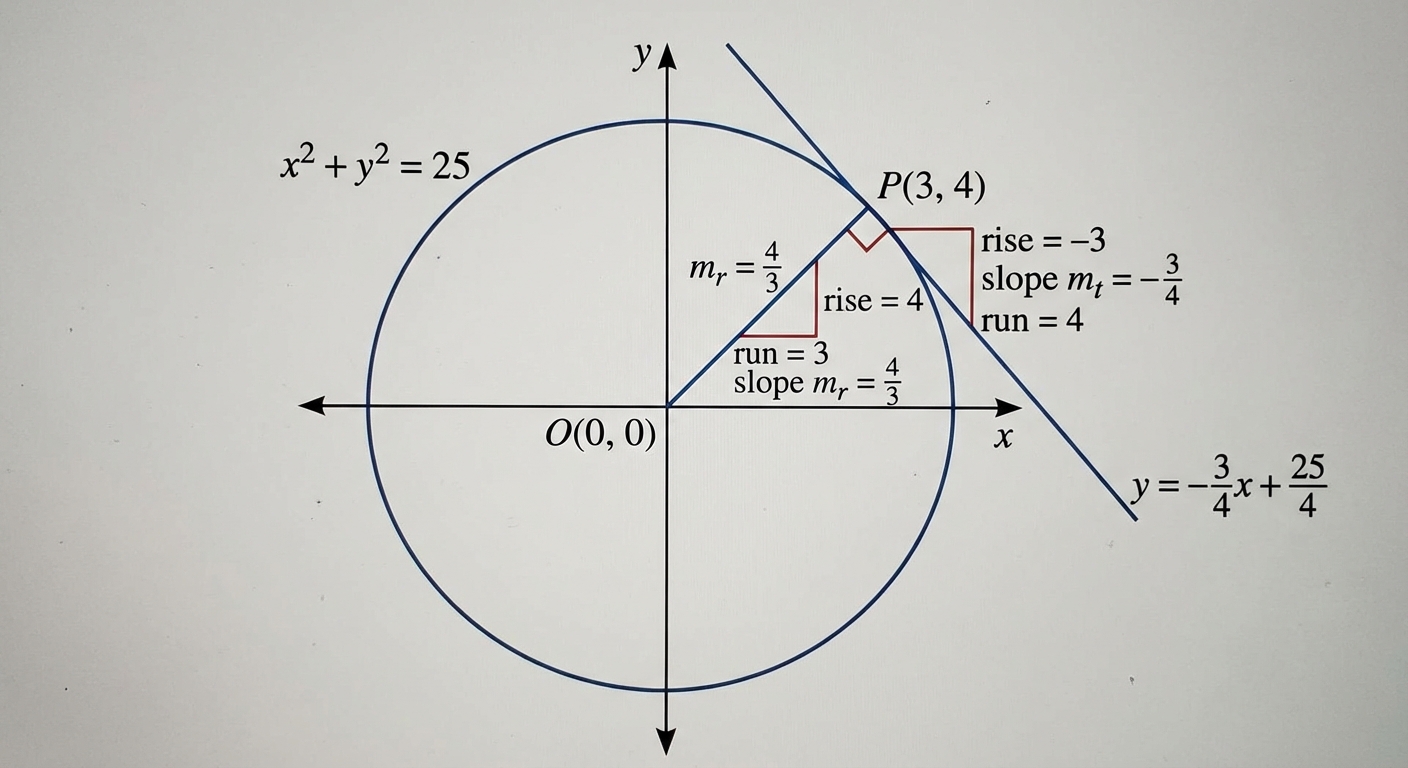
Worked example 1: circle and tangent line
Find for
Differentiate:
Solve:
At the point , the slope is
So the tangent line is
A common error is writing
instead of
Tangent lines from implicitly defined curves
Once you have an expression for %%LATEX97%%, substitute a point %%LATEX98%% to get the slope at that point, then use point-slope form for the tangent line.
Worked example 2: implicit with trig and product rule
Differentiate
Differentiate both sides. Use product rule on %%LATEX100%% and remember %%LATEX101%% requires the Chain Rule.
So
Group and solve:
Worked example 3: spotting implicit vs “solve first”
Consider
Solving for would require handling a cubic, so implicit differentiation is the intended method.
Differentiate:
Use the product rule on :
And
So
Solve:
Higher derivatives: finding implicitly
The second derivative is a favorite AP extension. The process is always:
- Find .
- Differentiate that result with respect to again.
- If your expression contains %%LATEX119%%, substitute your step-1 expression back in so the final answer is in terms of %%LATEX120%% and .
Example starting from the circle result:
Differentiate:
Use quotient rule and treat %%LATEX124%% as a function of %%LATEX125%%:
So
Substitute %%LATEX128%% to write the result purely in terms of %%LATEX129%% and :
Using , this becomes
Why implicit differentiation is powerful
Implicit differentiation:
- Handles curves that fail the vertical line test globally but still have function-like pieces.
- Is the main tool for differentiating inverse functions and inverse trig functions.
- Avoids messy algebra when solving for introduces square roots, powers, or multiple branches.
Exam Focus
- Typical question patterns
- Given %%LATEX136%%, find %%LATEX137%% and then evaluate the slope at a point.
- Find the equation of a tangent line or normal line to an implicitly defined curve.
- Compute for an implicit relation, sometimes simplifying using the original equation.
- Common mistakes
- Forgetting the %%LATEX139%% factor when differentiating terms like %%LATEX140%%, %%LATEX141%%, %%LATEX142%%.
- Forgetting product rule when variables are multiplied (for example, terms like %%LATEX143%% or %%LATEX144%%).
- Algebra errors when solving for , especially sign mistakes.
- When finding %%LATEX146%%, forgetting to substitute the step-1 expression for %%LATEX147%% back in.
Derivatives of Inverse Functions (Topic 3.3)
What an inverse function does
An inverse function reverses the action of a function. If a function maps an input to an output, the inverse maps that output back to the original input.
If the function is invertible (one-to-one on the domain you are using), then
and
Geometrically, the graph of the inverse is the reflection of the original graph across
Because reflections across swap rise and run, slopes of inverses at corresponding points are reciprocals.
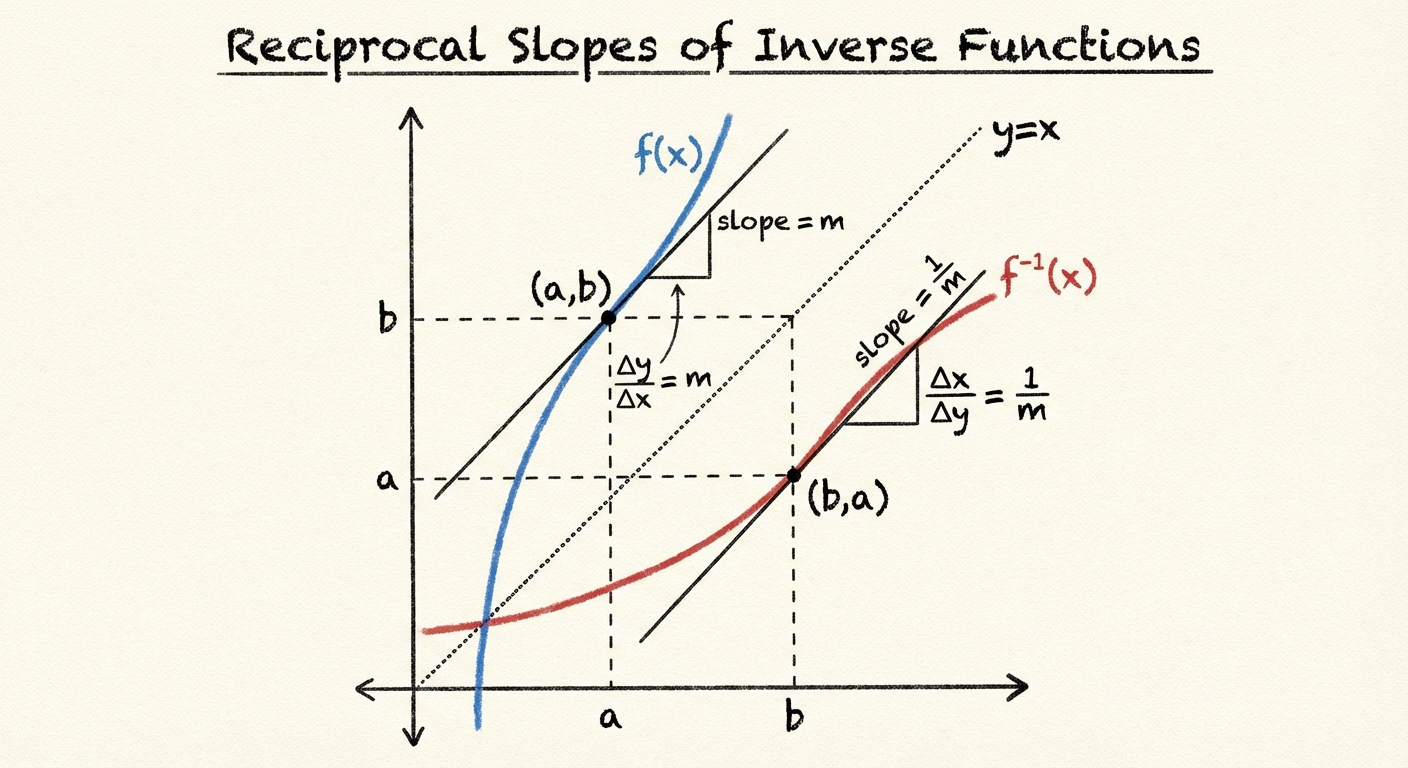
The inverse derivative relationship (Inverse Function Theorem in AB form)
Suppose %%LATEX152%% is differentiable and has an inverse. If %%LATEX153%% (so %%LATEX154%%) and %%LATEX155%%, then
A common functional form is
The condition %%LATEX158%% matters because a horizontal tangent on %%LATEX159%% reflects to a vertical tangent on the inverse, and vertical tangents do not have a defined slope.
Why the formula is true (Chain Rule derivation)
Start from
Differentiate both sides:
Solve:
This is a classic Unit 3 connection: composition plus Chain Rule plus inverses.
Notation equivalences (to keep inputs and outputs straight)
| Statement | Meaning |
|---|---|
| Point %%LATEX164%% is on %%LATEX165%% | |
| Point %%LATEX167%% is on %%LATEX168%% | |
| Reciprocal slopes at corresponding points |
Worked example 1: inverse derivative at a point
Suppose %%LATEX170%% and %%LATEX171%%. Find .
Because %%LATEX173%%, we know %%LATEX174%%, so
Worked example 2: inverse derivative without finding the inverse function
Let
Find .
First find the corresponding input: solve .
Compute the derivative:
So , hence
Worked example 3: inverse derivative in a functional context
You are told:
- is one-to-one and differentiable
Find .
Because %%LATEX188%%, we know %%LATEX189%%, so
Strategic approach for AP questions: the “table method”
AP questions often provide a table of values rather than a formula.
If you are asked to find :
- Your target is the slope of the inverse at input 3.
- That means you need to find where the original function has output 3. In other words, find %%LATEX192%% such that %%LATEX193%%.
- Use the reciprocal rule:
Memory aid: “The slope of the inverse is 1 over the slope of the original, but at the swapped input.”
Connection to logarithms
Logarithms are inverses of exponentials. For example, %%LATEX195%% is the inverse of %%LATEX196%%, and %%LATEX197%% is the inverse of %%LATEX198%% for %%LATEX199%% and %%LATEX200%%. Even when you use derivative rules from memory, it helps to remember that inverse-function logic is the reason the rules have reciprocal-like structure.
Exam Focus
- Typical question patterns
- Given %%LATEX201%% and %%LATEX202%%, find .
- Differentiate %%LATEX204%% and solve for %%LATEX205%%.
- Interpret slopes geometrically using reflection across .
- Inverse-derivative questions using tables of values for %%LATEX207%% and %%LATEX208%%.
- Common mistakes
- Swapping the input: using %%LATEX209%% when the problem asks for %%LATEX210%%.
- Forgetting the composition in and incorrectly writing
- Ignoring the requirement .
Derivatives of Inverse Trigonometric Functions (Topic 3.4)
Meaning and domain restrictions
Inverse trigonometric functions answer questions like “What angle has sine equal to this number?” For example, %%LATEX214%% (also written %%LATEX215%%) returns an angle whose sine is .
Because trig functions like sine are not one-to-one over all real numbers, inverses require restricted domains (standard AP Calculus conventions). This is why domain awareness shows up in derivative formulas.
Model derivation: derivative of
Let
By definition,
Differentiate:
So
To rewrite in terms of %%LATEX222%%, use a reference triangle idea. If %%LATEX223%%, you can model
Then the adjacent side is , so
Therefore
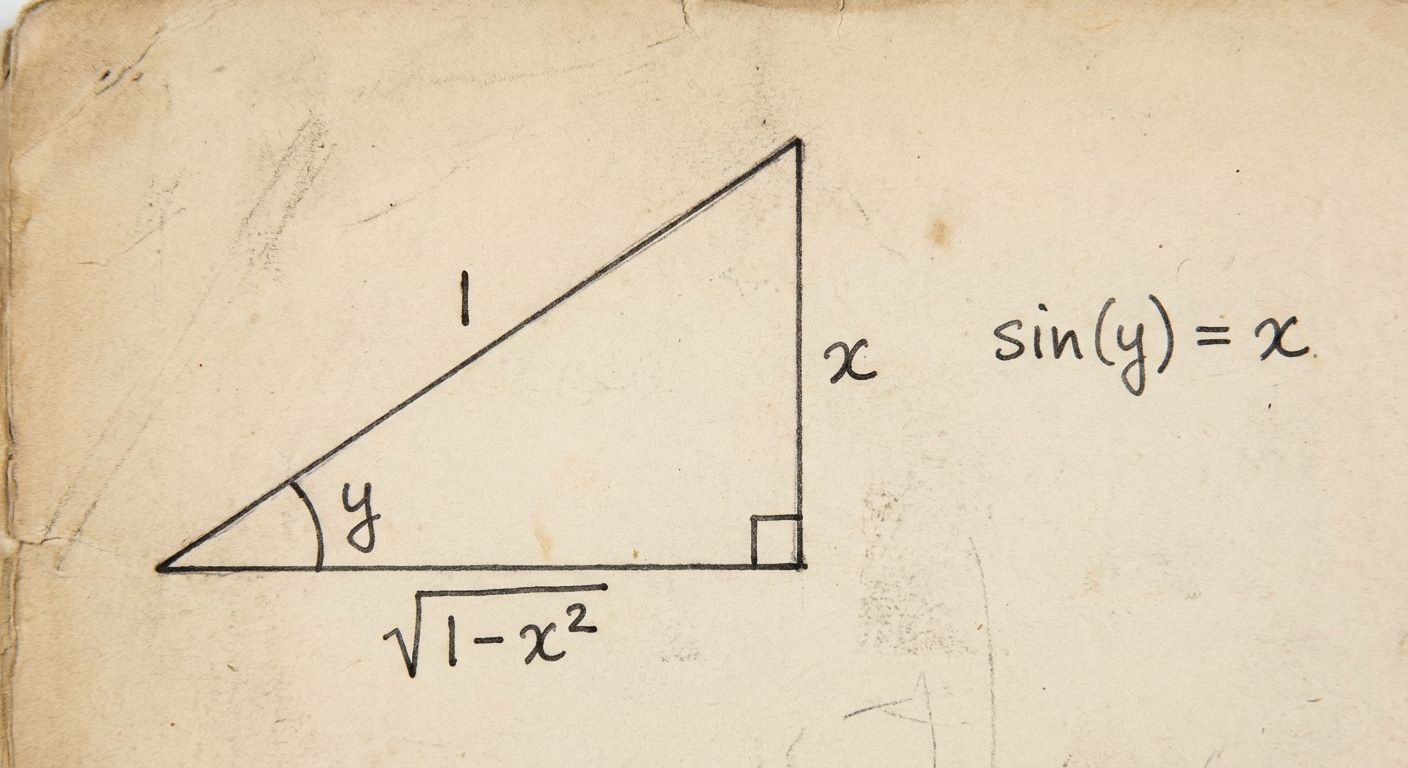
Common errors include forgetting the square root (using %%LATEX228%% instead of %%LATEX229%%) or failing to convert back to an expression in .
The main inverse trig derivative formulas (AB expectations)
The “big three” you must know are arcsine, arccosine, and arctangent.
With Chain Rule (writing the inside as ):
A quick memory pattern: the “co” inverse trig functions (arccosine, arccotangent, arccosecant) have a negative sign in their derivatives.
Other inverse trig derivatives you may encounter
These sometimes appear in AP-style materials:
\frac{d}{dx}(\arcsec(x))=\frac{1}{|x|\sqrt{x^2-1}}
\frac{d}{dx}(\arccsc(x))=-\frac{1}{|x|\sqrt{x^2-1}}
\frac{d}{dx}(\arccot(x))=-\frac{1}{1+x^2}
The absolute value appears for arcsec and arccsc due to sign choices across quadrants.
Chain Rule with inverse trig functions
Inverse trig derivatives almost always require the Chain Rule. For example:
Worked example 1: inverse trig + Chain Rule
Differentiate
Let .
So
A common error is writing instead of squaring the entire inside.
Worked example 2: inverse trig + quotient rule inside
Differentiate
Let
Then
Compute using the quotient rule:
So
Worked example 3: inverse trig + multiple layers + absolute value
Differentiate
Let .
Compute %%LATEX258%% by writing %%LATEX259%%:
Simplify inside the denominator:
So
Since
the derivative is
This reflects a real feature of the derivative: it behaves differently for positive and negative .
Reasonableness checks (quick self-debugging)
Domain sanity checks can catch algebra slips:
- Arcsin and arccos inputs must satisfy %%LATEX266%%, matching the square root %%LATEX267%% being real.
- Arctan accepts all real inputs, matching always being positive.
Exam Focus
- Typical question patterns
- Differentiate expressions like %%LATEX269%% or %%LATEX270%%, requiring the Chain Rule.
- Use implicit differentiation to derive or justify an inverse trig derivative.
- Evaluate a derivative at a specific point where simplification is possible.
- Common mistakes
- Forgetting the Chain Rule factor .
- Misplacing parentheses: confusing %%LATEX272%% with %%LATEX273%%.
- Losing the negative sign in the derivative of arccos.
- Simplifying %%LATEX274%% as %%LATEX275%% instead of .
Selecting a Differentiation Strategy and Working with General Exponentials/Logs (Topic 3.5)
Why strategy matters
By Unit 3 you have many tools: power, product, quotient, trig, exponential/log derivatives, plus the Chain Rule, implicit differentiation, and inverse-derivative relationships. Many AP problems are not about a mechanically hard derivative; they are about recognizing the structure quickly and choosing a method that avoids unnecessary algebra.
A decision-making framework (structure first)
When asked to differentiate, start by asking “How is this expression built?”
- If it is a composition (something inside something), you need the Chain Rule.
- If %%LATEX277%% and %%LATEX278%% are mixed and is not isolated, use implicit differentiation.
- If you see an inverse function, consider the inverse derivative formula.
- If you see inverse trig notation, use the inverse trig derivative rules, almost always with the Chain Rule.
These are not mutually exclusive. AP problems often require stacking them.
General exponentials and logarithms (bases other than )
While
bases other than require a correction factor involving a natural log.
Exponential with constant base %%LATEX283%% and differentiable exponent %%LATEX284%%:
Logarithm base :
Strategy: “which rule fits the base and the exponent?”
- Variable in the base, constant power (like ): power rule.
- Constant base, variable power (like %%LATEX289%%): exponential rule with a %%LATEX290%% factor.
- Variable base and variable exponent (like ): logarithmic differentiation.
Logarithmic differentiation (especially for )
If
take natural logs of both sides:
Then differentiate implicitly with respect to . (This is the standard setup you should recognize immediately; the remaining steps use implicit differentiation plus product rule.)
A note on presentation and simplification
AP Calculus typically accepts equivalent algebraic forms as long as they are correct and defined where the original function is defined. Good simplification can reduce later errors, especially when you will evaluate at a point.
Two time-saving approaches can both be useful, depending on the problem:
- If you only need a numerical value (like the slope at a point), it is often faster to differentiate first and then substitute the point immediately, avoiding heavy algebra.
- If you need a clean symbolic form (especially before a second derivative), simplifying the first derivative can save time and reduce mistakes.
Exam Focus
- Typical question patterns
- Mixed-rule derivatives: product or quotient where one piece is composite (Chain Rule inside product/quotient).
- Implicit differentiation followed by tangent line or evaluating at a point.
- Inverse-function derivative questions that give a table of values for %%LATEX296%% and %%LATEX297%%.
- Derivatives involving bases other than %%LATEX298%% (watch for the %%LATEX299%% factor).
- Recognizing when logarithmic differentiation is the intended method (especially for forms like ).
- Common mistakes
- Using the right rule on the wrong structure (for example, trying to use an inverse-derivative rule when nothing is written as an inverse).
- Losing parentheses when applying the Chain Rule to complicated inners.
- Forgetting the %%LATEX301%% factor for %%LATEX302%%.
Common Mistakes, Notation Traps, and Time-Savers (Unit 3 Wrap-Up)
Common pitfalls (consolidated)
The issues below are repeatedly responsible for lost points. If a pitfall sounds familiar, build a habit or checklist to prevent it.
Chain Rule incomplete. This shows up as differentiating the “outside” correctly but forgetting to multiply by the inner derivative. (See the Chain Rule section’s Exam Focus.)
Implicit differentiation algebra errors for second derivatives. When you compute %%LATEX303%%, your intermediate work often contains %%LATEX304%%; you must substitute your step-1 expression back in to finish in terms of %%LATEX305%% and %%LATEX306%%. (See the Implicit Differentiation section’s Exam Focus.)
Inverse function swaps. If you are asked for , you must look for where the original function output is 3, not where the original input is 3. (See the inverse “table method.”)
Trig chains and notation. Expressions like mean
so the derivative requires the Chain Rule:
- Notation confusion with inverses vs reciprocals. The derivative of the inverse function is associated with
whereas
means the reciprocal of the function value:
These are completely different objects.
Final hints (practical habits)
- When two variables are multiplied in an implicit equation (like ), you must use the product rule.
- Simplify your first derivative before taking a second derivative when you expect to differentiate again symbolically; it can save a lot of time.
- If you only need a derivative value at a specific point, differentiate and then plug the numbers in immediately; arithmetic is often faster than algebraic simplification.
- For inverse trig, know arcsine and arctangent especially well; they appear most often.
Exam Focus
- Typical question patterns
- Problems designed to trigger a notation trap (inverse vs reciprocal, or as a composite).
- Second-derivative implicit problems where substitution of is required.
- Common mistakes
- Misreading notation, then applying a completely correct rule to the wrong interpretation.
- Rushing through algebra after differentiating (especially sign errors and lost parentheses).