AP Calculus BC: Unit 3 - Derivatives of Inverse Functions
The Derivative of an Inverse Function
The relationship between a function and its inverse is one of the most conceptually tested topics in AP Calculus BC. Before memorizing the formula, it is crucial to understand the geometric and algebraic connection between a function $f$ and its inverse $f^{-1}$.
Geometric Interpretation
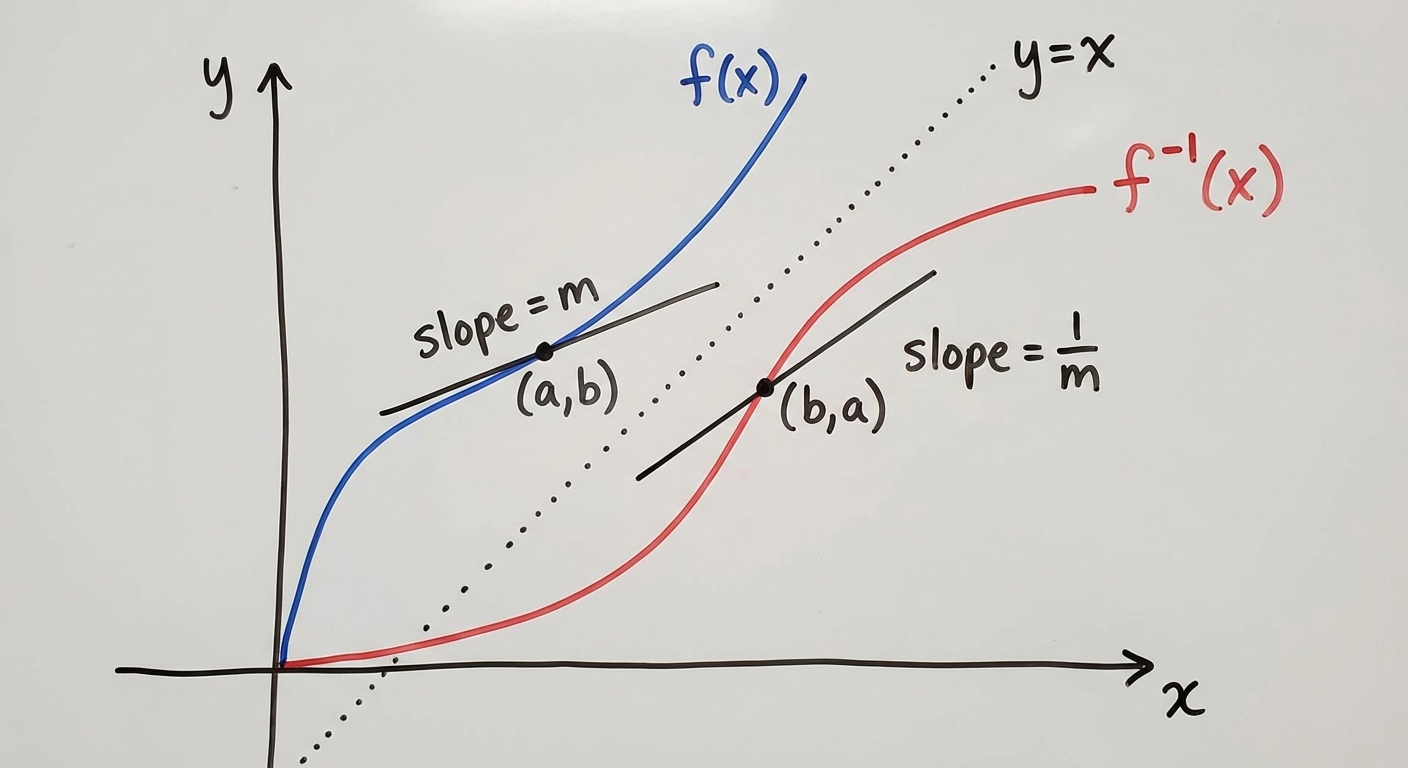
Geometrically, the graph of an inverse function $f^{-1}$ is the reflection of the graph of $f$ across the line $y = x$.
Because of this reflection, if the function $f$ contains the point $(a, b)$, the inverse function $f^{-1}$ contains the point $(b, a)$. Consequently, there is a specific relationship between their slopes:
- The slope of the tangent line to $f$ at point $(a, b)$ is $f'(a)$.
- The slope of the tangent line to $f^{-1}$ at the corresponding point $(b, a)$ is the reciprocal of the slope of $f$.
The Inverse Function Derivative Formula
If $f$ is a differentiable one-to-one function with inverse $g = f^{-1}$ and $f'(f^{-1}(a)) \neq 0$, then the inverse function is differentiable at $a$, and the derivative is given by:
Alternatively, using the notation $g(x)$ for the inverse of $f(x)$ at a specific point $x=b$ (where $f(a)=b$):
Derivation via Chain Rule:
We know that by definition, $f(f^{-1}(x)) = x$. Differentiating both sides with respect to $x$ using the Chain Rule:
- $\frac{d}{dx}[f(f^{-1}(x))] = \frac{d}{dx}[x]$
- $f'(f^{-1}(x)) \cdot (f^{-1})'(x) = 1$
- $(f^{-1})'(x) = \frac{1}{f'(f^{-1}(x))}$
Worked Example: The "Table Problem"
This is the most common format for this topic on the AP Exam.
Problem: Let $f$ be a differentiable function with $f(2) = 5$ and $f'(2) = 3$. If $g$ is the inverse function of $f$, find $g'(5)$.
Solution:
- Identify the corresponding points: We are asked for the derivative of the inverse at $x = 5$. Inverse functions swap inputs and outputs. Since $f(2) = 5$, we know that $g(5) = 2$.
- Point on $f$: $(2, 5)$
- Point on $g$: $(5, 2)$
- Apply the formula:
- Substitute known values:
- Calculate: Since $f'(2) = 3$, then:
Derivatives of Inverse Trigonometric Functions
In AP Calculus BC, you must memorize the derivatives of the six inverse trigonometric functions. The Chain Rule is almost always involved, so the formulas below are written with an inner function $u$ (where $u$ is a differentiable function of $x$).
Primary Inverse Trig Derivatives
These three appear most frequently.
| Function ($y$) | Derivative ($\frac{dy}{dx}$) |
|---|---|
| $\arcsin(u)$ | |
| $\arctan(u)$ | |
| $\text{arcsec}(u)$ | \frac{u'}{ |
Note: The domain of validity depends on the restricted domain of the original trig function to ensure it is one-to-one.
The "Co-Function" Derivatives
The derivatives of the "co-" inverse functions are simply the negatives of their counterparts.
- $\frac{d}{dx}\arccos(u) = -\frac{u'}{\sqrt{1-u^2}}$
- $\frac{d}{dx}\text{arccot}(u) = -\frac{u'}{1+u^2}$
- $\frac{d}{dx}\text{arccsc}(u) = -\frac{u'}{|u|\sqrt{u^2-1}}$
Conceptual Aid: The Reference Triangle
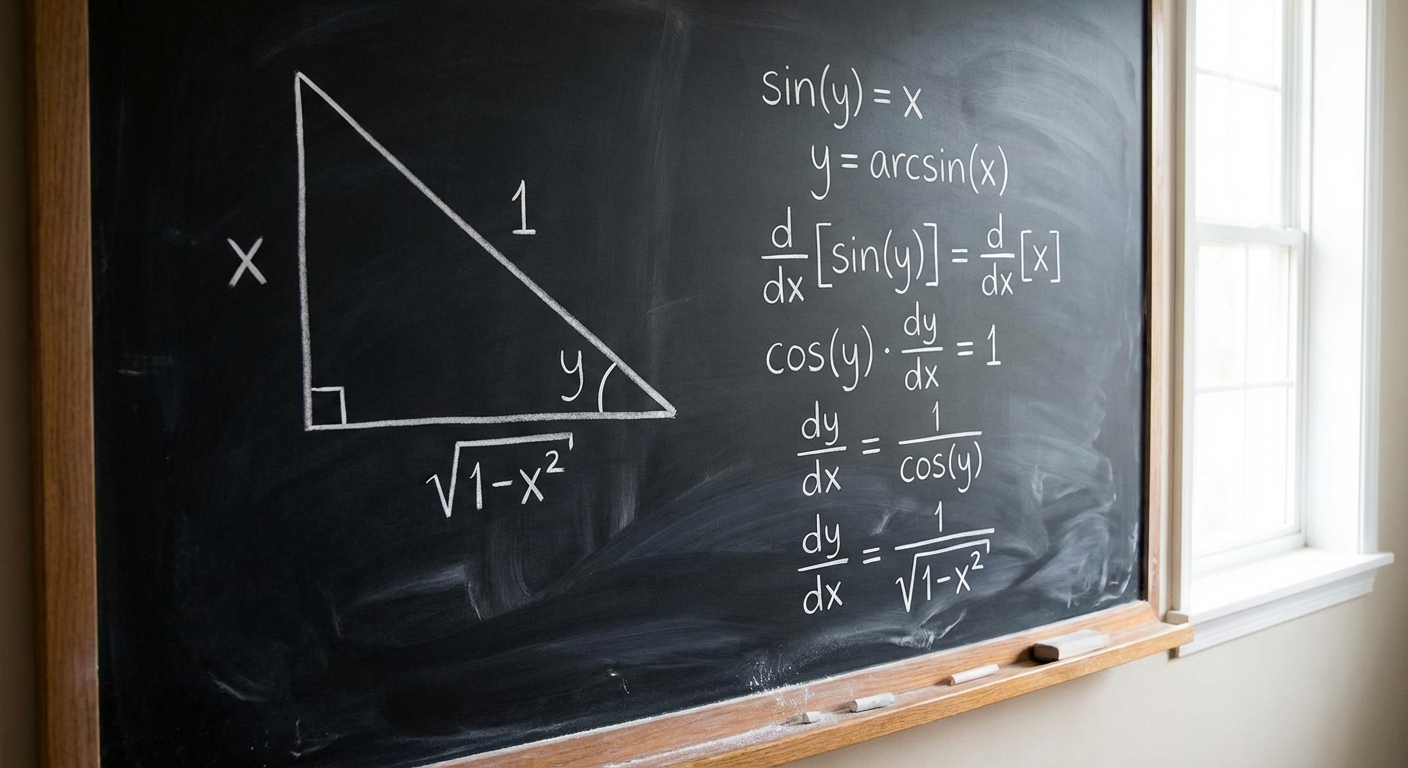
If you forget the formula for $\frac{d}{dx}(\sin^{-1} x)$, you can derive it using implicit differentiation and a triangle.
- Let $y = \arcsin x$, which implies $\sin y = x$.
- Differentiate implicitly: $\cos y \cdot y' = 1 \implies y' = \frac{1}{\cos y}$.
- Draw a right triangle where angle is $y$. Since $\sin y = \frac{x}{1}$ (Opposite/Hypotenuse), the Adjacent side is $\sqrt{1-x^2}$ (Pythagorean theorem).
- Therefore, $\cos y = \frac{\text{adj}}{\hyp} = \sqrt{1-x^2}$.
- Substitute back: $y' = \frac{1}{\sqrt{1-x^2}}$.
Worked Example: Chain Rule application
Problem: Find $f'(x)$ if $f(x) = \arctan(3x^2)$.
Solution:
- Identify $u = 3x^2$. Determine $u' = 6x$.
- Apply the arctan formula: $\frac{u'}{1+u^2}$.
- Substitute:
f'(x) = \frac{6x}{1 + (3x^2)^2} = \frac{6x}{1 + 9x^4}$$
Selecting Procedures for Calculating Derivatives
In Unit 3, you encounter various derivative rules (Chain, Product, Quotient, Implicit, Inverse). A key skill is identifying when to use inverse rules versus other methods.
Identifying the Structure
Inverse Trigonometry vs. Reciprocals:
- Case A: $y = \sin^{-1}(x)$. This is the inverse sine function (arcsin). Use the formulas from the section above.
- Case B: $y = (\sin x)^{-1}$. This is the reciprocal function, $\csc x$. Use the standard Chain Rule (Power Rule first) or the derivative of cosecant.
- $\frac{d}{dx}(\sin x)^{-1} = -1(\sin x)^{-2} \cdot \cos x = -\csc x \cot x$.
Explicit vs. Implicit Inverse calculation:
- If asked for $(f^{-1})'(b)$ and you have the function equation $f(x)$ for the original function, do not try to find the equation for $f^{-1}(x)$ first. Inverting a function like $f(x) = x^5 + x + 1$ algebraically is impossible. Instead, use the inverse derivative theorem (find the $x$ that produces the $y$-value, then reciprocate the slope).
Common Mistakes & Pitfalls
To ensure maximum points on the AP exam, avoid these frequent errors:
- Confusing Notation: $f^{-1}(x)$ means inverse function. $[f(x)]^{-1}$ means $\frac{1}{f(x)}$. These derivatives are completely different.
- The "Wrong Input" Error: When using the formula $(f^{-1})'(b) = \frac{1}{f'(a)}$, students often calculate $\frac{1}{f'(b)}$. Remember: you calculate the slope of $f$ at the x-coordinate of f, not the x-coordinate of the inverse.
- Forgetting Absolute Value: The derivatives of $\text{arcsec}(u)$ and $\text{arccsc}(u)$ include an absolute value $|u|$ in the denominator. This is frequently missed in free-response questions.
- Omitting the Cham Rule: When differentiating $\arcsin(x/2)$, the result is not just $\frac{1}{\sqrt{1-(x/2)^2}}$; you must multiply by the derivative of the inside function, $\frac{1}{2}$.