Mastering Poetic Voice: Diction, Sound, and Irony in AP Literature
Deconstructing Tone Through Diction
In AP English Literature, understanding Tone is the gateway to uncovering a poem's deeper meaning. Tone is defined as the speaker’s attitude toward the subject or the audience. It is distinct from Mood, which characterizes the emotional atmosphere experienced by the reader.
The primary vehicle for establishing tone is Diction (word choice). Authors do not choose words randomly; they select them for their specific Denotations (dictionary definitions) and Connotations (emotional associations).
The Connotation Spectrum
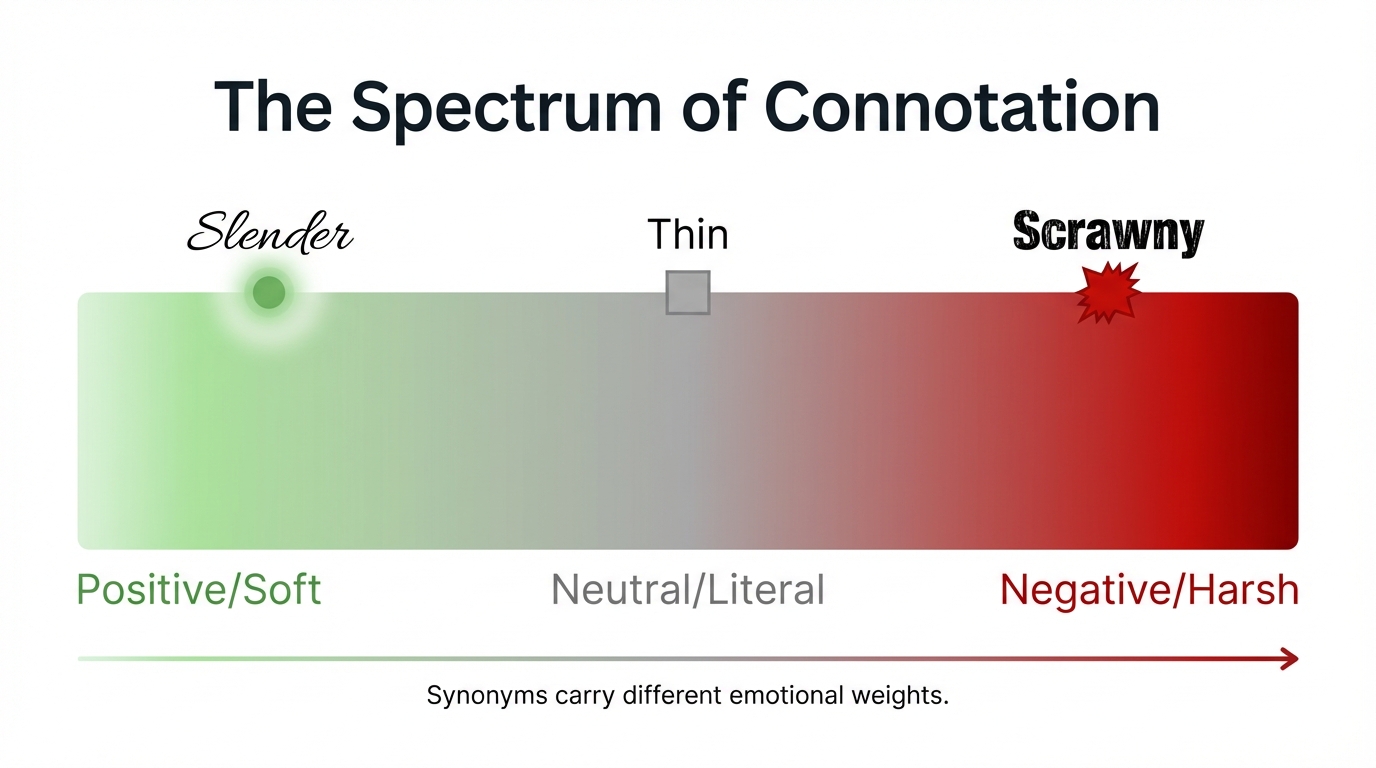
To analyze diction effectively, you must look past the literal definition of a word to its implied weight. Consider the variation in meaning among synonyms:
- Positive Connotation: "The slender pine tree."
- Neutral Connotation: "The thin pine tree."
- Negative Connotation: "The scrawny pine tree."
While all three describe a tree of small circumference, "slender" suggests elegance, "thin" is factual, and "scrawny" implies unhealthiness or lack of vitality. Using scrawny would contribute to a critical or pitying tone.
The Tone Equation
When writing essays (Q1 Poetry Analysis), avoid simply stating "the author uses diction." Instead, use this conceptual formula to guide your thesis:
For example, rather than saying "The author uses negative diction," write: "The author employs acerbic, biting diction to convey a tone of resentful resignation."
Shifts in Tone
A critical skill in Unit 5 is identifying Shifts (or Turns/Voltas). Rarely does a complex poem maintain a single, static tone from start to finish. Look for transition words that signal a change in attitude:
- But, Yet, However, Although
- Changes in punctuation (dashes, periods, colons)
- Stanza breaks
- Changes in verb tense (past to present)
The Function of Sound Devices
Sound devices are not merely decorative; in high-quality poetry, form follows function. The way a poem sounds should mirror what the poem means.
Repetitive Sound Patterns
Alliteration: The repetition of initial consonant sounds in adjacent or nearby words.
- Example: "The farrow foam flies…"
- Effect: Can speed up the line, create emphasis, or mimic the sound of the subject (e.g., wind, water).
Assonance: The repetition of vowel sounds within words (not necessarily rhyming).
- Example: "The rain in Spain stays mainly…"
- Effect: Creates flow, sets mood, or links words conceptually. Long vowels (O, A) often slow down the pace, creating a somber or lazy tone.
Consonance: The repetition of consonant sounds anywhere within words (not just the start).
- Example: "Potter, patter, pitter."
- Effect: Often creates a percussive, rhythmic, or harsh effect.

Rhyme and Meaning
While End Rhyme is common, AP examiners look for your understanding of how rhyme creates relationships between words.
- Perfect Rhyme: Suggests certainty, closure, or harmony.
- Slant Rhyme (Half/Near Rhyme): Occurs when sounds are similar but not identical (e.g., worm/swarm, hold/bald).
- Analysis Tip: Slant rhyme almost always indicates tension, dissonance, or a slight imperfection in the speaker’s world. It denies the reader the satisfaction of a perfect chime, signaling that something is "off."
Euphony vs. Cacophony
- Euphony: A grouping of harmonious, pleasing sounds. usually achieved through soft consonants (l, m, n, s, r, w) and long vowels. indicating peace or beauty.
- Cacophony: A grouping of harsh, discordant sounds. Achieved through explosive consonants (k, t, g, d, p, b) and hissing sounds. Indicates chaos, anger, or difficulty.
Irony and Ambiguity
Advanced poetry analysis requires you to be comfortable with uncertainty. A poem is not a riddle with a single answer; it is often an exploration of conflicting emotions.
Irony in Poetry
Irony deals with the gap between expectation and reality.
- Verbal Irony: The speaker says one thing but means the opposite. (Similar to sarcasm, but sarcasm is intended to wound, whereas irony can be distinctively observational).
- Example: Describing a war zone as a "playground for the brave."
- Situational Irony: The outcome is the opposite of what is expected.
- Example: A poem about a "Master Builder" whose life is falling apart.
- Structural Irony: The author creates a speaker (persona) who is naive or unreliable, creating a distance between the author's views and the speaker's views.
Embracing Ambiguity
Ambiguity occurs when a word, phrase, or statement contains more than one meaning. In AP Lit, ambiguity is considered a strength, not a weakness. It adds richness to the text.
When you encounter ambiguity:
- Do not try to solve it by choosing just one meaning.
- Argue that the author uses ambiguity to show the complexity of the subject.
Example of Ambiguity:
"The deep heart's core."
Is the core "deep" because it is profound and wise? Or is it "deep" because it is buried, hidden, and inaccessible? An effective analysis argues that it is likely both.
Common Mistakes & Pitfalls
1. Labeling Without Linking
This is the most common error in AP Lit essays. Students list techniques ("The author uses alliteration") without explaining the function.
- Wrong: "The author uses alliteration in line 4."
- Right: "The harsh 'c' alliteration in 'cutting cold' mimics the physical stinging of the wind, reinforcing the speaker's isolation."
2. Confusing Mood with Tone
Remember: Tone is the Author/Speaker's attitude. Mood is the Reader's feeling.
- A poem can have a spooky mood but a humorous tone.
3. Ignoring the "Shift"
If a student analyzes the tone of the first stanza and applies it to the whole poem, they often miss the point. Most AP poems contain a shift where the speaker creates a resolution, realization, or complication. Always look for the pivot point.
4. Over-simplifying Tone
Avoid elementary words like "happy," "sad," or "angry." Use precise descriptors: "melancholic," "euphoric," "indignant," "wistful," or "apathetic." Furthermore, complex poems often have complex tones (e.g., "bittersweetly nostalgic" or "aggressively defensive").