Unit 5: The Industrial Revolution and Its Global Consequences (c. 1750–1900)
Industrialization Spreads
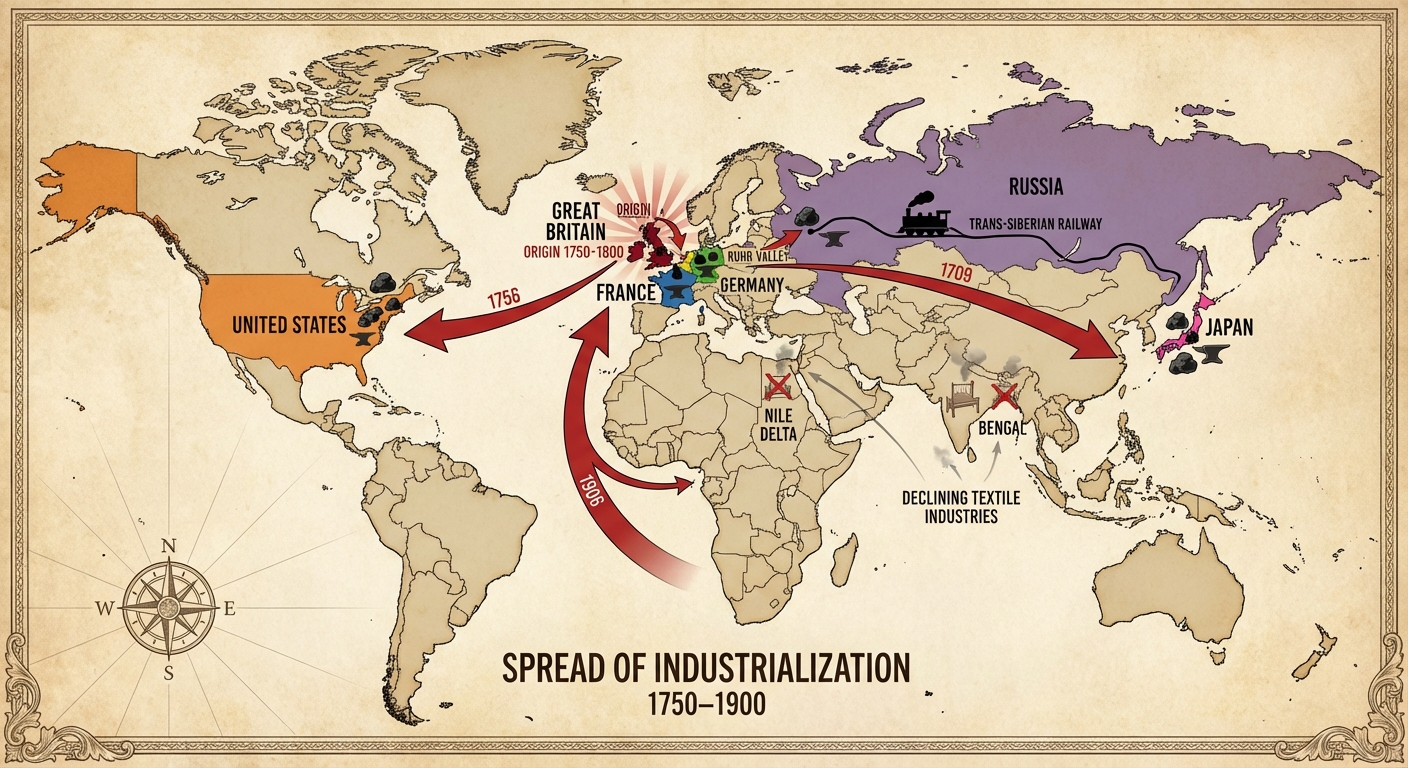
While the Industrial Revolution began in Great Britain due to its unique combination of environmental factors (coal, iron, waterways) and legal protection of property, the phenomenon quickly transformed from a British anomaly to a global standard. However, the pace and method of industrialization varied significantly by region.
The Spread to the West (Europe and North America)
Other nations copied the British model but faced different constraints.
- France: Industrialization was slower and less disruptive than in Britain due to sparsely populated urban centers and the French Revolution/Napoleonic Wars consuming attention and capital. France eventually focused on high-quality luxury goods.
- Germany: Initially politically fragmented. Once unified in 1871, Germany industrialized rapidly, focusing heavily on steel and coal. By the early 20th century, Germany rivaled Britain as Europe's leading industrial power.
- The United States: Possessed vast natural resources and a rapidly growing population due to immigration. The U.S. excelled in the construction of railroads (e.g., the Transcontinental Railroad, 1869) and eventually became the world's leading industrial power by 1900 through the use of "human capital" (labor from immigrants).
State-Sponsored Industrialization
Unlike in the West, where private investors drove industrialization, governments in Russia and Japan took a direct role to catch up.
- Russia: The state focused on heavy industry rather than consumer goods. Key achievements included the Trans-Siberian Railroad, linking Moscow to the Pacific, allowing trade with East Asia. While steel and coal production spiked, the agricultural economy remained dominant, and the working class suffered under poor conditions, fueling future revolutionary sentiment.
- Japan (The Meiji Restoration): realizing that isolationism left them vulnerable to Western imperialism (illustrated by Matthew Perry’s arrival), Japan overthrew the Shogunate in 1868. The new Meiji government strictly copied Western industrial and military models—a process called Defensive Modernization.
- Government sold state-built factories to private families (zaibatsu), mixing state direction with private profit.
- Japan became the first non-Western power to successfully industrialize.
Decline of Middle Eastern and Asian Manufacturing
As Western industrial efficiency skyrocketed, traditional manufacturing centers in the East declined—a process known as deindustrialization.
- Shipbuilding: India (under British control) and Southeast Asia saw their massive shipbuilding industries dismantled due to British mismanagement and the rise of British steamships.
- Iron Works: British colonial rule in India imposed steep tariffs and regulations (e.g., the uprising of 1857 led to mining restrictions) that crippled the Indian iron industry.
- Textiles: Egypt and India had been full-cycle textile producers. British machine-made textiles flooded these markets, forcing India and Egypt to transition into becoming merely exporters of raw cotton rather than producers of finished cloth.
Technology of the Industrial Age
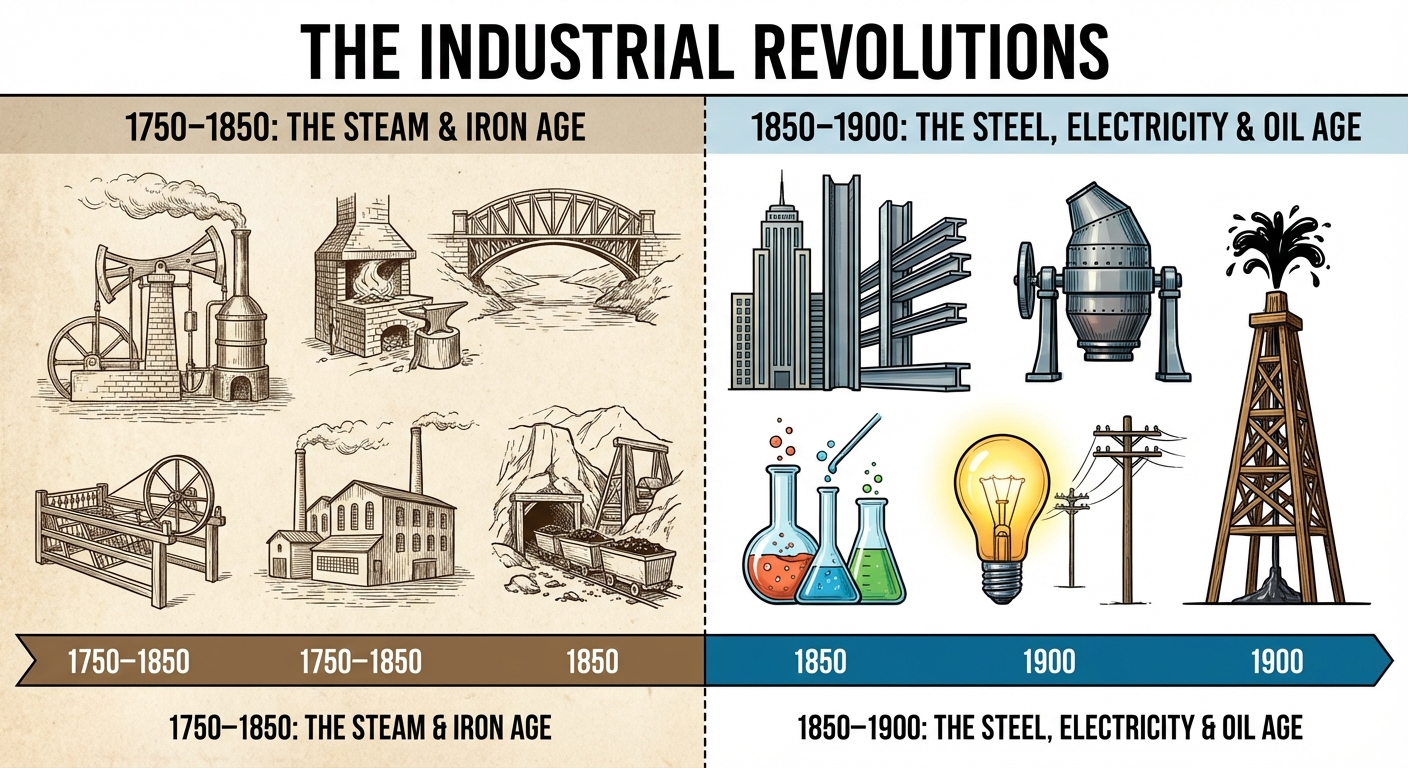
The Industrial Revolution is often divided into two distinct phases based on the dominant technology and energy sources.
The First Industrial Revolution (c. 1750 – 1850)
Focused on Textiles, Steam, and Iron.
- The Steam Engine: Refined by James Watt in 1765. Originally used to pump water out of mines, it was adapted to power textile machinery and eventually transportation.
- Transportation:
- Steamships: Allowed for travel upstream and independent of wind belts. Coaling stations were established globally to refuel these ships.
- Railroads: Drastically lowered the cost of transporting raw materials and finished goods, creating national markets.
The Second Industrial Revolution (c. 1850 – 1900)
Focused on Steel, Chemicals, Precision Machinery, and Electronics.
| Area of Innovation | Key Developments |
|---|---|
| Steel Production | The Bessemer Process (1856) allowed iron to be refined into steel (stronger/lighter) quickly and cheaply. Used for skyscrapers and bridges. |
| Oil (Petroleum) | Initially for kerosene (lighting), later for the Internal Combustion Engine, leading to automobiles. |
| Electricity | Replaced steam in factories; allowed for street lighting (reducing crime), electric streetcars, and 24-hour factory operations. |
| Communications | Alexander Graham Bell (Telephone) and Guglielmo Marconi (Radio) revolutionized global connectivity. |
Reactions to the Industrial Economy
The shift from farm to factory fundamentally altered how humans lived, leading to intense debate over economic systems, social structures, and government roles.
Economic Ideologies: Capitalism vs. Socialism
Laissez-Faire Capitalism:
- Championed by Adam Smith (The Wealth of Nations, 1776).
- core belief: The government should not interfere in the economy. The "invisible hand" of the market will regulate prices and wages. Business owners prefer this.
Utilitarianism:
- Proposed by John Stuart Mill.
- Argued that capitalism was good but had "sharp edges" that harmed workers. The goal of society should be "the greatest good for the greatest number," justifying moderate reforms (labor unions, child labor laws).
Marxism (Scientific Socialism):
- Karl Marx and Friedrich Engels published the Communist Manifesto (1848).
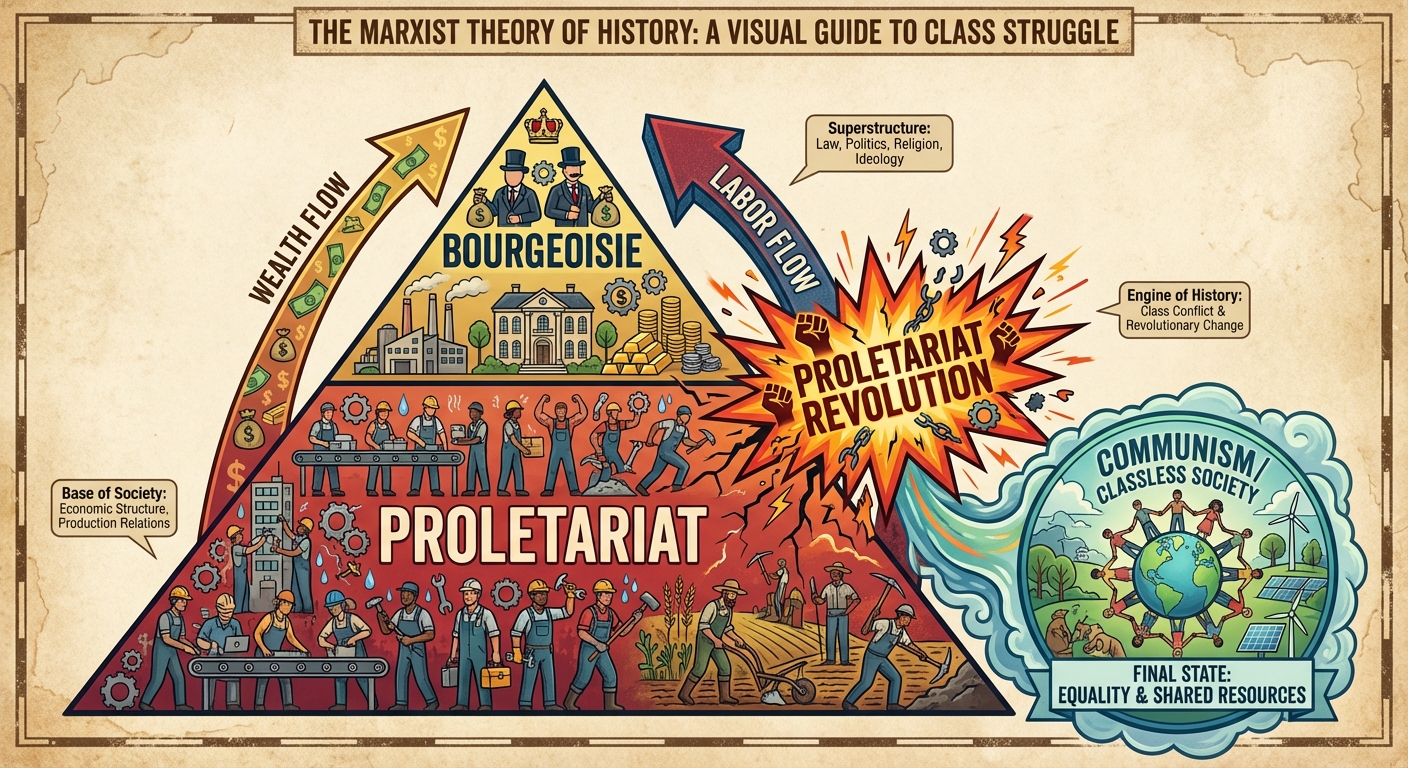
- They argued that capitalism created a class struggle between the Bourgeoisie (owners of the means of production) and the Proletariat (working class).
- Prediction: The Proletariat would violently overthrow the Bourgeoisie, seize the means of production, and create a classless, stateless society (Communism).
Government Responses to Modernization
Empire struggled to balance tradition with the need to modernize.
- The Ottoman Empire (Tanzimat Reforms): The Ottomans attempted to root out corruption, secularize education, and code laws to please foreign investors. While they built railroads and modernized the military, the reforms were ultimately halted by the Sultan (Abdul Hamid II) who feared losing power to reformists.
- Qing China (Self-Strengthening Movement): China attempted to blend Chinese cultural traditions (