AP Calculus BC Unit 5: Curve Analysis & Optimization
Unit Overview
Unit 5 focuses on the Analytical Applications of Differentiation. This unit transitions from the mechanics of calculating derivatives (Unit 2–3) to interpreting them to understand the behaviors of functions. You will use the first and second derivatives to determine extrema, concavity, and optimal values in real-world contexts.
5.1 The Mean Value Theorem (MVT) & Existence Theorems
Existence theorems guarantee that a value exists within an interval, though they do not tell you how to find it.
The Mean Value Theorem (MVT)
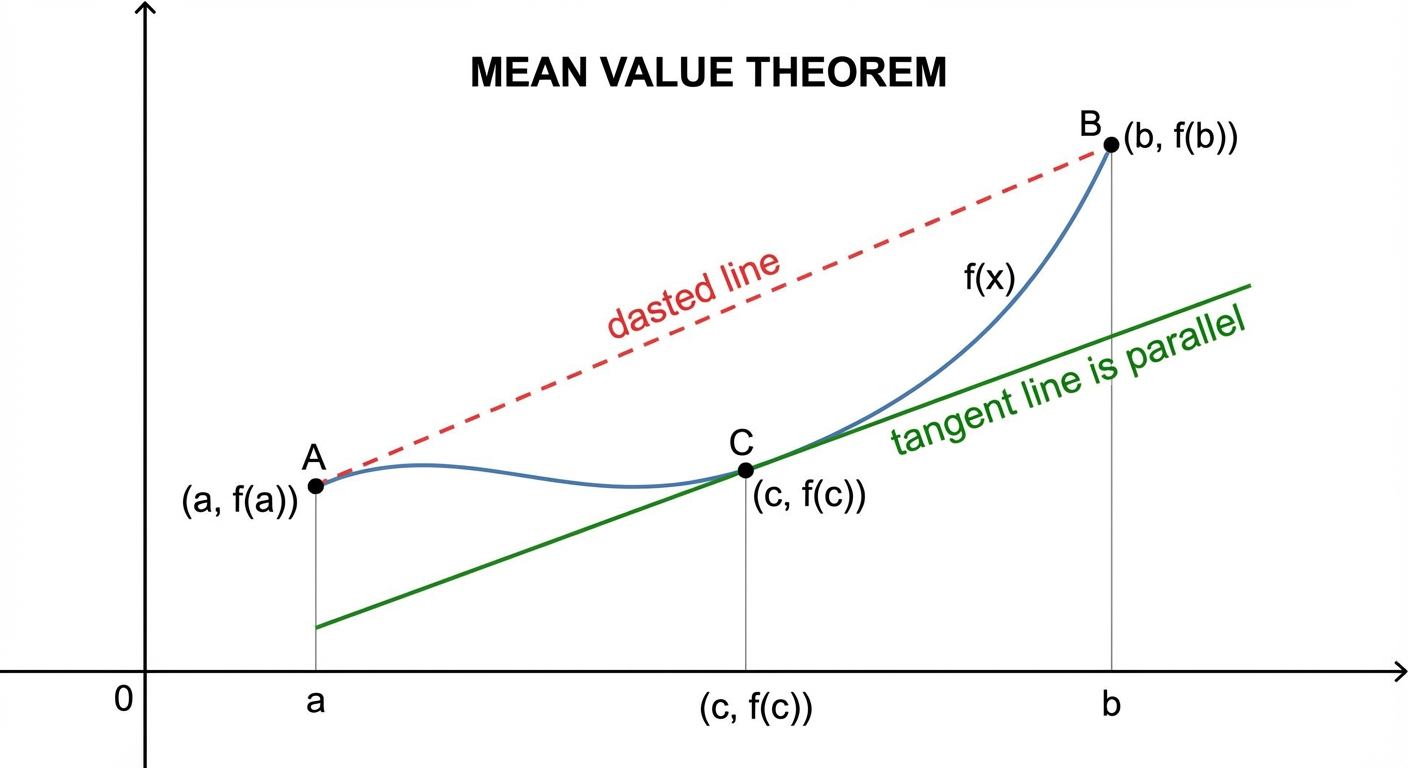
The MVT states that for a "nice" curve, there is at least one point where the instantaneous rate of change (derivative) equals the average rate of change (slope of the secant line) over an interval.
Conditions:
- $f(x)$ is continuous on the closed interval $[a, b]$.
- $f(x)$ is differentiable on the open interval $(a, b)$.
Formula:
If conditions are met, there exists at least one $c$ in $(a, b)$ such that:
Geometric Interpretation:
There is a tangent line parallel to the secant line connecting the endpoints $(a, f(a))$ and $(b, f(b))$.
Rolle’s Theorem
Rolle’s Theorem is a special case of the MVT.
Additional Condition: $f(a) = f(b)$.
Conclusion: Since the start and end heights are the same, the average slope is 0. Therefore, there must be a point $c$ where $f'(c) = 0$ (a horizontal tangent).
5.2 The Extreme Value Theorem (EVT)
Definition
The Extreme Value Theorem states that if a function $f(x)$ is continuous on a closed interval $[a, b]$, then $f(x)$ must attain both an absolute maximum and an absolute minimum on that interval.
Types of Extrema
- Absolute (Global) Extrema: The highest or lowest $y$-value on the entire domain or interval.
- Relative (Local) Extrema: The highest or lowest point relative to the points immediately surrounding it (a "hill" or a "valley").
Critical Points:
Potential locations for extrema occur at critical points, defined as $x$-values in the domain where:
- $f'(x) = 0$ (Horizontal tangent)
- $f'(x)$ is undefined (Sharp corner/cusp or vertical tangent)
5.3 & 5.4 First Derivative Analysis
The first derivative $f'(x)$ tells us the direction of the function.
Intervals of Increasing and Decreasing
- If $f'(x) > 0$ for all $x$ in $(a, b)$, then $f$ is increasing on $[a, b]$.
- If $f'(x) < 0$ for all $x$ in $(a, b)$, then $f$ is decreasing on $[a, b]$.
The First Derivative Test
This test determines if a critical point is a relative maximum, minimum, or neither.
- Find critical points ($f'(x)=0$ or undefined).
- Place critical points on a number line.
- Test values in the intervals between critical points to determine the sign of $f'(x)$.
| Change in $f'(x) at c$ | Behavior of $f(x)$ | Conclusion |
|---|---|---|
| From Positive to Negative | $\nearrow \bullet \searrow$ | Relative Maximum |
| From Negative to Positive | $\searrow \bullet \nearrow$ | Relative Minimum |
| No sign change | $\nearrow \bullet \nearrow$ or $\searrow \bullet \searrow$ | Not an extrema |
Worked Example: Curve Analysis
Let $f(x) = x^3 - 6x^2 + 9x + 2$. Find the intervals of increase/decrease and relative extrema.
Step 1: Find Critical Points
Set equal to 0:
Step 2: Sign Chart (Number Line)
We test intervals: $(-\infty, 1)$, $(1, 3)$, and $(3, \infty)$.
- Test $x=0$: $f'(0) = 9$ (Positive) $\rightarrow$ Inc
- Test $x=2$: $f'(2) = 3(4)-24+9 = -3$ (Negative) $\rightarrow$ Dec
- Test $x=4$: $f'(4) = 3(16)-48+9 = +9$ (Positive) $\rightarrow$ Inc
Step 3: Conclusion
- Increasing: $(-\infty, 1] \cup [3, \infty)$
- Decreasing: $[1, 3]$
- Relative Max: At $x=1$ (Sign change $+$ to $-$)
- Relative Min: At $x=3$ (Sign change $-$ to $+$)
5.5 Finding Absolute Extrema (Candidates Test)
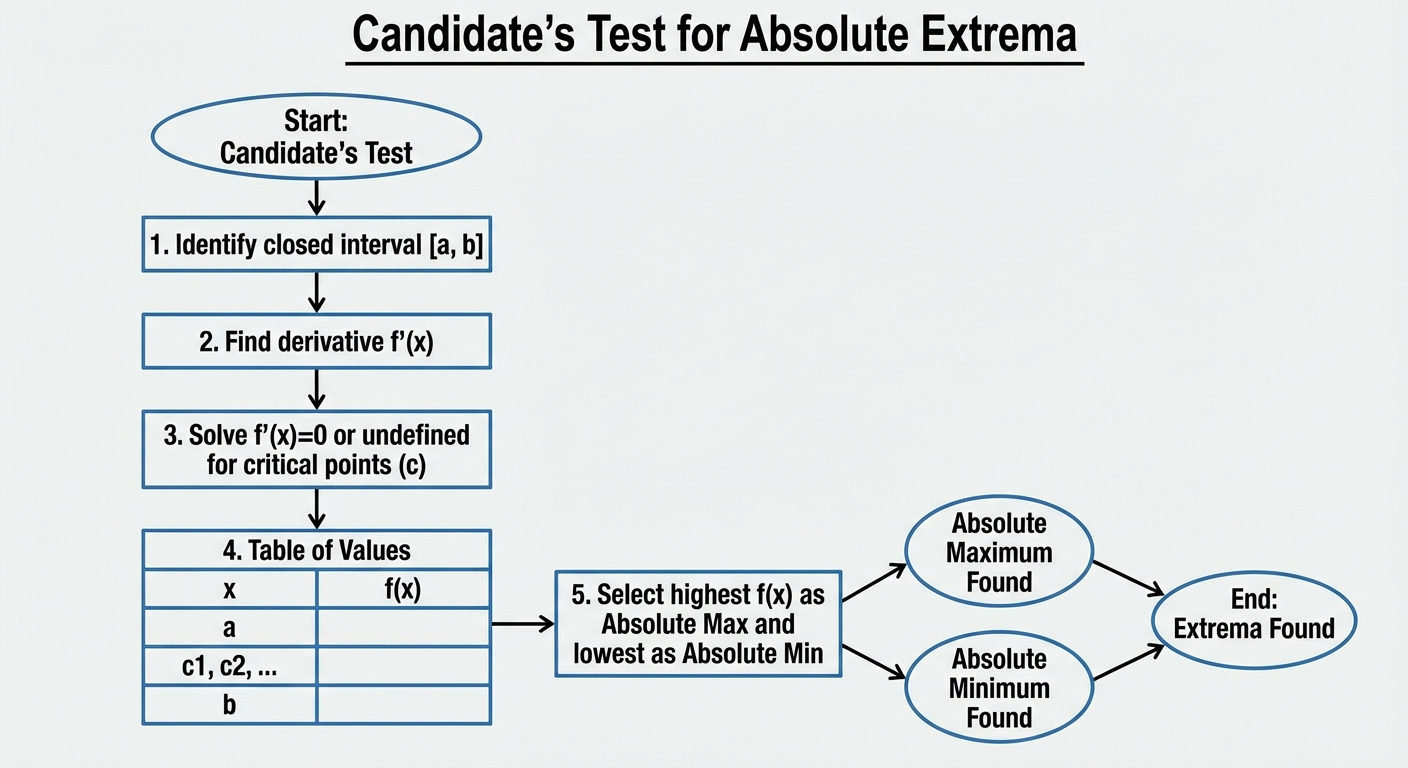
When finding absolute extrema on a closed interval $[a, b]$, you cannot rely solely on the first derivative changes. You must check the endpoints.
The Candidates Test Strategy:
- Find all critical numbers $c$ inside $(a, b)$.
- Evaluate $f(x)$ at all critical numbers ($f(c)$).
- Evaluate $f(x)$ at the endpoints ($f(a)$ and $f(b)$).
- Compare the $y$-values. The largest is the Absolute Max; the smallest is the Absolute Min.
5.6 & 5.7 Second Derivative Analysis
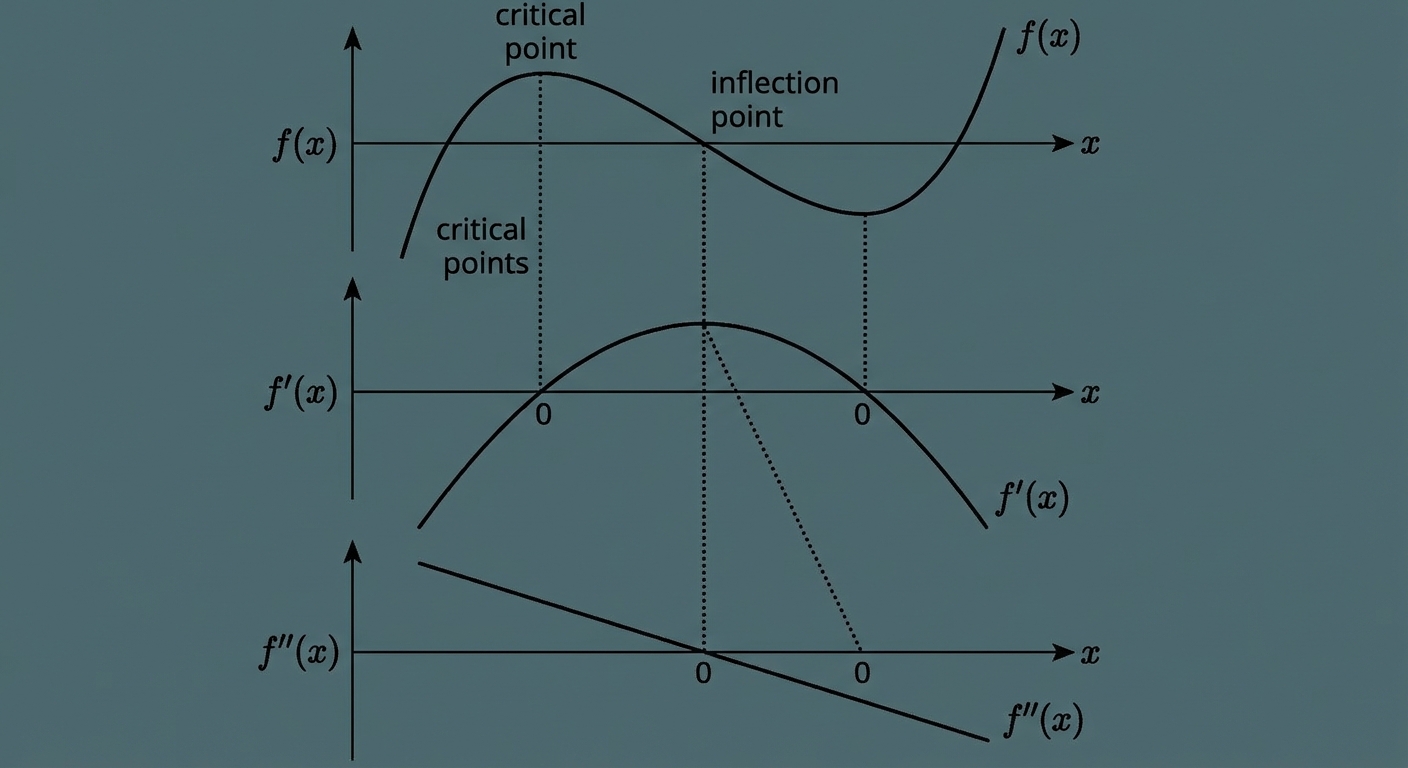
The second derivative $f''(x)$ describes the concavity (curvature) of $f(x)$ and the rate of change of $f'(x)$.
Concavity & Points of Inflection
- Concave Up: $f''(x) > 0$ (graph looks like a cup $\cup$). $f'$ is increasing.
- Concave Down: $f''(x) < 0$ (graph looks like a frown $\cap$). $f'$ is decreasing.
- Point of Inflection (POI): A point where the function is continuous and the concavity changes (sign of $f''$ changes).
- Note: $f''(c)=0$ is a possible POI, but you must verify a sign change.
Example (Continued)
Using $f(x) = x^3 - 6x^2 + 9x + 2$:
Set $f''(x) = 0 \implies 6x = 12 \implies x = 2$.
Check sign change:
- $x < 2$ (e.g., 0): $f''(0) = -12$ (Negative $\to$ Concave Down)
- $x > 2$ (e.g., 3): $f''(3) = 6$ (Positive $\to$ Concave Up)
Result: The graph is Concave Down on $(-\infty, 2)$, Concave Up on $(2, \infty)$, with a POI at $x=2$.
The Second Derivative Test (For Extrema)
This is an alternative to the First Derivative Test for finding Max/Min values.
If $f'(c) = 0$ (Horizontal Tangent) AND:
- $f''(c) > 0$: The graph is concave up, so $c$ is a Relative Minimum.
- $f''(c) < 0$: The graph is concave down, so $c$ is a Relative Maximum.
- $f''(c) = 0$: The test is inconclusive (must use First Derivative Test).
5.8 Connecting f, f', and f''
Many AP questions provide the graph of $f'$ and ask about $f$. You must memorize these relationships:
| Function ($f$) | Derivative ($f'$) | Second Derivative ($f''$) |
|---|---|---|
| Increasing | Positive ($>0$) | N/A |
| Decreasing | Negative ($<0$) | N/A |
| Relative Max | Changes Pos $\to$ Neg | Negative (usually) |
| Relative Min | Changes Neg $\to$ Pos | Positive (usually) |
| Concave Up | Increasing | Positive ($>0$) |
| Concave Down | Decreasing | Negative ($<0$) |
| Point of Inflection | Extrema (Max/Min) | Changes Sign |
5.10 Optimization
Optimization involves finding the "best" value (max profit, min cost, max area) in a real-world scenario.
Step-by-Step Strategy:
- Draw and Label: Sketch the situation and assign variables.
- Primary Equation: Write the formula for the quantity you want to maximize/minimize (e.g., Area $A = xy$).
- Constraint: Find the equation relating the variables (e.g., Perimeter $2x + 2y = 100$).
- Substitution: Use the constraint to rewrite the Primary Equation in terms of one variable.
- Differentiation: Find the derivative of the new equation and set it to 0.
- Justification: Use the First Derivative Test or Candidates Test (if interval is closed) to prove it is the absolute max/min.
5.11 Behaviors of Implicit Relations
For non-functions where $y$ is defined implicitly in terms of $x$ (e.g., $x^2 + y^2 = 25$):
- Find $\frac{dy}{dx}$ using implicit differentiation.
- Horizontal Tangents: Set the numerator of $\frac{dy}{dx}$ to 0 (and check denominator $\neq 0$).
- Vertical Tangents: Set the denominator of $\frac{dy}{dx}$ to 0 (and check numerator $\neq 0$).
Summary of Common Mistakes
- Forgetting Conditions for Theorems: Students often apply MVT or EVT without stating "Since f is continuous and differentiable…" leading to point deductions.
- Confusing Concavity with Slope: "It's increasing" does NOT mean "It's concave up." (e.g., $\sqrt{x}$ is increasing but concave down).
- Candidates Test Omission: When asked for absolute extrema on a closed interval, students frequently forget to check the endpoints.
- Improper Justification: Saying "The function is increasing because the slopes are going up" is wrong. You MUST say "The function is increasing because $f'(x) > 0$."
- Undefined Critical Points: Students solve $f'(x)=0$ but forget to check where $f'(x)$ is undefined (like the cusp of $x^{2/3}$), which are also critical points.