Unit 1 Topic 1.2: Motion in 2D and 3D
Unit 1 Review: Multi-Dimensional Kinematics
In AP Physics C: Mechanics, moving from one dimension to two (or three) dimensions introduces vector interaction. While the fundamental kinematic relationships remain tied to the definitions of position, velocity, and acceleration, the mathematics now requires separating motion into independent orthogonal components.
Vectors and Vector Components
Scalars are quantities fully described by a magnitude (e.g., mass, time, temperature). Vectors are quantities described by both a magnitude and a direction (e.g., displacement, velocity, force).
Unit Vector Notation
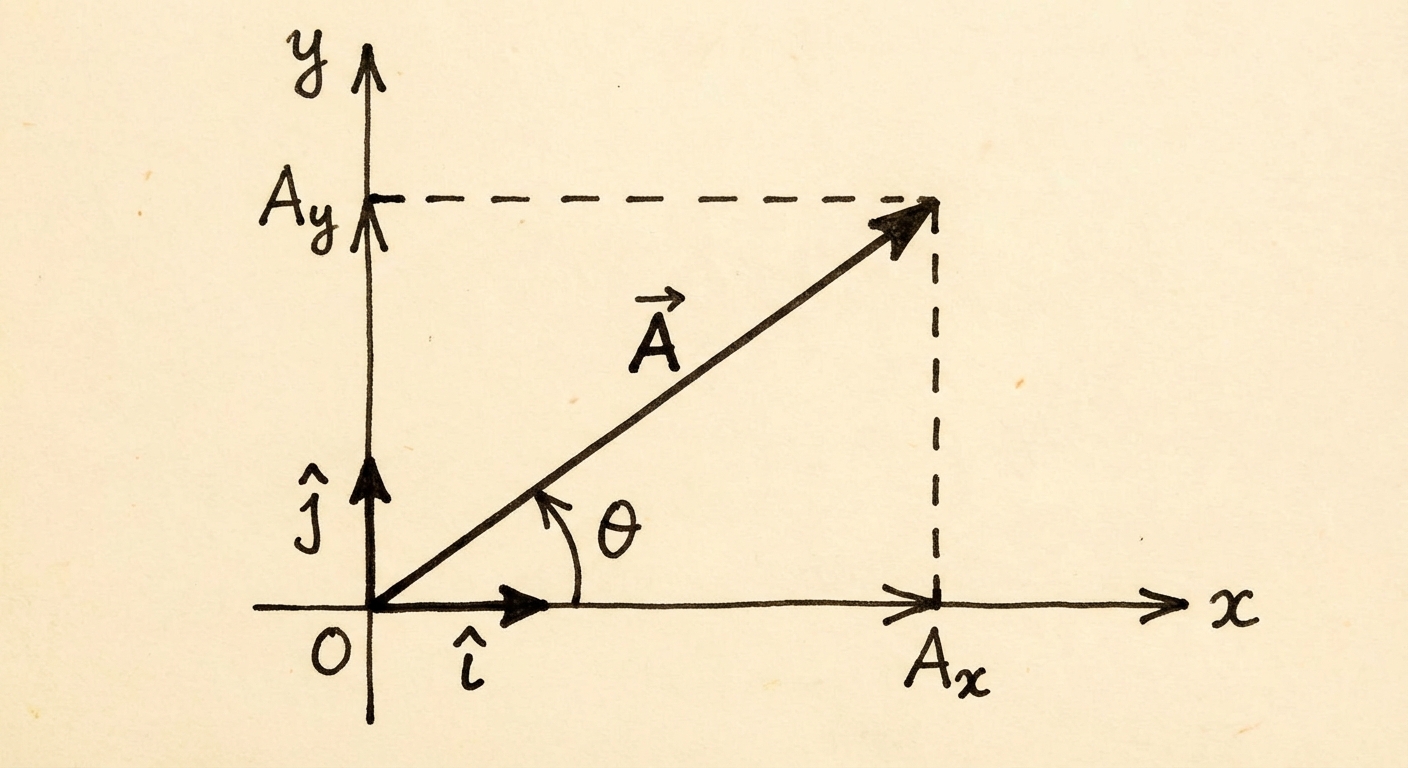
In AP Physics C, vector notation is crucial. We use unit vectors—vectors with a magnitude of 1 pointing in the direction of the coordinate axes—to express kinematic quantities.
- $\hat{i}$ points in the $+x$ directon.
- $\hat{j}$ points in the $+y$ direction.
- $\hat{k}$ points in the $+z$ direction.
A generic vector $\vec{A}$ is written as:
Magnitude and Direction
To convert from component form back to magnitude and direction (polar coordinates) in 2D:
- Magnitude (using the Pythagorean theorem):
- Direction (angle $\theta$ relative to the positive x-axis):
Calculus with Vectors
Kinematics definitions in C are based on calculus. If the position vector is given as a function of time $\vec{r}(t)$, velocity and acceleration are the time derivatives of the vector components.
| Quantity | Definition | Vector Form |
|---|---|---|
| Position | Location relative to origin | $\vec{r}(t) = x(t)\hat{i} + y(t)\hat{j}$ |
| Velocity | Derivative of position | $\vec{v}(t) = \frac{d\vec{r}}{dt} = \frac{dx}{dt}\hat{i} + \frac{dy}{dt}\hat{j} = vx\hat{i} + vy\hat{j}$ |
| Acceleration | Derivative of velocity | $\vec{a}(t) = \frac{d\vec{v}}{dt} = \frac{dvx}{dt}\hat{i} + \frac{dvy}{dt}\hat{j} = ax\hat{i} + ay\hat{j}$ |
Projectile Motion
Projectile motion is a specific type of two-dimensional motion where an object is launched into the air and is subject only to the acceleration of gravity.
The Fundamental Principle
The most important concept to master is the Independence of Motion:
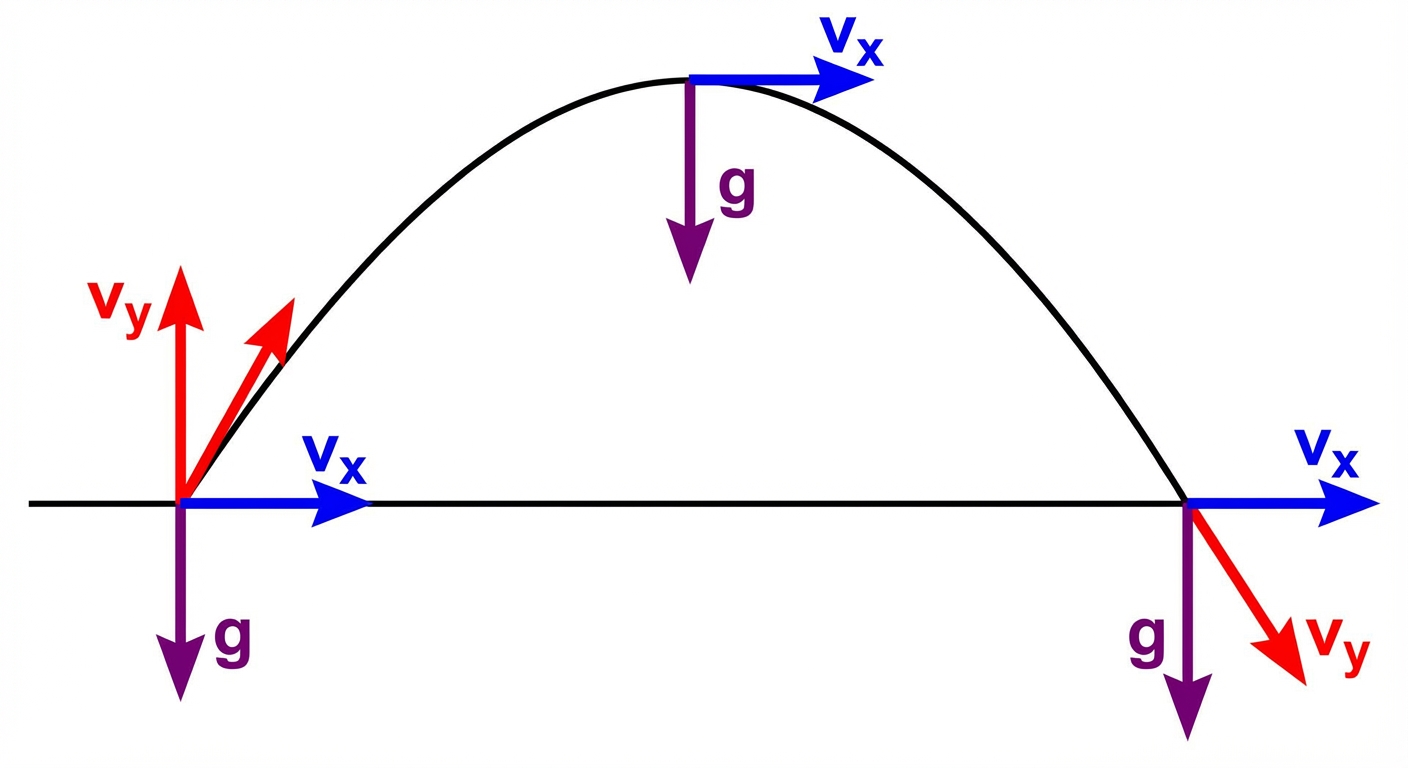
The horizontal motion ($x$) and vertical motion ($y$) are completely independent of each other. They are linked only by time ($t$).
Analysis of Components
1. Horizontal Motion (x-axis)
Assuming air resistance is negligible, there are no forces acting horizontally.
- Acceleration: $a_x = 0$
- Velocity: Constant ($vx = v{0x}$)
- Equation:
2. Vertical Motion (y-axis)
The object is in free fall.
- Acceleration: $a_y = -g$ (where $g \approx 9.8\, \text{m/s}^2$)
- Velocity: Changes linearly with time
- Equations:
Initial Velocity Decomposition
If a projectile is launched with an initial speed $v_0$ at an angle $\theta$ above the horizontal:
- $v{0x} = v0 \cos(\theta)$
- $v{0y} = v0 \sin(\theta)$
Note on the "Range Formula":
You may see the formula $R = \frac{v_0^2 \sin(2\theta)}{g}$ in textbooks. Avoid relying on this. It is only valid when the launch height equals the landing height (level ground). It is safer to derive the solution using the $x(t)$ and $y(t)$ kinematic equations.
Example Problem: The Cliff Launch
Scenario: A ball is thrown horizontally at $20\, \text{m/s}$ off a cliff $45\, \text{m}$ high.
Strategy:
- Define Coordinates: Let the base of the cliff be $(0,0)$. The launch point is $(0, 45)$.
- Identify Initial Conditions:
- $x0 = 0$, $y0 = 45\, \text{m}$
- $v{0x} = 20\, \text{m/s}$, $v{0y} = 0$ (thrown horizontally)
- $ax = 0$, $ay = -9.8\, \text{m/s}^2$
- Find Time of Flight (using Y):
- Find Range (using X):
Relative Motion
Motion is not absolute; it depends on the Frame of Reference of the observer. Relative motion problems involve relating the velocity of an object as measured by two different moving observers.
Vector Addition of Relative Velocities
The standard notation $v_{AB}$ reads as "the velocity of Object A relative to Frame B."
The Chain Rule for Subscripts:
To find the velocity of A relative to B, you can insert an intermediate frame C (often the ground):
Alternatively, since $\vec{v}{CB} = -\vec{v}{BC}$:
- Memory Aid: Notice how the inner subscripts "cancel" out in the addition formula: $A\mathbf{C} + \mathbf{C}B \rightarrow AB$.
Example: Crossing a River
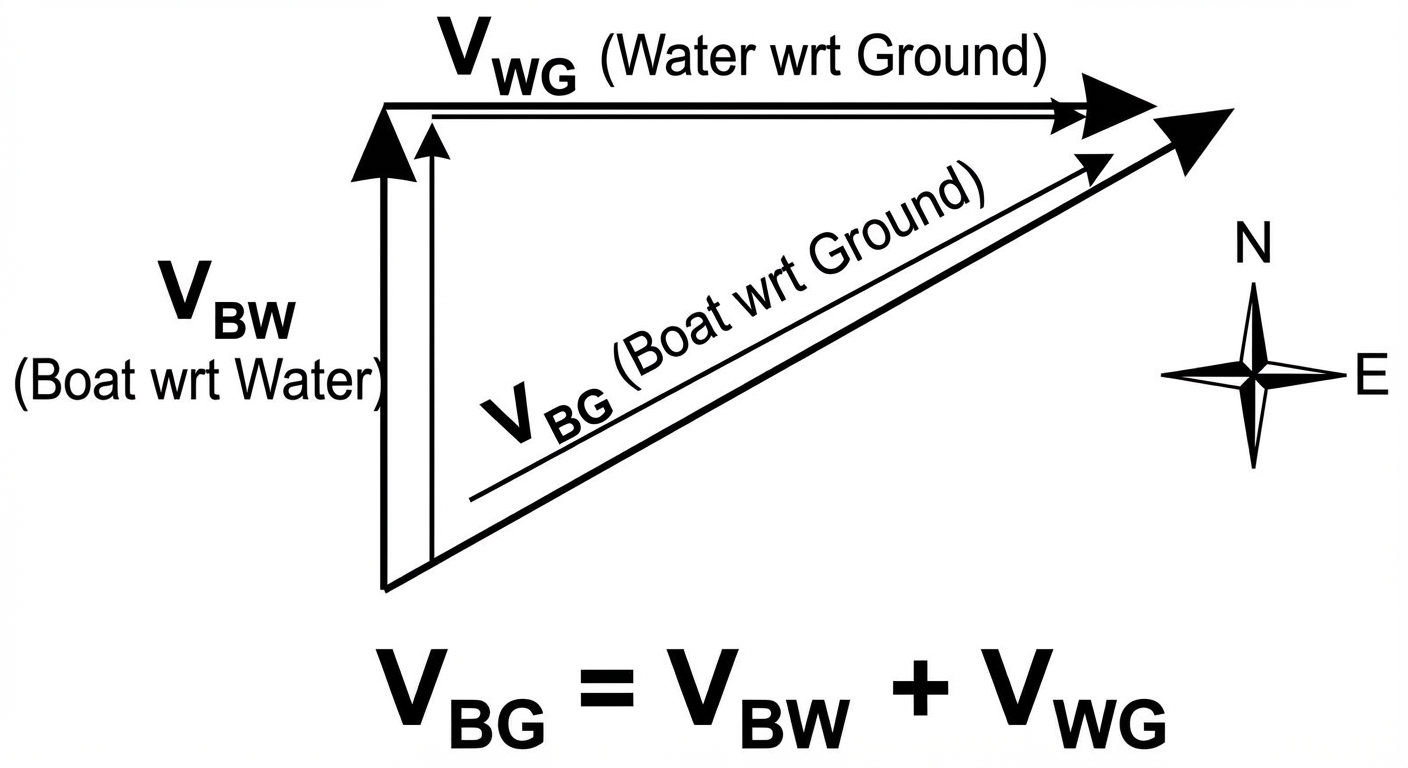
A boat heads due North across a river at $4\, \text{m/s}$ (relative to the water). The river flows East at $3\, \text{m/s}$ (relative to the ground).
- $\vec{v}_{BW}$ (Boat relative to Water) = $4\hat{j}$
- $\vec{v}_{WG}$ (Water relative to Ground) = $3\hat{i}$
- $\vec{v}{BG}$ (Boat relative to Ground) = $\vec{v}{BW} + \vec{v}_{WG}$
The magnitude of the boat's speed relative to the shore is $\sqrt{3^2 + 4^2} = 5\, \text{m/s}$.
Common Mistakes & Pitfalls
Mixing X and Y components:
- The Mistake: Using the vertical acceleration ($g$) in the horizontal equation, or using the total velocity $v$ instead of $v_y$ in the vertical equation.
- Correction: Create two distinct columns on your paper: one for X-data and one for Y-data. Never mix them.
Assuming $v_y = 0$ at the peak implies $v = 0$:
- The Mistake: Thinking the projectile stops completely at the highest point.
- Correction: At the peak, only the vertical velocity is zero ($vy=0$). The horizontal velocity $vx$ remains constant and non-zero throughout the flight.
Calculator Mode Errors:
- The Mistake: Calculating vector components with the calculator in Radians while inputs are in Degrees (or vice versa).
- Correction: Always check the mode settings before starting an exam section.
Sign Errors with Acceleration:
- The Mistake: Setting $a = +9.8$ while defining "up" as positive.
- Correction: Consistency is key. If "up" is positive, acceleration $g$ must be negative. If "down" is positive, initial upward velocity must be negative.