Unit 3 Guide: Dismantling Jim Crow and the Rise of Black Power
The Long Civil Rights Movement
While popular history often frames the Civil Rights Movement as strictly occurring between 1954 (Brown v. Board) and 1968 (MLK's assassination), the AP African American Studies framework emphasizes the Long Civil Rights Movement. This concept acknowledges that the struggle for freedom did not appear out of nowhere; it was built upon decades of resistance, legal battles, and grassroots organizing dating back to Reconstruction.
Core Concepts
- De Jure Segregation: Segregation enforced by law (Jim Crow laws in the South).
- De Facto Segregation: Segregation that happens "by fact" rather than by legal requirement (often seen in the North through housing covenants and "white flight").
- Double V Campaign: A WWII-era campaign championed by The Pittsburgh Courier demanding a double victory: victory over fascism abroad and victory over racism at home. This set the stage for post-war activism.
Key Supreme Court Catalyst
Brown v. Board of Education (1954) overturned the "separate but equal" doctrine established by Plessy v. Ferguson. Lawyer Thurgood Marshall (NAACP Legal Defense and Educational Fund) argued that segregation psychologically damaged Black children (citing the "Doll Test" studies).
Key Figures and Organizations
The movement was not a monologue delivered by a few charismatic men; it was a choral effort involving diverse organizations, youth, and women.
The "Big Four" Organizations
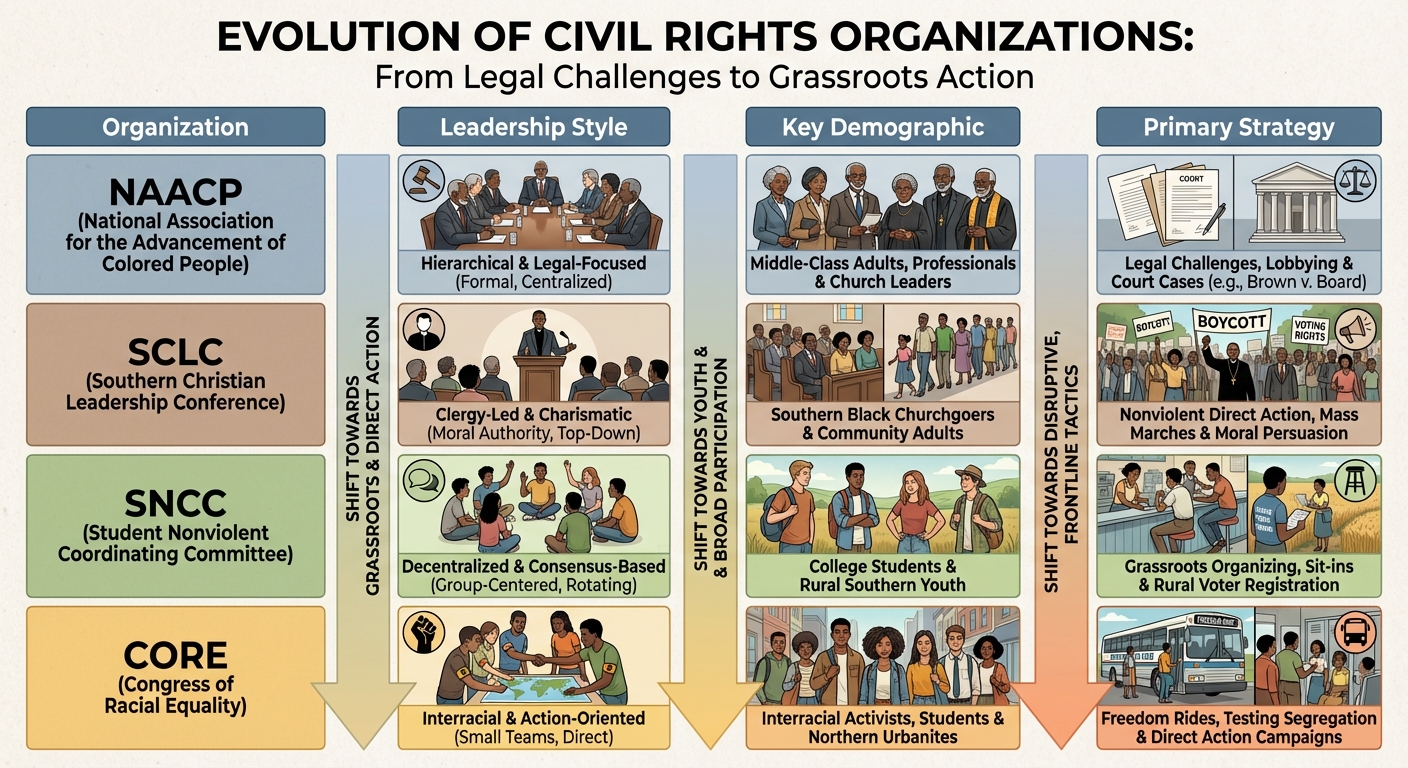
| Organization | Full Name | Key Demographics & Philosophy |
|---|---|---|
| NAACP | National Association for the Advancement of Colored People | Focused on legal challenges and legislation. (Key figure: Roy Wilkins, Thurgood Marshall). |
| SCLC | Southern Christian Leadership Conference | Ministers and older adults. Focused on nonviolent direct action and moral suasion. (Key figures: MLK Jr., Ralph Abernathy). |
| SNCC | Student Nonviolent Coordinating Committee | Young people/students. More democratic, decentralized, and eventually more radical. (Key figures: John Lewis, Stokely Carmichael, Diane Nash). |
| CORE | Congress of Racial Equality | Interracial group focused on nonviolent direct action in northern and border cities. (Famous for the Freedom Rides). |
The Role of Women and Grassroots Leadership
Often overlooked in traditional narratives, women were the backbone of logistical organizing.
- Ella Baker: The "mother" of the movement. She organized the founding meeting of SNCC and believed in group-centered leadership rather than leader-centered groups. She famously warned against relying too heavily on charismatic messiah figures.
- Fannie Lou Hamer: A sharecropper turned activist who challenged the legitimacy of the all-white Mississippi delegation at the 1964 Democratic National Convention. Her testimony vividly described the brutality she faced for trying to vote.
- Jo Ann Robinson: President of the Women's Political Council (WPC) in Montgomery; she actually initiated the bus boycott distribution flyers before the ministers took the lead.
Strategies of Resistance
Nonviolent Direct Action
Influenced by Mahatma Gandhi and Christian theology, this strategy sought to create such a crisis and "constructive tension" that a community refusing to negotiate is forced to confront the issue.
- Sit-ins: Began prominently with the Greensboro Four in 1960. Students sat at widespread segregated lunch counters, refusing to move until served or arrested. This catalyzed the formation of SNCC.
- Freedom Rides (1961): Organized by CORE, activists rode interstate buses into the Deep South to test the Supreme Court ruling Boynton v. Virginia (which outlawed segregation in interstate travel facilities). They faced firebombings and brutal beatings, forcing federal intervention.
- Project C (Birmingham, 1963): "C" stood for Confrontation. MLK and the SCLC used children in marches (The Children's Crusade) to provoke public outrage at police brutality (fire hoses and dogs). It led to MLK writing the "Letter from Birmingham Jail," a defense of nonviolent resistance against unjust laws.
Armed Self-Defense
While nonviolence was the public face of the movement, armed self-defense was a reality for many Southern Black families protecting their homes.
- Robert F. Williams: An NAACP chapter president in North Carolina who advocated for armed black self-defense in his book Negroes with Guns. He influenced the later Black Panther Party.
Legislative Achievements
The pressure from the streets translated into three landmark pieces of federal legislation.
1. Civil Rights Act of 1964
- Signed by: President Lyndon B. Johnson.
- Impact: Outlawed discrimination based on race, color, religion, sex, or national origin. It explicitly ended inequality in voting application requirements and racial segregation in schools, at the workplace, and by facilities that served the general public (known as "public accommodations").
2. Voting Rights Act of 1965
- Catalyst: The Selma to Montgomery Marches ("Bloody Sunday"), where John Lewis and others were beaten on the Edmund Pettus Bridge.
- Impact: It prohibited racial discrimination in voting. Most importantly, it outlawed literacy tests and provided for federal oversight of voter registration in areas with a history of discrimination.
3. Civil Rights Act of 1968 (Fair Housing Act)
- Context: Passed shortly after the assassination of Martin Luther King Jr.
- Impact: Prohibited discrimination concerning the sale, rental, and financing of housing based on race, religion, national origin, and sex.
Black Power and Black Nationalism
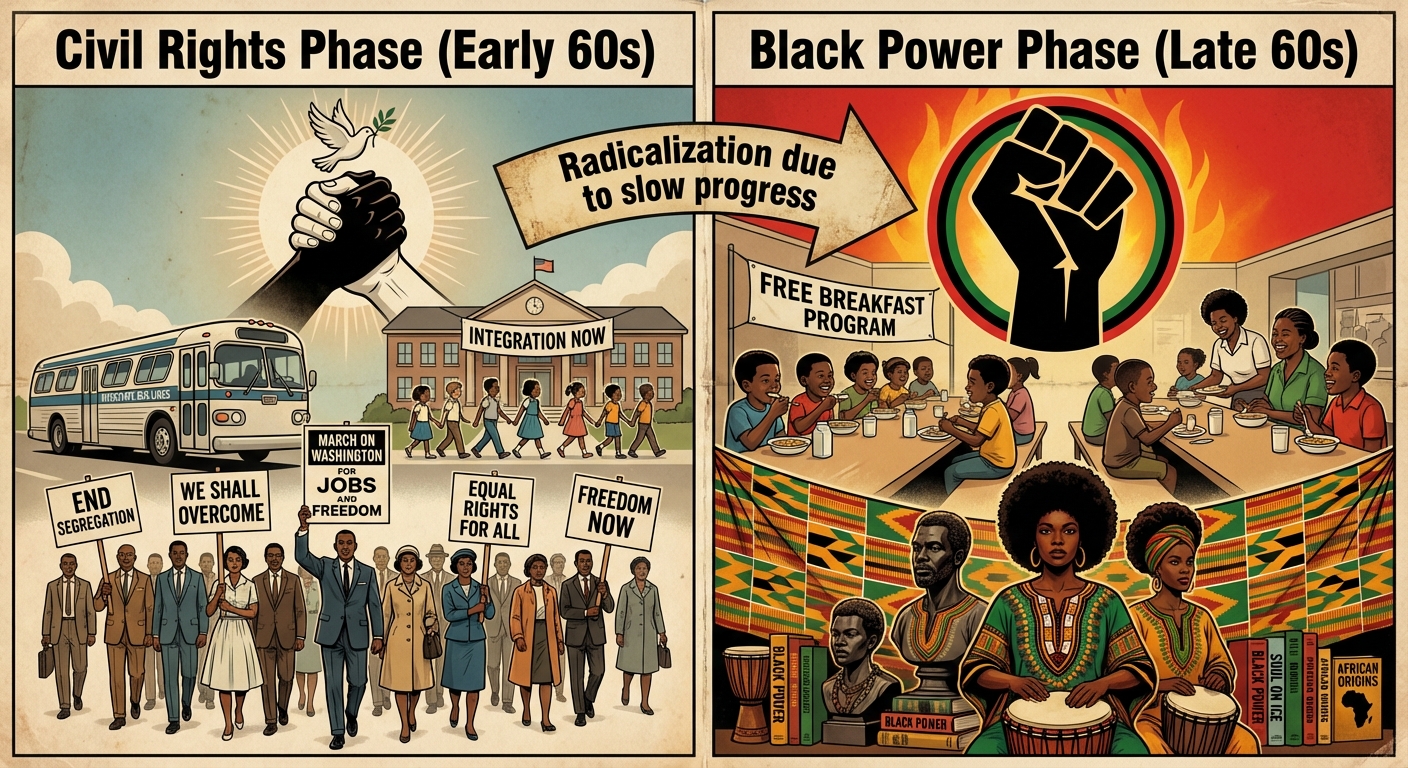
By the mid-1960s, younger activists grew frustrated with the slow pace of change, the persistence of economic inequality, and the continued violence against peaceful protesters. The movement began to pivot from a goal of integration to a goal of Black Power.
Defining the Shift
Black Power emphasized racial pride, economic self-sufficiency, and the creation of black political and cultural institutions. It rejected the need for white validation.
- Stokely Carmichael (Kwame Ture): Popularized the term "Black Power" during the March Against Fear in 1966. He moved SNCC away from interracial cooperation toward black self-determination.
- Malcolm X: Initially a spokesman for the Nation of Islam (NOI), he critiqued the mainstream civil rights movement's nonviolence as defenselessness. He advocated for Black Nationalism—the idea that Black people should control their own communities. His autobiography heavily influenced the Black Power generation.
The Black Panther Party for Self-Defense (1966)
Founded in Oakland, California, by Huey P. Newton and Bobby Seale.
- Philosophy: They combined Black Nationalism with Marxist-Leninist ideology.
- Activities:
- Copwatching: Legally armed patrols to monitor police behavior.
- Survival Programs: The most famous was the Free Breakfast for Children Program, which fed thousands of children.
- Ten-Point Program: Their manifesto demanding freedom, full employment, decent housing, education, and an end to police brutality.
Common Mistakes & Pitfalls
Conflating SCLC and SNCC:
- Mistake: Thinking all civil rights groups were the same.
- Correction: SCLC was clergy-led and moderate; SNCC was student-led and evolved to be radical. They frequently clashed over tactics.
Misunderstanding "Black Power":
- Mistake: Viewing Black Power simply as "anti-white" violence.
- Correction: It was primarily about agency—economic control of Black communities, pride in African heritage (the "Black is Beautiful" movement), and self-reliance.
The Rosa Parks Myth:
- Mistake: Believing Rosa Parks was just a tired old lady who sat down spontaneously.
- Correction: Parks was a trained activist and secretary of the NAACP. Her action was part of a planned challenge to segregation, and the boycott was logistically organized by the Women's Political Council.
Geography:
- Mistake: Thinking the movement only happened in the South.
- Correction: Issues of redlining, school segregation, and police brutality fueled massive movements in the North and West (e.g., Chicago, Los Angeles/Watts, Oakland) later in the 1960s.