Unit 2: Analyzing Judicial and Bureaucratic Authority
The Judiciary: Interpreting and Applying the Law
In comparative government, the judiciary is not just about courts and judges; it is about the relationship between the state, the law, and the citizen. We analyze judiciaries based on their independence, their authority to check the executive, and the source of their legal code.
Core Concept: Rule of Law vs. Rule by Law
This creates the fundamental distinction between democratic and authoritarian judicial systems.
Rule of Law: A system where the law applies equally to everyone, including high-ranking government officials. No one is above the law. In these systems, the judiciary is typically independent.
- Key Feature: Due process and protection of civil liberties.
- Example: Unless Parliament changes a statute, the Prime Minister of the United Kingdom is subject to the same legal standards as a regular citizen.
Rule by Law: A system where the state uses the law as a tool to control the populace and reinforce state power, but the state itself (or the political elite) is often exempt from or manipulates the law.
- Key Feature: High conviction rates for political dissidents and a lack of judicial independence.
- Example: In China, the Chinese Communist Party (CCP) uses the judicial system to swiftly punish dissent, yet Party leaders are often disciplined internally rather than through public courts.
Judicial Review and Independence
Judicial Review is the power of a court to overturn a law or executive action if it conflicts with the constitution. Not all countries have this.
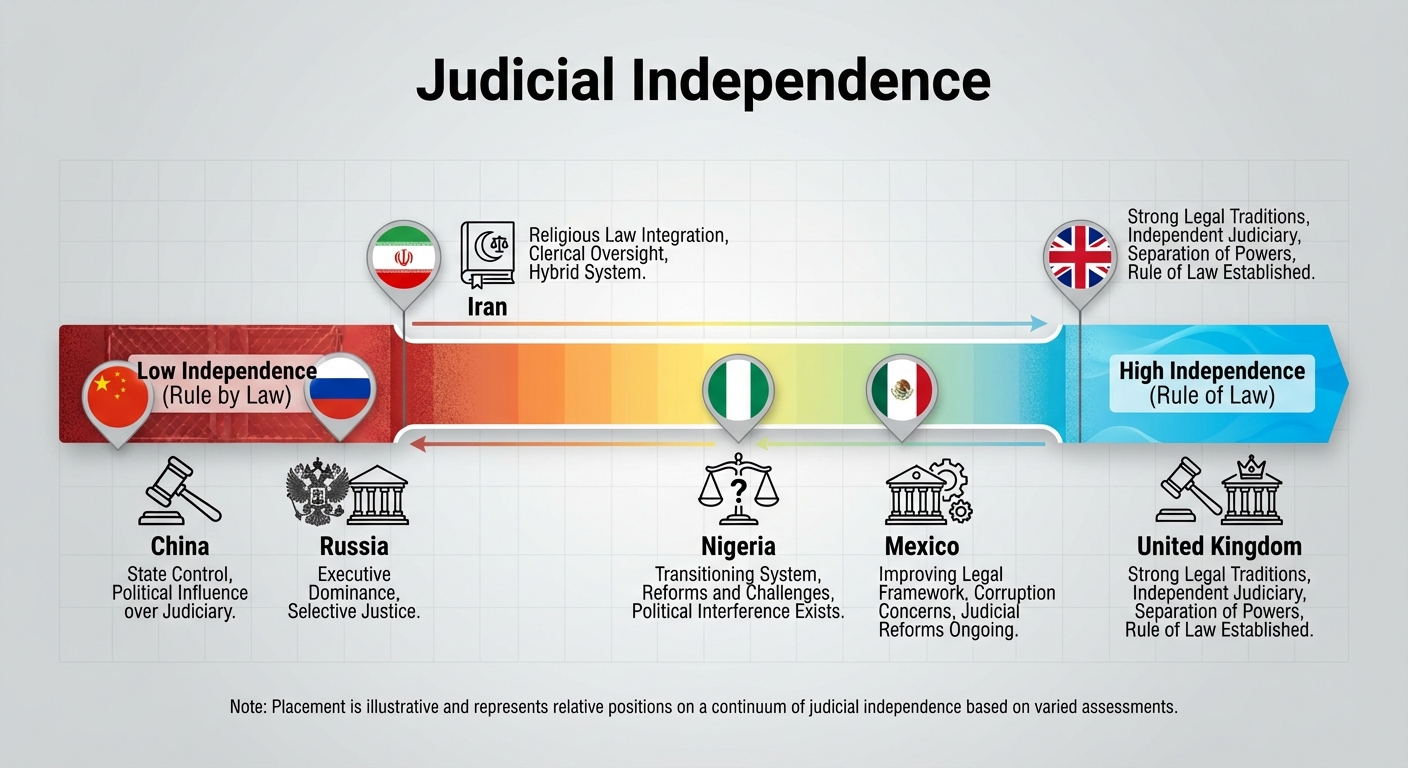
Country-Specific Applications
| Country | Legal System | Judicial Review Status | Notes on Independence |
|---|---|---|---|
| United Kingdom | Common Law | Weak/None | Parliamentary Sovereignty means courts cannot overturn primary legislation, only review executive compliance. |
| Russia | Civil Law | Theoretical | The Constitutional Court exists but rarely challenges the President (Putin). Courts are often used to target political opponents. |
| China | Civil/Socialist Law | None | The Judiciary is subservient to the CCP. "The Party controls the law." |
| Mexico | Civil Law | Growing | Historically weak under PRI rule; reforms have strengthened the Supreme Court's independence and power of review. Usage of the Writ of Amparo (protection of rights). |
| Nigeria | Common + Sharia | Yes (Weak) | Theoretical power exists, but corruption and executive pressure often undermine independence. The North uses Sharia courts for non-criminal and some criminal matters. |
| Iran | Sharia Law | Theocratic | The Guardian Council (not a traditional court) reviews laws for compatibility with Islam. The Chief Justice is appointed by the Supreme Leader. |
Religious vs. Secular Law
Most of the AP 6 countries rely on secular law (Common or Civil). However, Iran and Nigeria (specifically the northern states) incorporate religious law.
- Sharia Law in Iran: The foundation of the legal system. It is interpreted by Islamic jurists. High-ranking judges must be clerics.
- Sharia in Nigeria: Used in 12 northern states parallel to the secular federal system. This creates tension regarding the supremacy of the secular Constitution.
Bureaucratic Structures: The Engine of State
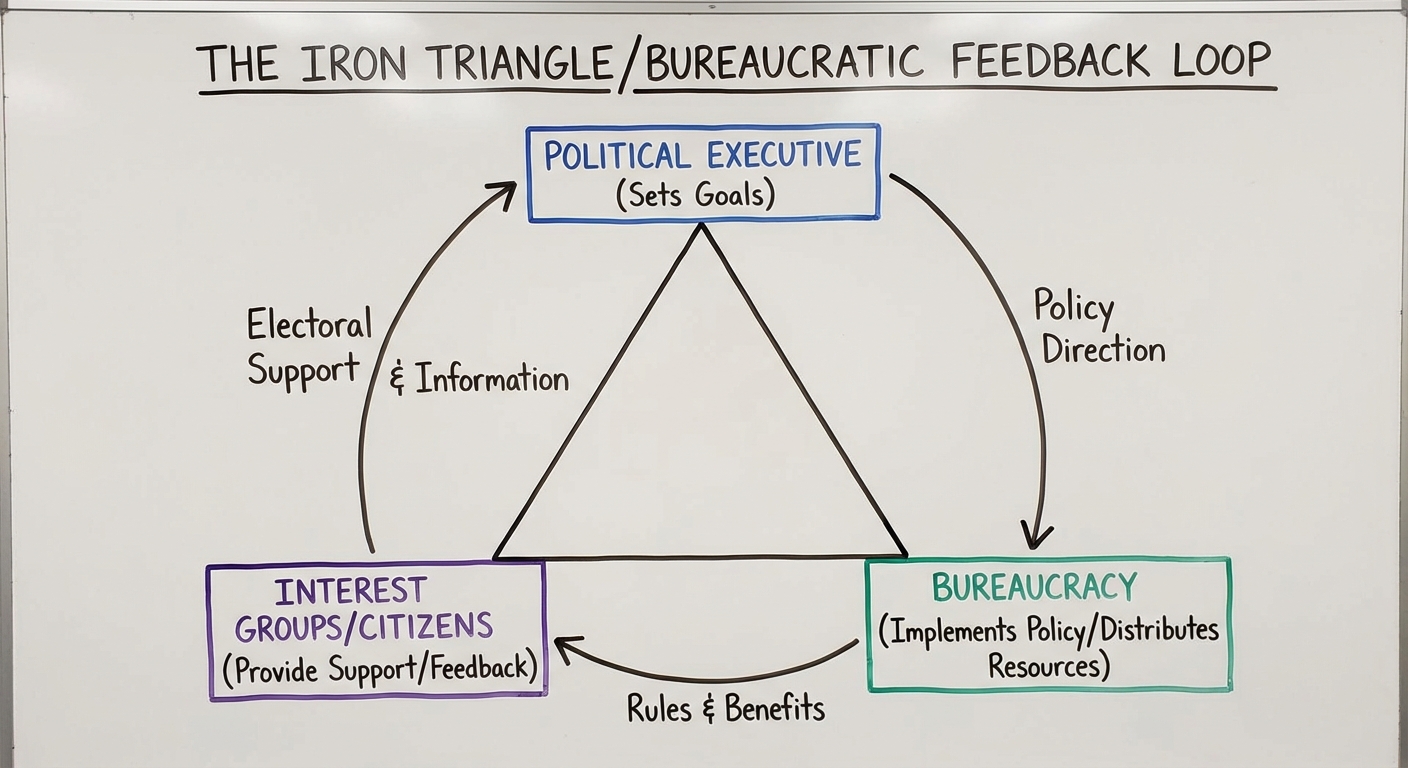
Bureaucracies consist of unelected officials responsible for implementing, executing, and enforcing laws and policies. They are the "machinery" of government that functions regardless of who wins an election.
The Role of the Bureaucracy
- Implementation: Translating abstract legislation into specific rules and actions.
- Regulation: creating standards for industries and society.
- Stability: Providing continuity when political leadership changes.
Recruitment: Meritocracy vs. Patronage
The way bureaucrats get their jobs determines the efficiency and corruption level of the state.
Meritocracy (Civil Service)
Ideally, bureaucrats are Technology Experts (Technocrats) hired based on education, exam results, and professional qualifications.
- UK: Highly professional, neutral civil service. Bureaucrats serve whichever party is in power without partisan bias.
- China: While authoritarian, China utilizes a fierce meritocracy for lower and mid-level cadre promotion (economic growth targets), blended with political loyalty.
Patronage (Clientelism)
Jobs are awarded based on political loyalty, clan ties, or bribes rather than skill.
- Prebendalism (Nigeria): A specific form of clientelism where officials feel entitled to use state resources (and bureaucratic positions) to benefit their ethnic or religious support group.
- Nomenklatura (Russia & China): A list of sensitive or important positions that can only be filled with approval from the ruling party (CCP in China, United Russia connection in Russia). This ensures loyalty over pure merit at the highest levels.
Military and Security Forces
In comparative politics, we study the military not just as defenders of borders, but as political actors. The key metric is Civilian Control of the Military—whether the armed forces answer to elected officials or act independently.
Democratic Control
In consolidated democracies, the military is subordinate to the government.
- UK: Complete civilian control.
- Mexico: Traditionally under civilian control, though the military's role in domestic policing (fighting cartels) has recently expanded, raising human rights concerns.
The Military as a Political Actor
Nigeria: The Legacy of Coups
Nigeria experienced repeated Coups d'état (military takeovers) between 1966 and 1999. Since the Fourth Republic began in 1999, the military has returned to the barracks, but the threat is part of the historical memory. Democratization requires keeping the military professional and out of politics.
China: Party Control
The People's Liberation Army (PLA) is the armed wing of the Communist Party, not the country (technically). The Central Military Commission (CMC), chaired by the General Secretary (Xi Jinping), ensures the "Party commands the gun."
Iran: The Dual Military
Iran maintains two distinct military forces to ensure regime survival:
- The Artesh (Regular Army): Defends the borders and national security.
- Islamic Revolutionary Guard Corps (IRGC): Defends the Revolution itself. The IRGC has massive political and economic power, controlling broad swaths of the Iranian economy and intelligence sectors.
Common Mistakes & Pitfalls
- Confusing Rule of Law vs. Rule by Law: Students often think "Rule by Law" means the country is lawless. It is not. It means the law is strictly enforced against citizens, but the government can bypass it (common in China and Russia).
- Assuming all Supreme Courts have Judicial Review: In the UK, the Supreme Court cannot strike down laws because Parliament is sovereign. In China, courts interpret laws but cannot declare Party actions unconstitutional.
- Head of State vs. Head of Government: While this is an executive concept, students often confuse whom the military reports to. In Russia, the President (Head of State) controls the "power ministries" (FBS, Defense), not the Prime Minister.
- Ignoring the IRGC's Economy: In Iran, the IRGC is not just guys with guns; they own telecommunications, construction, and oil companies. This makes them a bureaucratic and economic powerhouse, not just a military one.