Period 8: Global Conflict and Social Transformation (1945–1980)
Period 8: The Cold War and the Postwar Boom (1945–1980)
8.1 The Cold War Begins (1945–1953)
Origins of the Conflict
Definition: The Cold War was a state of geopolitical tension, proxy warfare, and ideological struggle between the democratic/capitalist United States and the authoritarian/communist Soviet Union (USSR).
- Yalta & Potsdam Conferences: Even before WWII ended, tensions rose over the fate of Eastern Europe. Stalin promised free elections in Poland (Yalta) but installed puppet communist regimes, creating a "sphere of influence."
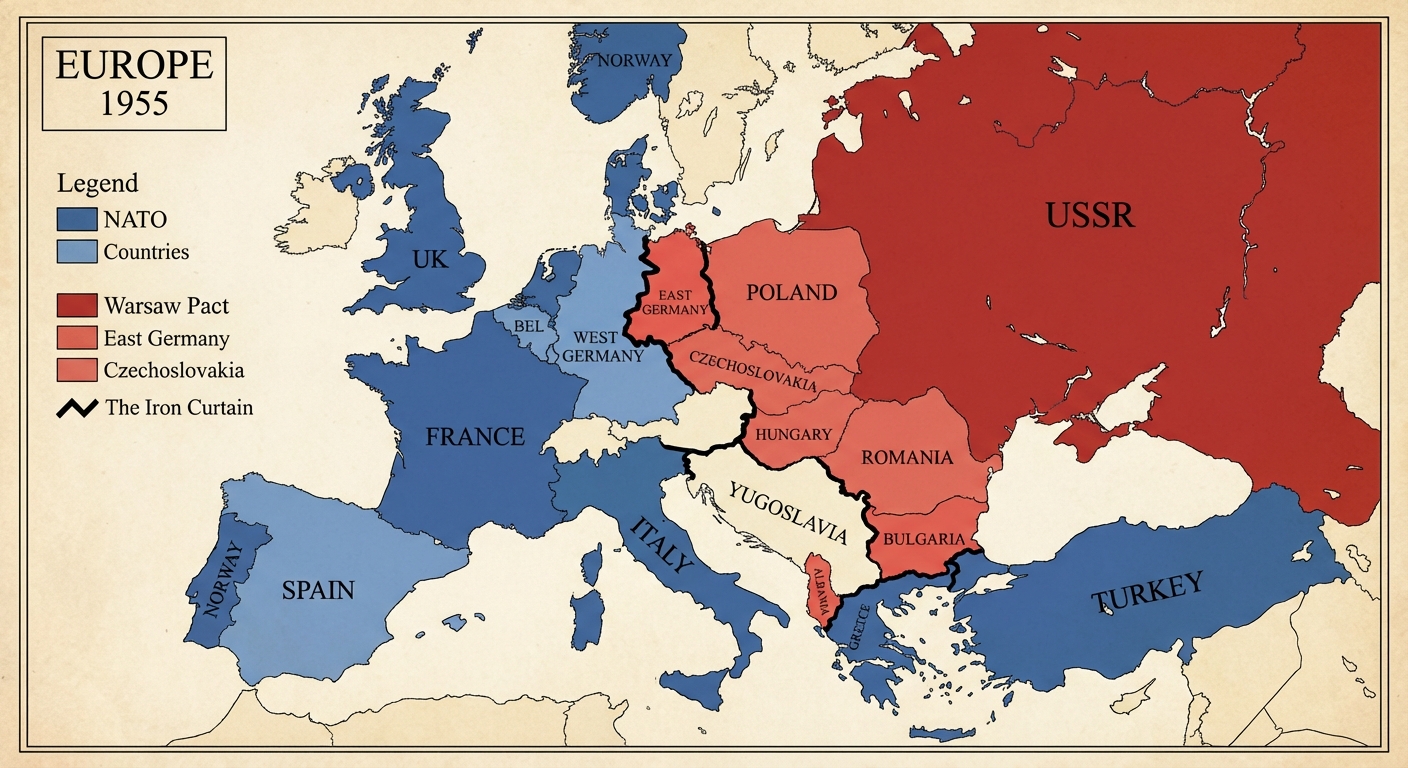
- The Iron Curtain: In 1946, Winston Churchill declared an "iron curtain" had descended across Europe, dividing the democratic West from the communist East.
Containment Policy
Based on the Long Telegram by diplomat George Kennan, the U.S. adopted the policy of Containment: the U.S. would not fight a hot war to roll back communism where it existed, but would vigorously prevent it from spreading.
- The Truman Doctrine (1947): President Truman pledged military and economic aid to Greece and Turkey to prevent communist takeovers. It established the precedent that the U.S. would support "free peoples who are resisting attempted subjugation."
- The Marshall Plan (1948): U.S. successfully channeled $13 billion to Western Europe to rebuild economies.
- Goal: Economic stability prevents political extremism (communism).
- Result: Western Europe boomed; the USSR rejected the aid and tightened control over Eastern Europe.
- NATO (North Atlantic Treaty Organization, 1949): A collective security alliance (attack on one is an attack on all) between the U.S., Canada, and Western Europe. This broke the U.S. tradition of avoiding permanent peacetime alliances.
- Soviet Response: Formed the Warsaw Pact.
Crisis in Germany
- Berlin Blockade (1948): Stalin cut off land access to West Berlin (located deep inside East Germany) to starve the Allies out.
- Berlin Airlift: Truman responded not with force, but with a massive airlift of supplies for nearly a year. Stalin eventually lifted the blockade.
The Cold War turns "Hot" in Asia
- Fall of China (1949): Mao Zedong's Communists defeated the U.S.-backed Nationalists (Chiang Kai-shek), who fled to Taiwan. Republicans blamed Truman for the "loss of China."
- NSC-68: A secret National Security Council report recommending a massive increase in military spending (quadrupling the defense budget) to deter Soviet aggression.
- The Korean War (1950–1953):
- Proxy War: Communist North Korea invaded South Korea. Truman secured a UN mandate to intervene (Soviet Union was boycotting the UN and couldn't veto).
- MacArthur vs. Truman: General Douglas MacArthur pushed North Koreans back to the Chinese border. China entered the war, pushing U.S. troops back. MacArthur publicly demanded to nuke China; Truman fired him for insubordination (reasserting civilian control of the military).
- Outcome: Stalemate. Armistice signed in 1953 (under Eisenhower) established the demilitarized zone (DMZ) at the 38th Parallel. No peace treaty was signed.
8.2 The Red Scare (McCarthyism)
The Second Red Scare
Fear of communist infiltration ("subversion") permeated American society, fueled by the fall of China, the Soviet nuclear bomb, and spy exposure.
- HUAC (House Un-American Activities Committee): Congressional committee that investigated suspected communists, particularly in Hollywood (The Hollywood Ten) and the government.
- Espionage Cases:
- Alger Hiss: A high-ranking State Department official convicted of perjury regarding passing secrets to the Soviets. (Prosecuted by Richard Nixon).
- Rosenbergs: Julius and Ethel Rosenberg were executed for passing atomic bomb secrets to the USSR.
Rise and Fall of Joseph McCarthy
- The Tactics: Senator Joseph McCarthy claimed to have lists of improper "communists" in the State Department. He used bullying, hearsay, and the "Big Lie" tactic.
- The Downfall (1954): McCarthy attacked the U.S. Army.
- The Army-McCarthy Hearings were televised. Millions saw McCarthy's bullying firsthand.
- Journalist Edward R. Murrow exposed him on TV. McCarthy was censured by the Senate and died disgraced.
8.3 The Post-War Economy and Society (1950s)
The Era of Conformity and Consumption
While the Cold War raged, white middle-class America experienced unprecedented prosperity.
- The G.I. Bill (Servicemen's Readjustment Act of 1944): Provided veterans with money for college, low-interest loans for homes, and business start-up capital.
- Impact: Created a massive, educated middle class and fueled the housing boom.
- Baby Boom: A massive explosion in birth rates from 1945–1960.
- Suburbanization:
- Levittowns: Mass-produced, affordable housing developments.
- "White Flight": Middle-class whites moved to suburbs, leaving minorities in decaying inner cities due to discriminatory lending pacts.
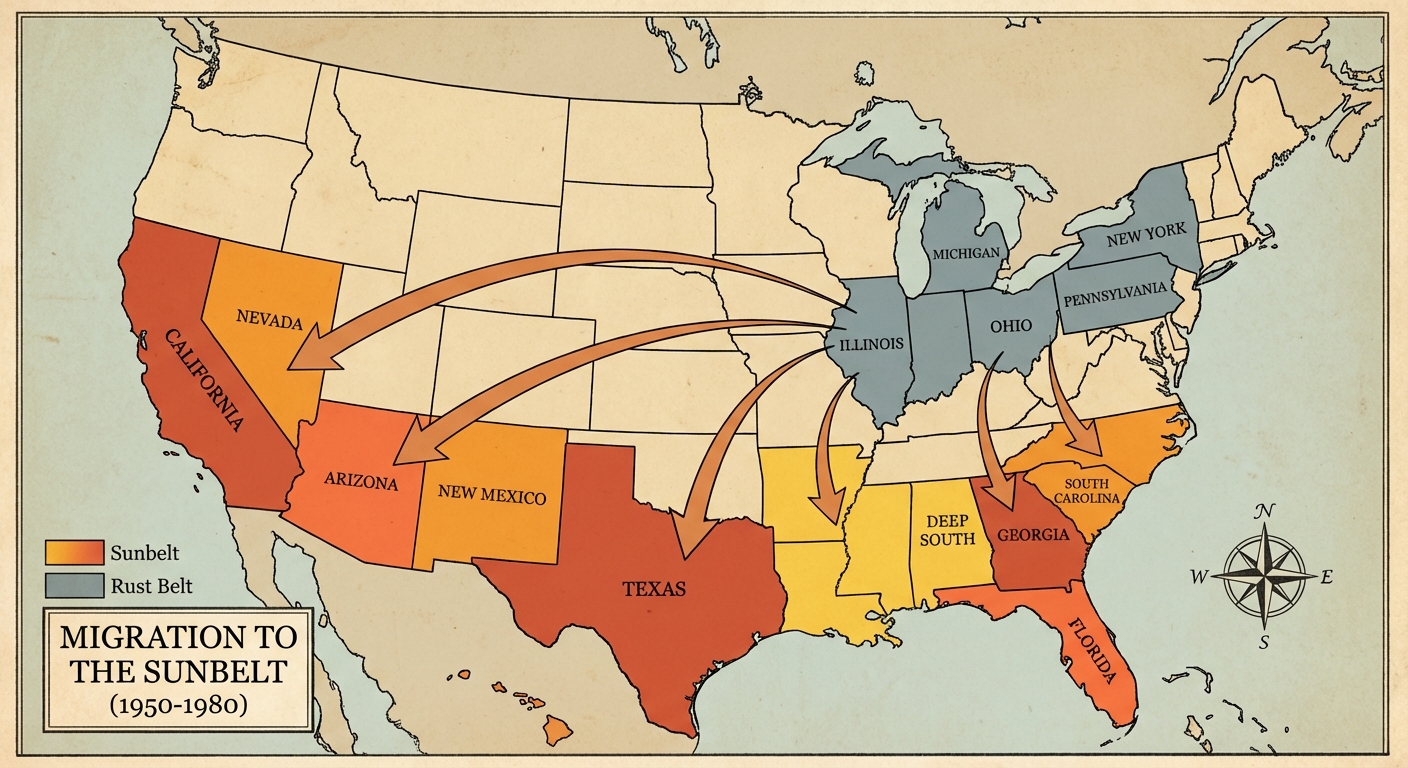
- The Sunbelt: A region stretching from Florida to California that saw a population explosion due to:
- Defense industry jobs (aerospace/electronics).
- Air conditioning.
- Lower taxes and non-union (Right-to-Work) states.
Infrastructure
- Interstate Highway Act (1956): Eisenhower's largest public works project. Defined as a "defense" measure (moving military equipment), it spurred trucking, suburbs, and travel culture.
Culture and Rebellion
- Television: Promoted a common culture and idealized the nuclear family (Leave it to Beaver).
- Rock 'n' Roll: Elvis Presley and Chuck Berry bridged the racial cultural divide, concerning older generations.
- The Beat Generation: Writers like Jack Kerouac (On the Road) and Allen Ginsberg (Howl) criticized the conformity and materialism of the 1950s, serving as precursors to the 1960s hippies.
8.4 The Civil Rights Movement (1950s–1960s)
Phase 1: Legal Victories (The Courts)
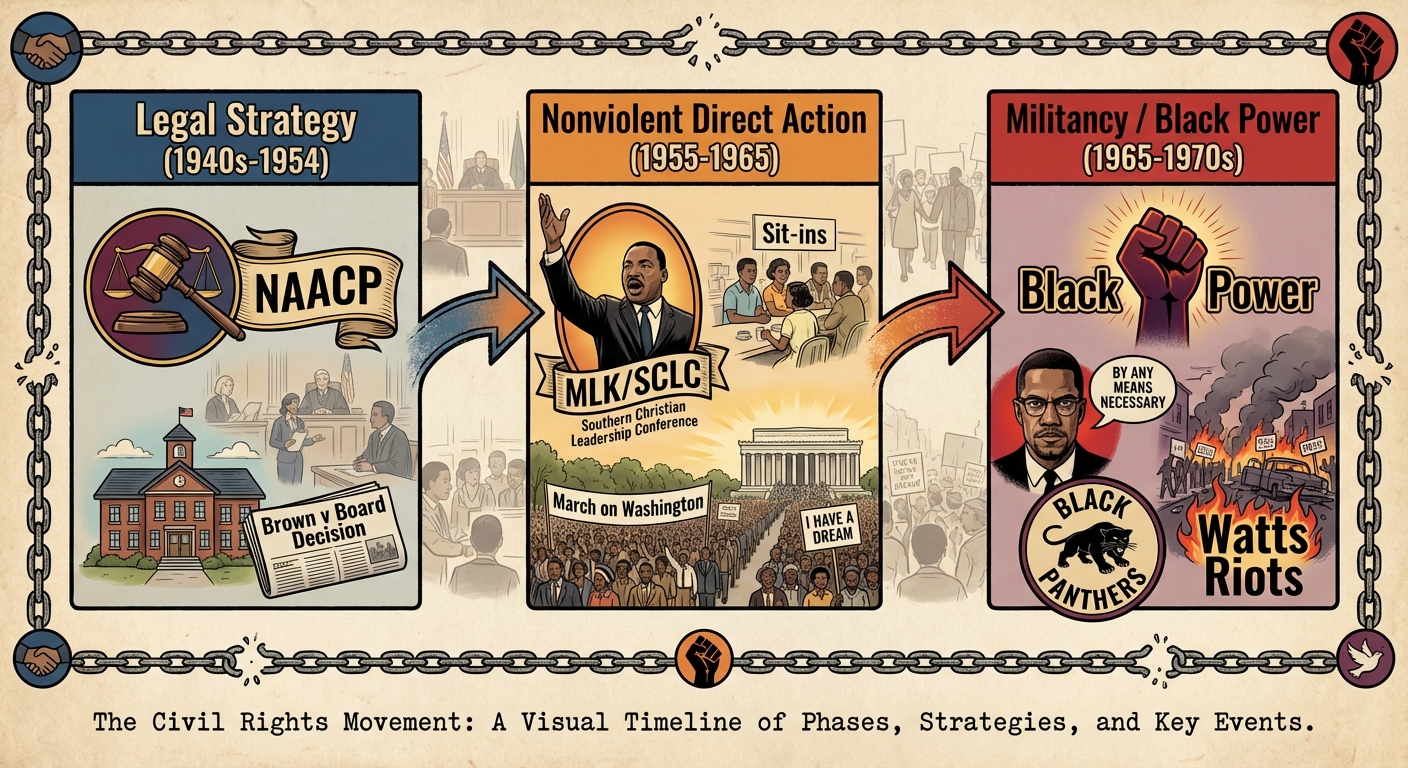
Led by the NAACP and lawyer Thurgood Marshall, the movement sought to overturn Plessy v. Ferguson ("Separate but Equal").
- Brown v. Board of Education (1954): The Supreme Court ruled that separate schools are "inherently unequal."
- Reaction: The Southern Manifesto (Southern Congressmen denouncing the decision) and "Massive Resistance." Eisenhower had to send the 101st Airborne to Little Rock, Arkansas (1957) to enforce the integration of the "Little Rock Nine."
Phase 2: Nonviolent Direct Action (Grassroots)
- Montgomery Bus Boycott (1955): Sparked by Rosa Parks, led by Martin Luther King Jr. (MLK). Proved economic boycotts worked.
- Organizations:
- SCLC (Southern Christian Leadership Conference): Ministers and MLK. Focused on nonviolent resistance.
- SNCC (Student Nonviolent Coordinating Committee): College students. Organized sit-ins (Greensboro, NC) and Freedom Rides (to desegregate interstate buses).
- Birmingham Campaign (1963): Police Chief "Bull" Connor used fire hoses and dogs on children. TV footage horrified the nation and JFK, prompting federal action.
- March on Washington (1963): "I Have a Dream" speech. aimed to pressure Congress to pass Civil Rights legislation.
Phase 3: Legislative Triumphs (Under LBJ)
- Civil Rights Act of 1964: Banned discrimination in public facilities and employment (Title VII).
- Voting Rights Act of 1965: Outlawed literacy tests and authorized federal registrars in the South. (Response to the violence at Selma).
- 24th Amendment: Banned poll taxes.
Phase 4: Black Power & Militancy (Late 60s)
Frustration with slow progress and police brutality led to a split in the movement.
- Malcolm X: Advocated black nationalism and self-defense ("by any means necessary").
- Black Panthers: Founded by Bobby Seale and Huey Newton. Focused on monitoring police and community service (free breakfast programs) but carried weapons.
- Race Riots: The "Long Hot Summers" (Watts 1965, Detroit 1967) showed that legislation didn't fix economic inequality.
8.5 The Era of Liberalism: JFK & LBJ
John F. Kennedy (The New Frontier)
- Election of 1960: First televised debates helped JFK beat Nixon.
- Domestic: Modest success due to a conservative Congress. Invested in NASA (Space Race).
- Foreign Policy:
- Bay of Pigs (1961): Failed CIA invasion of Cuba to overthrow Castro. Pushed Cuba closer to USSR.
- Berlin Wall (1961): Soviets built the wall to stop East Germans from fleeing.
- Cuban Missile Crisis (1962): Closest the world came to nuclear war. JFK ordered a naval quarantine. Soviets eventually withdrew missiles in exchange for U.S. promising not to invade Cuba and removing missiles from Turkey.
Lyndon B. Johnson (The Great Society)
Following JFK's assassination (1963), LBJ used his mastery of Congress to pass the most ambitious domestic agenda since the New Deal.
The Great Society Goals: End poverty and racial injustice.
- War on Poverty: Created the Office of Economic Opportunity (Head Start, Job Corps).
- Health: Medicare (health insurance for elderly) and Medicaid (for the poor).
- Immigration Act of 1965: Abolished the discriminatory 1920s quota system, allowing a new wave of immigrants from Asia and Latin America.
The Warren Court (Judicial Activism)
Chief Justice Earl Warren led a liberal Supreme Court that expanded rights.
- Gideon v. Wainwright: Right to a lawyer (even if you're poor).
- Miranda v. Arizona: Rights of the accused (Miranda rights).
- Griswold v. Connecticut: Recognized a "right to privacy" (basis for Roe v. Wade).
8.6 The Vietnam War (1955–1975)
Escalation
- Domino Theory: If South Vietnam falls to communism, the rest of SE Asia will follow.
- Gulf of Tonkin Resolution (1964): Following a reported attack on U.S. ships, Congress gave LBJ a "blank check" to use military force. This marked the shift from "advisors" to full combat troops.
- Strategies: Search and Destroy missions, Napalm, Agent Orange, Operation Rolling Thunder (bombing).
Turning Point: 1968
- Tet Offensive: A massive coordinated attack by the Vietcong on South Vietnamese cities. Militarily a failure for the North, but a psychological victory: it proved the war was nowhere near over, creating a "Credibility Gap" between government reports and reality.
- My Lai Massacre: U.S. troops killed hundreds of unarmed civilians, fueling anti-war sentiment.
The Anti-War Movement
Fueled by the Draft, television coverage ("The Living Room War"), and student activism (SDS - Students for a Democratic Society).
- Kent State (1970): National Guard shot 4 students protesting Nixon's invasion of Cambodia.
Ending the War
- Vietnamization (Nixon): Gradually withdrawing U.S. troops while training South Vietnamese to fight.
- War Powers Act (1973): Passed over Nixon's veto. Limited the President's ability to wage war without Congressional approval (reversing the Gulf of Tonkin Resolution).
8.7 Rights Movements Expand (Identity Politics)
The Civil Rights movement inspired other marginalized groups.
- Women's Rights:
- Betty Friedan: Wrote The Feminine Mystique (1963), challenging the cult of domesticity.
- NOW (National Organization for Women): Fought for the slightly failed Equal Rights Amendment (ERA).
- Roe v. Wade (1973): Legalized abortion based on the right to privacy.
- Latino/Chicano Movement:
- Cesar Chavez and the United Farm Workers (UFW) used boycotts (grapes) to gain rights for migrant workers.
- American Indian Movement (AIM): Occupied Alcatraz and Wounded Knee to demand sovereignty.
- Gay Liberation: Sparked by the Stonewall Inn Riots (1969) in NYC.
- Environmentalism: Sparked by Rachel Carson’s Silent Spring. Led to the EPA and Clean Air/Water Acts (under Nixon).
8.8 The Turmoil of 1968
1968 was the "year the world caught fire."
- Tet Offensive (Jan).
- MLK Assassinated (April) $\rightarrow$ Riots in 100+ cities.
- Robert Kennedy Assassinated (June) $\rightarrow$ Democratic party left without a unifying candidate.
- DNC Riots in Chicago: Police beat protestors on live TV outside the Democratic convention.
- Election of 1968: Richard Nixon (Republican) won by appealing to the "Silent Majority" (those tired of chaos, protests, and counterculture).
8.9 The Nixon Era and Watergate
Foreign Policy: Détente
Nixon and Henry Kissinger pursued Détente (easing of tensions).
- Opening of China (1972): Nixon visited China to leverage them against the USSR.
- SALT I: Strategic Arms Limitation Treaty with the USSR to cap nuclear weapons.
Watergate Scandal
- The Break-in: Operatives linked to Nixon's CREEP (Committee to Re-Elect the President) broke into Democratic HQ at the Watergate complex.
- The Cover-up: Nixon blocked the FBI investigation.
- The Tapes: Oval Office recordings revealed Nixon approved the cover-up.
- Saturday Night Massacre: Nixon fired the special prosecutor.
- Outcome: Nixon resigned in 1974 to avoid impeachment. Left Americans with deep distrust of government.
8.10 The 1970s: Malaise and Transition
Stagflation
A new economic phenomenon baffling economists: Stagnant Economy (High Unemployment) + High Inflation.
- Causes:
- Spending on Vietnam + Great Society (without raising taxes).
- Rise of German/Japanese manufacturing competition.
- Oil Shock (OPEC): Arab nations embargoed oil to the U.S. in 1973 (due to U.S. support of Israel), causing gas prices to quadruple.
Jimmy Carter (1977–1981)
A "Washington Outsider" elected to restore morality after Watergate.
- Success: Camp David Accords (Peace treaty between Egypt and Israel).
- Failures:
- Iran Hostage Crisis: Revolutionaries in Iran stormed the U.S. embassy and held 52 Americans hostage for 444 days.
- "Malaise" Speech: Carter suggested the nation's problems were due to a "crisis of confidence," which was perceived as blaming the American people.
Reformulating Conservatism
By 1980, the New Right emerged, coalition building among:
- Fiscal Conservatives: Lower taxes (Proposition 13).
- Religious Right: Evangelical Christians (Moral Majority) mobilized against abortion (Roe) and the ERA.
- Cold War Hawks: Demanded stronger military stance.
- Result: This coalition paved the way for Ronald Reagan's victory in 1980.
Common Mistakes & Pitfalls
- Confusing Medicare vs. Medicaid:
- Mnemonic: Medicare is for the "gray hair" (elderly). Medicaid is for those who need "aid" (low income).
- The "Solid South" Switch: Students often forget when the South switched from Democrat to Republican. It began in 1964 (Goldwater) and 1968 (Nixon's Southern Strategy) largely due to the Civil Rights Acts passed by Democrat LBJ.
- Joseph McCarthy vs. Truman: Students often think the government fought McCarthy. Actually, the government (HUAC) was also hunting communists. McCarthy was just the most visible/extreme figure.
- Brown v. Board Immediacy: Mistake: "Brown v. Board ended segregation immediately." Reality: It took over a decade and acts like the Civil Rights Act of 1964 to truly enforce it due to massive Southern resistance.
- Détente vs. Containment: Détente is not the end of Containment; it is a shift in strategy about how to contain (negotiation vs. confrontation).