Unit 8: Structural Complexity, Ambiguity, and Valuation in Poetry
Introduction to Unit 8
Unit 8 of AP English Literature and Composition, often titled "Poetry III," serves as the culmination of poetic analysis. While previous units focused on individual elements like imagery or character, this unit requires you to synthesize those elements to understand how structure, contrast, and ambiguity contribute to a poem's overall complexity and meaning.
The objective is not just to identify a technique, but to argue how that technique constructs the poem's interpretation.
Structure and Syntax
Beyond basic rhyme schemes, Unit 8 examines how the arrangement of words, lines, and sentences (syntax) impacts the poem's pacing and emphasis.
Punctuation as Pacing
Punctuation in poetry is never accidental. It dictates the breath and rhythm of the reading experience.
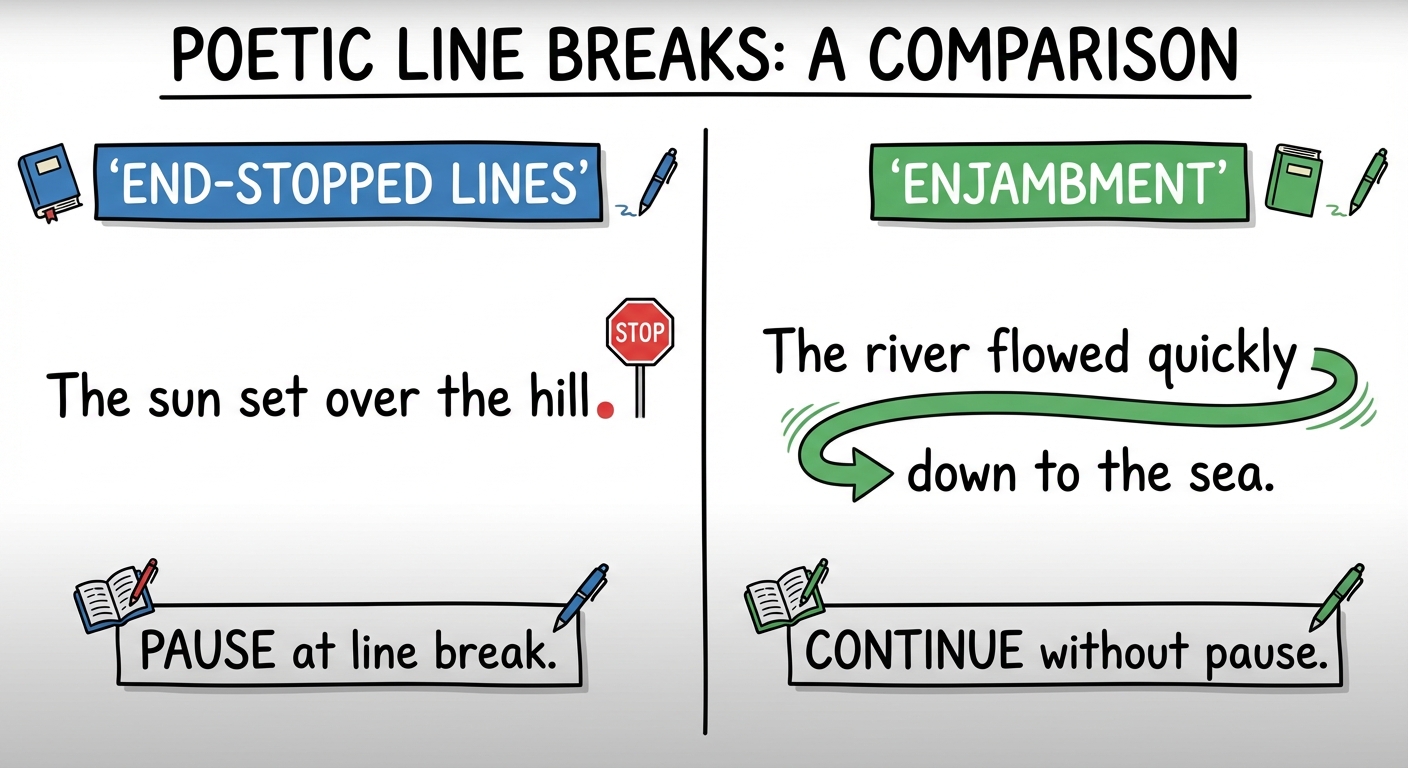
- End-Stopped Lines: A line ending in a full pause (period, colon, semicolon). This creates a sense of stability, finality, or logical progression.
- Enjambment: The continuation of a sentence without a pause beyond the end of a line, couplet, or stanza. It accelerates the pace and can create tension or double meanings (where the end of the line suggests one idea, but the next line completes it differently).
- Caesura: A strong pause within a line, often marked by punctuation (dashes, periods). It fractures the rhythm to create dramatic effect or emphasize the phrase immediately preceding the pause.
Syntactic Patterns
Syntax refers to the grammatical order of words.
- Inversion (Anastrophe): Reversing normal word order (e.g., "Subject-Verb-Object" becomes "Object-Subject-Verb"). This often preserves rhyme but also places emphasis on the displaced word.
- Chiasmus: A rhetorical device where two parallel phrases are reversed (A-B becomes B-A). Example: "Pleasure's a sin, and sometimes sin's a pleasure" (Lord Byron).
Structural Forms and Meaning
Understanding how a poem is built helps decode its intent. Common patterns include:
- Chronological: Follows time linearly.
- Comparison-Contrast: Alternates between two opposing ideas.
- Cyclical: The poem ends where it began, suggesting futility or eternal recurrence.
Contrast and Juxtaposition
Poets often utilize contrast to highlight differences, create tension, or provoke a reaction from the reader.
Juxtaposition
Juxtaposition is the placement of two or more things (images, ideas, characters) close together for the purpose of developing a comparison or contrast.
- Visual Juxtaposition: Placing images of light next to darkness (e.g., Romeo and Juliet: "She hangs upon the cheek of night / Like a rich jewel in an Ethiope's ear").
- Thematic Juxtaposition: Placing the sacred next to the profane to comment on society.
Antithesis
A specific form of juxtaposition involving a striking opposition or contrast of words or sentiments is made in the same sentence. It is a grammatical arrangement of opposites.
Example: "To err is human; to forgive divine." (Alexander Pope)
Shifts (Volta)
A shift adds complexity by introducing a change in speaker, tone, or irony. In a sonnet, this is called the volta. Always look for transitional words (but, yet, however) that signal a pivot in the poem's argument.
Figurative Complexity
Unit 8 moves beyond spotting a metaphor to analyzing how complex figurative language sustains an argument throughout a poem.
The Metaphysical Conceit
A conceit is an elaborate, extended metaphor that compares two highly dissimilar things. It is intellectual and often paradoxically logical.
- Origin: Famous in 17th-century Metaphysical poetry (e.g., John Donne).
- How to Analyze:
- Identify the Comparison: What two unlikely objects are linked? (e.g., lovers and a geometry compass).
- Trace the Logic: How does the poet stretch this comparison across multiple stanzas?
- Determine the Effect: Does it intellectualize an emotion? Does it make the abstract concrete?

Symbolism vs. Allegory
- Symbol: An object/action that implies a meaning beyond its literal sense (e.g., a rose represents love, but it also remains a rose).
- Allegory: A narrative where characters/events represent specific abstractions (e.g., a character named "Charity" who behaves charitably). Symbols are fluid; allegories are fixed.
Ambiguity, Paradox, and Irony
One of the most critical skills in Unit 8 is recognizing that great poetry often resists a single, simple "answer."
Ambiguity
Ambiguity is not vagueness; it is the intentional inclusion of multiple meanings. A phrase is ambiguous when it can be validly interpreted in more than one way, enriching the text.
- Syntactic Ambiguity: A sentence structure that allows two grammatical readings.
- Lexical Ambiguity: A word with two relevant meanings (puns).
- Significance: Ambiguity forces the reader to hold two contradictory ideas simultaneously, which mirrors the complexity of real life.
Paradox
A paradox is a statement that appears self-contradictory or illogical on the surface but contains a deeper truth upon reflection.
- Example: "I must be cruel so I can be kind." (Hamlet)
- Function: Paradoxes challenge conventional wisdom and shock the reader into a new understanding.
Irony
Irony creates a gap between expectation and reality.
- Verbal Irony: Saying the opposite of what is meant (related to sarcasm).
- Situational Irony: When the outcome is the opposite of what was expected.
- Dramatic Irony: When the audience knows something the speaker does not.
Note: Do not confuse irony with "unfortunate coincidence." Irony requires a specific reversal of expectations.
Literary Argumentation and Attribution
When writing about poetry (Free Response Question 1), you are making an argument. You must attribute ideas correctly to the author.
Attribution vs. Citation
- Attribution: Using signal phrases ("Dickinson argues…" or "The speaker suggests…") within your sentence to indicate the source of the idea.
- Citation: The formal referencing style (MLA/APA).
MLA Style Basics
In AP English Literature, MLA is the standard.
- In-Text Citation (Poetry): Cite the line numbers, not the page number.
- Example: The speaker describes the sea as a "cruel mistress" (lines 12-13).
- Slash Marks: When quoting 3 or fewer lines of poetry, use a forward slash ( / ) to indicate line breaks.
- Example: Frost writes, "The woods are lovely, dark and deep, / But I have promises to keep" (13-14).
- Block Quotes: If quoting more than 3 lines, separate the quote from the text, indent it, and remove the quotation marks.

Common Issues in Writing
- "The Author" vs. "The Speaker": In poetry, never assume the "I" is the poet. Always refer to the "Speaker" unless you have biographical evidence otherwise.
- Floating Quotes: Do not drop a quote into a paragraph without context.
- Bad: The poem is sad. "I wept all day."
- Good: The speaker demonstrates their grief when they admit, "I wept all day" (12).
Common Mistakes to Avoid in Unit 8
Confusing Complexity with Confusion:
- Mistake: Saying "The poem is confusing so it is bad."
- Correction: If a poem is difficult, ask why? Is the confusion reflecting the speaker's state of mind? That is ambiguity.
Ignoring the Title:
- Mistake: Skipping the title to read the verses immediately.
- Correction: Titles often provide the context, irony, or central allusion needed to decipher the poem.
Plagiarism & Sloppy Attribution:
- Mistake: Paraphrasing an idea without crediting the source.
- Correction: Even if you change the words, if the idea belongs to a critic or the poet, provide attribution.
Over-analyzing sound, Under-analyzing meaning:
- Mistake: Listing rhyming words without explaining their effect.
- Correction: Only mention rhyme or rhythm if it contributes to the tone or meaning (e.g., a nursery rhyme rhythm used in a poem about death creates irony).