Mastery of Vergil’s Aeneid: Books 1 & 2 and Poetic Analysis
Unit 4: Vergil's Aeneid (Books 1 & 2) and Latin Poetry Fundamentals
This unit serves as the deep dive into the poetic side of the AP Latin curriculum. While you have likely studied Caesar's prose, Unit 4 shifts the focus to the intricate meter, stylized syntax, and mythological depth of Publius Vergilius Maro (Vergil). We will focus on the required readings from the Aeneid, specifically the Introduction/Storm/Landing (Book 1) and the Fall of Troy (Book 2), alongside the skills necessary for analyzing "Teacher's Choice" poetry sight readings.
1. Fundamentals of Latin Poetry
Before analyzing the text, you must understand the rules of the genre. Epic poetry is defined by its meter and elevation of style.
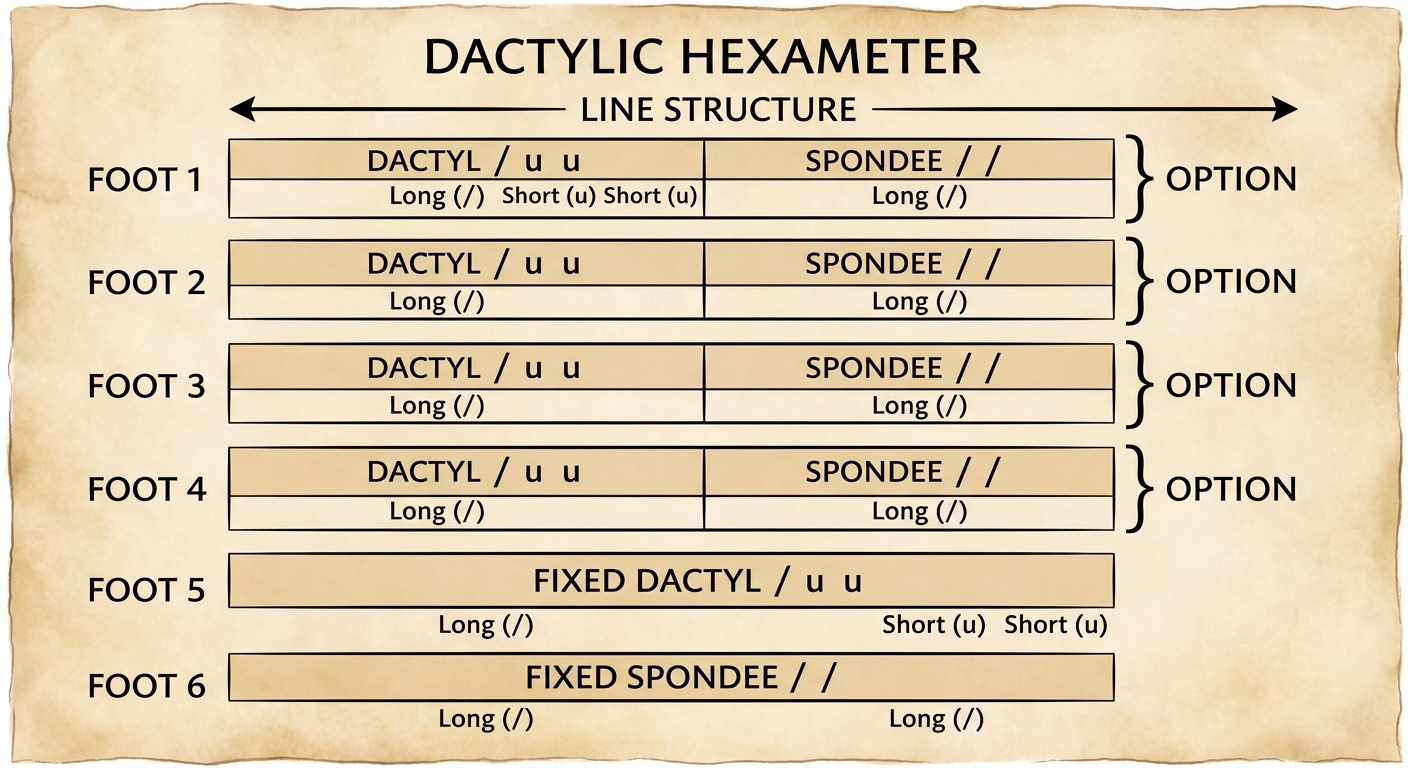
Dactylic Hexameter
The Aeneid is written entirely in Dactylic Hexameter, the rhythm used for epic poetry (derived from Homer's Iliad and Odyssey). A line of hexameter consists of six metrical "feet."
The Rules of Construction
- The Feet: Each foot can be a Dactyl (long-short-short) or a Spondee (long-long).
- The Fifth Foot: Almost always a dactyl (strawberry).
- The Sixth Foot: Always a spondee or a trochee (long-short), but the final syllable acts as a long (ancipital). It functions as a spondee (sponge-cake).
- Quantity Rules (How to scan):
- By Nature: Diphthongs (ae, au, ei, eu, oe, ui) are long. Vowels with macrons are long.
- By Position: A vowel followed by two consonants (including x and z, but excluding h) is long.
Important Metrical Features
- Elision: When a word ends with a vowel (or vowel + m) and the next word begins with a vowel (or h + vowel), the first sound is "knocked out" or slurred.
- Example: Monstrum horrendum $\rightarrow$ Monstr'orrendum.
- Caesura: A natural pause in the middle of a line, usually in the third foot. It often emphasizes the word immediately preceding it.
Literary Devices (Figures of Speech)
AP Latin exams require you to identify these devices in the text. They are the "special effects" of Latin poetry.
- Alliteration: Repetition of consonant sounds (e.g., magno cum murmure montis - repetition of 'm' mimics the rumble of the mountain).
- Anaphora: Repetition of a word/phrase at the beginning of successive clauses.
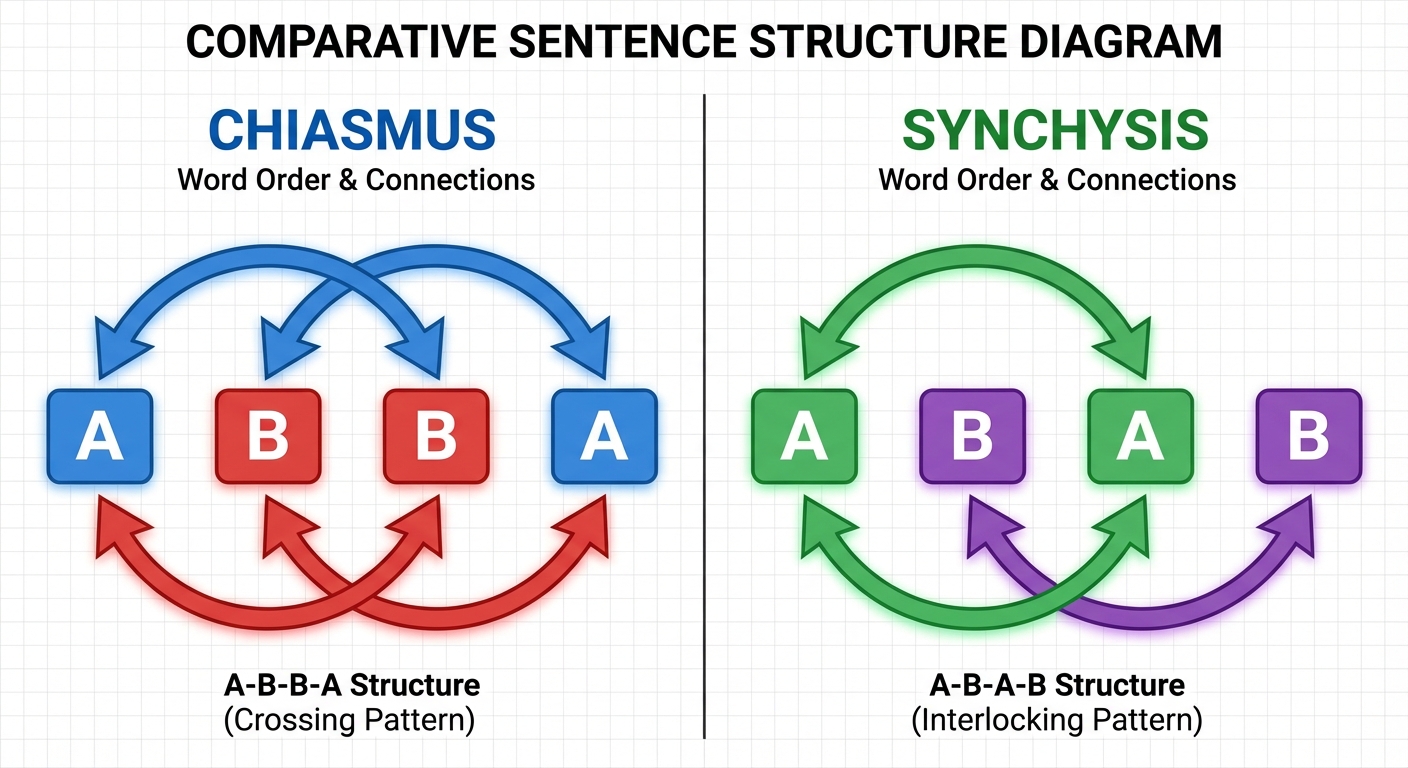
- Chiasmus (ABBA): An arrangement of pairs where the order of the second pair is reversed.
- Structure: Adjective A (Nom) / Noun B (Gen) / Noun B (Gen) / Adjective A (Nom).
- Synchysis (Interlocked Word Order - ABAB): An arrangement of pairs where the words are interlaced.
- Structure: Adj A / Adj B / Noun A / Noun B.
- Metonymy: Using a related object to represent a concept (e.g., Ferrum [iron] for "sword" or "weapon").
- Synecdoche: Using a part to represent the whole (e.g., Carina [keel] for "ship").
2. Aeneid Book 1: Destiny and the Storm
Book 1 sets the stage for the entire epic. It establishes the conflict (Juno vs. Aeneas) and the ultimate goal (Rome).
The Proem (Lines 1-11)
"Arma virumque cano…" (I sing of arms and the man).
- Concept: Vergil states his theme immediately. "Arms" references the Iliad (war), and "the man" references the Odyssey (wandering hero).
- The Wrath of Juno: The poet asks the Muse for the causes (causas) of Juno's anger. Her hatred stems from three reasons:
- The Judgment of Paris (slighted beauty).
- The abduction of Ganymede (jealousy).
- The prophecy that Trojans (Romans) would one day destroy her favorite city, Carthage.
The Storm (Aeolus and Neptune)
Juno bribes Aeolus (King of Winds) with a beautiful nymph, Deiopea, to unleash a storm against the Trojan fleet.
- Key Imagery: The winds are personified as roaring beasts in a mountain prison.
- Neptune's Intervention: Neptune senses the storm (the "rioting" of the winds) and calms the sea using the famous Statesman Simile. He compares the calming of the waves to a respected man (pietate gravem) silencing a rioting crowd. This creates a direct link between the order of nature and the political order of Rome.
Aeneas in Carthage
Aeneas lands in Libya (modern Tunisia). He hunts stags to feed his men and gives a rousing speech ("O socii…") encouraging them to endure, reminding them they have suffered worse (dabit deus his quoque finem).
- The Bees Simile: Upon entering Carthage, Aeneas sees the Tyrians building their city. They are compared to bees in summer—organized, diligent, and productive. Aeneas cries out, "O fortunati, quorum iam moenia surgunt!" (O fortunate ones, whose walls are already rising!), highlighting his longing for his own city.
3. Aeneid Book 2: The Fall of Troy
In Book 2, Aeneas tells the story of Troy's destruction to Dido at a banquet. This is a "flashback" narrative.
The Trojan Horse & Sinon
The Greeks leave a massive wooden horse. The Trojans debate what to do.
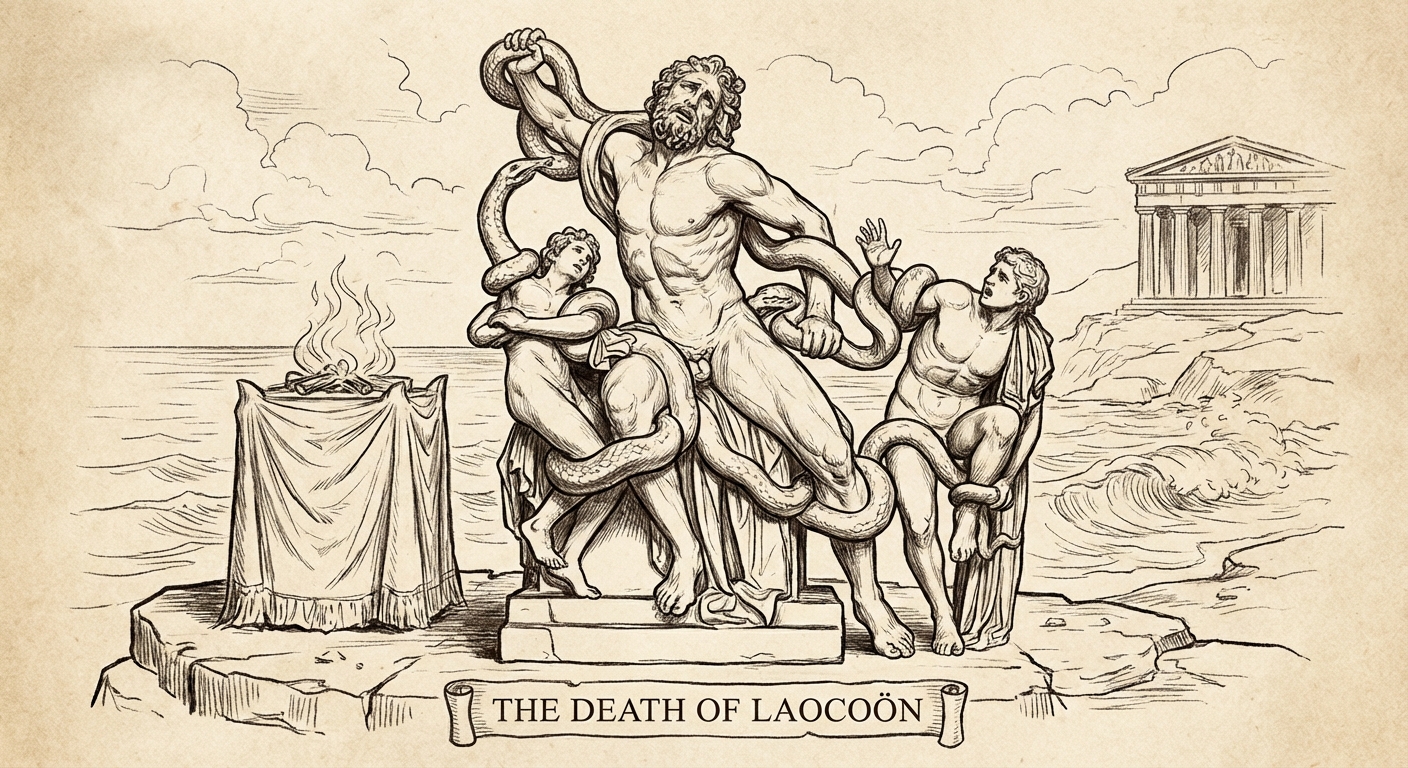
- Laocoön: The priest who warns, "Timeo Danaos et dona ferentes" (I fear Greeks, even when bearing gifts). He hurls a spear at the horse.
- Sinon: A Greek spy who claims the Greeks abandoned him. He lies, saying the horse is an offering to Minerva and if the Trojans take it inside, they will be victorious. His deceit opens the city.
The Death of Laocoön
To seal Sinon's lie, Minerva sends two giant serpents from Tenedos. They kill Laocoön and his two sons. The Trojans interpret this as divine punishment for spearing the horse, so they drag the horse inside.
Hector's Ghost
Aeneas sleeps as the city burns. The ghost of Hector (Troy's greatest hero) appears to him, dirty and bloody.
- The Message: Hector does not tell Aeneas to fight. He tells him to flee and take the household gods (Penates) to found a new city. This is the first charge of Aeneas's fatum (fate).
The Death of Priam
Aeneas witnesses the death of King Priam at the altar.
- Pyrrhus (Neoptolemus): Achilles' son, who kills Priam's son Polites before the King's eyes, then kills the King. This scene emphasizes the impietas (lack of piety) of the Greeks, contrasting with Aeneas's later behavior.
The Escape
The climax of Book 2 is the image of Pietas:
- Anchises (Father): Carried on Aeneas's shoulders (symbolizing the past/tradition).
- Ascanius/Iulus (Son): Held by the hand (symbolizing the future).
- Creusa (Wife): Follows behind.
Tragedy: Creusa gets lost and dies. Her ghost appears to Aeneas, telling him not to mourn, as a new kingdom and a royal wife await him in Hesperia (Italy).
4. Key Themes & Cultural Context
Pietas vs. Furor
This is the central conflict of the epic.
- Pietas (Duty): Not just "piety," but duty to gods, family, and country. Aeneas is pius Aeneas. He suppresses his own desires (staying with Dido) for the greater good (founding Rome).
- Furor (Rage/Madness): Uncontrolled emotion that leads to destruction. Represented by the Storm, Juno, and the burning of Troy.
The Augustan Context
Vergil wrote during the reign of Augustus Caesar. The Aeneid serves as a national epic to legitimize the Julio-Claudian dynasty.
- Genealogy: Aeneas $\rightarrow$ Iulus $\rightarrow$ The Julian Clan $\rightarrow$ Julius Caesar $\rightarrow$ Augustus.
- Propaganda: The poem suggests that the Pax Romana (Peace of Rome) is the divinely ordained end of history.
5. Poetic Grammar & Syntax
Poetry breaks the rules of prose to fit the meter. You must recognize these deviations.
The Greek Accusative (Accusative of Respect)
Vergil often uses the accusative case to show "in respect to what" an action or quality applies, borrowing from Greek grammar.
- Formula: Adjective/Participle + Body Part (Accusative).
- Example: Os umerosque deo similis (Similar to a god [in respect to] his face and shoulders).
Poetic Plural
Using a plural noun to refer to a singular object, often for metrical convenience or grandeur.
- Example: Sceptra (scepters) used to mean a single royal power or scepter.
Syncopation
Shortening verb forms to fit the meter.
- Example: Audierunt becomes Audiere (3rd person plural perfect active). Watch out for this—it looks like an infinitive, but it is a perfect verb!
6. Common Mistakes & Pitfalls
1. Confusing "Short" Vowels with "Short" Syllables
- Mistake: Thinking a short vowel acts as a short syllable even when followed by two consonants.
- Correction: Scansion is about the syllable. Even if the vowel 'e' is short, if the word is est and the next word is nunc, the syllable is Long by Position.
2. Misidentifying the Subject in Poetry
- Mistake: Assuming the first noun is the subject.
- Correction: In poetry, word order is flexible (Hyperbaton). Always look for the Nominative case ending, regardless of where it sits in the line.
3. The "Future" vs. "Past" Participle Trap
- Mistake: Confusing -urus (Future Active) with perfect forms.
- Correction: If you see -ur-, it is almost always Future (e.g., futurus). If you see -nt-, it is Present. If you see -tus/sus, it is Perfect Passive.
4. Who is speaking?
- Mistake: In excerpts, students often lose track of the speaker.
- Correction: Always memorize the context of the set passages. In Book 2, Aeneas is the narrator of the whole book, but he quotes others (Sinon, Priam, etc.).
5. Translation Authority
- Mistake: translating Aeneas as "hero" or fatum as "luck".
- Correction: Stick to the core meanings. Fatum is rigid Fate. Pietas is Duty. Be precise with terminology in essays.