Study Notes: Asymptotic Behavior and Existence Theorems
Infinite Limits and Vertical Asymptotes
Unlike limits that result in a specific number, infinite limits describe the behavior of functions as they grow without bound (unbounded behavior) near a specific $x$-value. This concept is directly tied to the geometric feature known as a Vertical Asymptote.
Definition of an Infinite Limit
Technically, if a function grows without bound, the limit does not exist (DNE). However, to convey specific directional information about how it fails to exist, we use the notation:
This notation indicates that as $x$ approaches $c$, $f(x)$ increases or decreases without limit.
Identifying Vertical Asymptotes (VA)
A vertical asymptote occurs at $x = c$ if at least one of the one-sided limits approaches infinity:
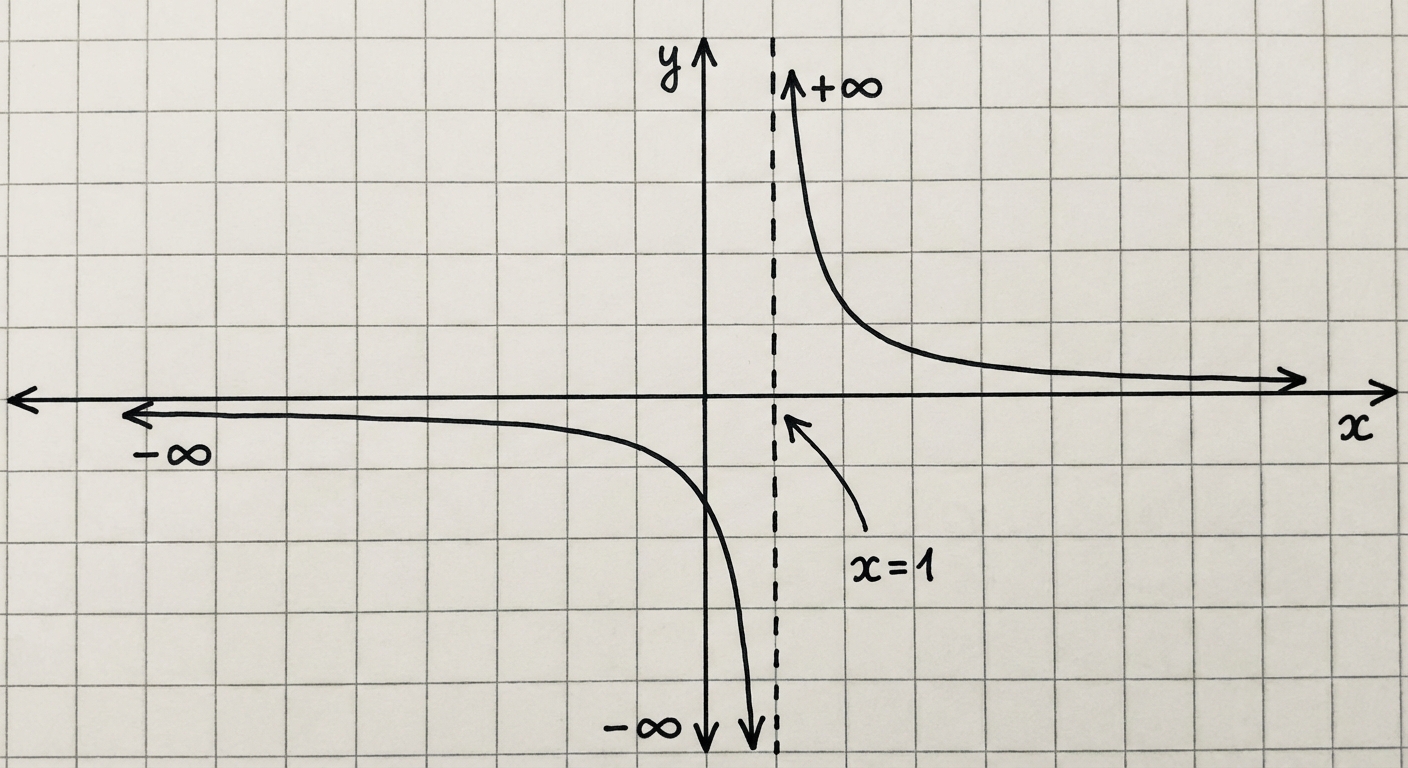
The "Non-Zero over Zero" Rule
For rational functions $f(x) = \frac{N(x)}{D(x)}$, a vertical asymptote occurs at $x=c$ if:
- $D(c) = 0$ (The denominator is zero)
- $N(c) \neq 0$ (The numerator is not zero)
If both represent zero (the form $\frac{0}{0}$), there is likely a removable discontinuity (hole), not a vertical asymptote.
Determining the Direction (Sign Analysis)
To determine if the graph goes to $+\infty$ or $-\infty$ without a calculator, test a value infinitesimally close to the asymptote.
Example: Determine the behavior of $f(x) = \frac{x+3}{x-2}$ as $x \to 2^-$.
- Identify the Form: At $x=2$, numerator is $5$, denominator is $0$. This confirms a Vertical Asymptote.
- Test a Value: Choose $x = 1.9$ (close to 2 from the left).
- Conclusion:
Limits at Infinity and Horizontal Asymptotes
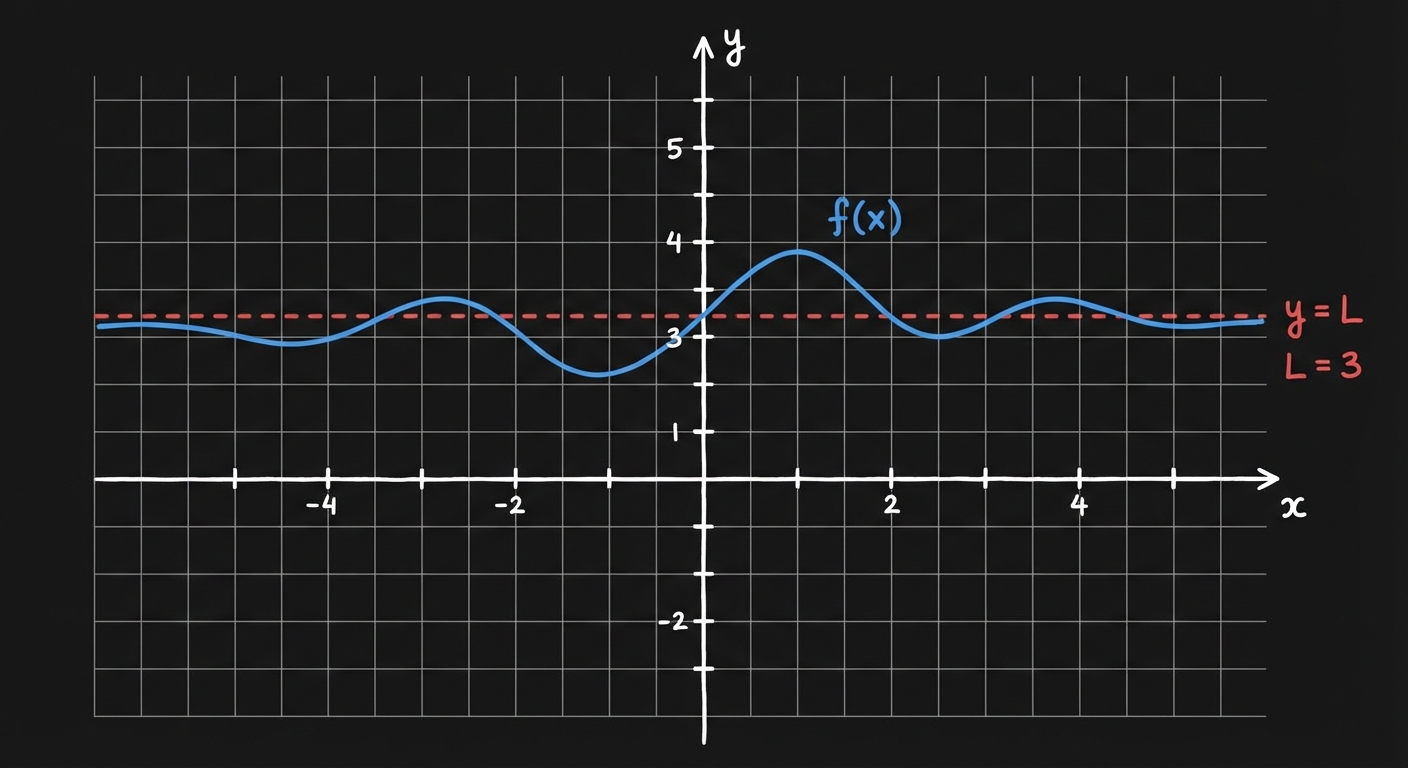
While infinite limits look at vertical unboundedness, limits at infinity describe the end behavior of a function—what happens to the $y$-values as $x$ gets extremely large ($x \to \infty$) or extremely small ($x \to -\infty$).
Definition of Horizontal Asymptotes (HA)
The line $y = L$ is a horizontal asymptote of the graph $f(x)$ if:
Rules for Rational Functions (Dominance)
For rational functions, the limit at infinity is determined by comparing the leading terms (highest powers) of the numerator and denominator. This creates three specific cases.
Consider $f(x) = \frac{an x^n + \dots}{bm x^m + \dots}$
1. Bottom Heavy ($n < m$)
If the degree of the denominator is greater than the degree of the numerator, the denominator grows faster.
- Limit: $0$
- HA: $y = 0$
2. Balanced ($n = m$)
If the degrees are equal, the terms grow at the same rate. The limit is the ratio of their coefficients.
- Limit: $\frac{an}{bm}$
- HA: $y = \frac{an}{bm}$
3. Top Heavy ($n > m$)
If the degree of the numerator is greater, the function grows without bound. There is no horizontal asymptote (though there may be a slant asymptote).
- Limit: $\infty$ or $-\infty$ (Check signs of leading terms)
Memory Aid: BOBO BOTN EATS DC
- BOBO: Bigger On Bottom? 0 (Zero)
- BOTN: Bigger On Top? N (None/Infinity)
- EATS DC: Exponents Are The Same? Divide Coefficients
Limits with Radicals and Transcendental Functions
Do not rely solely on polynomial degrees for non-rational functions. You must identify which term "dominates."
Common Hierarchy of Dominance (fastest to slowest growth):
- Exponentials ($e^x$, $2^x$)
- Polynomials ($x^5$, $3x^2$)
- Logarithms ($\ln x$)
- Bounded Functions ($\sin x$, $\cos x$)
Example:
(Because exponential $e^x$ grows much faster than polynomial $3x^2$, making the fraction extremely small).
Important Note on Oscillating Functions:
Since $-1 \le \sin x \le 1$ is bounded, dividing by a growing infinity results in zero.
Intermediate Value Theorem (IVT)
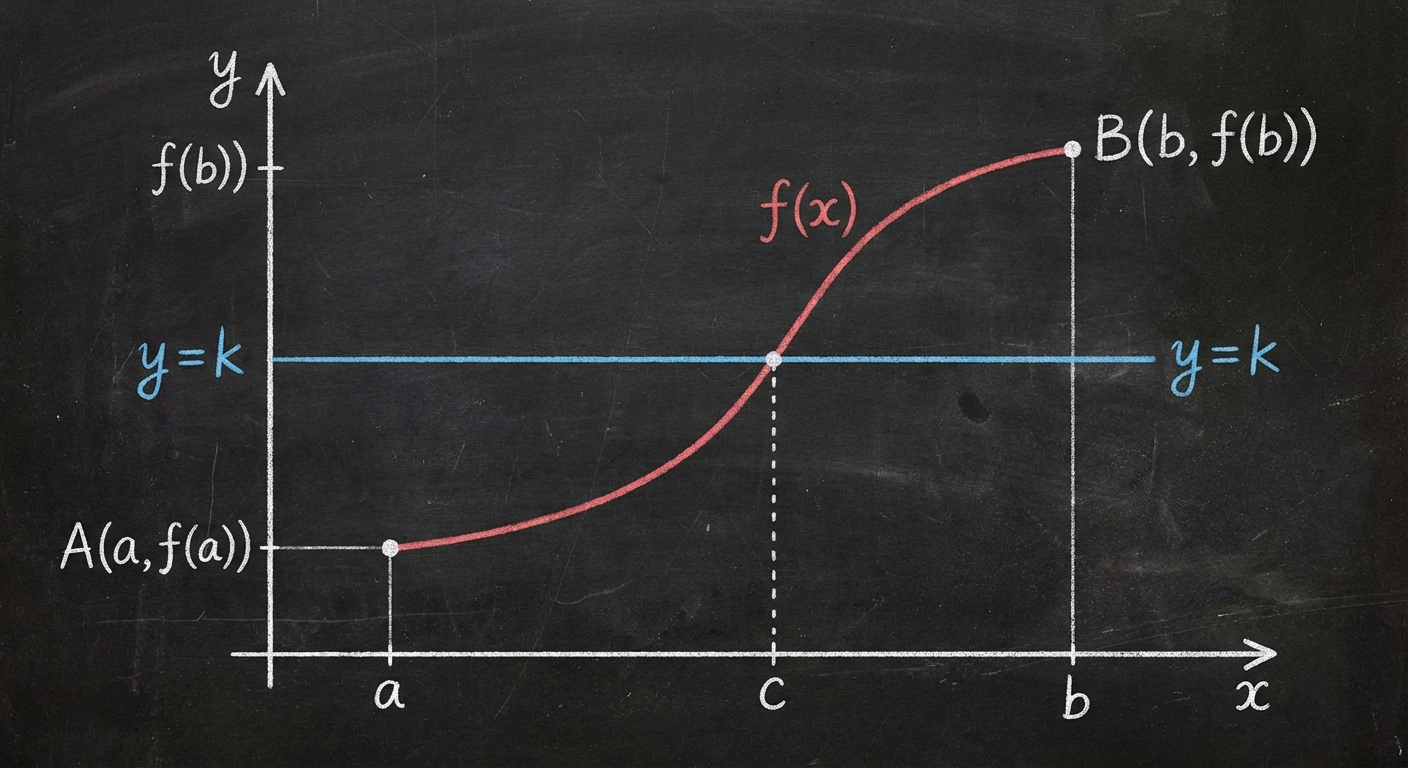
The Intermediate Value Theorem is an existence theorem. It does not tell you what the solution is or how to find it; it simply creates a guarantee that a specific value exists.
The Theorem Statement
If a function $f$ is continuous on the closed interval $[a, b]$ and $k$ is any number between $f(a)$ and $f(b)$, then there exists at least one number $c$ in the interval $(a, b)$ such that:
Conditions for Use (The "Hypothesis")
For the IVT to hold true, you must verify and state these conditions in your proofs:
- $f(x)$ is continuous on the interval $[a, b]$.
- $f(a) \neq f(b)$ (The endpoints have different $y$-values).
- The value of interest $k$ lies strictly between $f(a)$ and $f(b)$.
Application: Finding Zeros
A common application is proving a function has a root (a zero). If $f(x)$ is continuous, and you can find two points where the sign changes (one positive $y$-value and one negative $y$-value), the function MUST cross the x-axis ($y=0$) somewhere in between.
Example Writing Sample for AP Exam:
"Since $f(x)$ is continuous on $[0, 5]$, and $f(0) = -3$ and $f(5) = 4$, by the Intermediate Value Theorem, there must exist a value $c$ in $(0, 5)$ such that $f(c) = 0$."
Common Mistakes & Pitfalls
1. Confusing $x=0$ and $y=0$
- Mistake: Stating a Horizontal Asymptote is $x=0$.
- Correction: Horizontal Asymptotes are lines $y=L$. Vertical Asymptotes are lines $x=c$.
2. Assuming VAs are just "zeros of the denominator"
- Mistake: Saying $f(x) = \frac{x-2}{x-2}$ has a VA at $x=2$ because the denominator is zero.
- Correction: Check the numerator! If both are zero, it is a hole (removable), not a VA. It is a VA only if the form is $\frac{\text{non-zero}}{0}$.
3. Forgetting Continuity in IVT
- Mistake: Applying IVT without stating "the function is continuous".
- Correction: IVT fails on discontinuous functions (e.g., step functions). Explicitly stating continuity is often worth 1 point on Free Response Questions (FRQs).
4. Radical Sign Errors in Limits at Infinity
- Mistake: For $\lim_{x \to -\infty} \frac{\sqrt{x^2}}{x}$, assuming $\sqrt{x^2} = x$.
- Correction: $\sqrt{x^2} = |x|$. If $x \to -\infty$, then $\sqrt{x^2} = -x$. The limit is $-1$, not $1$.