APUSH Period 6: Transformation of the West and City Life
Development of the West and the Growth of Cities (1865–1898)
During Period 6, the United States underwent a profound transformation. While the North and South struggled with Reconstruction and industrialization, the West was "closed" through rapid settlement and the forcible removal of American Indians. Simultaneously, American cities exploded in size due to industrial demands, fueled by a massive wave of "New Immigration."
Westward Expansion and Conflicts with American Indians
Following the Civil War, the vision of specific territories for Native Americans collapsed under the pressure of white migration, railroad construction, and the discovery of mineral resources.
Economic Drivers of Expansion
The federal government actively promoted economic development in the West through legislation and subsidies.
- The Transcontinental Railroads: In 1862, Congress passed the Pacific Railway Act, granting massive land subsidies and loans to railroad companies (like the Union Pacific and Central Pacific).
- Impact: This created a national market, allowed for rapid troop movement, and decimated the buffalo herds essential to Plains Indian survival.
- The Homestead Act (1862): Offered 160 acres of public land free to any person who lived on it and improved it for five years. While it encouraged settlement, much of the best land was grabbed by speculators or railroad companies.
- Mining and Ranching: The discovery of gold and silver (e.g., the Comstock Lode in Nevada) and the rise of the Cattle Kingdom (via the Long Drive from Texas to railroad junctions) drew thousands of men to the frontier.
The Decimation of the Bison
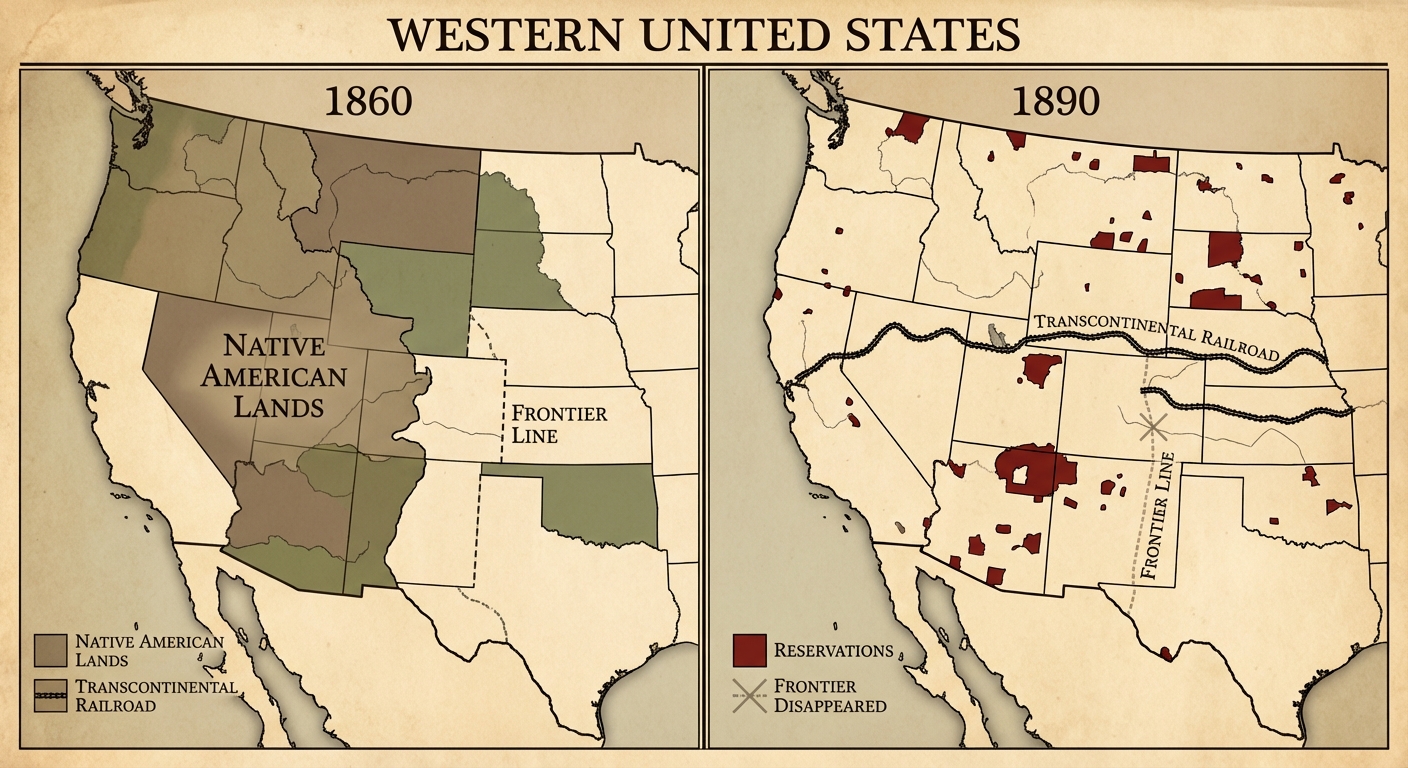
The construction of railroads cut through grazing lands, and hunters (often encouraged by the military) killed bison by the millions for hides and sport. This accumulation of environmental pressure destroyed the economic foundation of the Plains Indians' way of life.
Wars, Treaties, and Assimilation
From 1865 to 1890, the U.S. Army fought a series of wars to confine tribes to reservations.
Key Conflicts:
- Battle of Little Bighorn (1876): A temporary victory for the Sioux (Lakota) and Cheyenne under Sitting Bull and Crazy Horse, where General Custer's forces were wiped out. It ultimately led to overwhelming U.S. military retaliation.
- Wounded Knee Massacre (1890): The U.S. Army killed over 200 Lakota men, women, and children. It marks the symbolic end of organized Native American military resistance on the Plains.
Shift in Policy: Assimilation:
Reformers, such as Helen Hunt Jackson (author of A Century of Dishonor), documented the government's broken promises but argued that the solution was forcing Native Americans to adopt white culture (farming, Christianity, English).- The Dawes Severalty Act (1887): The most critical piece of legislation regarding Native Americans in this era.
- Goal: Break up tribal organizations, which were seen as preventing "civilization."
- Mechanism: It dissolved tribes as legal entities and divided tribal lands into individual plots (160 acres) for families. Citizenship was promised to those who stayed on the land for 25 years and "adopted the habits of civilized life."
- Result: Massive loss of Native American land (sold to white settlers) and cultural devastation.
- The Dawes Severalty Act (1887): The most critical piece of legislation regarding Native Americans in this era.
The Ghost Dance Movement
A religious revitalization movement among Native Americans that prophesied the return of the buffalo and the disappearance of white settlers. The U.S. government perceived this spiritual dance as a threat, directly leading to the crackdown that resulted in Wounded Knee.
Immigration and Migration in the Gilded Age
While Americans moved West, millions of foreigners moved to American cities. This period marks a distinct shift in the source of European immigrants.
"Old" vs. "New" Immigrants
This distinction is a frequent topic on the AP exam.
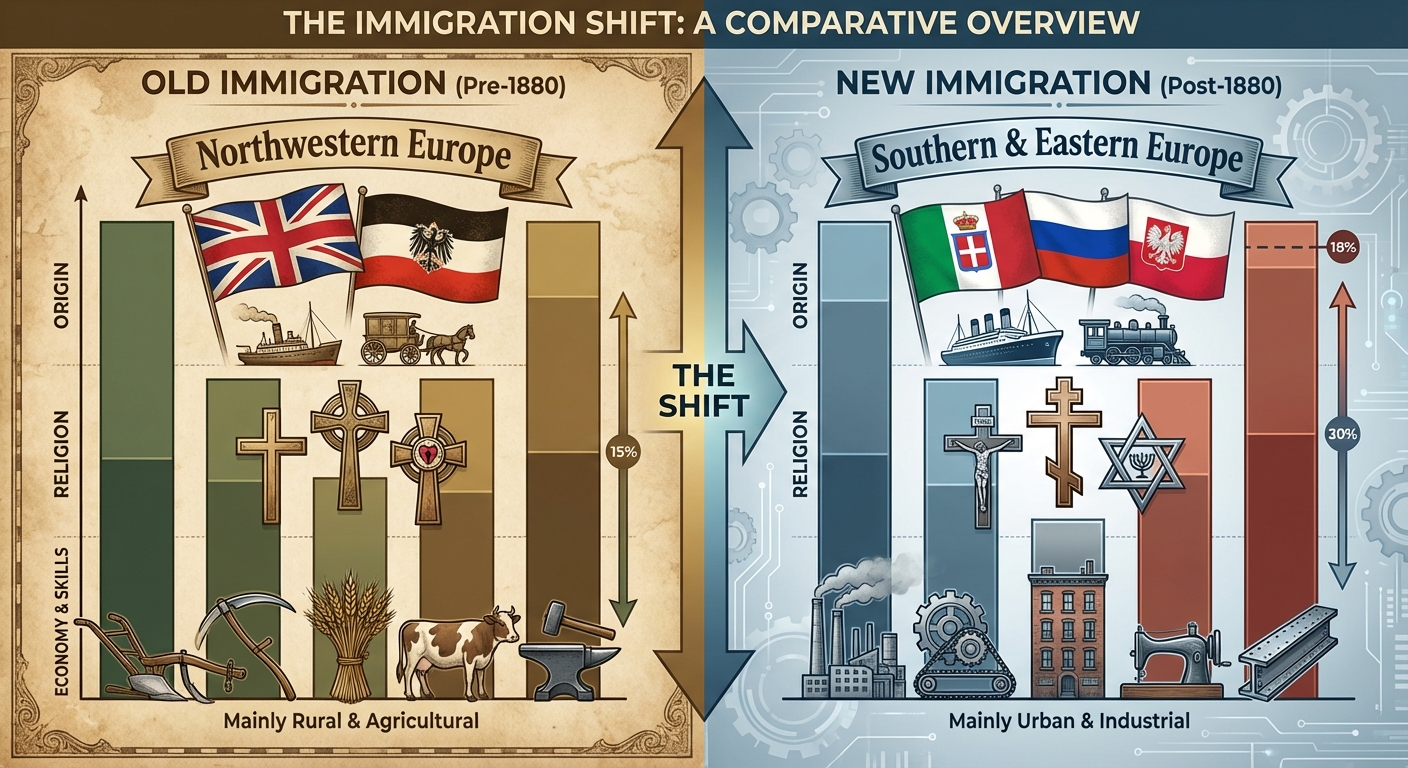
| Feature | Old Immigration (Pre-1880) | New Immigration (1880–1920) |
|---|---|---|
| Origin | Northern & Western Europe (Britain, Germany, Scandinavia) | Southern & Eastern Europe (Italy, Greece, Poland, Russia) |
| Religion | Mostly Protestant (some Irish Catholic) | Heavy mix of Catholic, Orthodox, and Jewish |
| Language | Frequently English-speaking | Frequently non-English speaking |
| Skill Level | Often literate; skilled workers or farmers | Often illiterate; unskilled laborers |
| Destination | Frontier farms or cities | Distinct ethnic enclaves in major industrial cities |
Push and Pull Factors
- Push (Why leave home?): Mechanization of agriculture in Europe (poverty), population overcrowding, and religious persecution (specifically pogroms against Jews in Russia).
- Pull (Why the U.S.?): Reputation for political and religious freedom, and arguably the most important factor: industrial jobs.
Asian Immigration
Significant numbers of Chinese immigrants arrived in the West Coast (California), primarily working on railroads and mining. They faced severe discrimination.
Nativism and Exclusion
As the "New Immigrants" arrived, Nativism (the policy of protecting the interests of native-born inhabitants against those of immigrants) surged.
Reasons for Nativism:
- Labor Unions: Feared immigrants would work for lower wages and break strikes (scabs).
- American Protective Association (APA): An anti-Catholic organization committed to stopping immigration.
- Social Darwinism: Used to justify the belief that Anglo-Saxon "stock" was genetically superior to Southern/Eastern Europeans.
Chinese Exclusion Act (1882):
- This was the first major U.S. law to suspend immigration based on race/nationality.
- It banned Chinese laborers from entering the country and was not repealed until 1943.
Urbanization and Social Change
By 1900, 40% of Americans lived in towns or cities. Urbanization and industrialization occurred simultaneously—cities provided the labor and the market for factories.
The Changing City
Cities grew up and out due to technology.
- Vertical Growth: The interaction of the Otis safety elevator and steel frame construction allowed for the first skyscrapers (e.g., Chicago).
- Horizontal Growth: Streetcars and trollies allowed the middle class to move to the "streetcar suburbs," leaving the city centers to the working poor and immigrants.
Living Conditions: The Slums
The working poor lived in crowded, unsanitary tenements.
- Dumbbell Tenements: Designed to fit as many people as possible, these buildings were notorious for poor ventilation and spreading disease (cholera, typhoid).
- Jacob Riis: A photojournalist (muckraker) who published How the Other Half Lives (1890). His flash photography exposed the horrific conditions of tenement life to the middle/upper class.
Urban Politics: The Machine
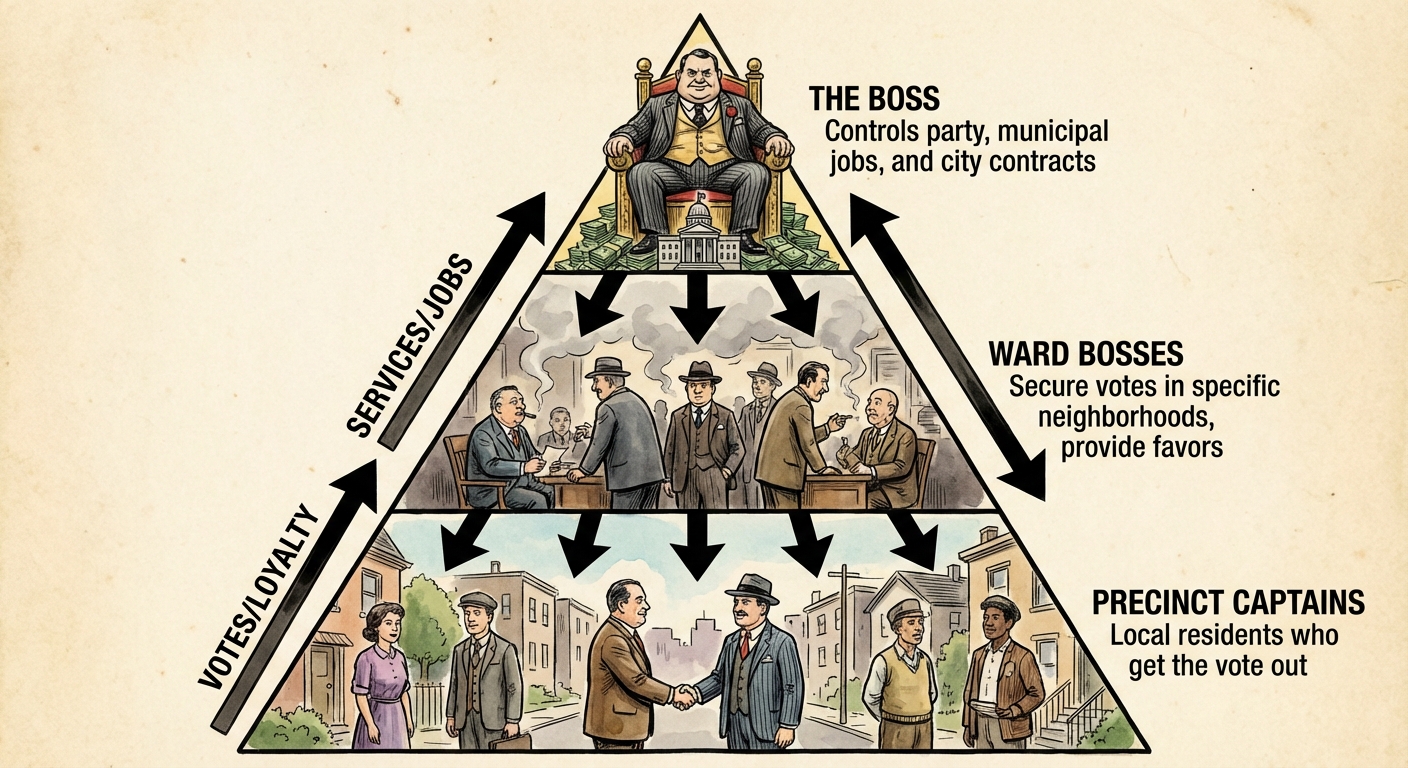
With rapid growth, city governments were inefficient. Political Machines filled the power vacuum.
- Definition: Tightly organized groups of politicians that controlled political parties in major cities.
- Structure: Led by a "Boss" who gave orders to rank-and-file members.
- Function: They acted as a crude welfare system. They provided jobs, food, and help with the law to immigrants in exchange for votes on election day.
- Example: Tammany Hall in NYC, led by William "Boss" Tweed. While corrupt (stealing millions from taxpayers), they were often the only organizations helping the poor.
Reform Movements
Middle-class reformers attempted to address urban poverty, driven by moral and religious convictions.
Settlement House Movement:
- Young, educated, middle-class women moved into immigrant neighborhoods to provide social services (English classes, early childhood education, arts).
- Jane Addams established Hull House in Chicago (1889).
- Significance: It pioneered the profession of social work.
The Social Gospel:
- A Protestant movement led by clergy (like Walter Rauschenbusch) arguing that Christian principles should be applied to social problems (poverty, inequality) rather than just saving individual souls.
Memory Aid: "WEST"
To practice the impacts of Westward Expansion:
- W - War (Indian Wars, Little Bighorn, Wounded Knee)
- E - Economics (Homestead Act, Mining, Railroads)
- S - Severalty (Dawes Severalty Act - assimilation)
- T - Transportation (Transcontinental Railroad)
Common Mistakes & Pitfalls
Confusing the "Dawes Act" with the "Dawes Plan":
- Mistake: Mixing up the 1887 Indian assimilation law with a 1924 WWI reparations finance plan.
- Fix: Dawes Severalty Act (1887) severs tribes. Dawes Plan (1924) deals with debt.
Misunderstanding the "Melting Pot":
- Mistake: Assuming immigrants immediately assimilated.
- Reality: Most immigrants maintained their culture in ethnic enclaves (Little Italy, Chinatown) for generations. The concept of the "Melting Pot" is more of a romanticized ideal than a historical reality for this period.
The Timeline of Resistance:
- Mistake: Thinking Native American armed resistance continued deep into the 20th century.
- Reality: Organized armed resistance effectively ended at Wounded Knee in 1890.
Populists vs. Progressives:
- Mistake: Treating them as the same group.
- Reality: Populists (Period 6) were primarily agrarian/farmers fighting railroads/banks. Progressives (Period 7) were primarily urban middle-class reformers fighting city/industrial problems (though they did adopt many Populist ideas).