Unit 2: The Art of Ancient Rome (509 BCE–337 CE)
Etruscan and Roman Architecture
The architecture of Rome did not exist in a vacuum; it was a synthesis of Etruscan engineering and Greek aesthetics, revolutionized by the invention of concrete. This combination allowed Romans to shape space rather than just mass.
The Etruscan Influence
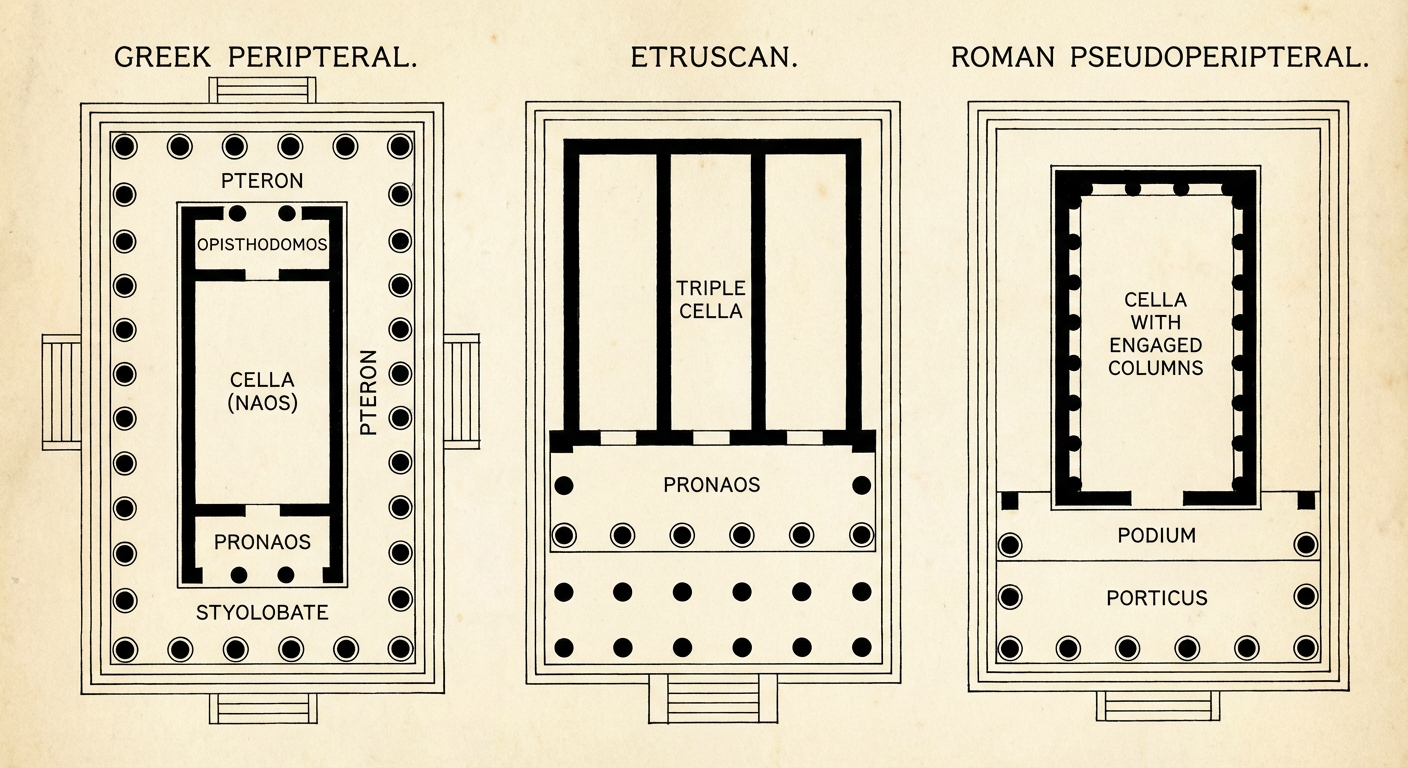
Before Rome became an empire, the Etruscans dominated central Italy. Their temple design deeply influenced Roman religious architecture.
- Materials: Unlike the Greeks who used marble, Etruscans used wood for columns and roof structures, and mudbrick for walls. Not much survives today.
- The Podium: Temples were raised on a high base with a single set of stairs in the front, unlike Greek temples which had steps on all sides.
- The Porch: A deep front porch occupied roughly half the podium.
- Tuscan Order: A simplified Doric column with a base and an unfluted shaft.
The Concrete Revolution
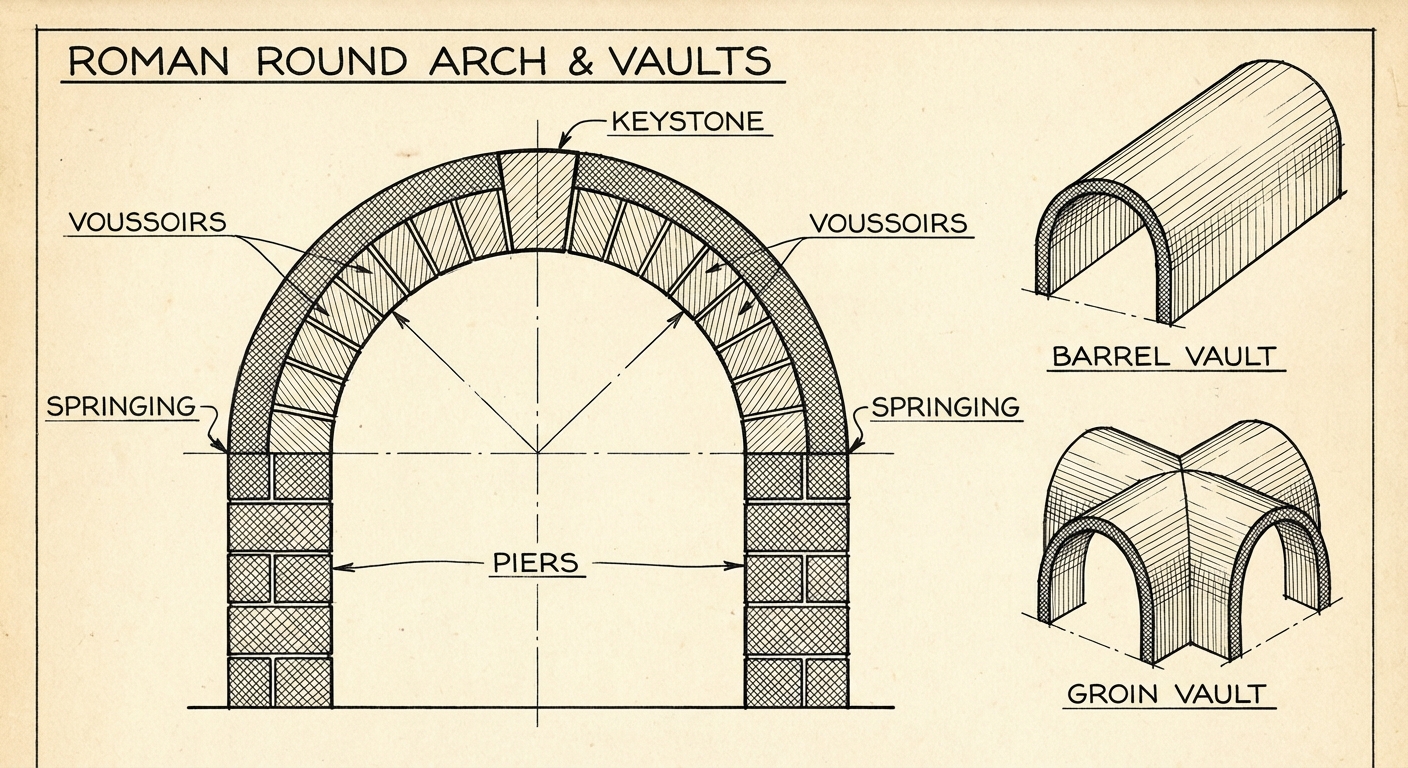
The most significant Roman contribution to architecture was concrete (opus caementicium). It was cheap, flexible, and could set underwater. This material ended the restriction of the post-and-lintel system, allowing for massive domes and vaults.
Key Architectural Forms
- The Arch: Uses wedge-shaped stones (voussoirs) locked in place by a keystone. It channels weight outward and downward.
- The Barrel Vault: An arch extended spatially into a tunnel.
- The Groin Vault: Two barrel vaults intersecting at a right angle; allows light to enter from the sides.
Essential Sites & Works
1. The Colosseum (Flavian Amphitheater) (70–80 CE)
- Function: Public entertainment (gladiator combats, animal hunts) to pacify the populace (bread and circuses).
- Structure: A massive concrete bowl faced with travertine. It utilizes the Hierarchy of Orders: Tuscan columns on the bottom (sturdiest), Ionic in the middle, and Corinthian on top.
- Innovation: Extensive use of groin vaults allowed for wide corridors to move 50,000 spectators quickly.
2. The Pantheon (118–125 CE)
- Function: A temple dedicated to all gods.
- The Facade: Looks like a standard Greek temple front (corinthian columns, pediment) to mislead the viewer.
- The Interior: A massive cylindrical drum topped by a hemispherical dome.
- The Oculus: The "eye" at the top is the only light source, symbolizing the connection between the gods and the emperor.
- Coffers: Sunken decorative panels in the dome reduce the weight of the concrete.
3. The Forum of Trajan (112 CE)
- Designed by Apollodorus of Damascus.
- Features a massive Basilica Ulpia (civic building for law courts, not religious) with a double colonnade and clerestory lighting.
Roman Sculpture and Portraiture
Roman sculpture shifts dramatically depending on the political climate. You must distinguish between the hyper-realism of the Republic and the distinct propaganda styles of the Empire.
Republican Sculpture: Verism
During the Roman Republic (509–27 BCE), power resided in the Senate, comprised of old, wealthy men. Art reflected the values of experience, wisdom, and lineage.
- Verism: A hyper-realistic style of portraiture that emphasizes (and often exaggerates) wrinkles, warts, furrows, and signs of age.
- Concept: Gravitas (seriousness of mind) and Virtus (virtue/strength).
- Context: Influenced by the tradition of Imagines—death masks of ancestors kept in house shrines.
Work of Art: Head of a Roman Patrician (c. 75–50 BCE)
- Features a hooked nose, deep wrinkles, and sunken cheeks.
- The subject is not meant to look pretty; he is meant to look experienced and loyal to the state.
Imperial Sculpture: Idealism and Propaganda
With the rise of Augustus, Rome transitioned to an Empire. The Emperor became the sole authority and head of the state religion (Pontifex Maximus). Art became a tool for political propaganda.
Work of Art: Augustus of Prima Porta (Early 1st Century CE)
- Style: Classical Greek Idealism (patterned after the Doryphoros).
- The Look: Augustus is depicted as eternally young and athletic, despite being middle-aged at the time of commissioning.
- Symbolism:
- Breastplate (Cuirass): Depicts the return of Roman standards by the Parthians (a diplomatic victory).
- Cupid on Dolphin: Associates Augustus with Venus, claiming divine lineage (the Julian line).
- Bare feet: Suggests he is standing on holy ground or is semi-divine.
- Pose: Adlocutio (orator's pose), addressing the troops.
Late Imperial Sculpture: Chaos and Abstraction
As the Empire began to crumble (instability, civil wars), the art style rejected Classical proportions in favor of crowded, abstract compositions.
Work of Art: Ludovisi Battle Sarcophagus (c. 250 CE)
- Horror Vacui: "Fear of empty space." The figures are piled on top of one another.
- Lack of Space: No illusion of depth or background.
- Content: Romans looking noble/heroic vs. Goths/Barbarians looking caricatured. It represents the chaotic reality of the Late Empire.
Roman Wall Painting and Mosaics
Most surviving Roman painting comes from Pompeii and Herculaneum, preserved by the volcanic ash of Mt. Vesuvius in 79 CE. These works appear in domestic spaces (Domus).
The House of the Vettii
- Context: Owned by two freedmen (former slaves) who became wealthy merchants. The house displays their new status.
- Atrium: The center of the Roman house, featuring an impluvium (rainwater catch basin).
- Frescoes: The walls are covered in the Fourth Style of painting.
The Four Styles of Pompeian Painting
| Style | Name | Characteristics | Key Concept |
|---|---|---|---|
| First | Incrustation | Painted to look like expensive marble slabs. | Material Wealth |
| Second | Architectural | Creates illusion of 3D space (landscapes, buildings) on a 2D wall. | Trompe l'oeil (Trick of the eye) |
| Third | Ornate | Flat, monochrome backgrounds with thin, delicate, impossible visuals. | Decoration over realism |
| Fourth | Intricate | A chaotic mix of all previous styles; framed pictures on walls. | Eclectic excess |
Mosaics
Mosaics used tesserae (small cubes of stone or glass) to create durable floor or wall images.
Work of Art: Alexander Mosaic (c. 100 BCE)
- Location: Floor of the House of the Faun, Pompeii.
- Subject: Battle of Issus between Alexander the Great and Darius III of Persia.
- Technique: Based on a Greek painting. Incredible use of foreshortening (objects receding in space) and modeling (light/shadow on the horses). Note the reflection of a soldier's face in a shield on the ground.
Memory Aids & Mnemonics
For the Orders:
- Tuscan (Basic, Etruscan)
- Doric (Dull)
- Ionic (Eyes/Scrolls)
- Corinthian (Fancy Cabbage leaves/Acanthus)
Verism: Think VERY old. If the sculpture looks very old and wrinkly, it is Verism from the Republic.
Augustus: "Augustus is Always Athletic." (He never ages in art).
Common Mistakes & Pitfalls
- Confusing the Pantheon and the Parthenon:
- Parthenon = Greek, Acropolis, Doric columns, ruined roof.
- Pantheon = Roman, concrete dome, oculus, intact roof.
- Misunderstanding "Verism": Students often think "Verism" means the person looked exactly like that. While it is realistic, it is also a stylistic choice to exaggerate age to symbolize wisdom.
- Concrete vs. Marble: Do not assume all white buildings are solid marble. Romans built in brick/concrete and veneered (covered) the surface with thin marble slabs.
- The Arch: Remember that Greeks knew about arches but didn't use them extensively. Romans exploited the arch for structural integrity in bridges and aqueducts.