AP Biology Unit 8: Ecology and Energy Dynamics
Responses to the Environment
Energy Strategies: Endotherms vs. Ectotherms
Organisms must exchange matter and energy with their environment to grow, reproduce, and maintain organization. The strategy an organism uses to regulate body temperature (thermoregulation) affects its metabolic rate.
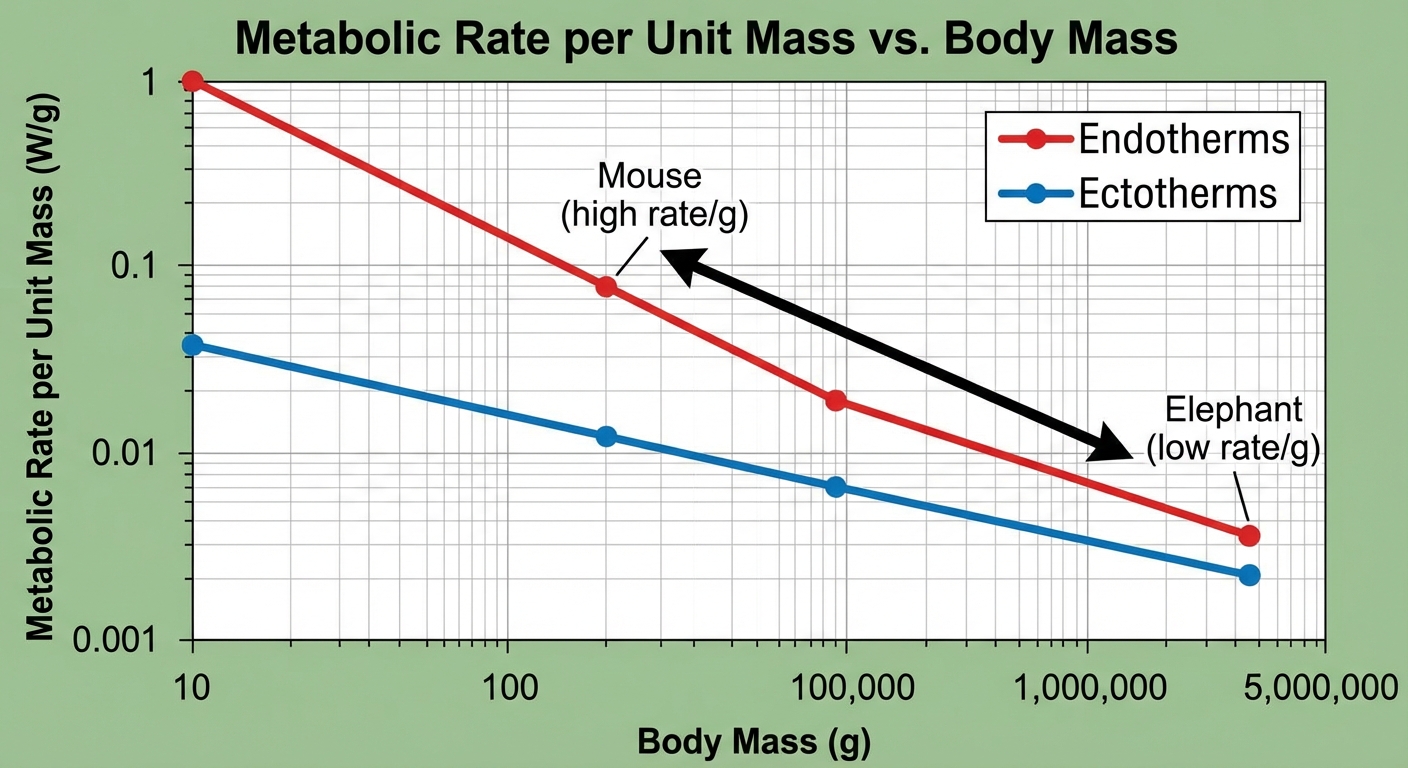
- Endotherms (e.g., birds, mammals): Use thermal energy generated by metabolism to maintain homeostatic body temperatures. They can remain active in diverse environments but require a higher calorie intake.
- Ectotherms (e.g., reptiles, amphibians, fish): Lack internal physiological mechanisms to regulate body temperature. They rely on external behaviors (like moving into the sun) to regulate temperature. Their metabolic rate is generally lower than endotherms.
Key Trend: There is an inverse relationship between metabolic rate per unit body mass and the size of the organism.
- A mouse (small endotherm) has a much higher metabolic rate per gram of tissue than an elephant. This means the mouse requires much more food relative to its body size to prevent heat loss.
Behavioral Responses
Behavior is an action carried out by muscles under control of the nervous system. Natural selection favors behaviors that increase survival and reproductive fitness.
Innate vs. Learned Behaviors
- Innate Behavior (Instinct): Genetically hardwired; all members of a species perform it the same way without prior experience.
- Fixed Action Pattern (FAP): A sequence of unlearned acts directly linked to a simple stimulus (sign stimulus). Once initiated, it is usually carried to completion (e.g., a stickleback fish attacking anything with a red belly).
- Learned Behavior: Modification of behavior based on specific experiences.
- Imprinting: A long-lasting behavioral response to a particular individual or object established during a critical period (a specific window of time early in development).
- Habituation: A loss of responsiveness to specific stimuli that convey little or no new information (learning to ignore the "background noise").
- Associative Learning: Associating one environmental feature with another (e.g., Classical Conditioning—Pavlov's dogs; Operant Conditioning—trial and error learning).
Communication
Communication involves the transmission and reception of signals between animals. It is vital for mating, dominance, and resource protection.
- Pheromones: Chemical signals effective at low concentrations (often used for reproductive signaling or alarm signals in ants).
- Agonistic Behavior: Threats or combat used to settle disputes over resources (e.g., males fighting for mates). This often results in a dominance hierarchy or "pecking order."
- Altruism: Behavior that reduces an individual's fitness but increases the fitness of others in the population. This is often driven by kin selection (saving relatives ensures your shared genes are passed on).
Plant Responses
Plants are not static; they respond to environmental changes to maximize photosynthesis and survival.
- Photoperiodism: A physiological response to the specific length of day/night (mediated by Phytochromes). It triggers flowering.
- Short-day plants: Flower when nights are longer than a critical length (late summer/fall).
- Long-day plants: Flower when nights are shorter than a critical length (late spring/summer).
- Tropisms: Directional growth responses.
- Phototropism: Growth toward light (driven by hormones called auxins).
- Gravitropism: Growth in response to gravity (roots grow down, shoots grow up).
- Thigmotropism: Growth in response to touch (e.g., vines winding around a trellis).
Energy Flow Through Ecosystems
Trophic Structure
Energy flows through an ecosystem in one direction: Sun $\rightarrow$ Producers $\rightarrow$ Consumers $\rightarrow$ Decomposers.
- Producers (Autotrophs): Capture energy from physical or chemical sources (Photosynthesis or Chemosynthesis).
- Consumers (Heterotrophs): Capture energy present in carbon compounds produced by other organisms.
- Primary Consumers: Herbivores.
- Secondary/Tertiary Consumers: Carnivores/Omnivores.
- Decomposers: Recycle nutrients (matter) back into the soil, but energy is lost as heat. Matter cycles, energy flows.
The 10% Rule
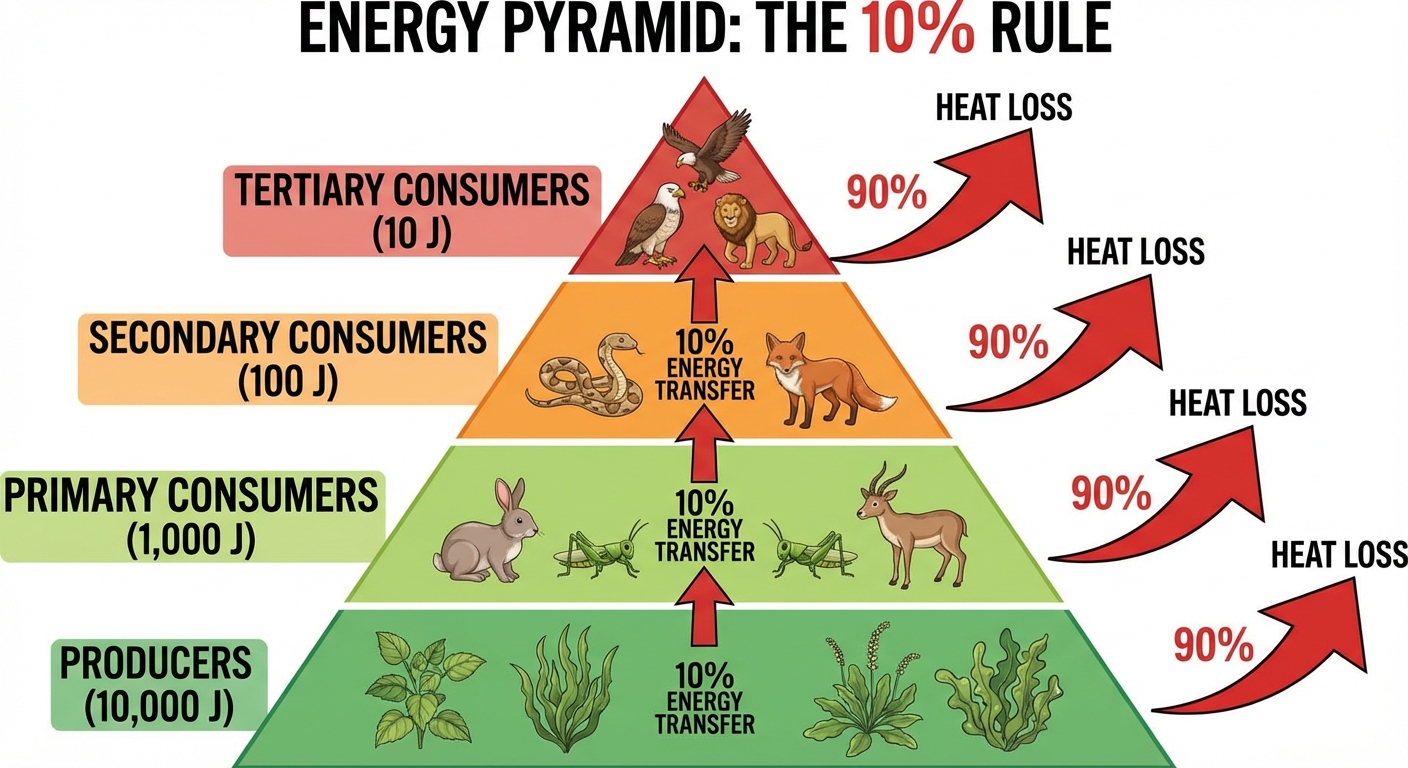
In accordance with the Second Law of Thermodynamics, energy transfer between trophic levels is inefficient.
- Only about 10% of the energy at one trophic level is stored and available to the next level.
- The remaining 90% is lost as heat (metabolic cost), waste, or used for cellular respiration.
- This inefficiency limits the number of trophic levels a food chain can support (usually 4–5 max).
Primary Productivity
Primary productivity is the rate at which solar energy (or chemical energy) is converted into organic compounds by autotrophs.
- Gross Primary Productivity (GPP): The total amount of solar energy converted to chemical energy by photosynthesis.
- Net Primary Productivity (NPP): The energy captured that is actually stored as biomass and available to consumers.
The Formula:
Where:
- $NPP$ = Net Primary Productivity
- $GPP$ = Gross Primary Productivity
- $R$ = Respiration (energy used by the plants themselves for metabolism)
Population Ecology
Population Characteristics
Allows us to analyze the health and stability of a population.
- Density: Number of individuals per unit area.
- Dispersion: Pattern of spacing (Clumped, Uniform, or Random).
Population Growth Models
There are two main mathematical models you must master for AP Biology.
1. Exponential Growth
Occurs under ideal conditions with unlimited resources. The population grows without restraint.
- Shape: J-shaped curve.
- Formula:
2. Logistic Growth
Occurs when resources are limited. The growth rate slows as the population approaches the environment's limits.
- Shape: S-shaped (sigmoid) curve.
- Carrying Capacity ($K$): The maximum population size the environment can sustain.
- Formula:
Variable Key:
- $dN/dt$: Change in population size over time (growth rate).
- $r_{max}$: Maximum per capita growth rate (reproductive potential).
- $N$: Current population size.
- $K$: Carrying capacity.
Note: In Logistic Growth, when $N$ is small, $(K-N)/K$ is close to 1, mimicking exponential growth. As $N$ approaches $K$, the term becomes 0, and growth stops.
Limiting Factors
- Density-Independent Factors: Abiotic factors that affect birth/death rates regardless of population size (e.g., floods, fires, volcanic eruptions).
- Density-Dependent Factors: Biotic factors whose intensity increases as population density increases (e.g., competition for food, disease spread, predation, accumulation of toxic wastes).
Life History Strategies
- r-selected species: Many offspring, little parental care, rapid growth, thrive in unstable environments (e.g., insects, bacteria).
- K-selected species: Few offspring, high parental care, slow growth, live near carrying capacity (e.g., humans, elephants).
Community Ecology
A community is a group of populations of different species interacting in the same area. Diversity is crucial for ecosystem resilience.
Measuring Biodiversity: Simpson’s Diversity Index
Higher diversity generally means an ecosystem is more resilient to environmental changes.
Formula:
Where:
- $n$ = total number of organisms of a particular species
- $N$ = total number of organisms of all species
- $(n/N)$ is squared, summed for all species, and subtracted from 1.
- Values range from 0 (low diversity) to 1 (high diversity).
Interspecific Interactions
| Interaction | Effect | Description |
|---|---|---|
| Competition | (-/-) | Species compete for a limited resource. Can lead to Competitive Exclusion (one species dies out) or Resource Partitioning (species evolve to use different specialized niches). |
| Predation | (+/-) | One species kills and eats another. Drives evolutionary adaptations like camouflage or mimicry. |
| Herbivory | (+/-) | An organism eats part of a plant or alga. |
| Symbiosis: Parasitism | (+/-) | Parasite derives nourishment from host, harming the host. |
| Symbiosis: Mutualism | (+/+) | Both species benefit (e.g., Nitrogen-fixing bacteria and legumes, Lichen). |
| Symbiosis: Commensalism | (+/0) | One benefits, the other is unaffected. |
Niche Concept
- Ecological Niche: The sum of a species' use of biotic and abiotic resources.
- Fundamental Niche: The niche potentially occupied by that species.
- Realized Niche: The niche actually occupied (usually smaller due to competition).
Ecosystem Disruptions and Biodiversity
Keystone Species
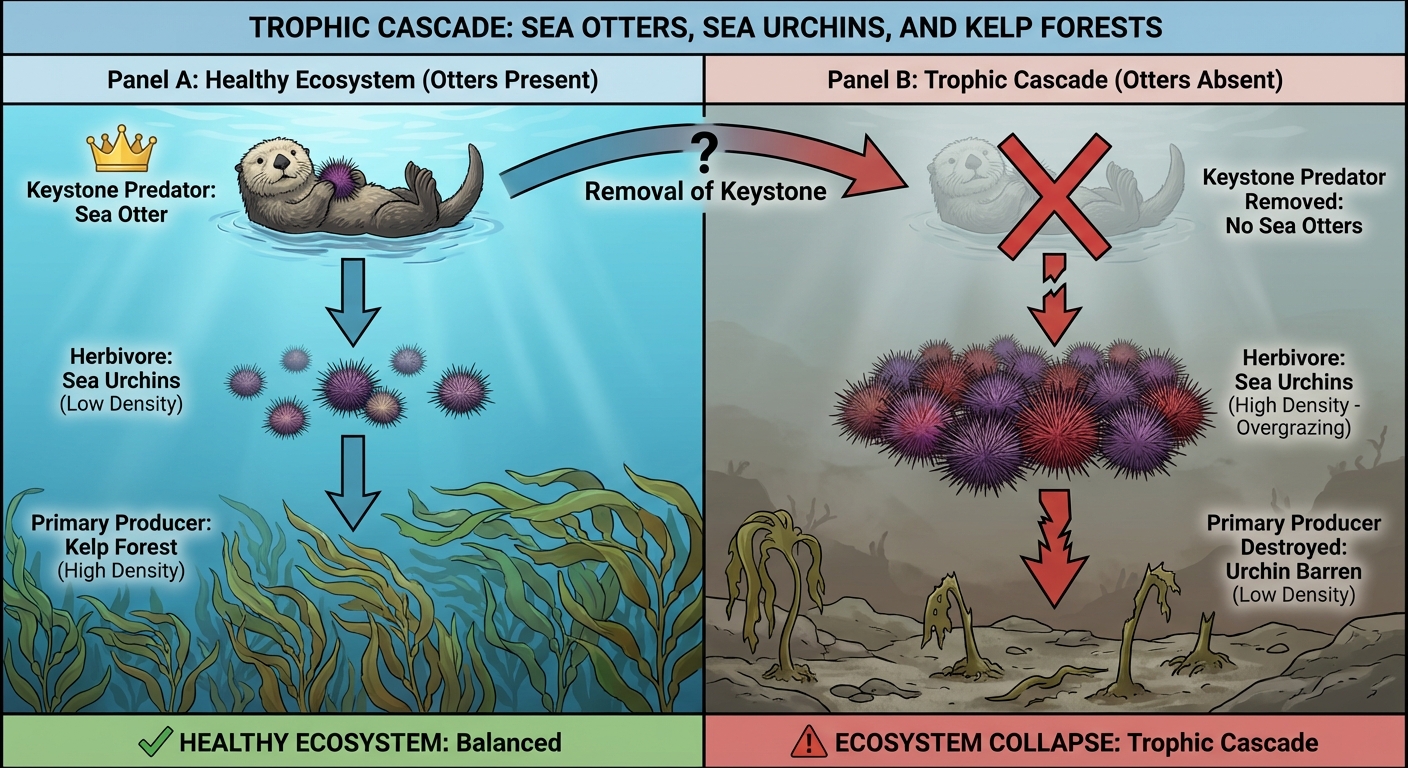
A species that has a disproportionately large effect on its ecosystem relative to its abundance. Removal of a keystone species often causes the ecosystem structure to collapse.
- Example: Sea Otters in the Pacific Northwest. They eat sea urchins. Without otters, urchins destroy kelp forests, eliminating habitat for many other fish.
Ecological Succession
The sequence of community and ecosystem changes after a disturbance.
- Primary Succession: Occurs in a lifeless area where soil has not yet formed (e.g., retreating glacier, new volcanic island).
- Pioneer Species: The first to colonize (Lichens and mosses). They break down rock to create soil.
- Secondary Succession: Occurs where an existing community has been cleared by some disturbance (fire, farming) but soil remains intact.
Human Impacts
Human activities largely reduce biodiversity and disrupt cycles.
- Invasive Species: Non-native species introduced to a new area. They lack natural predators/parasites and often outcompete native species (e.g., Kudzu, Zebra Mussels).
- Eutrophication: Excess nitrogen/phosphorus (fertilizer runoff) enters water bodies $\rightarrow$ Algal bloom $\rightarrow$ Algae die and decompose $\rightarrow$ Decomposers use up all oxygen $\rightarrow$ Fish kills (Dead Zones).
- Biomagnification: Toxins (like DDT or Mercury) become more concentrated in successive trophic levels. Top predators suffer the highest toxicity.
- Climate Change: Burning fossil fuels increases $CO_2$, trapping heat (Greenhouse Effect), shifting biomes, and altering range of tolerance for species.
Common Mistakes & Pitfalls
- GPP vs. NPP: remember that NPP is the "Checking Account" (what's left to spend), while GPP is the "Paycheck" (total income). Plants have bills to pay (Respiration), so they can never pass on 100% of the GPP.
- Logistic Growth Math: When calculating logistic growth, don't forget the portion $(\frac{K-N}{K})$. If a question asks for the growth rate at carrying capacity, the answer is 0, because $N=K$, making the multiplier 0.
- Energy vs. Matter: Energy flows (enters as light, leaves as heat; never recycled). Matter cycles (Carbon, Nitrogen, Water are reused constantly). Do not say energy is recycled.
- Lamarckian Language: When describing adaptations (like camouflage), avoid saying "The animal learned to hide so it evolved." Say "Animals with better camouflage survived and reproduced more, passing on the trait." Evolution acts on populations, not individuals.
- Regulators vs. Conformers: Do not confuse these. An endotherm is a temperature regulator. An ectotherm is a temperature conformer.