AP Calculus AB Unit 4 Study Guide: Contextual Applications of Differentiation
Interpreting the Meaning of the Derivative in Context
In earlier units, the focus was on computing derivatives. In Unit 4, the emphasis shifts to what derivatives mean in real situations. Calculus is not just about abstract numbers; it is the language of change in the real world. A derivative is not just an algebraic expression: it describes how one quantity changes in response to another.
Derivative as an instantaneous rate of change (and tangent slope)
When a function models a relationship between two quantities, the derivative represents an instantaneous rate of change.
If %%LATEX0%% then %%LATEX1%% tells you how fast %%LATEX2%% is changing at that particular input value %%LATEX3%%. Geometrically, this is the slope of the tangent line to the graph of at that point.
A reliable way to remember the meaning:
- answers: “What is the value of the output?”
- answers: “How fast is the output changing right now as the input changes?”
What a “complete” interpretation must include (AP phrasing)
On AP-style interpretation questions, a derivative statement is most accurate when it contains three parts:
- Instantaneous time/value: “At %%LATEX7%% (or at time %%LATEX8%%) …”
- Direction of change: “… the [quantity] is increasing/decreasing …”
- Rate with units: “… at a rate of [number] [output units] per [input units].”
Average rate of change vs. instantaneous rate of change
Before derivatives, you used average rate of change on an interval :
This is the slope of the secant line through the points %%LATEX11%% and %%LATEX12%%.
The derivative %%LATEX13%% is the slope of the tangent line at %%LATEX14%%. Conceptually, it is what happens to the average rate of change as the interval shrinks down to a single point.
This distinction matters because many real situations demand “right now” change (instantaneous). For example, your speed at exactly 3 seconds is different from your average speed over the first 3 seconds.
Units: the fastest way to interpret a derivative
In context, almost always has units, and those units often determine the correct interpretation.
If %%LATEX16%% has units “output units,” and %%LATEX17%% has units “input units,” then has units:
Examples:
- If %%LATEX20%% is cost in dollars after %%LATEX21%% hours, then is dollars per hour.
- If %%LATEX23%% is population in thousands and %%LATEX24%% is height in miles, then is thousands of people per mile.
- If %%LATEX26%% is height in meters as a function of distance in meters, then %%LATEX27%% is meters per meter (dimensionless), interpreted as slope/grade.
A common misunderstanding is to treat derivatives as unitless just because you can compute them algebraically.
Interpreting increasing, decreasing, and “changing rates” (using first and second derivatives)
Once you attach meaning to , you can interpret behavior:
- If %%LATEX29%%, the quantity modeled by %%LATEX30%% is increasing at .
- If %%LATEX32%%, the quantity modeled by %%LATEX33%% is decreasing at .
- A larger magnitude of means faster change.
The second derivative measures how the rate of change itself is changing.
- If , the derivative is increasing (rate of change is increasing).
- If , the derivative is decreasing (rate of change is decreasing).
In context, this is often described as “accelerating” (motion) or “the growth rate is increasing/decreasing” (population, revenue, medication level, etc.).
Estimating derivatives from tables and graphs
AP questions frequently provide a graph or a table rather than a formula.
From a graph:
- %%LATEX38%% is the slope of the tangent line at %%LATEX39%%.
- You estimate it by drawing or visualizing the tangent line and computing rise over run.
From a table:
You approximate %%LATEX40%% by using nearby values to compute an average rate of change close to %%LATEX41%%. If possible, use a symmetric difference quotient:
This uses values on both sides of and typically reduces error.
Worked Example 1: interpreting a derivative with units (marginal cost)
A company’s total cost (in dollars) to produce %%LATEX44%% items is %%LATEX45%%. Suppose %%LATEX46%% and %%LATEX47%%.
- means it costs 5400 dollars (total) to produce 200 items.
- has units dollars per item.
A complete interpretation is: at a production level of 200 items, the cost is increasing at about 12 dollars per additional item. This is a marginal cost interpretation.
A common mistake is to say “the cost is 12 dollars” (forgetting “per item”) or to claim it is the average cost. The average cost at 200 would be:
which is not the derivative.
Worked Example 2: estimating a derivative from a table
A table gives %%LATEX51%%, %%LATEX52%%, %%LATEX53%%. Estimate %%LATEX54%%.
Using a symmetric difference around 3:
Interpretation (without extra context): at , the output is increasing at about 4.5 output units per input unit.
Notation you must recognize
The derivative can appear in several equivalent forms. Switching comfortably between them is essential.
| Meaning | Common notation | Notes |
|---|---|---|
| Derivative of %%LATEX57%% with respect to %%LATEX58%% | Read as “dee y dee x”; emphasizes rate of change | |
| Derivative of | Most common when a function name is given | |
| Derivative evaluated at a point | A number (slope/rate at ) | |
| Operator form | Emphasizes “differentiate with respect to ” |
Exam Focus
Typical question patterns
- Interpret %%LATEX66%% and %%LATEX67%% in words with correct units, often using “marginal” language in economics.
- Estimate from a graph (tangent slope) or from a table (difference quotient, ideally symmetric).
- Decide whether a statement is true by connecting the sign of %%LATEX69%% or %%LATEX70%% to increasing/decreasing and “increasing/decreasing at an increasing/decreasing rate.”
Common mistakes
- Confusing (instantaneous) with average rate of change on an interval.
- Ignoring units, leading to incorrect interpretations.
- Using points too far from when estimating from a table, producing a rough average rather than a local estimate.
- Writing an “interpretation” without specifying the instant (for example, forgetting to say “at ”).
Straight-Line Motion: Connecting Position, Velocity, Acceleration
Motion problems are a perfect setting for derivatives because the language of motion is fundamentally about rates.
The core functions in one-dimensional motion
In straight-line motion, you typically have:
- Position function %%LATEX74%% or %%LATEX75%%: where the object is at time .
- Velocity function : how fast position is changing.
- Acceleration function : how fast velocity is changing.
The derivative relationships are:
A compact summary:
| Function | Notation | Definition | Units example |
|---|---|---|---|
| Position | %%LATEX81%% or %%LATEX82%% | Location relative to origin | meters |
| Velocity | Rate of change of position; sign matters | meters per second | |
| Acceleration | Rate of change of velocity | meters per second squared |
Units, velocity vs. speed
Units matter: if %%LATEX85%% is meters and %%LATEX86%% is seconds, then %%LATEX87%% is meters per second and %%LATEX88%% is meters per second squared.
A frequent misconception is to treat velocity as the same thing as speed. Velocity includes direction (sign). Speed is the magnitude of velocity:
Displacement vs. distance traveled
These are often tested together because they sound similar.
- Displacement on is the net change in position:
- Distance traveled is the total amount of ground covered, regardless of direction:
Even if you are not asked to compute that integral in a complicated setting, you must understand the concept: distance uses absolute value because moving backward still adds to total distance.
Interpreting velocity and acceleration (including speeding up/slowing down)
Because velocity is a derivative, its sign tells you whether the object’s position is increasing or decreasing.
- If , position is increasing (moving in the positive direction).
- If , position is decreasing (moving in the negative direction).
- If , the object is momentarily at rest (but not necessarily turning around).
Acceleration is the derivative of velocity:
- If , velocity is increasing.
- If , velocity is decreasing.
Speeding up vs. slowing down depends on how velocity and acceleration interact:
- Speeding up: %%LATEX98%% and %%LATEX99%% have the same sign.
- Slowing down: %%LATEX100%% and %%LATEX101%% have opposite signs.
Mnemonic to remember this:
- “Same Signs Speed Up.”
Position, velocity, and acceleration from graphs
AP questions often give a graph of one function and ask about the others.
- The slope of the position graph at time %%LATEX102%% equals %%LATEX103%%.
- The slope of the velocity graph at time %%LATEX104%% equals %%LATEX105%%.
- Where velocity crosses zero, position may have a local max/min, but only if velocity changes sign.
A common mistake is assuming %%LATEX106%% automatically means a local maximum or minimum of position. You need a sign change in %%LATEX107%%, not just a zero.
Worked Example 1: from position to velocity and acceleration
Suppose an object’s position is
where %%LATEX109%% is in seconds and %%LATEX110%% is in meters.
1) Find velocity and acceleration.
Differentiate:
Differentiate again:
2) Interpret %%LATEX113%% and %%LATEX114%%.
At %%LATEX117%% seconds, the velocity is %%LATEX118%% meters per second, meaning the object is moving in the negative direction at 3 m/s. At seconds, the acceleration is 0 m/s squared, meaning velocity is not changing at that instant.
3) Is the object speeding up at ?
Speeding up requires the same sign between %%LATEX121%% and %%LATEX122%%. Here %%LATEX123%% and %%LATEX124%%, so it is neither speeding up nor slowing down at that exact instant.
Worked Example 2: interpreting turning points correctly
Using the same velocity
find when the object changes direction.
A change of direction occurs when velocity changes sign, which can only happen when velocity is zero.
Divide by 3:
Factor:
Candidates: %%LATEX129%% and %%LATEX130%%. Test signs:
- For %%LATEX131%%, %%LATEX132%%.
- For %%LATEX133%%, %%LATEX134%%.
- For %%LATEX135%%, %%LATEX136%%.
Velocity changes sign at both 1 and 3, so the object changes direction at both times.
Worked Example 3: speeding up or slowing down from velocity
A particle moves with velocity
Is the particle speeding up or slowing down at ?
1) Velocity at :
2) Acceleration:
3) Conclusion: since %%LATEX143%% is negative and %%LATEX144%% is positive (opposite signs), the particle is slowing down.
Exam Focus
Typical question patterns
- Given %%LATEX145%%, find and interpret %%LATEX146%% and at specific times, including units.
- Determine when an object is at rest, moving forward/backward, speeding up, or slowing down using signs of %%LATEX148%% and %%LATEX149%%.
- Use a graph of %%LATEX150%% or %%LATEX151%% to infer information about the other function using slope connections.
- Distinguish displacement from distance traveled conceptually.
Common mistakes
- Saying “speeding up when %%LATEX152%%” (not always true; you need sign agreement with %%LATEX153%%).
- Confusing velocity (which can be negative) with speed (always nonnegative).
- Confusing “at rest” (velocity zero) with “turning around.”
- Forgetting that velocity is the derivative of position, so steepness of the position graph controls velocity, not the height of the graph.
Rates of Change in Applied Contexts (Non-Motion)
Motion is a familiar example of derivatives, but the same ideas apply to economics, biology, chemistry, geometry, and more. The key skill is translating words into “a quantity changing with respect to another quantity.”
A general interpretation framework
Suppose %%LATEX154%% depends on %%LATEX155%% (time), so .
- %%LATEX157%% is the amount at time %%LATEX158%%.
- %%LATEX159%% is the instantaneous rate at which the amount is changing at time %%LATEX160%%.
If %%LATEX161%% depends on something other than time, the idea is the same. For example, if revenue depends on price %%LATEX162%%, then is “change in revenue per dollar increase in price.”
A strong habit: every time you see a derivative, immediately ask:
1) What is changing?
2) With respect to what?
3) What are the units?
Analysis strategy (function, derivative, second derivative)
The logic matches motion:
1) Function: the amount of a quantity.
2) Derivative: the rate at which that quantity changes.
3) Second derivative: the rate at which the rate is changing.
Marginal interpretations (the “one more” idea)
In business contexts, derivatives are often marginal quantities.
- If %%LATEX164%% is cost to produce %%LATEX165%% units, then is marginal cost.
- If %%LATEX167%% is revenue from selling %%LATEX168%% units, then is marginal revenue.
- If %%LATEX170%% is profit, then %%LATEX171%% is marginal profit.
The meaning is local: near a particular output level, the derivative approximates the change for producing/selling one additional unit.
This connects to linear approximation:
If is small, then
If you produce one more item, , so
A subtle but important point: the derivative is not the exact additional cost of one more item unless the function is linear.
Interpreting derivatives when the input is not time
Not every rate is “per second.” The denominator tells you what the “per” is.
- Temperature as a function of altitude: %%LATEX176%%, so %%LATEX177%% is degrees per meter.
- Density as a function of radius: %%LATEX178%%, so %%LATEX179%% is density units per length.
- Volume as a function of pressure: %%LATEX180%%, so %%LATEX181%% is volume units per pressure unit.
A common trap is misreading a derivative like as a “per time” quantity.
Using derivatives to compare rates (reasoning without heavy computation)
Sometimes you are not asked to compute a derivative, but to interpret information about it.
- If %%LATEX183%% is increasing, then %%LATEX184%% is concave up.
- If %%LATEX185%% is decreasing but positive, then %%LATEX186%% is increasing but at a slowing rate.
In applied language:
- “The population is still growing, but the growth rate is decreasing.”
- “The medication amount is decreasing, but it’s decreasing more slowly over time.”
Worked Example 1: interpreting a derivative given a model (tank filling)
A tank contains %%LATEX187%% liters of water after %%LATEX188%% minutes. Suppose
1) Find and interpret it.
At time %%LATEX192%% minutes, the water volume is increasing at a rate of %%LATEX193%% liters per minute.
2) What does it mean that decreases over time?
As %%LATEX195%% increases, %%LATEX196%% increases, so %%LATEX197%% decreases. The volume is still increasing (since %%LATEX198%%), but it increases more slowly as time passes.
Common mistake: concluding “the volume decreases” just because the derivative decreases.
Worked Example 2: rate of change at a point from a graph (pollutant)
Suppose a graph shows %%LATEX199%%, the amount of pollutant in a lake over time. At %%LATEX200%%, the tangent line appears to drop 6 units of pollutant over a run of 2 days.
Interpretation: at day 4, the pollutant amount is decreasing at about 3 units per day. The negative sign means the pollutant level is going down.
Worked Example 3: the cooling coffee (exponential model)
The temperature of a cup of coffee is modeled by
where %%LATEX203%% is degrees Fahrenheit and %%LATEX204%% is minutes.
Find the rate of cooling at .
Differentiate:
Evaluate at 5:
Interpretation: at 5 minutes, the temperature of the coffee is decreasing at about 3.03 degrees Fahrenheit per minute.
Exam Focus
Typical question patterns
- Interpret %%LATEX208%% and %%LATEX209%% with units in context (especially marginal cost/revenue/profit).
- Use the sign of %%LATEX210%% and %%LATEX211%% to describe whether a quantity is increasing/decreasing and whether it’s doing so faster or slower.
- Estimate a derivative from a graph or table and explain what the estimate means.
Common mistakes
- Confusing “decreasing rate” with “decreasing function.”
- Dropping units or using the wrong “per” quantity when the input is not time.
- Interpreting a negative derivative as “cannot happen” in context.
Related Rates Foundations (Linking Multiple Changing Quantities)
Many real situations involve two or more quantities that change together over time. Related rates problems connect those rates using an equation that relates the variables (often a geometry relationship).
Essential mindset: everything depends on time
Even if the problem describes a radius changing, you should think %%LATEX212%%. In related rates, variables like radius %%LATEX213%%, area %%LATEX214%%, height %%LATEX215%%, and volume %%LATEX216%% are all functions of time %%LATEX217%%.
That is why you differentiate with respect to time:
The role of implicit differentiation and the chain rule
Because variables are functions of time, you must apply the chain rule when differentiating.
- Derivative of %%LATEX219%% with respect to %%LATEX220%% is:
- Derivative of %%LATEX222%% with respect to %%LATEX223%% is:
This is the heart of “implicit differentiation” in related rates.
Rates vs. values: do not mix them up
Related rates problems always involve both:
- a rate like
- a value at an instant like (at that moment)
A classic error is plugging values into the relationship before differentiating and turning a variable into a constant too early.
Example: if
differentiate first:
then plug in the instantaneous value of .
A small derivative “library” you’ll use constantly
You often start from a standard geometric formula and differentiate.
Circle area:
Sphere volume:
Cylinder volume (product rule because multiple factors can change):
Signs tell a story
Rates can be positive or negative, and the sign has physical meaning.
- If , radius is increasing.
- If , height is decreasing.
AP trap: “shrinking at 2 cm/s” means
not positive 2.
Worked Example 1: expanding circle
The radius of a circle increases at 3 cm/s. How fast is the area increasing when the radius is 10 cm?
Relationship:
Differentiate:
Substitute %%LATEX241%% and %%LATEX242%%:
Interpretation: when the radius is 10 cm, area is increasing at square centimeters per second.
Worked Example 2: shrinking sphere
A spherical balloon’s volume decreases at 12 cubic centimeters per second. How fast is the radius changing when the radius is 2 cm?
Relationship:
Differentiate:
Substitute %%LATEX247%% and %%LATEX248%%:
Interpretation: when %%LATEX251%% cm, the radius is decreasing at %%LATEX252%% cm/s.
Worked Example 3: expanding balloon (inches)
A spherical balloon is inflated at a rate of 10 cubic inches per second. How fast is the radius increasing when the radius is 4 inches?
Knowns:
Relationship:
Differentiate:
Substitute:
Solve:
Units: inches per second.
Exam Focus
Typical question patterns
- Identify the correct relationship equation (area/volume/Pythagorean theorem/similar triangles), differentiate with respect to time, then substitute an instant’s values.
- Use implicit differentiation correctly so rates like appear.
- Use correct signs for increasing vs. decreasing quantities.
Common mistakes
- Neglecting the chain rule: writing the derivative of %%LATEX261%% as %%LATEX262%% instead of including .
- Plugging in a changing value (like a radius) before differentiating.
- Forgetting product rule when multiple quantities depend on time.
- Getting the sign wrong when something is shrinking, draining, cooling, or decreasing.
Solving Related Rates Problems (A Reliable Step-by-Step Method)
More complex related rates problems are usually harder because the modeling is harder, not because the calculus is harder. The main skill is building the correct relationship between variables.
A dependable process
When you feel lost, return to this structure:
1) Draw a diagram (if geometric) and label variables.
2) Identify knowns and unknowns (both rates and values).
3) Write an equation relating the variables.
4) Differentiate with respect to time using .
5) Substitute known values at the specific instant.
6) Solve for the desired rate.
7) State the answer in a sentence with units.
Order matters: generally differentiate before substituting the instant’s values.
Mnemonic reminder:
- “SSD (Stop, Substitute, Differentiate?) NO.” Use DSD: Draw, Stop (identify variables/knowns), Differentiate, then Substitute.
How to decide what equation to use
Most AP related rates problems come from a short list:
- Right triangle relationships (Pythagorean theorem)
- Similar triangles (equal ratios)
- Area and volume formulas
- Occasionally a given physical relationship
Your goal is to choose an equation that uses the variables you actually have information about.
Diagram reference (ladder geometry)
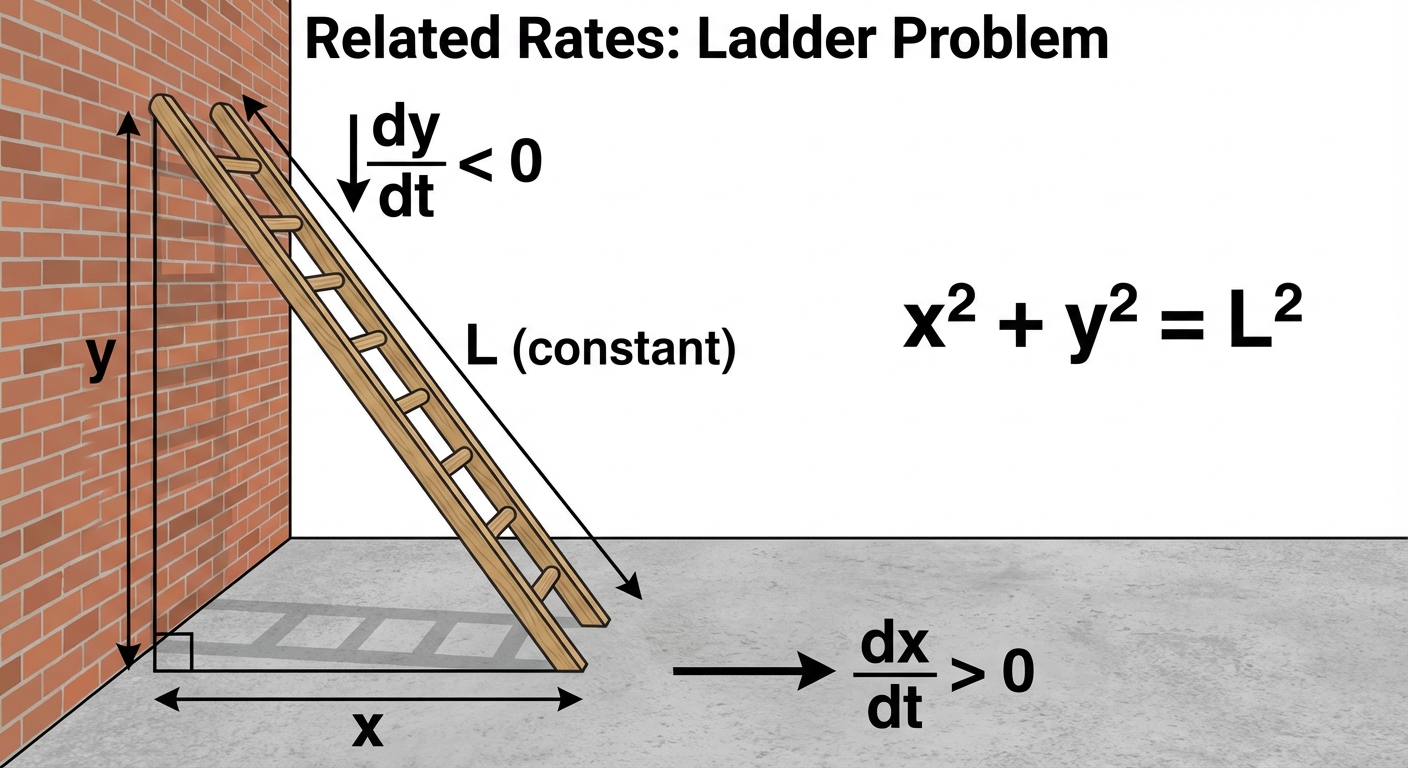
Worked Example 1: ladder sliding down a wall (Pythagorean theorem)
A 13-ft ladder leans against a wall. The bottom slides away from the wall at 2 ft/s. How fast is the top sliding down the wall when the bottom is 5 ft from the wall?
Let %%LATEX266%% be the distance of the ladder’s bottom from the wall and %%LATEX267%% be the height of the ladder’s top on the wall. The ladder length is constant 13.
Relationship:
Differentiate with respect to time:
Given %%LATEX270%% and %%LATEX271%%. First find at that instant:
Substitute into the differentiated equation:
Interpretation: the top is sliding down at ft/s (negative indicates downward).
Common mistake to watch: forgetting to compute %%LATEX278%% from the geometry before solving for %%LATEX279%%.
Worked Example 2: a shadow problem (similar triangles)
A 6-ft person walks away from a 15-ft streetlight at 4 ft/s. How fast is the length of the person’s shadow increasing when the person is 10 ft from the light?
Let %%LATEX280%% be the person’s distance from the light and %%LATEX281%% be the shadow length. The distance from the light to the tip of the shadow is .
Given:
We want %%LATEX284%% when %%LATEX285%%.
Similar triangles:
Cross-multiply and simplify:
Differentiate:
Substitute:
Interpretation: the shadow length is increasing at ft/s when the person is 10 ft from the light.
Notice: after simplification, %%LATEX292%% does not depend on %%LATEX293%%, so “when ” is unnecessary here, but you cannot assume that in advance.
Common mistake: mixing up corresponding sides in the similar-triangles ratio, or confusing %%LATEX295%% with %%LATEX296%%.
Worked Example 3: filling a cone (volume and similar triangles)
Water is poured into a conical tank. The tank has height 12 ft and radius 4 ft at the top. Water flows in at 2 cubic ft/s. How fast is the water level rising when the water is 3 ft deep?
Let %%LATEX297%% be the water height, %%LATEX298%% the water surface radius, and the water volume.
Given:
We want %%LATEX301%% when %%LATEX302%%.
Volume of a cone:
Similar triangles relate %%LATEX304%% and %%LATEX305%%. For the full cone, , so:
Substitute to write volume in terms of only:
Differentiate:
Substitute %%LATEX311%% and %%LATEX312%%:
Interpretation: when the water is 3 ft deep, the water level is rising at ft/s.
Common mistake: differentiating %%LATEX316%% with product rule and keeping both %%LATEX317%% and %%LATEX318%%, then getting stuck because %%LATEX319%% is unknown. Often, the intended move is to use similar triangles to eliminate a variable first.
“At what time/when” rate questions
Sometimes the question asks for when a rate hits a specific value (for example, “When is the area increasing at 50 square units per second?”). The setup is the same, but after differentiating you solve for the variable value that makes the rate equation true.
A practical tip: after differentiating, you might have
If %%LATEX321%% is constant, then %%LATEX322%% depends on %%LATEX323%%. Solve for %%LATEX324%% first, then interpret what that radius means in the context.
Exam Focus
Typical question patterns
- Set up and solve a full related rates problem using a diagram and differentiation with respect to time (ladder, shadow, cone, sphere).
- Compute a missing value (like from the Pythagorean theorem) at the instant before solving for the requested rate.
- Use similar triangles to express one variable in terms of another before differentiating.
Common mistakes
- Differentiating with respect to the wrong variable (using %%LATEX326%% instead of %%LATEX327%%), which prevents rates from appearing.
- Forgetting product rule when multiple quantities depend on time.
- Solving for the wrong rate because you confuse which segment is %%LATEX328%% and which is %%LATEX329%%.
Linearization (Tangent Line Approximation)
Complex functions can be hard to calculate mentally (for example, square roots near non-perfect squares). Linearization uses the tangent line at a “nice” point to approximate values near that point.
The idea and the formula
The linearization %%LATEX330%% of a function %%LATEX331%% at is the tangent line written as a function.
Start from point-slope form of the tangent line at :
So the linearization is:
Concavity and error (overestimate vs. underestimate)
Whether the tangent-line approximation overestimates or underestimates depends on concavity.
- If (concave up), the tangent line lies below the curve, so linearization is an underestimate.
- If (concave down), the tangent line lies above the curve, so linearization is an overestimate.
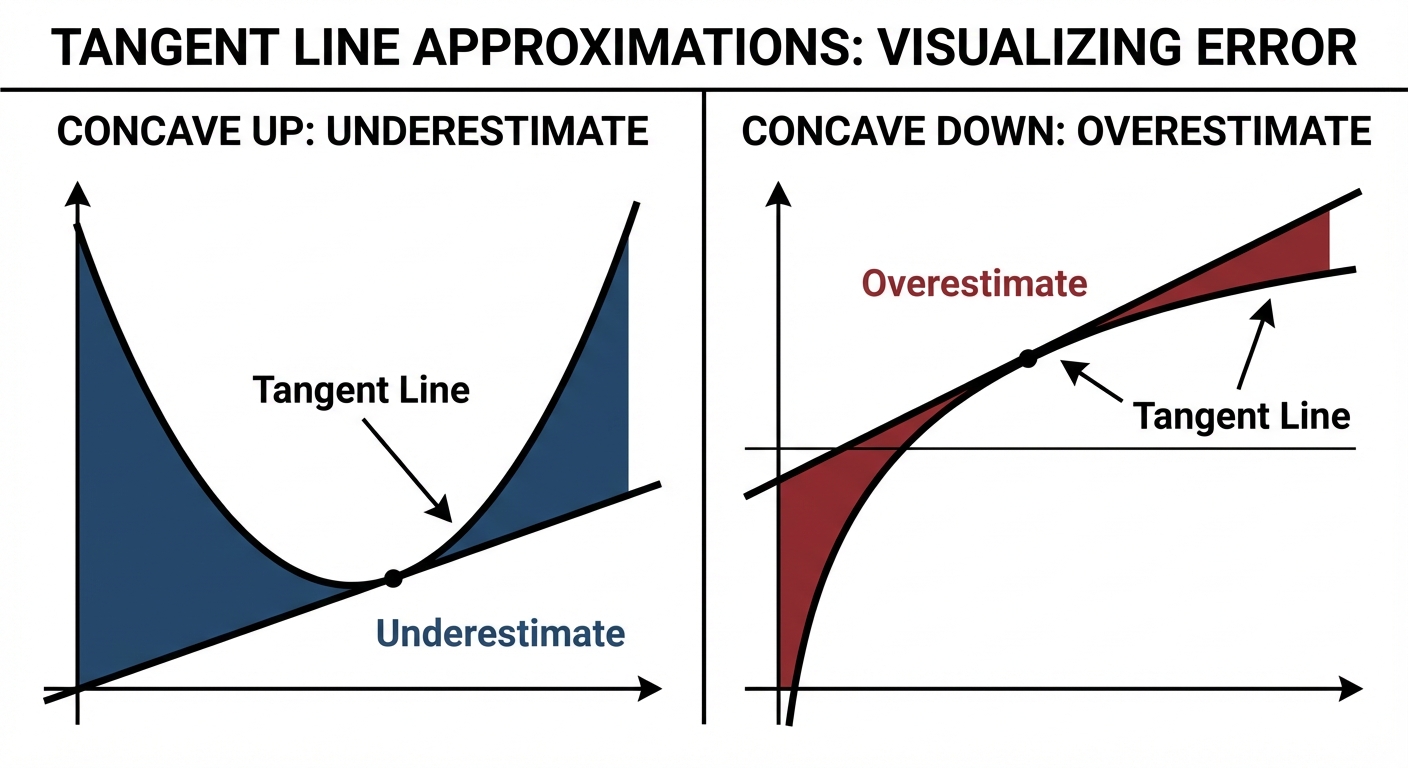
Worked Example: estimate a square root
Estimate using linearization.
Let
Choose a nearby perfect square:
Compute the point:
Derivative:
So
Build the linearization:
Estimate:
Exam Focus
Typical question patterns
- Construct %%LATEX346%% at a specified value %%LATEX347%% and use it to approximate nearby values.
- Use concavity (the sign of ) to justify whether the approximation is an overestimate or underestimate.
Common mistakes
- Using a point that is not close to the target value, producing poor approximations.
- Forgetting that linearization requires both %%LATEX350%% and %%LATEX351%%.
- Mixing up the concavity rule for error direction.
L’Hospital’s Rule
L’Hospital’s Rule is a tool for evaluating limits that result in certain indeterminate forms.
The rule (and when it applies)
If
yields an indeterminate form
or
then
provided the limit of the derivatives exists (or is infinite in a controlled way).
Crucial warnings
1) Verify conditions first. You must show the limit produces %%LATEX356%% or %%LATEX357%% before applying the rule. If you use it on a determinate form like %%LATEX358%% or %%LATEX359%%, you will get the wrong conclusion.
2) Not the quotient rule. Differentiate the numerator and denominator independently. Do not use the quotient rule.
Worked Example: trig limit
Evaluate
Check:
Apply L’Hospital’s Rule.
Numerator derivative:
Denominator derivative:
So the limit becomes:
Evaluate:
Exam Focus
Typical question patterns
- Identify an indeterminate form and correctly apply L’Hospital’s Rule.
- Explain (or show) that the limit is %%LATEX366%% or %%LATEX367%% before applying the rule.
Common mistakes
- Applying L’Hospital’s Rule to a determinate form.
- Using the quotient rule instead of differentiating top and bottom separately.
- Forgetting to re-check the new limit after differentiating (sometimes you must apply the rule more than once, but only if the indeterminate form persists).
Common Mistakes, FRQ Justification, and Mnemonics
Some pitfalls show up across multiple Unit 4 topics, especially on FRQs where explanations matter.
Common mistakes & pitfalls (cross-topic)
1) Neglecting the chain rule in related rates: for example, differentiating %%LATEX368%% with respect to time as %%LATEX369%% instead of including .
2) Plugging in constants too early: in related rates, never plug in a value that is changing (like the radius of a growing balloon) before you differentiate. Only plug in truly constant values (like the fixed length of a ladder) before differentiation.
3) Speed vs. velocity confusion: students often compute velocity (which can be negative) when asked for speed (always positive).
4) Justification on FRQs: simply saying “the derivative is positive” is often insufficient. A stronger statement is specific, such as: because %%LATEX371%% and %%LATEX372%% at a particular time, the particle is speeding up.
5) Misinterpreting L’Hospital’s Rule: applying the rule to determinate forms (for example, ) leads to incorrect work.
Mnemonics
- Same Signs Speed Up: if velocity and acceleration share the sign (both positive or both negative), speed increases.
- DSD, not SSD: Draw, Stop (identify variables/knowns), Differentiate, then Substitute.
Exam Focus
Typical question patterns
- FRQs that require a sentence interpretation with the correct instant, direction, rate, and units.
- Motion questions that ask you to justify speeding up/slowing down using signs.
- Related rates questions that reward a clear sequence: define variables, write an equation, differentiate, substitute, solve.
Common mistakes
- Giving an answer without units.
- Failing to connect the sign (negative/positive) to the real-world meaning.
- Doing correct calculus but incorrect modeling (wrong triangle ratio, wrong segment labeled, wrong “per” unit).